PART 1
In the summer of 1981, having a baby without a husband in our county was treated like a crime. I was eighteen years old, living under my mother’s roof on Elm Street, and the word disgrace was used in almost every conversation once my stomach started to show.
My mother, Helen, was a deaconess at the Baptist church and worked the customer counter at the municipal water office.
She cared about two things in this world: what the neighbors thought of our family, and keeping our name out of the weekly gossip circle. When I told her I was pregnant, she didn’t yell. She didn’t cry. She simply closed the kitchen blinds, sat me down at the oilcloth table, and told me how things were going to be.
“You are going to an out-of-state couple,” she told me, her voice cold and flat as an iron skillet. “People with a proper home, money in the bank, and a respectable marriage. It is the only respectable option you have. You will have this baby, you will sign the release papers, and then you will come home and act like this year never happened.”
I was terrified, young, and had nowhere else to turn. My father had passed away when I was ten, and I had no savings to my name.
When my labor started in mid-October, my mother drove me over the state line to St. Jude’s Memorial in Miller’s Creek. It was a private clinic where unmarried girls were taken to deliver in quiet rooms at the back of the ward.
My daughter was born on a rainy Tuesday morning at 6:14 a.m. She weighed six pounds and four ounces, with dark brown hair and tiny fingers that curled right around my thumb. They let me hold her for exactly twenty minutes. I remember the smell of her skin, clean and warm, and the way her little chest rose and fell against my hospital gown.
Then a woman in a grey wool coat came in with a clipboard, followed by a local photographer carrying a box camera and a portable flash.
The photographer snapped one picture of me holding my baby on the edge of the mattress. Just one.
The flash was so bright it left white spots floating across my eyes. My mother had promised me that I would get a copy of that photograph to keep in my Bible, a single image to prove that my child had existed and that I had held her in my arms.
Five minutes later, a registered nurse took the baby from my arms. The out-of-state couple was already waiting in a side room with their lawyer.
I never saw my daughter’s face again. And I never received that photograph.
Whenever I asked my mother about the picture during the weeks that followed, she snapped at me. She told me the negative was ruined in the wash, or that the studio had lost it, and that dwelling on the past would only rot my soul.
To make matters worse, the adoption agency did not cover the full medical expenses as my mother had promised they would.
A month after I returned home, St. Jude’s sent an itemized invoice for $3,175. It covered the delivery room fee, the anesthesiologist, and three days of nursery care.
My mother dropped the bill onto my bedspread. “You made your bed, Clara. You will pay for it. I am not spending your father’s life insurance on your mistake.”
I spent the next two years working two jobs to pay off every single penny of that $3,175 bill. From seven in the morning until three in the afternoon, I sorted mail and filed tax folders at the county courthouse. From four in the afternoon until eleven at night, I waited tables at the Blue Ribbon Diner, carrying heavy oval trays of fried chicken and scraping grease traps until my hands were red and raw. Every two weeks, I took money orders down to the bank and mailed them to St. Jude’s until the balance hit zero.
Forty-five years went by.
I never married. I stayed in that same county, bought a small yellow cottage two miles from my mother’s old house after she passed in 2004, and worked thirty years for the county health department before retiring. I learned to carry the ache quietly, tucked away behind church bake sales, community garden work, and Sunday crossword puzzles. But on the fourteenth of October every single year, I bought a single pink carnation, set it on my kitchen windowsill, and wondered where in the world my baby was.
Then, on a damp Thursday morning last week, the mail carrier left a thick brown manila envelope in my roadside box.
The return address had no name, just an address stamped in faded black ink: Miller’s Creek Studio, 104 North Main Street. That portrait studio had shut down twenty years ago when the owner died.
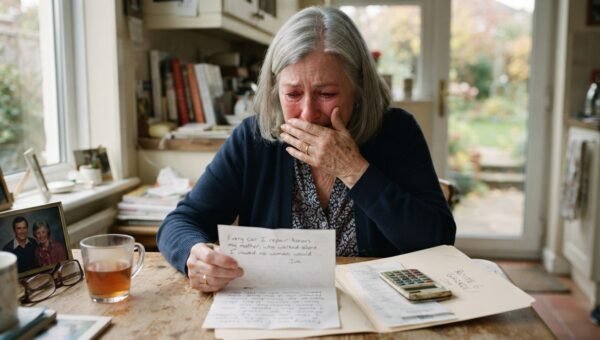
My hands trembled as I took the envelope inside to the kitchen table. I sliced the tape open with a butter knife.
Inside was a piece of cardboard protecting a photograph. But when I slid it out, my breath caught in my throat.
It was half of a vintage black-and-white photograph, cut straight down the vertical center with heavy shears. The left half showed my eighteen-year-old face, pale and exhausted against the hospital pillows, with tears clearly shining on my cheeks. But the baby was gone. The right side of the picture, where the child had rested in my arms, was completely missing.
Taped to the back of the cut photograph was a yellowed index card written in shaky, spidery cursive:
“I saved this because you were crying. The lady paid to take the other half. Forgive me.”
It was signed: Sister Mary Agnes, Retired Midwife, St. Jude’s.
I didn’t sleep that night. I sat at my table with the tea kettle running cold, staring at my own young face from 1981, wondering why someone had cut my baby out of the only proof I had ever had.
The next morning, at exactly 8:15, a dark blue sedan pulled into my gravel driveway.
A tall woman in her mid-forties, wearing an olive trench coat and carrying a worn leather handbag, stepped out of the car. She walked up the front porch steps, paused at the screen door, and looked right at me through the wire mesh.
Her hair was dark brown, parted on the side, and her chin had the exact same slight cleft that my father had carried all his life.
She did not knock. She reached into her coat pocket, pulled out a ragged slip of photo paper, and held it up flat against the screen door.
It was the matching right half of the photograph. It showed an infant wrapped in a white hospital blanket, with tiny clenched fists and dark hair.
“My name is Bethany,” the woman said, her voice shaking slightly but steady. “I want no money from you. But we need to talk about who really took me from that hospital.”
PART 2
I stood by the front door with my hand pressed against the wood frame, unable to draw a full breath.
For forty-five years, I had pictured this moment a thousand different ways. I had imagined meeting her in a grocery store aisle, or getting a letter from an ancestry registry, or seeing her name in a distant phone directory. I had always imagined having to explain myself, having to beg for forgiveness for letting her go.
Bethany stood on the porch in the cool autumn air, holding that half piece of photo against the wire screen.
“Come inside,” I whispered, pushing the screen door open with a trembling hand. “Please, come in out of the wind.”
She walked into my living room with slow, cautious steps, looking around at the braided rugs, the bookshelf filled with old paperbacks, and the small porcelain birds on the mantelpiece. She didn’t look angry. She looked exhausted, like someone who had traveled a thousand miles carrying a trunk full of lead.
I pulled out a chair at the kitchen table for her. She sat down, set her leather bag on the floor, and placed the right half of the photograph on the oilcloth.
I reached into my cardigan pocket and pulled out the left half.
My fingers were shaking so hard I could barely line up the edges. But when I pushed the two pieces together, the ragged scissor marks meshed perfectly. There I was, eighteen years old, hollow-eyed and weeping on the delivery bed, holding the little bundle wrapped in hospital cotton. The jagged cut ran right through my wrist, where my young arm had circled her back.
“How did you find me?” I asked, tears finally spilling over my eyelashes. “The records were sealed in Miller’s Creek. They told me the adoption was closed permanently.”
“The records were sealed because there was no adoption,” Bethany said quietly.
The sentence hung in the air between us like heavy smoke.
I stared at her, my mind refusing to take in the words. “What do you mean? My mother handled everything with the attorney. An out-of-state couple from Ohio. She told me they had signed all the affidavits before I even went into labor.”
Bethany reached into her coat pocket and pulled out a certified copy of a birth certificate from the state registry.
The child’s name was listed as Bethany Ruth Caldwell.
The mother’s name was listed as Marjorie Caldwell. The father was Donald Caldwell. The location of birth was listed not as St. Jude’s Memorial in Miller’s Creek, but as a private residence in Greenbrier County.
“Donald Caldwell was your mother’s older brother,” Bethany said.
The blood rushed into my ears with a sound like roaring water. My hands went completely cold.
Uncle Donald.
Donald was my mother’s older brother who lived across the mountain in Lewisburg. He and his wife, Aunt Marjorie, had been married for twenty years without having children. They owned a farm supply warehouse, drove new cars every three years, and came to our house every Thanksgiving with boxes of fancy citrus fruit from Florida.
Whenever Donald and Marjorie came to visit during my childhood, my mother treated them like royalty. But in the spring of 1982, six months after my baby was born, they stopped coming to Elm Street. My mother told me that Donald and she had quarreled over grandfather’s estate settlement, and that we were never to speak to them again. When Donald died of a stroke twelve years ago, my mother refused to attend the funeral.
“They didn’t give me to strangers,” Bethany said, her voice tight with grief. “They gave me to Marjorie. Marjorie had suffered four miscarriages in five years. She was desperate. Your mother went to them in August of 1981 and told them she had a solution that would keep the child in the bloodline and solve everyone’s problems.”
“No,” I choked out, gripping the edge of the table. “No, that’s impossible. My mother told me the couple paid five thousand dollars to the hospital trust! She made me pay the medical bill myself! I spent two years scrubbing diner floors to pay off $3,175!”
“Your mother didn’t just let them take me,” Bethany said, pulling an old yellowed carbon copy of a bank receipt from her purse. “She charged them.”
PART 3
The bank receipt was dated October 16, 1981. Two days after my daughter was born.
It was a cashier’s check drawn from Donald Caldwell’s account at the First National Bank of Lewisburg, made out directly to Helen Vance. My mother.
The amount was $7,500.
In the memo line, written in Uncle Donald’s familiar block handwriting, were the words: *Private settlement and medical reimbursement in full.*
“My father paid her,” Bethany said, her eyes fixed on mine. “He paid your mother seven thousand five hundred dollars to cover the entire clinic bill, the doctor’s fees, and five thousand dollars on top of that for her silence. He thought your mother was giving you that money to start your life over. He thought you had agreed to the whole thing.”
I sat there while the past forty-five years collapsed into a pile of ashes.
My mother had taken seven thousand five hundred dollars in cash from her own brother. She had put it in her personal account, paid nothing toward the clinic, and then handed me the unpaid $3,175 invoice from St. Jude’s to force me into sixty-hour work weeks so I would be too tired, too broken, and too poor to ever hire a lawyer or ask questions.
“She kept us apart so neither of us would ever find out,” I whispered.
“She cut the photograph herself,” Bethany explained, touching the torn edge of the print. “The midwife, Sister Mary Agnes, told me the whole story three weeks ago. She is ninety-one now, living in an assisted care facility outside Roanoke. She kept the clinic’s private log before they closed. She said the morning after I was born, your mother came into the recovery room with the studio photographer. Your mother took the original photograph from the envelope, took a pair of surgical shears from the counter, and cut you completely off the picture.”
Bethany took a slow, deep breath, fighting back her own tears.
“Your mother handed the half with me to Marjorie and Donald, and told them the mother was an out-of-work girl from Kentucky who wanted nothing to do with the child. She threw your half into the clinic wastebasket. But Sister Mary Agnes saw you crying in that bed. She waited until your mother left the hallway, fished your half out of the trash, and hid it in the clinic basement files. When the studio closed twenty years later, the photographer’s daughter turned the old archive boxes over to the historical society, and Sister Mary Agnes finally tracked it down.”
“How did you know to look?” I asked. “Did Marjorie tell you?”
“My mother Marjorie passed away last November,” Bethany said softly. “While my husband and I were cleaning out the attic in Lewisburg, we found a cedar chest locked with a small brass key. Inside was Donald’s old ledger, the cashier’s check stub, and my half of that photograph. Donald had kept every single piece of paper because he was terrified your mother would come back one day and demand more money.”
Bethany leaned forward across the kitchen table.
“On his deathbed, my father Donald told Marjorie that he had made a terrible mistake. He said he found out two years after the transfer that Helen had lied to them, that you never wanted to give me away, and that you were working two jobs in town just to survive. But by then, they were terrified of losing me, and they were terrified of going to prison for falsifying the birth records. So they stayed across the mountain and kept their mouths shut.”
“I looked for you in every baby carriage I passed on the sidewalk for ten years,” I told her, my voice breaking completely. “Every time I saw a dark-haired girl walking with her mother down Main Street, my heart stopped. I thought you were in Ohio. I thought you had a family who could give you everything I couldn’t.”
Bethany reached out across the table. Her hand was warm, her skin soft, and when her fingers touched mine, the knot that had lived under my ribs since 1981 finally tore open.
“I had a good home, Clara,” she said gently. “Donald and Marjorie were good parents to me. They loved me, they put me through nursing school, and they gave me a quiet life. But I always knew there was a piece missing. When I looked in the mirror, I didn’t look like anyone in that house. I spent forty years wondering why the woman who brought me into the world threw me away for nothing.”
“I never threw you away,” I wept, gripping her fingers with both hands. “I never wanted to let you go.”
ENDING
We sat at that yellow kitchen table until the afternoon sun faded into dusk.
Bethany told me about her life. She was a pediatric nurse supervisor at the regional hospital in Beckley. She had been married for twenty-two years to a high school science teacher named David. She had a nineteen-year-old son named Lucas who was studying civil engineering at West Virginia University, and a sixteen-year-old daughter named Hannah who played the cello.
“Hannah has your eyes,” Bethany told me, pulling her phone from her purse to show me a picture. “The exact same green. We could never figure out where she got them from, because everyone on Donald’s side had blue eyes.”
I looked at the photograph of that young girl with the cello, smiling in the sunlight on a high school lawn, and I saw my own mother’s jawline and my father’s green eyes staring back at me.
We walked out to the small local cemetery the next morning.
I took Bethany to my father’s grave on the hillside under the white oak trees. We didn’t stop at my mother’s headstone, which sat twenty feet away under a polished granite marker she had bought and paid for before she died. We left a bunch of fresh white chrysanthemums by my father’s stone instead.
When we walked back to her car, Bethany paused by the open door and looked at me.
“I want you to come to Sunday dinner next week,” she said. “David wants to meet you. The kids want to meet you. We have forty-five years of family photos to catch up on.”
“I would love that,” I said. “More than anything.”
Before she got into the driver’s seat, she reached into her purse, took out the right half of that old hospital photograph, and pressed it into my palm.
“Keep it,” she told me with a soft smile. “It’s yours. It was always yours.”
After her car turned the corner at the end of the gravel road, I walked back into my quiet house.
I sat down at my sewing table by the sunny window. I took out a small bottle of archival tape, a magnifying glass, and a fresh piece of heavy cardstock.
Very carefully, matching each tiny fiber of the ragged paper, I laid the two halves together. I smoothed the clear tape across the back until the seam was tight and flat.
The cut line was still there, running straight down between my young face and her tiny swaddled blanket. You could still see the scar where the scissors had separated us. You couldn’t erase what my mother had done, and you couldn’t get back the forty-five years of school plays, scraped knees, and bedtime stories that had been stolen away for seven thousand five hundred dollars.
But the picture was whole again.
I took an old silver frame down from the mantelpiece, placed the photograph inside, and set it right next to my kitchen window, right beside the fresh flowers.
And for the first time since October of 1981, when I looked at my eighteen-year-old face in the glass, I didn’t see a girl who had been broken. I saw a mother who had finally brought her daughter home.