PART 1
The appointment card on the refrigerator said two o’clock on a Tuesday. It had a little blue tooth printed in the corner and my mother’s handwriting below it: Dr. Ronald Hayes, checkup and cleaning, $120.
My mother, Martha Vance, is seventy years old. She lives three streets over from me in an old brick duplex near the water tower in Greenfield, Ohio. For twelve years, ever since my father passed away from lung complications, her routine has not varied by more than fifteen minutes.
On Tuesdays, she waters the African violets on the porch, takes her canvas bag to the small grocery on Market Street, and stops by my house around four to split a pot of decaf coffee.
When four-thirty rolled around and her white Buick had not turned into my driveway, I called her landline. It rang six times and kicked to her generic voicemail message. I tried her prepaid flip phone. It went straight to a recorded operator saying the subscriber was temporarily unavailable.
At five-fifteen, I drove over to her house. Her garage door was closed, but when I unlocked the side kitchen door, the interior smelled like cold lemon cleaner. Her reading glasses were sitting on the counter right next to her daily pill organizer. The Tuesday afternoon compartment was empty, which meant she had taken her blood pressure medication before leaving. Her house keys were missing, her purse was gone, but her garden clogs were sitting neatly on the mat by the back door.
I called the dental clinic on Elm Street. The recording said the office was closed for normal business hours.
By six o’clock, that cold, sick feeling had taken over my chest. People think an adult daughter overreacts when an elderly parent is late, but my mother does not lose track of time. She is the kind of woman who arrives twenty minutes early to church so she can sit in the exact same pew.
Because I am listed as the secondary authorized user on her First National Visa account to help her monitor utility payments, I logged into the mobile banking portal from my phone. I expected to see a pending charge for one hundred and twenty dollars from Greenfield Family Dental.
Instead, the pending transactions showed a charge from three-fifteen that afternoon for four thousand two hundred and eighty dollars.
The merchant name was Horizon International Travel, located six miles away in the strip mall off State Route 32.
I drove out there so fast my tires skidded on the wet gravel near the highway ramp.
The travel agency was tucked between an insurance office and a dry cleaner.
A brass bell chimed when I pushed open the glass door. A middle-aged woman wearing a blue lanyard looked up from behind a desk covered in glossy brochures for Caribbean cruises.
I pulled my mother’s picture up on my phone, the one from my daughter’s baby shower last summer, and held it out across the laminate desk.
“Did this woman come in here this afternoon?” my voice was shaking, and I did not even try to hide it. “Her name is Martha Vance. A four-thousand-dollar charge just hit her credit card from your terminal.”
The agent looked at the photo, pushed her glasses up the bridge of her nose, and nodded immediately.
“Yes, she was here around three,” the agent said, her voice turning guarded. “She had a cashier’s check for the service fee and put the remainder on that credit card. She purchased two one-way business class tickets to Paris, departing from Columbus at nine-forty tonight.”
I felt the air leave my lungs. “One-way? Paris? My mother despises flying. She refuses to get on a plane to visit her own sister in North Carolina. She took Amtrak for three days because she is terrified of turbulence.”
The agent reached over, tapped her computer screen, and turned the monitor slightly toward me.
“She was very specific about the seats, ma’am. Window and aisle together on the transatlantic leg.”
I leaned over the counter, staring at the reservation screen. The first passenger name was Martha Vance.
The second passenger name listed directly beneath hers was Ronald Hayes.
Dr. Ronald Hayes was sixty-eight years old. He had filled two of my own molars when I was in high school, and he had been my mother’s dentist for nearly thirty years. He was a soft-spoken widower who drove an old station wagon and always wore faded corduroy trousers under his dental smocks.
I ran back to my car and sped toward Elm Street.
Greenfield Family Dental sat on a quiet corner across from the municipal park. The gravel parking lot was completely empty. The exterior floodlights were switched off, and taped directly over the front glass entrance was a freshly printed red-and-white sign that read: COMMERCIAL PROPERTY FOR SALE.
The deadbolt on the front door was locked tight. When I peered through the narrow sidelight window, the reception desk was cleared of computer monitors, the magazine racks were empty, and the interior doors to the treatment operatories stood wide open into total darkness.
I called the county sheriff’s department from the front steps.
Deputy Miller arrived eight minutes later. Because I had my mother’s power of attorney paperwork on my phone and the suspicious four-thousand-dollar international flight record, he used a slim wedge and checked the rear utility door. The back lock was loose, and the door gave way with a dull click.
We stepped into the rear hallway, our flashlights cutting through the dust motes. The clinic looked like it had been abandoned in a hurry. Metal filing cabinets stood open with drawers hanging loose, empty folders scattered on the floor.
On the center counter of the sterilization lab, weighed down by an overturned stainless steel instrument tray, was a single sheet of paper torn from a prescription pad.
The handwriting was unmistakably my mother’s, written in blue ballpoint pen.
“Don’t search for me. The fronts are too hot. The flight leaves in six hours, and the man you knew as Dr. Hayes has to go before the marshals pull the local land registry. Tell Karen I left the basement safe key behind the third brick.”
PART 2
The words on that paper made no sense in the quiet life my mother and I had lived for four decades.
My father had died of lung cancer when I was twelve years old. He had been an insurance claims adjuster who left behind a modest paid-off mortgage and a small pension. My mother had worked as an administrative assistant at the municipal water authority until she retired at sixty-two. She grew heirloom tomatoes, entered county fair quilt competitions, and complained when postage stamps went up by two cents.
“The fronts are too hot.” It sounded like gibberish from a cheap spy novel.
“Ma’am, does your mother suffer from dementia or early-onset memory loss?” Deputy Miller asked gently, shining his flashlight around the empty dental operatory.
“No,” I snapped, tears burning my eyes. “She balanced her checkbook to the penny three days ago. She does the Sunday crossword in ink. Look at that handwriting. Her hand wasn’t even shaking.”
The handwriting was firm, slanted, and undeniably hers. But the content belonged to a stranger.
Deputy Miller called in a detective from the county criminal investigation division, an older investigator named Detective Ray Mercer. Mercer walked through the clinic with a tired, heavy step, inspecting the stripped wiring behind the front desk.
“This wasn’t a sudden panic,” Mercer observed, touching the dust-free outlines on the shelving where file cabinets had sat just hours earlier. “They spent days packing this up. The shredder in the back room is still warm to the touch. They fed hundreds of patient records through cross-cut blades before they walked out the door.”
“Why would my mother pay for his ticket?” I asked, my voice cracking. “If he kidnapped her, why did she sit in a travel agency and hand over her card?”
“We pulled the security feed from the gas station across from the travel agency ten minutes ago,” Mercer said, pulling up his phone. He turned the screen toward me.
The grainy footage showed my mother’s Buick pulling into the lot at 11:38 a.m. Dr. Vance was driving. He was an unassuming, balding man in a brown tweed jacket and khaki slacks. But he didn’t drag my mother out of the passenger seat. She stepped out on her own, walked around the hood, took his arm, and walked into the agency side-by-side with him. She was carrying a large leather shoulder bag I had never seen before in my life.
“We need to get to Dulles Airport,” I pleaded. “The note says the flight leaves in six hours. That means around midnight. We can intercept them before they board!”
Detective Mercer shook his head grimly. “Dulles is three hours north. We will alert Port Authority and federal transit officers immediately to flag their passports. But Laura, I need to look through your mother’s house. If there is a fraud ring or an identity theft operation operating under Vance’s practice, she might be in far deeper than you think.”
We drove back to my mother’s house in a quiet convoy. When Mercer stepped into the neat, floral-papered hallway, he stopped in front of the framed portrait hanging near the coat rack. It was a photograph of my parents on their wedding day in 1981, standing on the steps of our town hall.
Mercer stared at my father’s face, then pulled a small magnifying glass from his jacket pocket. He leaned in close to the glass, studying the lapel of my father’s suit.
“Where did your father work before the insurance company?” Mercer asked quietly.
“Nowhere,” I said, bewildered. “He was born here. He went to state college, then went to work for Mutual Life.”
Mercer didn’t answer. He walked past the living room, straight into my mother’s sewing room at the back of the house. He tapped along the baseboards with the toe of his boot until he heard a dull, hollow thud near the built-in linen cupboard.
Without asking my permission, he reached down, slid his fingers under the false bottom of the cedar chest, and lifted a concealed panel.
Inside the hidden compartment was not cash or jewelry.
It was a row of four black-bound logbooks dating from 1984 to 2012, two professional-grade mechanical micro-drills of the type used in precision dental lab work, and three blue United States passports, all bearing my mother’s photograph, but each with a different legal name: Evelyn Ross, Evelyn Vance, and Evelyn Moreau.
Nestled right beside the passports was an official legal deed, dated thirty-two years ago, showing that the commercial building housing Oak Ridge Dental had not been purchased by Arthur Vance.
It had been purchased and owned outright, through a private trust, by my mother.
PART 3
I stood frozen in the center of the sewing room, my world crumbling into pieces around my feet.
“She owned the clinic?” I whispered, staring down at the deed. “All these years, she told me she hated going there because of the bills. She complained about every cleaning, every crown, every single check she ever wrote him.”
“It wasn’t an expense,” Detective Mercer said, leafing through the first black logbook. “It was an audit trail. She was paying money into the business to justify taxable revenue, while extracting capital out the back end through equipment depreciation and rent write-offs.”
He turned the logbook toward me. The pages were filled with my mother’s neat, precise script. But they were not recipes or family budgets. They were detailed asset ledgers, wire transfer routing numbers, and patient account numbers accompanied by strange, coded alphanumeric strings.
“Arthur Vance wasn’t a dentist when he came to this country,” Mercer said, his voice dropping low. “In the late seventies, he was an unlicensed lab technician from Montreal who lost his Canadian credentials for running counterfeit medical supplies. But forty years ago, someone set him up with clean paperwork, bought this building, and built him a quiet, sleepy suburban dental practice that never took a single Medicaid patient and dealt almost entirely in cash and private insurance.”
“My mother did that?” My voice rose, hysterical. “She worked at the water board! She clipped coupons for canned tuna! She wouldn’t buy a new refrigerator when ours died because she said six hundred dollars was an outrage!”
“Because she was maintaining cover,” Mercer said flatly. “And if she just bolted, it means the structure broke.”
Mercer’s radio crackled on his shoulder. The voice of a federal transit agent came through, loud and sharp in the small bedroom.
“Detective Mercer, this is TSA Liaison at Dulles. We have located the reservation for flight 914 to Charles de Gaulle. The tickets for Evelyn Vance and Arthur Vance were checked in online at 4:00 p.m. But no one checked any baggage, and neither subject has scanned their boarding pass at Gate B32. Boarding closes in forty-five minutes.”
“They aren’t at the airport,” Mercer muttered, rubbing his jaw. “Why buy first-class international tickets with a traced credit card, leave a note spelling out the exact departure time, and then not show up?”
The realization hit me like a bucket of ice water.
“The travel agency was a decoy,” I blurted out, my mind racing through everything my mother had ever taught me about being careful. “When I was little, she would tell me: if a stray dog is chasing you, you throw your lunchbox to the left and run to the right. She bought those tickets knowing the charge would pop up on my phone app! She knew I had alerts on her account! She wanted everyone looking toward Dulles and Paris!”
“If she didn’t go north toward DC,” Mercer said, his eyes narrowing, “where did she go?”
I remembered the garden hose.
She had told me on the phone: *I want to put the garden hose away before it frosts tonight.*
My mother was obsessive about winterizing her house. But when I arrived, the hose was lying across the lawn, hooked up to the brass spigot on the side of the house, and the brass valve was turned completely open. The water had been running straight into the ground next to the foundation for hours.
I bolted out the back door, running across the freezing grass to the side of the brick foundation.
The water from the hose was pooling around an old, rusted iron storm cellar door that had been overgrown with ivy and padlocked shut for as long as I could remember. My mother had always told me the cellar was condemned, full of black mold and rotting floorboards.
The brass padlock hanging from the hasp wasn’t locked. It had been snapped open with bolt cutters and left hanging loose.
Detective Mercer caught up to me, his flashlight cutting through the darkness. He grabbed the iron handle, pulled the heavy storm doors upward with a groan of rusted metal, and pointed his gun down the concrete stairs.
“Police department! Anyone down there, show your hands!”
There was no sound from below except the slow, steady drip of water.
We walked down the slick stone steps. At the bottom, behind a stack of rotted firewood, was a heavy steel fire door set directly into the cinderblock foundation. The door was slightly ajar.
Mercer pushed it open. The beam of his light illuminated a room that was entirely soundproofed with acoustic foam tiles.
There was a stainless-steel workbench running the length of the wall. On top of it sat rows of high-grade dental vulcanizers, casting machines, and a digital laser engraving unit worth at least fifty thousand dollars. But they weren’t making dentures.
Scattered across the rubber floor mats were hundreds of tiny, discarded porcelain and ceramic tooth crowns.
Mercer knelt down, picked up a discarded ceramic molar, and tapped it against the steel table. The top of the molar popped loose on a tiny, precision-machined thread.
Inside the hollow tooth was a microscopic glass vial containing a tightly folded slip of micro-etched metallic film.
“What is that?” I whispered.
“It is a smuggling pipeline,” Mercer said, his face pale under the fluorescent tube he flicked on. “For thirty years, Vance wasn’t just fixing teeth. He was implanting custom hollow restorations into private patients who traveled here from all over the world for ‘specialized cosmetic care.’ High-value data, diamonds, chemical markers—passed right through international customs and airport body scanners inside people’s mouths. Safe, undetectable, and completely routine.”
“And my mother?”
Mercer pointed to the far wall. Behind a rolling tool chest was a small desk. On the desk sat a heavy industrial safe, its heavy door swung wide open and emptied of its contents.
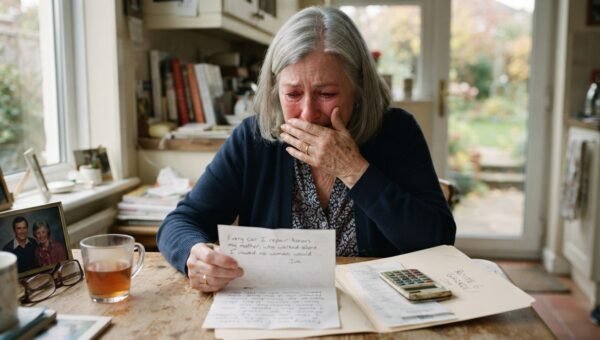
Taped to the inside of the safe door was a second handwritten note, written on the same cream stationery. This one had my name written across the top, but this time, the ink was slightly smudged, as if a tear had dropped onto the paper while she wrote it.
ENDING
I stepped forward and picked up the note with trembling fingers.
*Laura,* it read.
*If you are reading this in the cellar, it means you figured out the Dulles tickets were a ghost trail. I am so sorry. I know this will break your heart, and I know you will never look at our life the same way again.*
*Your father was not an insurance adjuster. He was an investigator who spent ten years trying to map out a private courier network that moved stolen defense patents out of the country through medical transport corridors. When he realized how deep it went, they staged his car crash on Route 9. He survived it just long enough to tell me who was running it.*
*It was Arthur Vance’s brother, operating out of Montreal. Vance himself was just a broken technician caught under his brother’s thumb. I bought the building thirty-two years ago not to get rich, but to trap them. I forced Vance to keep the practice running under my eyes. Every single transaction, every courier who sat in that chair, every serial number that went into those crowns—I logged every single one of them.*
*Two days ago, Vance’s brother’s associates found the offshore accounts I used to funnel the clinic’s real revenue into a blind trust for your future. They threatened to burn down your house while you were inside it if I didn’t hand over the master ledgers.*
*I couldn’t let them touch you. Vance was terrified, ready to hang himself in the operatory. I told him we had one way out: fake a panicked, sloppy run, pull their trackers toward Paris, and disappear where they can never reach us.*
*In the floorboards beneath the washing machine, you will find a bank safety deposit key for First National. The box contains the complete original logs, signed affidavits, and your father’s original case files. Give them to federal prosecutors. Do not give them to the local department. There are people in this county who were paid to look away.*
*I took fifty thousand dollars in cash from the safe. That is all I need. Arthur and I are taking the ferry across the maritime border into Nova Scotia under clean Canadian identities I secured twenty years ago for this exact day.*
*Forget the little old lady who watered ferns, Laura. That was the role I played so you could grow up safe, go to college, get married, and live a life without looking over your shoulder. You were the only real thing in that house.*
*Never search for me. Live your life. Be happy.*
*Love always,*
*Mom.*
I stood in that cold, concrete bunker beneath the house I grew up in, clutching the letter against my chest until the paper crumpled.
Detective Mercer didn’t try to take the letter from me. He watched me in silence, his eyes heavy with an understanding he had clearly carried long before tonight.
“You knew my father,” I said, looking up at him through hot, blurred tears.
Mercer looked at the concrete floor, his hands resting on his duty belt. “I was a rookie deputy thirty-two years ago, Laura. Your father called me two days before his accident. He told me if anything ever happened to him, Evelyn would finish what he started. I never believed she could pull it off. But she kept that whole ring pinned inside this county for three decades, waiting for the right moment to shut it down.”
“She’s gone to Canada,” I said flatly. “Are you going to radio border control?”
Mercer walked over to the open safe, picked up a piece of discarded packing tape, and pressed it against the empty shelf.
“Dulles Airport just notified us that two suspects matching their general description were spotted near the international terminal shuttle,” Mercer said smoothly, looking me right in the eye. “Our active pursuit is headed south toward Virginia. By the time federal transit clears the terminal and realizes it’s a decoy, the maritime ferries on the northern coast will have docked on the other side of the bay.”
He turned back toward the stairs. “Go upstairs, Laura. Get that key from beneath the washing machine. When the federal agents arrive tomorrow morning, you hand them the box, and you tell them your mother was kidnapped by an unlicensed dentist who emptied her bank accounts.”
“And what happens to her?” I asked, my voice barely a whisper in the damp chill of the room.
“She spent thirty years living inside a cage she built with her own hands,” Mercer said, pausing at the threshold of the steel door. “Let her have what’s left of her life.”
Two days later, three federal prosecutors from the Department of Justice sat in my living room, spreading out thirty-two years of my mother’s meticulous records across her dining table. They arrested six corporate executives, two foreign nationals, and a retired state senator before the week was out.
The little brick house is mine now.
I cut the water off to the storm cellar, padlocked the iron doors, and buried them beneath three truckloads of rich topsoil. Over the top of that cold concrete bunker, I planted three dozen rose bushes, just like she always said she wanted to do when she had the time.
Every Tuesday morning at nine o’clock, I walk out onto the back porch and water the ferns.
And every Thursday at noon, I pick up my mail from the box at the end of the driveway. There are no postcards from Paris. There are no letters from Nova Scotia.
Only once, three months after she vanished, an unmarked envelope arrived with a Canadian postmark and no return address. Inside was a single, laminated four-leaf clover, dried and pressed flat, and a tiny newspaper clipping from a small coastal daily paper in Halifax.
It was a classified ad for a weekend bridge tournament at a local community center.
I folded the clipping, slipped it inside my locket next to my father’s picture, and walked back inside the house to drink my coffee in the quiet sunlight.