PART 1
Odis handled the money for forty-one years. I never once saw a bank statement. He told me figures gave me headaches, and back when the children were small and the washing machine leaked every Tuesday, I was glad enough to let him. He kept the checkbook in the top left drawer of his rolltop desk, under a box of yellowed index cards. I never touched that drawer. In forty-one years, you build habits that feel like love, even when they are only convenience.
Then a property tax notice came addressed to me.
It was a Tuesday in early October. The county envelope was thin, with my maiden name tucked into the middle initial slot where Odis never put it. He was down at the lumberyard picking up cedar posts for the back fence. I sat on the porch swing, slid my thumb under the flap, and opened it before he turned up the drive.
The escrow on our mortgage was short by three thousand four hundred dollars. The county warned that an adjustment would hit our monthly payment starting December first unless the deficit was paid in full.
We had refinanced the house twelve years ago to a fifteen-year fixed note. There were only three years left on the place. Odis always bragged to our neighbors that the bank practically worked for us.
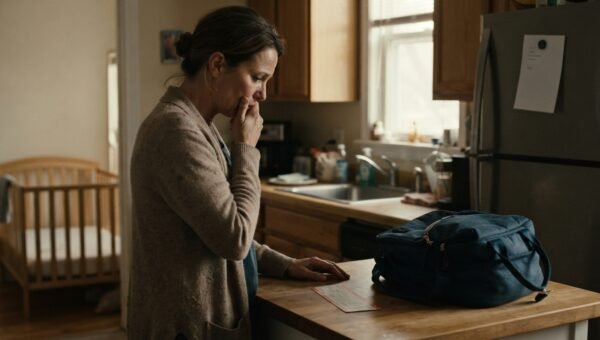
I took the slip into the kitchen. My hands were steady, but my throat was dry.
I dialed the local branch where we had banked since 1983. The girl who answered had a soft, polite voice. I gave her our account numbers from the old slip of paper I kept taped inside the recipe tin.
“Mrs. Miller,” she said after checking my security questions, “I can see the escrow recalculation here. Your property taxes increased after the county reassessment in June.”
“Odis must have missed the notice,” I said, already making excuses for him. “Just move the difference over from our savings. The retirement money market. That should clear it up today.”
There was a pause. The line went quiet enough that I heard a printer running in her office.
“Mrs. Miller,” she said, slower this time. “The balance in that account is nine thousand one hundred and forty dollars.”
I leaned against the counter. “No, dear. You have the wrong file. There was two hundred and fourteen thousand in that account back in April. Odis showed me the yearly projection on his tablet.”
“I am looking at the active ledger,” she said gently. “The balance today is nine thousand one hundred and forty-two dollars and sixteen cents. There was a wire transfer out in May, and two cashier checks issued in July and August.”
I put both hands flat on the table until the room stopped moving. The formica was cool against my palms. My heart did not race; it felt heavy and dull, like an old iron skillet dropped into wet sand.
“Thank you,” I told her. I hung up the receiver before she could ask if I wanted to speak to an officer.
I sat there at the table while the grandfather clock in the hall ticked off forty minutes. Two hundred and fourteen thousand dollars. That was the sale of my father’s forty acres of timberland in 2004, combined with twenty-eight years of Odis driving a concrete mixer for the county road crew.
That was our replacement roof, our dental work, our insurance against being a burden to our daughter Sarah or our son Greg.
At five o’clock, his truck tires crunched on the gravel outside.
Odis came through the utility room, smelling like damp sawdust and gasoline. He kicked his work boots off against the door jamb, kissed the side of my forehead like he had done every afternoon since Carter was president, and hung his cap on the peg.
“Pot roast?” he asked, looking toward the stove.
“Pot roast,” I said.
We sat down across from each other. I served him two ladles of meat and carrots, then passed the rolls. He buttered his bread carefully, edge to edge, the way his mother taught him.
“Odis,” I said, keeping my voice easy as pie. “How are our savings doing these days? With the market jumping around like it does on the evening news.”
He did not look up from his plate. He cut a piece of potato with the side of his fork.
“Same as always,” he said, chewing. “Don’t worry your head about that stuff, Clara. We are sitting right where we need to be.”
I watched his fingers. They were thick, calloused, and perfectly calm. He was not nervous. He had lied so comfortably that his fork never even shook.
“That’s good,” I said. I smiled and passed the potatoes.
That night, Odis went to sleep by nine. His breathing was slow and heavy beside me, the familiar whistle through his broken nose filling the bedroom. I lay awake staring at the streetlight through the sheer curtains until the green numbers on the alarm clock rolled over to four in the morning.
At six, he woke up, kissed my cheek, and said he was meeting his old work crew at the diner for country-fried steak before heading out to work on the fence line.
“Take your time,” I told him from the stove.
The minute his taillights faded down the county road, I dressed in my Sunday navy slacks and a pressed blouse. I took my driver’s license, the tax letter, and our original marriage certificate from the metal lockbox in the closet.
By eight-thirty, I was sitting in the parking lot of the bank, waiting for the deadbolts to click open.
PART 2
The bank manager was a man named Arthur Vance. His father had sold Odis our first homeowner policy back when the subdivision was mostly cow pasture, so Arthur knew both our names without checking his computer screen.
He brought me into his office, offered me black coffee in a foam cup, and shut the door.
“Clara, what can I do for you this morning?” he asked.
I took the county tax notice out of my purse and laid it flat on his desk. “Arthur, our escrow account is short. I called yesterday afternoon to pay it from our money market account. The girl on the phone told me we have nine thousand dollars left.”
Arthur’s face changed. The easy, neighborly smile disappeared, replaced by the careful stillness people use when someone brings bad news into a room.
“You are a full joint owner on both accounts, Clara,” he said. He tapped a few keys on his computer. “You have every right to see the transaction history. Give me just a minute.”
The printer behind his desk whirred and spat out five sheets of paper. He picked them up, scanned the top page, and frowned. He did not hand them over immediately. He tapped them straight on his blotter.
“Odis didn’t mention this to you?” Arthur asked quietly.
“He told me last night that our savings were the same as always.”
Arthur slid the papers across the desk.
The balance at the beginning of April had been $214,830.
On May 14, there was a wire transfer of $120,000 to an LLC named Red River Hauling and Equipment.
On July 2, there was a cashier check for $45,000 made out to our son, Greg Miller.
On August 19, another cashier check for $40,000, also made out to Greg.
I stared at our son’s name printed on the ledger. Greg was thirty-eight. He lived two hours south in Tyler. For the past two years, every Sunday phone call had been full of talk about his new logistics company. He told us he had investors. He told us he had contracts with major freight distributors. He bought a new four-door diesel pickup in June and brought his family up for Labor Day, bragging about how well the fourth quarter was going.
Odis had sat on the back patio with him that weekend, drinking sweet tea and nodding along while Greg talked about fleet expansion. Neither one of them had looked at me. Neither one of them had said a word.
“Red River Hauling is Greg’s company,” Arthur said, confirming what I already felt settling in my gut. “Odis came in personally for each transaction. He signed the withdrawal slips right at that counter outside.”
“Did Odis sign them as an individual, or did he need my signature?” I asked.
“Your account was set up as an ‘or’ account back in 1983,” Arthur explained. “Either owner has full authority to withdraw, transfer, or close the funds without the other signature. Legally, Clara, the bank followed all standard procedures.”
“I know,” I said. “I am not blaming the bank.”
“Do you want me to print the copies of the cashier checks?”
“Yes,” I said. “Print every single check, every wire receipt, and the account agreements.”
I sat in that chair while the machine hummed. Two hundred and five thousand dollars gone in ninety days. Our entire life’s cushion had been poured into Greg’s company. Not loaned through a lawyer. Not secured with collateral. Just handed over in secret to protect a grown man from his own reckless choices, while I was left to worry about three thousand dollars in property taxes.
When I walked out of the bank with the envelope under my arm, the October wind was blowing dry leaves across the asphalt. My hands were no longer cold. A strange, clean clarity had settled over me.
I did not drive straight home. I drove to the county tax assessor’s office first. I used my personal credit card, the one I kept for grocery emergencies and Christmas presents, to pay the $3,400 escrow deficit on the house. I took the stamped receipt and put it inside my purse.
Then I drove to our daughter Sarah’s house on the north side of town.
Sarah was a nurse at the regional hospital. She was off shift, sitting at her kitchen island folding laundry when I knocked on her back door. One look at my face and she dropped a bath towel on the floor.
“Mama? What happened? Is Daddy hurt?”
“Your father is fine,” I said. I sat down at her table and laid the bank statements between us. “Read these.”
Sarah went through the sheets line by line. Her eyes widened, then her jaw tightened until her teeth clicked. She knew Greg’s habits better than I did. She had loaned him five hundred dollars three years ago for his daughter’s braces, and she had never seen a nickel of it back.
“Daddy gave him two hundred thousand dollars?” she whispered. “Mama, Greg has been telling everyone he secured private venture capital.”
“Odis was the venture capital,” I said. “And your father looked me in the eye twelve hours ago and told me nothing had changed.”
Sarah pushed her chair back, her face red. “I am calling Greg right now.”
“No,” I said, putting my hand over her wrist. “You are not calling Greg. You are not calling your father. You are going to sit here and listen to what we are going to do.”
PART 3
I stayed at Sarah’s kitchen table until two in the afternoon. We called an accountant Sarah trusted, a woman named Beverly who handled estates for older couples in our county. Beverly gave me the names of two reputable title agents and told me exactly what documents to look for at home.
When I pulled back into my driveway at three, Odis’s truck was parked by the barn. He was carrying a sack of quick-mix cement toward the fence posts, his shirt dark with sweat between his shoulder blades.
He looked up, wiped his brow with the back of his forearm, and smiled.
“Where’ve you been all morning?” he called out. “I thought you were going to the grocery store.”
“I went into town,” I said.
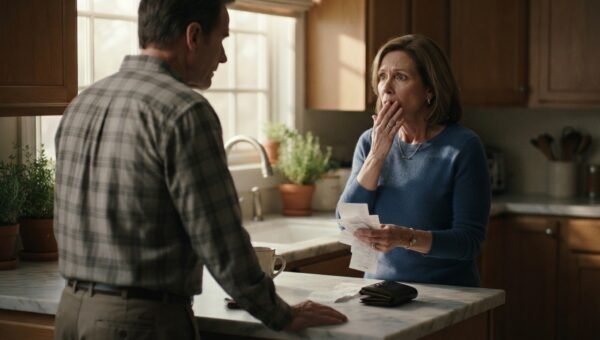
I went into the house. I did not start dinner. I did not put on the tea kettle. I took the thick manila envelope from the bank, walked into the living room, and placed it right in the center of his clean oak coffee table. Next to it, I set the paid receipt from the county tax assessor.
Then I sat down in the wingback chair by the front window and waited.
Odis came inside at four-thirty. He kicked off his boots, rinsed his hands at the kitchen sink, and walked into the living room drying his fingers on a dish towel.
He saw the envelope immediately. He saw the official bank seal on the corner.
The towel stopped moving in his hands.
“What’s that?” he asked.
“Sit down, Odis.”
He hesitated. He looked at the chair across from me, then at the envelope, then back at my face. He did not sit. He walked over to the table and picked up the top paper.
It was the wire confirmation for $120,000 to Red River Hauling. Underneath it were the two cashier checks with Greg’s signature on the back, deposited directly into Greg’s personal checking account in Tyler.
The room was completely quiet except for the hum of the refrigerator in the kitchen.
Odis did not look up from the paper for a full two minutes. The skin around his collar flushed deep red.
“He was going under, Clara,” Odis said. His voice was lower than usual, rough around the edges. “He took out short-term merchant loans at thirty percent interest to buy those three rigs. If he didn’t clear the balance by June, the repo men were going to seize the trucks and attach his house. He would have lost everything. Amy and the kids would have been out on the street.”
“So you gave him our retirement,” I said.
“It’s a bridge loan,” Odis snapped, his voice rising defensively as his pride tried to find purchase. “He’s paying it back. He’s paying eight percent interest. He’s our son, Clara. What was I supposed to do, let him go bankrupt?”
“You were supposed to ask your wife,” I said.
“You would have said no!” he shouted. The dish towel fell to the floor between his socks. “You always held Greg to a different standard than Sarah! You would have panicked, you would have made him feel like dirt, and you would have let his business fold just to prove a point about his budget!”
I did not raise my voice. I leaned back into the chair and looked at him.
“Forty-one years, Odis. Forty-one years of me washing your overalls, cooking your meals, packing your lunch tin, and trusting that when you said we were safe, we were safe. That two hundred and fourteen thousand dollars wasn’t just your overtime. It was my daddy’s timberland. It was thirty years of saving fifty dollars a week while you told me figures gave me headaches.”
“I was going to replace it,” he stammered. “Greg has three freight contracts starting next month. He promised he’d wire twenty thousand a month back into the money market starting in January. You never even would have had to know.”
“The escrow on this house was delinquent by thirty-four hundred dollars, Odis,” I told him, pointing to the yellow receipt on the table. “Our mortgage company was about to penalize us. You had nine thousand dollars left in the world, and you were hiding notices in your truck.”
He reached for his back pocket, but his hand came away empty. He had no answer for the tax notice.
“I drove to Tyler while you were working on the fence,” I said.
That was a small untruth, but it wasn’t a lie about what I knew. Sarah had called Greg from her bathroom while I was reviewing the papers. She had put him on speakerphone.
“Greg didn’t buy rigs with that last eighty-five thousand, Odis,” I said plainly. “Greg paid off back payroll taxes to the IRS for 2023, and he settled a private judgment with an equipment rental outfit in Dallas. His company didn’t survive. He dissolved Red River Hauling on Friday. He filed the paperwork in Austin.”
Odis’s face went slack. The anger drained out of his eyes so fast it left him looking seventy-five instead of sixty-six.
“What?” he whispered.
“The money is gone,” I said. “Every single dollar. Our son used your guilt and your pride to clean up his mess, and he let you think he was building an empire. And you let him do it because you wanted to play the big provider without your wife asking questions.”
Odis reached out and braced himself against the mantle. His knuckles turned white. He looked down at the coffee table, at the cashier checks with his own scrawled handwriting authorizing the transfer of our entire future.
“Clara,” he crooned, his voice shaking. “We’ll work something out. I can take on night shifts at the dispatch yard. I can sell the tractor. I can—”
“I have already worked it out,” I told him.
ENDING
The next morning, Odis and I sat in Arthur Vance’s office together.
Odis looked like he had not slept a minute. His eyes were bloodshot, and he kept his hands folded tightly in his lap, staring at the floor between his clean boots.
I had the paperwork ready.
First, the remaining nine thousand dollars was moved into a brand-new checking account in my name alone. Odis signed the release without reading it.
Second, we signed an agreement converting our primary checking account into a two-signature requirement for any withdrawal over two hundred dollars. Arthur stamped the signature cards himself.
Third, we walked down the street to the county courthouse and met with Beverly’s associate. I had already had the paperwork drawn up. Odis signed a deed of trust transferring his half of the house and our ten acres into a revocable living trust, naming me as the sole trustee during my lifetime, with Sarah as the secondary successor. If he ever attempted to encumber the property or take an equity line, he could not do it without my notarized consent.
When the notary pressed her seal into the paper, Odis finally looked up at me. His eyes were wet.
“Are you leaving me, Clara?” he asked. His voice was thin and small, like a child who had dropped a glass on Sunday morning.
I took my purse off the table and stood up.
“I am sixty-four years old, Odis,” I said. “I am not packing my bags to live in an apartment, and I am not tearing forty-one years into scraps over money that is already spent. But the man who handled our lives while I passed the potatoes doesn’t exist anymore.”
We drove home in silence. The truck heater rattled against the dash, blowing warm air across our knees.
Greg called three times that evening. His name lit up the screen on Odis’s flip phone where it sat on the kitchen counter. Odis stood by the sink, watching the phone vibrate against the laminate, but he never reached out his hand to answer it. By the fourth ring, the phone went quiet.
“He’s going to have to get a job driving for somebody else,” Odis said quietly to the window glass. “He’s going to have to tell Amy the truth.”
“Yes,” I said. “He is.”
That was three years ago.
The fence line is finished. Odis took a part-time job driving a shuttle bus for the veterans hospital three days a week. Every Friday, his paycheck goes directly into the account with my name on it. We paid off the remaining three years on the mortgage last November. The house belongs entirely to the trust now, safe and clear.
Greg did not come home for Thanksgiving that first year, but he came for Christmas. He sat on our sofa, looking older, working as a warehouse supervisor in Longview. He didn’t talk about venture capital. He didn’t talk about fleets. When he looked at his father, he looked down at his own shoes. Odis treated him kindly, but he didn’t offer him a dime, and he didn’t take him out back to talk in secret.
Every Tuesday morning, I sit at the rolltop desk in the hallway. I open the top left drawer. The box of yellowed index cards is gone; in its place is a black ledger with my own handwriting on every line.
I balance the receipts, I check the county notices, and I pay the light bill online.
Odis comes in from the porch, sets a hot mug of coffee on the coaster next to my elbow, and asks if we need anything from the hardware store. He doesn’t tell me figures give me headaches. And I don’t ask him for permission.