PART 1
When my mother-in-law, Martha, passed away, the first thing I felt was relief. It sounds ugly to admit it out loud, but fourteen years of marriage to her son had taught me never to expect warmth from her. She had never accepted me into her family. At Thanksgiving dinners, she looked right past my shoulder when I tried to join the kitchen talk. If our daughters made cards for her, she thanked the girls, took the paper, and never mentioned me.
On birthdays, my husband Mark got a card with a crisp check, while I got cold silence. In fourteen years, she never offered me a single present, never asked how my day was, and never spoke a solitary kind word directly to my face.
So when Mark and I sat in the second pew of the chapel on a rainy Tuesday morning, I was mostly just holding up my husband. Mark loved her in the complicated way sons often love distant mothers. He had spent his childhood trying to earn her approval, and now that chance was gone.
The service was small. About thirty people from her church and her old neighborhood came. The minister talked about Martha’s quiet endurance, her discipline, and her service to the altar guild. I sat with my hands folded on my wool coat, just waiting for the organ music to stop so we could go home.
As the congregation stood for the closing benediction, Mark reached inside his dark suit jacket. His hand was shaking. He turned to me, placed a small, tarnished metal tin in my palms, and leaned down close.
“She told me to give this to you on the day of her funeral,” he whispered.
The tin was about the size of an old tea canister, wrapped tightly around the center with two thick rubber bands that had dried and cracked with age. It felt cold against my skin.
I looked at Mark, trying to understand what kind of parting shot his mother had left behind. “Did she say what it was?” I asked.
Mark swallowed hard and looked toward the altar. “No. She made me swear three weeks ago in hospice that I wouldn’t open it, and that I wouldn’t hand it over until her service ended.”
Curious and confused, I slowly worked my thumb under the brittle rubber bands.
They snapped, dropping yellowed bits onto the church carpet. With the hymn still playing behind us, I lifted the lid.
Inside was a faded pink hospital bracelet from thirty-two years ago, a folded yellow carbon copy of a legal relinquishment paper, and a cashier’s check made out to me for exactly thirty-five thousand dollars.
PART 2
I stared at the name on that faded infant hospital band: Baby Boy Miller, born June 14, 1994.
That was not Mark. Mark was born in 1988 at St. Luke’s downtown, and his family name was Vance.
Beneath the band was an official receipt from an adoption attorney named Arthur G. Vance, Martha’s late brother, who had died before I ever met Mark. Below that sat the cashier’s check for thirty-five thousand dollars, drawn from a regional credit union five weeks before Martha took her final breath. It was typed clearly with my full name: Laura Miller.
My maiden name was Miller.
My breath felt caught in my chest. I looked up at Mark, but he was staring down the aisle as the pallbearers began to move Martha’s casket toward the double doors. He had not looked inside the box. He didn’t even know what was resting in my lap.
“We need to get through the graveside,” Mark said quietly, his voice thick with tears. He touched my elbow to guide me up. “Can you put it in your purse?”
I closed the lid, slipped the cold tin into my shoulder bag, and walked out behind the casket.
During the fifteen-minute drive to the cemetery, neither of us spoke. Mark watched the windshield wipers sweep across the glass, while my mind spun through every Sunday dinner, every cold shoulder, and every look Martha had ever given me.
For fourteen years, I had thought she hated me because I grew up in a run-down trailer park on the county line. I had assumed she looked down on my family because my father was a shift mechanic and my mother worked third shift at a packaging plant. When Mark brought me home to meet her, she had taken one look at my face, excused herself to the hallway, and barely came back into the room.
After the burial, Mark stayed behind by the plot to talk to a cousin who had driven in from Ohio. I walked back to our sedan, sat in the passenger seat with the door locked, and pulled the tin back out.
I opened the folded carbon copy from the adoption lawyer. The ink had faded to a dull gray, but the names were clear.
It was a voluntary relinquishment document signed in July 1994. The mother listed was my older sister, Brenda, who had died in a car accident when I was nineteen. Brenda had disappeared for five months the summer I was twelve, told our family she had gone to stay with an aunt in Kentucky, and never spoken about it again after she returned.
On the line marked “Adopting Mother,” the name typed was not Martha. It was Martha’s younger sister, Clara, who had lived three states away in North Carolina until her death eight years ago.
And on the bottom line, written in thin blue ink, was a note in Martha’s handwriting:
“Your sister took fifty dollars from Arthur to get on the bus and never asked where he went. Clara raised him with everything she had. When Mark brought you through my front door, I thought you were sent here to tear him away from his life.”
PART 3
The boy was Mark.
He had not been born to Martha at all. He had been born to my sister Brenda in a clinic forty miles south of our town. Martha had taken him in through her brother’s legal practice when Clara lost a child in infancy, and then, after Clara fell ill when Mark was six, Martha had taken the boy into her own home and raised him as her own son. She had kept that adoption private from the rest of the town, carrying the secret by herself for over three decades.
When Mark met me at a community college library fourteen years ago, Martha had recognized my last name immediately. When she saw my face, she must have seen Brenda.
All those years, she hadn’t looked at me with disdain. She had looked at me with pure, unyielding terror.
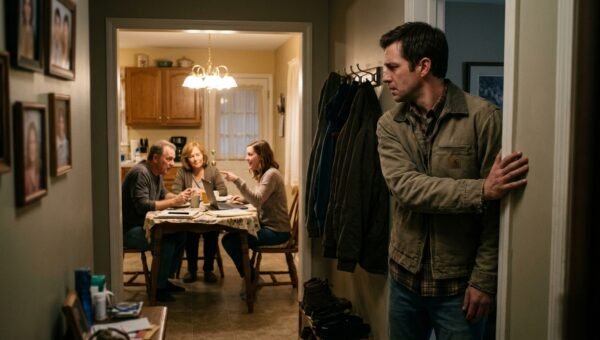
Every time I visited, every family dinner where she sat stiff and silent with her hands folded, she had lived in absolute fear that I had tracked her down to take Mark back, or to tell him that his entire childhood was built on an arranged silence.
I sat in the front seat of that car, trembling, until Mark opened the driver’s side door and shook the rain from his coat.
“You look white as a sheet, Laura,” he said, turning the key in the ignition. The heater kicked on with a low hum. “What was in that box? Did she leave something mean?”
I looked at my husband. I saw the slight curve of his brow, the small cleft in his chin, details I had looked at across our kitchen table for over a decade. Brenda had that exact cleft. It had sat in front of me every morning of our married life, and I had never seen it.
“Mark,” I said, keeping my hands resting firmly on the bag. “Pull out of the cemetery gate and park on the shoulder. We need to talk.”
He looked startled, but he put the car in reverse, drove past the iron gate, and pulled over beside an old stone wall under the maple trees. He cut the engine.
“What is it?” he asked, his voice strained.
I didn’t hand him the legal paper right away. Instead, I pulled out a small, handwritten note that was tucked underneath the cashier’s check. It was folded in quarters on Martha’s personal stationery, dated just three weeks earlier.
“Read this first,” I said.
Mark took the paper. He read it in silence while the rain tapped against the glass.
The note was short:
“Laura,
I guarded him from you because I loved him too much to let him be hurt, and because I judged your family for what Brenda did. I was wrong to hold it against you. You made him a good home. You gave him two daughters who know real peace. The money is what my brother kept in trust for the child’s care, which I never touched. It belongs to your side of the family. Tell him what you think he can bear. I leave that burden with you, because you are stronger than I was.”
A single tear rolled down Mark’s cheek, but he didn’t break down. He looked up at me with open, raw confusion.
“I don’t understand,” he said. “Why does she say the money belongs to your side?”
“Because your birth mother was Brenda,” I told him, keeping my voice gentle and steady. “My sister. You and I share blood, Mark. We are cousins.”
The silence inside that car lasted a long time.
ENDING
We sat by that stone wall for nearly two hours. I laid the papers across the dashboard between us, one by one. I showed him the birth registry, the clinic receipt, and the relinquishment paper his aunt had drafted thirty-two years ago.
Mark didn’t yell. He didn’t slam the wheel. He just picked up the faded pink plastic bracelet and ran his thumb over the stamped letters of our family name.
“She was terrified of you,” he whispered finally. “Every Sunday dinner. That’s why she gripped her tea glass so tight her knuckles turned white.”
“She thought I knew,” I said. “She thought I had planned it.”
We drove home to our house, made a pot of coffee, and sat at the kitchen table until our daughters came home from school. We didn’t tell the girls that afternoon. They were twelve and ten, and they only needed to know that their grandmother had been laid to rest with respect.
The following month, Mark and I drove out to the county courthouse in the next district. We verified the sealed filing with a clerk, confirmed that the paperwork was entirely lawful, and closed the final records on the trust account.
The thirty-five thousand dollars didn’t go toward a vacation or new cars. We deposited it into a separate high-yield account reserved solely for our daughters’ college expenses. It felt like the only clean way to use money that had been locked away out of fear for so long.
Our marriage did not end, but the foundation under it settled into something different. When you learn that the person sleeping next to you carried the ghost of your own sister into your living room every day for fourteen years, you stop looking at life in neat, tidy boxes.
Martha was buried next to her brother under a plain granite marker. I went back there alone in late November, after the leaves had all turned brown and fallen against the curb.
I stood by her headstone with my coat buttoned against the wind. For fourteen years, I had hated her coldness. Standing there in the damp grass, I realized she had spent half her life terrified that one careless conversation would shatter the only world she knew how to protect.
I reached out, touched the cold edge of the stone, and said the words she had never managed to say to me.
“Rest easy, Martha,” I said into the quiet air. “He’s safe.”