PART 1
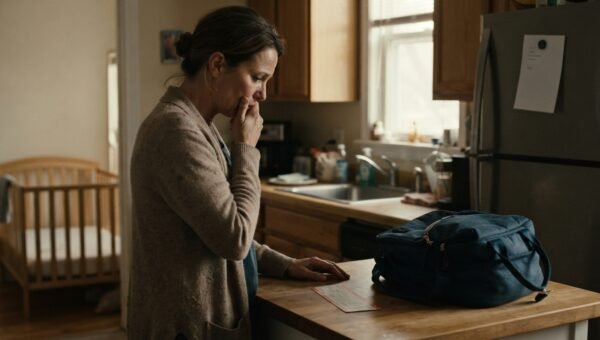
My six-year-old son, Toby, wrote a letter to Santa at school on wide-ruled notebook paper. His first-grade teacher, Mrs. Albright, put it in a manila envelope and mailed it straight to our duplex. I found it in the metal wall box by my front door after a double shift at the diner.
I sat down on the bench in the hallway, kicked off my non-slip shoes, and tore the top open expecting the usual things.
Legos. A red bicycle. Maybe the remote-control monster truck he pointed at every time we walked past the toy aisle at Walmart.
Instead, the paper had three uneven lines in thick blue crayon.
“Dear Santa, I don’t want toys. I want Mommy to stop crying at night. I want the man who yells at her to go away. He broke the kitchen table. He says bad words. Mommy says it’s our secret. But I don’t like secrets.”
I read it three times. My hands shook so hard the paper rattled against my knees.
I make $34,000 a year waiting tables and running the register at Miller’s Grill. I count every dollar, I stretch ground beef with oats, and I pay my rent four days early so the landlord never has a reason to knock. For eleven months, the man in Toby’s letter had been my boyfriend, Greg.
Greg moved in during late spring. He paid half the electric bill, helped carry up the fifty-pound sacks of dog kibble, and told me I was the hardest working woman he had ever met.
But when he lost his warehouse job in August, the house changed. The small arguments turned into slammed doors. Then came the night two weeks before Thanksgiving when Greg slammed his fist onto the pine dining table we bought at a yard sale, splitting the center seam right down through the wood screws underneath.
I hid the cracked seam with a heavy vinyl tablecloth. When Toby asked why the table rocked whenever he leaned on his elbow to color, I told him the floor was just uneven. I told him grown-ups had loud days, and what happened under our roof stayed under our roof. I told him it was our secret.
I folded the paper, shoved it into the pocket of my apron, and stood in my quiet kitchen. Greg was asleep in the back bedroom, his heavy work boots resting by the radiator.
At two in the afternoon, my phone buzzed on the counter. The caller ID showed the elementary school.
I pressed the phone to my ear, stepping into the narrow pantry so my voice wouldn’t carry.
“Mrs. Walker?” It was Mrs. Albright. Her voice was too quiet, careful in the way school staff sound when they are reading from an official protocol. “I’m calling because I mailed Toby’s envelope this morning. But I need you to know that I read the letter before I sent it. By law, as a teacher, I am a mandated reporter. I had to contact child protective services an hour ago.”
My throat closed up. “Mrs. Albright, please. It was an argument. We had an argument weeks ago. Toby just got frightened by the noise. Nobody touched him. Nobody has ever laid a hand on him.”
She paused. On the other end of the line, I heard the faint click of a computer mouse and the muffled sound of children walking down a tiled hallway.
“Mrs. Walker, that isn’t all Toby said,” she answered. “When I asked him why he didn’t want any toys this year, your son told me something else. He said, ‘The man told me if I tell anyone, he’ll make Mommy go away and never come back.'”
PART 2
The pantry suddenly felt like it had no air left in it.
“Did you hear me, Mrs. Walker?” Mrs. Albright asked gently.
“I heard you,” I whispered.
“A caseworker will be contacting you before five o’clock,” she said. “Toby is safe in my classroom right now. He had his juice box, and he’s working on a drawing of his dog. But you need to understand that the county takes threats like this very seriously. And you need to decide what the home looks like when they arrive.”
I thanked her, hung up, and leaned my forehead against the pantry shelf next to two cans of tomato soup.
My whole body felt cold. I had spent months convincing myself that I was being strong, that swallowing Greg’s temper was the price of keeping a roof over our heads and not being alone. I had told myself Toby was asleep in the next room whenever Greg started pacing and swearing. I had convinced myself that because Greg never threw a punch at me, the broken wood under that vinyl tablecloth did not count as real danger.
Now I knew the truth. Greg had cornered my six-year-old child while I was at work, looked him in the eye, and told him his mother would disappear if he spoke.
I walked out of the pantry and down the short hallway to the bedroom. Greg was still asleep on his side, snoring softly, the gray blanket pulled to his shoulder.
I looked at his gym bag on the floor, his car keys on the dresser, and the silver watch my brother had given me before he passed away, which Greg had taken to wearing because the clasp on his own had broken.
I didn’t scream. I didn’t shake him awake to demand an explanation. A woman making thirty-four thousand dollars a year with a child protective services caseworker arriving in three hours doesn’t have the luxury of an emotional scene.
I walked into the spare closet by the bathroom, pulled out two heavy black garbage bags from the bottom shelf, and came back into the bedroom. I opened Greg’s dresser drawers and began emptying them into the plastic. Socks, jeans, thermal shirts, work gloves.
The rustling plastic woke him. He rolled over, squinting against the gray afternoon light coming through the blinds.
“What are you doing, Sarah?” he mumbled, his voice gravelly with sleep.
“You’re packing,” I said, my voice steady, lower than it had ever been.
He sat up, rubbing his face with both hands, his brow furrowing in that familiar, irritated way that used to make my stomach knot. “What is your problem? I didn’t get to sleep until six.”
“Toby wrote a letter to Santa at school,” I said. I pulled his heavy winter coat off the closet hanger and shoved it into the bag. “His teacher read it. She called child services, and she told me what you said to my son while I was on the morning shift.”
Greg’s expression didn’t soften. He didn’t look shocked or ashamed. Instead, his jaw tightened, the lines around his mouth hardening into the stubborn, defensive mask I had learned to fear.
“He’s a kid,” Greg said, swinging his legs off the bed. “Kids make things up. You’re going to throw me out because a first-grader told a story?”
PART 3
“He didn’t make up the table,” I said.
Greg stood up, towering over me in his gray undershirt. He took one step toward me, trying to crowd my space the way he always did when an argument started. “Sarah, you listen to me. If some state worker comes in here and sees you throwing a fit, who do you think they’re going to look at? You work sixty hours a week. You’re barely keeping up. I help you. You kick me out, you can’t pay the full rent next month.”
He was using the one weapon he thought he owned: my poverty. He thought the fear of falling behind on twelve hundred dollars of rent would make me fold, the way it had every time he lost his temper over a late bill or an unwashed skillet.
I held my ground. I didn’t step back an inch.
“My son told his teacher that you promised to make me disappear if he talked,” I said, looking him dead in the eye. “That didn’t come from a cartoon. That came from your mouth. The caseworker is going to be here before five. If your car is still parked in the driveway when she pulls up, I will hand her Toby’s letter, I will pull the tablecloth off the dining table to show her the split wood, and I will tell the police officer who comes with her that you threatened my child.”
Greg stared at me. For five long seconds, the bedroom was entirely silent except for the hum of the old refrigerator through the wall.
He saw something in my face that had never been there before. The apology was gone. The excuse-making was gone. The woman who tiptoed around the living room so he wouldn’t get irritated had vanished.
“You’re crazy,” he muttered under his breath. But he reached for his jeans on the floor. “You’re ruining a good thing over nothing. Good luck paying for heat in January.”
He dragged his duffel bag from under the bed, grabbed the two garbage bags I had packed, and snatched his keys off the dresser. He took off my brother’s silver watch, dropped it onto the nightstand without looking at me, and shoved his feet into his work boots.
He didn’t apologize. He didn’t ask to say goodbye to Toby. He walked down the hall, opened the front door, let the cold December wind sweep across the linoleum, and pulled the door shut behind him.
Two minutes later, I heard his truck engine cough to life, rumble down the gravel driveway, and fade down the county road.
I stood in the center of the kitchen for sixty seconds, just breathing. Then I went to work.
I stripped the heavy vinyl tablecloth off the table. I looked at the jagged crack in the pine wood, where Greg’s fist had splintered the board straight through the center. I didn’t hide it. I left it bare.
When the county caseworker, a woman named Ms. Henderson with gray hair and a navy wool coat, knocked on the door at four-fifteen, I opened it immediately. She held a black clipboard against her chest. A police deputy stood three steps behind her on the porch, his hands resting quietly on his utility belt.
“Mrs. Walker?” she asked.
“Come in, please,” I said.
They stepped inside. The air was cold, but the house was clean. I took Toby’s letter out of my apron pocket and handed it directly to Ms. Henderson. Then I pointed to the kitchen table.
“My boyfriend moved out an hour ago,” I told her, keeping my voice clear and plain. “His things are gone. His truck is gone. He broke that table three weeks ago, and I lied to my son about it because I was ashamed and afraid I couldn’t make rent on my own. I told my boy it was a secret. That was my fault. But he is never coming back through that door, and I will sign whatever safety plan you have in that folder right now.”
Ms. Henderson looked at the letter. She walked into the kitchen, touched the cracked pine with the tip of her gloved finger, and looked around the room. She saw Toby’s school artwork taped to the refrigerator, his clean sneakers lined up by the coat rack, and the pantry stocked with bread and peanut butter.
She turned back to me. The guarded tightness in her face softened just a fraction.
“Let’s sit down and do the paperwork, Mrs. Walker,” she said.
ENDING
We sat at that broken table for nearly an hour.
I signed the formal county safety agreement stating that Greg had vacated the residence and was not permitted near Toby or the home. Ms. Henderson wrote down every detail without judgment. Before she left, she handed me a card for a local emergency utility grant that helps single parents in the winter months.
“You did the right thing today,” she said as she reached the door. “Not every parent does.”
I walked to the elementary school at five-fifteen to pick Toby up from the after-care room.
When he saw me standing by the classroom door, he didn’t run. He walked toward me slowly, dragging his little green backpack by the strap, his eyes searching my face to see if I was angry about what he had written.
I dropped to my knees right on the hallway tile, pulled him against my chest, and held him so tight I could feel his small heart beating against my collarbone.
“You didn’t do anything wrong, Toby,” I whispered into his hair. “Not one thing. You were so brave.”
He pulled back, his lower lip trembling. “Is he at the house?”
“No,” I told him. “He’s gone. He took his clothes and his truck, and he’s never coming back. It’s just you and me now.”
Toby let out a long, shuddering breath, the kind of breath an adult takes when a heavy weight is lifted off their shoulders. He wrapped his arms around my neck and buried his face in my coat.
We walked home together under the streetlights, stopping at the corner market to buy a roll of sugar cookie dough with the last five dollars in my coin purse.
The next evening, after my shift, I borrowed a hand drill and four heavy steel L-brackets from my neighbor, Mr. Henderson. Toby sat on the kitchen floor with a bowl of cookies, holding the flashlight steady while I crawled under the table.
My knuckles were scraped and the drill bit slipped twice against the hard pine, but I drove the steel screws deep into the wood until the seam pulled tight. When I climbed out, the table didn’t rock anymore. The jagged crack was still visible right down the center, dark and rough against the lighter varnish, but the wood was solid. It was strong enough to lean on.
Toby climbed onto his chair, set his elbows down hard on the repaired seam, and pulled his notebook toward him.
“What are you writing now?” I asked, setting a glass of milk beside his plate.
“A new letter,” he said, not looking up. “I have to tell Santa I don’t need help anymore, so he can bring the monster truck if he has room.”
I sat down across from him, resting my hands on the rough pine, and watched him draw big, uneven wheels in purple crayon.