PART 1
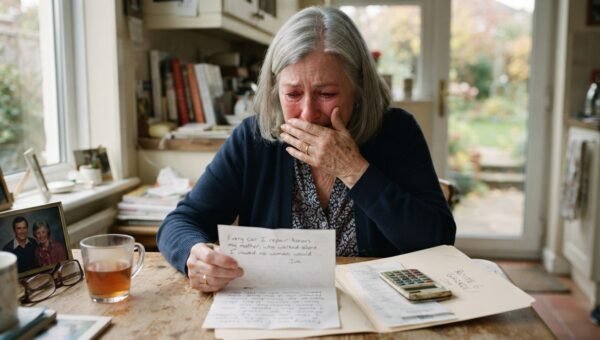
The screen lit up my nightstand at 2:14 in the morning. I was already half awake, the way you sleep when you know something is wrong in your family but you keep hoping you imagined it.
The text was from my son, Brian.
“Mom, I know you spent $10 million on this house, but my mother-in-law says you can’t attend your own grandson’s birthday. It’s just too awkward with her family there. Please don’t come tomorrow.”
I sat on the edge of the bed and read the words three times. My hands were steady, which surprised me. When you spend thirty years working your fingers raw building a commercial laundry business from two leased storefronts to twenty-four industrial plants, you learn how to go quiet when someone tries to back you into a corner.
My grandson, Leo, was turning six. For three weeks, Leo had been telling me about the red bicycle he wanted. I had already bought it. It was sitting downstairs in my garage with a silver bow taped to the handlebars.
I didn’t call Brian. I didn’t scream into a voicemail. I typed five words back into the phone:
“I understand. Have a good party.”
Then I put the phone facedown on the pine nightstand.
The house Brian lived in was a ten-thousand-square-foot brick home sitting on five gated acres outside Nashville.
It had cost exactly $10 million two years ago when I closed on it. Brian and his wife, Clara, had moved in six months after their townhouse flooded. At the time, Clara had hugged my neck in the foyer and cried on my shoulder. She told me I was the mother she never had, that her own mother, Evelyn, had spent Clara’s childhood chasing wealthy boyfriends across Florida and leaving Clara to fend for herself.
I felt sorry for her. That was my mistake. I felt sorry for both of them, and I wanted my boy to have the kind of ease I never tasted until my hair was already gray.
So I let them move into the estate. I paid the property taxes. I paid the landscapers. I paid the pool service. When Clara asked if her mother, Evelyn, could stay in the guest wing for “a couple of weeks to recover from hip surgery,” I said yes.
That was fourteen months ago. Evelyn never left.
Within three months of moving in, Evelyn had replaced the foyer rugs with antique runners charged to Brian’s household debit card, an account I funded with a monthly transfer of twelve thousand dollars for household upkeep. She started hosting a Tuesday garden club on the back terrace, telling the neighbors Brian had bought the place after selling a tech startup. In reality, Brian worked as a junior estimator for a commercial drywall contractor, pulling down sixty-two thousand a year before taxes.
I had let the lies slide because Brian looked happy, and because Leo loved running through the orchard. I told myself an older woman doesn’t need to fight every battle she sees.
Sitting there in the dark at 2:30 a.m., I realized my patience had been mistaken for weakness.
I walked down the hall to my home office. I didn’t turn on the overhead lights; I just switched on the small green banker’s lamp my late husband, David, gave me the year we bought our third delivery van.
I opened the bottom drawer of the mahogany filing cabinet and pulled out the thick blue folder labeled *Rolling Hills Estate*.
Inside was the original purchase agreement, the title policy, and the deed.
Brian thought the house was his. Clara believed it was theirs. Evelyn had convinced herself it was the family compound she had earned by right of association.
When I bought the property, Brian had begged me to put his name on the deed. He said it would make him feel like a real man in front of Clara’s high-toned relatives. Clara’s family came from old country-club money in Virginia that had run out of cash two generations ago, leaving behind nothing but silver teapots, unpaid club tabs, and immense pride.
I had loved my son, but I had not built a business by being a fool.
The deed in my hands listed one single owner: *The Eleanor Vance Revocable Living Trust, Eleanor Vance, Trustee.*
Brian was not on the deed. Clara was not on the deed. Evelyn certainly was not on the deed.
More importantly, tucked behind the title policy was the standard residential occupancy agreement my attorney, Sarah Lind, had insisted on drafting before Brian and Clara turned a single key in the front door. It was signed by Brian and Clara.
Section 8 was clear: *Occupancy is conditioned upon property remaining open and accessible to the Trustee at all times. Any attempt to exclude the Trustee constitutes immediate material breach, terminating tenancy upon written notice.*
Brian and Clara had never paid a single dollar in rent. They were guests at my pleasure.
I pulled out my phone and dialed Sarah Lind’s private mobile number. It rang four times before Sarah answered, her voice gravelly with sleep.
“Eleanor? Is something wrong? Is it your heart?”
“My heart is fine, Sarah,” I said, looking out the dark window at my quiet driveway. “Brian just barred me from my grandson’s birthday party at Rolling Hills.”
Sarah was silent for a few seconds. The rustle of bedsheets came through the receiver.
“I told you this day was coming eighteen months ago, Eleanor.”
“You did,” I said. “And now it’s here. I need you to do what we discussed in June.”
“Are you sure? Once the paper hits the county server and the notice is served, you can’t walk it back without looking like a pushover.”
“I am completely sure,” I said. “Send Marcus out at ten in the morning.”
Marcus was Sarah’s senior process server, an ex-deputy sheriff who weighed two hundred and sixty pounds and never raised his voice.
“I’ll have the packet printed and ready by eight,” Sarah said. “Eleanor, don’t go over there alone before Marcus arrives.”
“I have no intention of going alone,” I said. “I’m going to Leo’s party with his bicycle.”
PART 2
By nine that morning, the sun was bright over the hills, warming the asphalt on the long drive out to the property.
I had the red bicycle loaded into the back of my old Buick Enclave. I didn’t drive a fancy car. I had driven that Buick for nine years, and it ran smooth.
I parked three houses down from the gates of the estate at 9:45. The driveway was already packed with late-model luxury cars: a row of glossy German SUVs, two vintage convertibles, and a line of caterers’ vans unloading white folding chairs and silver warming trays.
Evelyn’s garden club friends were walking up the stone path in pastel dresses and wide-brimmed hats. I saw Evelyn standing near the carved double front doors. She was wearing a lavender linen suit, holding a flute of champagne, and holding court with three couples from the local historical society.
She looked every bit the mistress of the house.
At 9:58, a plain gray Ford sedan pulled up behind my Buick. Marcus stepped out, wearing a charcoal suit and carrying an embossed manila legal envelope under his arm. He walked up to my window, tipped his head, and smiled faintly.
“Morning, Mrs. Vance. Sarah sent over the complete packet. Notice of termination of guest occupancy, notice of immediate inspection, and the private event cease-and-desist regarding the commercial catering setup.”
“Is the county sheriff notified?” I asked.
“Deputy Miller is parked at the bottom of the lane,” Marcus said. “Just in case anyone forgets who owns the dirt they’re standing on.”
“Let’s go wish my grandson a happy birthday,” I said.
I got out of the Buick, walked to the rear hatch, and rolled the red bicycle out onto the asphalt. Marcus walked beside me, his long strides easily matching my pace as I pushed the bicycle up the long, curving driveway.
The chatter on the lawn started dying down before we even reached the front steps.
A woman in a floral silk dress turned to look at us, her glass pausing halfway to her mouth. I suppose the sight was unusual: a sixty-two-year-old woman in slacks pushing a kid’s bicycle, flanked by a six-foot-three man in a dark suit with a legal envelope.
Clara saw me first. She was coming out of the side arbor carrying a tray of iced cupcakes. Her face went tight, the polite hostess smile vanishing into thin air. She set the tray down on an iron table so hard two cupcakes tipped over.
“Brian!” she called out, her voice sharp enough to cut through the quiet. “Brian, get out here now.”
Brian stepped through the French doors of the living room, holding a craft beer. When his eyes hit me, he froze on the second step.
“Mom,” he said, hurrying down toward me. “What are you doing? I texted you. I asked you not to do this.”
“I got your text, Brian,” I said clearly, not raising my voice at all. “You told me your mother-in-law said I wasn’t allowed on the property.”
Evelyn glided down the stone steps then, her lavender linen jacket fluttering. She had that smooth, practiced Southern condescension down to an art.
“Eleanor, dear,” Evelyn said, placing a manicured hand lightly on Brian’s forearm. “Brian tried to spare your feelings. This is a private gathering for Leo’s school circle and our personal friends. We felt your presence might create some friction, given the differences in… social rhythm.”
A few of the guests near the fountain pretended to look away, but every ear was tilted toward us.
“Differences in social rhythm?” I asked, looking Evelyn dead in her pale eyes.
“We simply wanted a cohesive day for the boy,” Evelyn said, taking a delicate sip from her glass. “You don’t need to make a scene in front of our guests. Brian asked you politely to stay away today. As the master of this house, his wishes should be respected.”
Brian didn’t correct her. He stared at his deck shoes, his face flushed red under his collar.
“Brian isn’t the master of this house, Evelyn,” I said.
“Oh, stop the nonsense, Eleanor,” Evelyn snapped, her mask slipping just enough to show the sharp, bitter woman underneath. “Brian provided this home for my daughter and my grandson. You’re an embarrassment to him, coming up the drive like a delivery girl. Turn around and leave before we have the gate security escort you out.”
“You don’t have gate security, Evelyn,” I said. “The gate code belongs to me. Just like the brick under your heels, the slate over your head, and the water in your glass.”
I turned to Marcus.
“Serve her.”
PART 3
Marcus stepped forward. He didn’t rush. He pulled two identical blue-backed documents from the envelope and extended one directly toward Brian, and the other toward Evelyn.
“Brian Vance, you are served with formal Notice of Termination of Occupancy. Evelyn Morris, you are served with formal Notice of Trespass and Immediate Vacancy.”
Brian didn’t reach for the paper. It fell against his chest, and his hands came up automatically to catch it.
Evelyn pulled her hands back as if the envelope were covered in poison. “What is this trash? You can’t serve me with anything. This is my son-in-law’s estate!”
“It isn’t,” I said. The silence across the lawn was total now. Even the catering staff had stopped stacking plates. “This house is owned outright by my trust. I paid $10 million in cash from the sale of my laundry company’s northern district two years ago. Brian has lived here rent-free because I wanted him to build a savings account. Clara has lived here rent-free. And you, Evelyn, have lived in my west wing for fourteen months without contributing fifty cents toward the roof over your head.”
Clara’s mother looked like someone had slapped her across the mouth. She turned to Brian, her voice screeching up an octave.
“Brian! What is she talking about? Tell her to stop this lying!”
Brian didn’t speak. He couldn’t. His throat worked, but no sound came out.
“He can’t tell you to stop, Evelyn,” I said, “because Brian knows the truth. He signed the occupancy agreement as a guest. And when he sent me that message at two o’clock this morning telling me his mother-in-law wouldn’t allow me to attend my grandson’s birthday in my own house, he violated Section 8 of that agreement.”
Clara rushed over, her eyes wild as she looked around at the forty guests watching every second.
“Eleanor, please! Not in front of our friends! This is humiliating!”
“You weren’t concerned about my humiliation at two in the morning, Clara,” I said. “You were perfectly content to let your mother ban me from my own property while you served my champagne out of glasses I bought.”
“We’re family!” Clara hissed, stepping into my space. “You can’t just throw us out on Leo’s birthday! What kind of grandmother does that?”
Right on cue, the screen door on the side porch banged open.
Leo came running out across the lawn in his little navy shorts and sneakers. When he saw me, his whole face lit up.
“Grandma Ellie!” he shouted.
He didn’t see the legal papers. He didn’t notice the stiff postures of the adults or the silence hanging over the terrace. He just saw me, and then his eyes landed on the red bicycle.
“My bike!” he screamed, running straight past Evelyn, straight past Clara, and throwing his arms around my waist. “Grandma, you got the red one! With the silver bell!”
I knelt down on the grass, ignoring the gravel under my knees, and wrapped my arms around the boy. He smelled like grass and lemon frosting.
“Happy birthday, sweetheart,” I whispered in his ear. “I promised you I would bring it, didn’t I?”
“You did,” he said, his little hands gripping the lapel of my jacket. “Can I ride it on the driveway?”
I stood up, holding his small hand in mine, and looked at Brian. My son looked smaller than I had ever seen him. He wasn’t looking at Clara or Evelyn. He was looking at his son holding my hand.
“Leo,” I said gently, “why don’t you show your dad how the bell rings?”
Leo ran over to the bike and gave the bell three sharp, clear rings. The sound echoed off the high brick walls of the courtyard.
I turned back to Evelyn and Clara.
“The catering company has thirty minutes to pack their trucks and leave. The guests have forty-five minutes to clear their cars from the private drive. The sheriff’s deputy is waiting at the gate to ensure everyone departs in an orderly fashion.”
Evelyn’s face had gone from red to an ugly, mottled gray. “You’re a monster, Eleanor. A spiteful, bitter old woman.”
“I may be old, Evelyn,” I said, “and I may be tired of your arrogance. But I am not a fool, and I do not subsidize people who teach my grandson that his grandmother is something to be hidden in the closet.”
ENDING
The party vanished faster than morning dew.
The guests didn’t linger to offer Clara condolences or Evelyn support. People who come to drink free champagne on a five-acre lawn don’t stick around when the police show up at the gate. Within forty minutes, the long driveway was empty except for my Buick, Marcus’s sedan, and the moving truck Sarah Lind had dispatched from town.
Evelyn was out of the west wing by four that afternoon. She left with four suitcases and two garment bags, muttering curses under her breath as Marcus watched her load them into a rented sedan. She didn’t look at me once as she backed down the lane.
I didn’t put Brian and Clara out on the street that night. I’m a mother, not a brute.
I sat Brian down at the heavy oak dining table that had never seen a family dinner because Evelyn insisted on eating in the formal conservatory.
I laid the reality out in plain numbers.
“You have thirty days to find an apartment,” I told him. “You will pay the rent from your drywall salary. You will pay for Leo’s preschool yourselves. If you want this marriage to work, you had better learn what a man actually pays for, because my money will not be the foundation of your wife’s vanity.”
Brian put his face in his hands and wept. He didn’t argue. For the first time in his thirty-two years, he didn’t offer an excuse.
“Mom,” he choked out, his shoulders shaking. “I’m sorry. I let them run over me. Evelyn said if I didn’t back Clara, Clara would take Leo and go to Virginia.”
“Then you should have stood up like a father months ago,” I said softly. “You don’t buy your wife’s loyalty with my blood and sweat. That’s not love, Brian. That’s cowardice.”
Two weeks later, the deed to the Rolling Hills estate was transferred to a premier Nashville commercial brokerage. The property sold in late October to an orthopedic surgeon from Atlanta. I took the proceeds and moved them into safe, interest-bearing municipal bonds that Clara and Evelyn will never lay their eyes on.
Brian and Clara rented a two-bedroom brick duplex four miles from my house. It’s small, and the kitchen counters are cheap laminate instead of Italian marble. Evelyn didn’t move in with them; she went back to a studio apartment in Tampa, complaining to anyone who would listen that she had been swindled out of her rightful family estate.
Brian called me last Tuesday. It was the first time he had dialed my number without Clara prompting him in the background.
“Mom,” he said. His voice sounded tired, but clear. “Leo learned how to ride without the training wheels yesterday. On the red bike.”
“Did he?” I asked, looking down at my hands.
“Yeah,” Brian said. He went quiet for a moment, and I could hear the wind blowing on his end of the line, like he was standing in the small yard behind his duplex. “He asked if you could come over this Saturday to watch him. Just you. No party. Just hot dogs on the little grill I bought.”
I sat in my chair by the window, where the sun was hitting David’s old green desk lamp.
“I’d like that, Brian,” I told him. “Tell him I’ll bring the mustard.”