PART 1
The bill was going to be about $78, which felt like an absurd thing to worry about while planning to dismantle a twenty-five-year marriage.
We were sitting in Martha’s favorite corner booth at the Olive Garden out on Route 4. The server had just dropped off the basket of warm garlic breadsticks and taken our orders. I ordered first, getting the tour of Italy because I could not concentrate enough to look at the menu.
Martha ordered the chicken alfredo. She had ordered the chicken alfredo at that same restaurant every October 14th since our fifteenth anniversary.
She picked up a breadstick, broke off the end, and smiled at me across the small fake candle on the table. “Twenty-five years, David. Half our lives.”
My chest felt tight. My stomach had been sour all afternoon. I placed both hands flat on the table cloth, right next to the salt shaker.
“I need to tell you something,” I said.
Martha stopped mid-chew. She put the breadstick down on the side of her small salad plate. Her eyes did not leave mine. “What is it?”
“Back in 2011,” I started, and my own voice sounded strange to my ears, raspy and thin. “I had an affair. It lasted four months. It ended that same summer. It was completely over in August.”
Martha did not gasp. She did not grab her chest or drop her napkin.
She simply stared at me across the booth. Her eyes stayed wide, unblinking, holding onto my face like she was trying to read words written under my skin.
“Why now?” she asked. Her voice was not loud. It was dead level. “Why would you tell me this right now, David?”
“Because the woman called me last week,” I said, leaning forward so the family two booths over wouldn’t hear us. “Her name is Brenda. She has a daughter. The girl is twelve years old. Martha, Brenda sent me a photo. The girl looks just like me. She has the exact same dark patch, that same little birthmark right behind her left ear. Brenda says the girl needs heart surgery. A valve repair. The out-of-pocket balance is $47,000. She asked me for the money. She said if I didn’t help, she was coming to our house.”
I waited for the tears. I waited for her to slap the table or call me a liar or ask me how I could have done it.
I had rehearsed this awful conversation ten times in the truck outside my office, bracing myself for her to crumble.
Instead, Martha slowly reached down to the vinyl seat beside her. She picked up her black leather purse and zipped it shut. Then she slid across the booth and stood up.
She stood there tall under the low hanging lamp, looking down at me. Her hands were completely steady on the strap of her bag.
“I knew about her,” Martha said.
My mouth went bone dry. I looked up at her, convinced I had misheard. “What?”
“I knew about Brenda,” she said, her voice so calm and quiet it was almost a whisper. “I’ve known about her since 2012.”
“Martha, how could you…”
“I never said anything,” she continued, cutting through my question without raising her voice. “Because in 2011, while you were meeting her at that business hotel near the interstate, I was at the very same hotel. Different floor. With your brother.”
PART 2
The noise of the restaurant seemed to cut out entirely. The server walked past our booth carrying a tray of soup bowls, completely unaware that everything under our roof had just turned to ash.
Martha did not wait for me to speak. She turned and walked down the carpeted aisle toward the front lobby.
I threw a hundred-dollar bill onto the table, grabbed my coat, and hurried after her. By the time I pushed through the double glass doors into the chilly October air, she was already unlocking the passenger side of our sedan.
“Get in,” she said, not looking at me. “I am not having this conversation on the asphalt.”
I got behind the wheel. My hands were shaking so hard I dropped the keys between the console and the driver’s seat. I had to fish them out with my fingernails. When the engine turned over, I did not put the car in reverse. I just sat there staring through the windshield at the strip mall across the street.
“Greg?” I asked. The name felt jagged in my throat. Greg was two years younger than me. He was the one who helped me build our back deck in 2015. He sat at our Thanksgiving table every single November. “You and Greg?”
“Don’t sound so righteous, David,” Martha said quietly. She was looking straight ahead into the dark parking lot. “You were gone every Tuesday and Thursday for four straight months. You told me you were auditing the warehouse branch in Scranton. But your mileage didn’t add up. You forgot to clear the navigation history on the truck. I drove down there on a Thursday in July. I sat in the parking lot and watched you walk into the lobby with a woman carrying an overnight bag.”
“So you called my brother?”
“I called Greg because I was crying so hard I couldn’t drive home,” she said, and for the first time, a small crack appeared in her composure. “He met me at the lounge in that hotel to calm me down. He got a room on the third floor so I could wash my face and pull myself together before I drove home to the kids. One thing led to another. We stayed until midnight while you were up on the sixth floor doing whatever you were doing with Brenda.”
“Did it happen again?” I asked.
“No,” she said instantly. “It happened twice. That night, and one more time three weeks later when you went away for your company retreat. Then we stopped. We both felt sick about it. We agreed never to speak of it again, never to be alone together, and never to break up the family.”
“And you stayed with me,” I said, the bitter taste of it coating my mouth. “For fourteen years. You smiled at him at Christmas. You let him hold our granddaughter.”
“And you stayed with me while another woman raised your child,” Martha answered, turning her head to look right at me. “You didn’t confess tonight because you felt guilty, David. You confessed because a bill came due. You needed $47,000, and you couldn’t take that much out of our joint savings without me seeing the withdrawal.”
She hit the center of the truth so hard that I could not answer.
She was right. If Brenda had not called last Tuesday, if Brenda had not texted me that pediatric cardiology estimate from the hospital in Philadelphia, I would have taken that secret to my grave. I had convinced myself I was doing the honorable thing by coming clean, but I was really just trying to clear a path to our bank account.
“What are you going to do about the girl?” Martha asked.
“I don’t know,” I said. “Brenda sent medical records. The condition is called aortic stenosis. The child really is sick, Martha. If she’s mine, I can’t just let her die.”
Martha looked down at her hands folded neatly in her lap. “Then tomorrow morning, you go find out if she’s yours. But you do it with a legal test, not a photograph of a birthmark. And until the paper is in your hand, you do not touch a single dollar of our retirement.”
PART 3
I slept on the fold-out couch in my home office that night. Neither of us slept more than an hour.
At seven in the morning, I called Greg.
When he answered, his voice was thick with sleep. “Hey Dave. Everything okay? Happy anniversary, by the way.”
The casual warmth in his voice made my stomach heave. “I know about 2011, Greg. Martha told me last night.”
The line went completely dead. He didn’t ask what I meant. He didn’t try to make an excuse or pretend he didn’t hear me. There was just five seconds of absolute, heavy silence.
“I’m sorry, Dave,” he whispered. “I’ve hated myself every single day since.”
“Don’t come to Thanksgiving,” I said, and hung up the phone. I didn’t yell. There was no point in yelling. The wound was already fourteen years old, scarred over and rotten underneath.
Two hours later, I called Brenda.
I told her I was willing to help with the $47,000, but I would not wire money to a personal checking account, and I would not hand over cash. I told her we were doing a legal paternity swab through an accredited lab, and if the results were positive, I would pay the hospital directly.
Brenda balked at first. “Her surgery is scheduled for three weeks from now, David. She doesn’t have time for your games.”
“A rush test takes seventy-two hours,” I told her. “I will pay the extra fee for the expedited processing. If you want the money, you meet me at the diagnostic clinic on Market Street tomorrow at ten.”
She showed up.
She looked tired, older than her thirty-eight years, wearing a faded winter jacket and running shoes. But she brought the girl with her.
Her name was Chloe. She was small for twelve, quiet, holding a worn paperback book against her ribs. When she looked up at me to say hello, she had my mother’s gray eyes. When she brushed her hair back from her ear, the small brown mark was right there, identical to the one I’d had checked by dermatologists three times in my thirties.
My throat closed up. The anger I had been carrying all morning melted into an awful, hollow sadness. This little girl had done nothing wrong. She didn’t know about Olive Garden, or hotel rooms, or broken vows. She was just a kid whose heart wasn’t pumping right.
We did the cheek swabs. I paid the lab $350 for the rush courier service.
On Thursday afternoon, the email notification came through. I downloaded the PDF and opened it at my desk with trembling fingers. The probability of paternity was 99.98 percent.
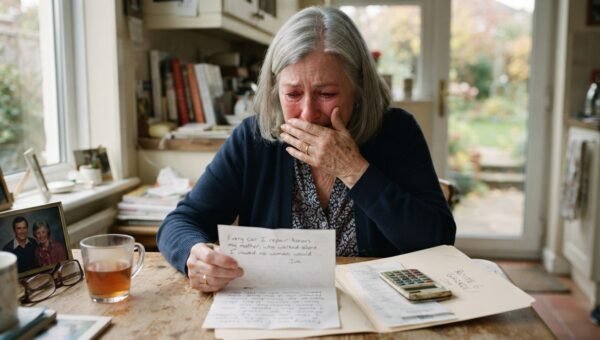
I walked the document out to the kitchen, where Martha was sitting at the table with our household ledger and the checkbook. She had spent the last two days quiet, moving around the house like a ghost, washing dishes that were already clean.
I laid the paper on the wood in front of her.
“She’s mine,” I said.
Martha read the document twice. She took off her reading glasses and set them on top of the paper. She didn’t cry. Martha had never been a woman who wasted time on tears when there was business in front of her.
“The $47,000,” she said. “We have $52,000 in the liquid money market account. The rest of our net worth is tied up in the house and the IRA.”
“I know,” I said. “If I take it, it wipes out our emergency reserve. It sets us back years.”
“You have to pay it,” Martha said flatly.
I looked at her, stunned. “You want me to pay it?”
“The child didn’t ask to be born out of our mess, David,” Martha said, her voice hard and clean. “You made a mess, and now a twelve-year-old girl is paying for it with her health. You will call the hospital billing office. You will get the wire instructions. You will pay them directly. Every cent.”
She paused, folding her hands together on the table.
“And then,” she added, “we are selling this house.”
ENDING
We split the proceeds from the house six months later.
In the real estate market that spring, the four-bedroom colonial we had lived in since 1999 went for $340,000. After the remaining balance on our second mortgage and the closing fees, we each walked away with roughly $118,000.
I gave Martha an extra $23,500 from my half of the sale, reimbursing her share of the money market account we had emptied for Chloe’s surgery. She didn’t thank me, and she didn’t refuse it. She simply took the cashier’s check, signed the quitclaim deed, and handed the keys to the buyers.
Chloe’s valve surgery was successful. The procedure took five hours at Children’s Hospital, and Brenda sent me a text message from the recovery room with a photo of Chloe giving a weak thumbs-up from under a white blanket. I visit her twice a month now. We go to a small diner near Brenda’s apartment in Allentown. We don’t talk about the past. I help her with her middle school algebra homework, and I set up a modest college fund with $200 automatically transferred from my paycheck every month. It is the least I can do for a life I spent twelve years ignoring.
Greg tried to come by my apartment once, around Christmas. He stood outside the hallway door for ten minutes, knocking softly and calling my name. I sat on my couch with the television muted and waited until his footsteps faded down the stairwell. Some things are too broken to be repaired by an apology, and I have accepted that my brother is a stranger now.
Martha moved two towns over, into a quiet brick townhouse near our daughter and the grandbabies. We speak on the phone occasionally, mostly about taxes or the kids’ birthdays. We are polite. We don’t yell, and we don’t bring up 2011.
Last week, our daughter sent a group text with photos from our grandson’s fifth birthday party. Martha was in the background of one picture, sitting on a lawn chair in the sun, wearing a light blue sweater I had never seen before. She looked rested. She looked like a woman who was no longer carrying someone else’s secrets on her back.
I still drive past that Route 4 shopping center on my way to work every Tuesday morning. The Olive Garden sign is still there, green and bright against the gray highway sky. I haven’t eaten Italian food since that night, and I doubt I ever will again. But every time I see that building in my rearview mirror, I remember that the truth always finds a way out. It just doesn’t care whose life it breaks open on the way.