PART 1
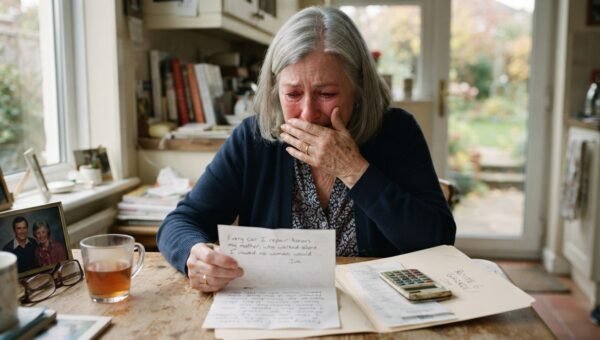
The notification popped up on our shared iPad right around six in the evening while I was boiling potatoes. “Withdrawal processed: $42,000.” It was from the Fidelity app. I stared at the glass screen with wet hands. Our retirement balance was supposed to be right around $380,000, built up slowly across 29 years of marriage.
I wiped my hands on my apron and tapped the banner. The account summary loaded, and the number at the top made my stomach turn over.
Over the last six months, there had been three separate wire transfers out of the core fund. $28,000 back in May. $35,000 in July. And now $42,000 today.
A total of $105,000 was completely gone.
All three transfers went directly into a personal checking account at an institution we had never used together. I sat down at the kitchen table and dialed the Fidelity customer service line. After five minutes on hold, the representative checked the account profile and gave me a flat answer.
“Ma’am, only the primary account holder can authorize electronic disbursements or change funding instructions,” he said. “Your husband is the primary. You are listed only as the primary beneficiary.”
He could not freeze it. He could not reverse it.
When my husband, Dan, walked through the door twenty minutes later, I didn’t say a word about it right away. I dished up dinner. Meatloaf, his mother’s recipe with the brown sugar and tomato glaze he always asked for on Fridays.
He sat down, shook salt over his green beans, and picked up his fork.
“Where is the $105,000, Dan?” I asked.
His fork stopped an inch above his plate. He set it down against the rim, looked at the meatloaf, and took a slow breath.
“Invested it,” he said.
“Invested it in what?”
“A house,” he said.
“We have a house,” I said. “We’ve lived in this house since 1997.”
Dan looked toward the living room and said nothing. He didn’t offer a single explanation. He just stood up, left his full plate on the table, and walked out to the garage, shutting the heavy entry door behind him.
Later that night, after he fell asleep in the guest room, I sat on the couch with his unlocked phone. His browser history was full of recent searches for Pinellas County property records and listings in Clearwater, Florida. It took me less than ten minutes to find the exact address on Zillow.
It was a 3-bedroom, 2-bath ranch with a screened pool, listed as sold three weeks ago for $310,000.
I pulled the public deed from the county clerk’s website. The title listed two buyers as joint tenants with right of survivorship. The first name was Daniel R. Miller. The second name was Brenda Kay Holloway.
A woman I had never heard him mention in three decades together.
PART 2
I barely slept that night. Every time I shut my eyes, I saw that $105,000 figure and the name on the Florida deed. By eight in the morning, while Dan was out running errands, I was sitting in the office of Claire Bennett, a family law attorney in town who had helped my sister through her divorce five years ago.
Claire pulled up the Pinellas County property records on her monitor and reviewed the copies of the Fidelity transaction logs I had printed out from the iPad.
“Here is the immediate problem, Martha,” Claire said, turning the screen slightly so I could see. “Under this specific institutional plan structure, the automated rollover election Dan signed is already queued up.
The remaining balance, which is right around $275,000, is set to transfer automatically in fourteen days into an external rollover trust account.”
“Can he just take the rest of it without me signing anything?” I asked.
“Under federal law for this plan type, a distribution of this size requires spousal consent,” Claire explained. “He submitted an electronic certification claiming spousal waiver. But because you never signed or acknowledged that form, we can file a formal spousal consent revocation directly with Fidelity’s compliance department. That will freeze the entire account before that fourteen-day clock runs out.”
Claire made a note on her yellow pad, then tapped her pen against a printout she had pulled from an online asset registry database.
“There’s something else you need to know before we serve him with anything,” she said quietly. “Your husband also opened a second private life insurance policy eighteen months ago. A half-million-dollar term policy. You aren’t on it. Brenda Kay Holloway is the sole primary beneficiary.”
“Who is she?” My voice sounded thin, like paper. “Is she someone from his company? An affair?”
Claire slid a photocopy across the desk. It was an excerpt from an old probate filing and a state voter registration card. Brenda Kay Holloway was sixty-two years old, born and raised in Ohio, and she had spent the last twenty-five years living in Tampa.
“Look at the maiden name listed on her original Social Security application,” Claire said.
I looked down at the line. Brenda Kay Holloway’s maiden name was Miller.
She was Dan’s older sister.
The sister Dan had sworn for twenty-nine years was dead.
When I married Dan back in 1995, his parents were already gone. He had shown me an old photograph of a dark-haired girl in a high school sweater once, telling me his older sister Brenda had passed away from a sudden medical issue in her twenties before we ever met. He never spoke about her. He had no other family, just a few cousins in Indiana he barely kept up with.
I drove home with my hands shaking on the steering wheel. Dan was not running off with a secret lover to Florida. He was quietly gutting our life savings to set up a woman he had hidden from me for my entire adult life.
PART 3
When I got home, Dan was sitting at the kitchen table with a mug of black coffee. He looked exhausted, the skin under his eyes dark and puffy.
I laid the Florida deed, the life insurance profile, and the Fidelity withdrawal sheets right beside his coffee cup.
“Claire Bennett filed the spousal consent revocation with Fidelity two hours ago,” I told him, standing by the counter. “That $275,000 isn’t moving anywhere in fourteen days. The account is locked. And you have five minutes to tell me why your dead sister is on the title of a house in Clearwater.”
Dan didn’t jump. He didn’t look angry. He just closed his eyes, let out a slow, shuddering breath, and rubbed his face with both hands.
“She isn’t dead,” he whispered.
“I know she isn’t dead,” I said. “I’m looking at her signature from three weeks ago.”
“My parents cut her off when I was nineteen,” Dan said, looking at the tabletop. “She had terrible drug problems back in the eighties. She stole checks from my dad, cleaned out my mother’s jewelry box, and ended up doing sixteen months in county jail. My father told everyone in the family she was dead to us. When he died, he made me swear on his Bible that I would never give her a single dollar of the family estate or bring her around anyone I married.”
“Dan, that was forty years ago,” I said. “Why lie to me? Why tell me she died in a hospital?”
“Because I was ashamed,” he said, his voice cracking. “I met you, and you had this normal, decent family that loved each other. I didn’t want you to think my family was garbage. So I buried it. I repeated the lie so many times I almost believed it myself.”
“Then what is this house?” I pointed hard at the deed. “You took $105,000 out of our joint retirement. You left me with almost nothing to fall back on if something happens to you.”
Dan leaned forward, gripping his coffee mug with both hands.
“She found me six months ago,” he said. “She tracked down my work email. She’s been clean for over twenty years, Martha. She worked as an aide in a nursing home down in St. Petersburg until her back gave out last winter. She has severe degenerative disc disease and congestive heart failure. Her landlord in Tampa was jacking her rent to $2,100 a month on an $1,100 disability check. She was two weeks away from being put out on the street.”
“So you decided to buy her a house with a pool behind my back?”
“The house has an accessible ground-floor suite and a walk-in pool she can use for physical therapy,” Dan said, tears finally spilling down his cheeks. “I panicked. She was crying on the phone every night, coughing, telling me she had nowhere to go. I thought about what my dad made me promise, and I felt sick. I thought if I told you, you would tell me no, or you would look at me like I was a liar who kept a secret for thirty years. I convinced myself I could move the money, set up the private trust, and pay it back out of my consulting checks over the next five years before I fully retired.”
“You didn’t give me the chance to say anything,” I said. “You stole from me. You made me look like an idiot to a customer service rep on an iPad.”
“I know,” Dan choked out. “I was terrified. I broke everything trying to fix something that went wrong before I even met you.”
ENDING
We didn’t yell after that. The house was dead quiet for two days. Dan slept in the guest room, and I spent the weekend reading through every financial statement we had accumulated over twenty-nine years.
On Tuesday morning, Dan came with me to Claire Bennett’s office.
He didn’t fight anything Claire put on the table. We drafted a legally binding postnuptial agreement. The Clearwater house remains in Dan and Brenda’s names so she has a safe place to live, but Dan executed an immediate second mortgage and promissory note on the Florida property in my sole name for the full $105,000. If that house is ever sold, refinanced, or transferred, every dollar of that money returns directly to my personal account first.
Dan also signed the irrevocable spousal protections on the Fidelity core fund. The remaining $275,000 was moved into a joint management setup where no distribution or rollover can occur without both of our physical signatures verified by a notary. The separate life insurance policy was amended, naming me as the fifty-percent beneficiary, with the other half held in a restricted medical trust specifically managed by a third-party administrator for Brenda’s healthcare needs.
Brenda called me two weeks later. Her voice was raspy, slow, and frightened. She told me she had no idea Dan was taking funds from a joint retirement account; Dan had told her he had received an old inheritance from an uncle that was finally paid out. She offered to move out, to let the house go back on the market.
“You don’t have to leave the house, Brenda,” I told her, looking out my kitchen window at the backyard garden Dan had built twenty years ago. “You need a roof over your head, and you’re sick. But your brother is going to work two extra years to replace every single dollar he took from this home.”
Dan took a part-time supervisory role with the county water authority on top of his regular hours. Every month, his supplementary paycheck goes straight into our joint reserve fund to rebuild the cushion we lost.
We still have dinner together every night. Sometimes it’s meatloaf. He still salts his green beans, and he still thanks me when I hand him his plate. We are trying to rebuild something out of the wreckage, but when the iPad screen lights up on the kitchen counter now, I still feel that cold knot in my chest, remembering how easily thirty years of trust can be traded away in the dark.