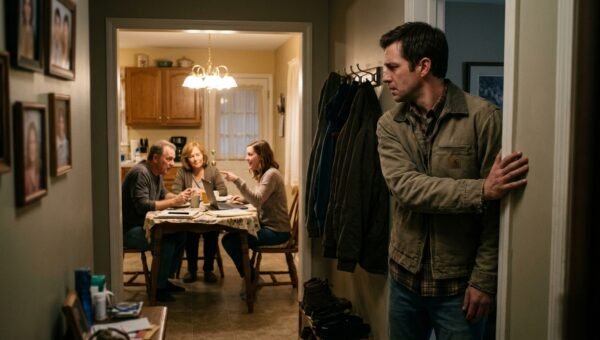
The rosemary from the roast had got into my shirt before Candace asked me to leave my own Thanksgiving table. I can still remember that, though I couldn’t tell you what I ate the night before. Rain pattered on the glass roof of the conservatory, and Stuart was sitting in my chair at the head of the table.
Candace said it softly, like she was asking me to move a centerpiece. “Calder, could you eat in the kitchen tonight? My parents need the dining room.”
Connie had her cider lifted halfway to her mouth. Trey was beside Candace, passing the gravy without looking at me. I checked the clock over the pantry door, picked up my plate, and said, “Sure. You all enjoy yourselves.”
Candace gave me a grateful little smile. Trey said nothing. The kitchen door swung shut behind me, and their voices carried through it, bright and untroubled. I stood by the sink for a second with my plate in my hands. I didn’t want to give them the satisfaction of seeing what that had done to me.
I’d planted the first row of trees in the orchard thirty years earlier. Wynn Grounds & Orchard was me, a borrowed trailer, and a used mower that only started if you kicked the deck. I built the service yard near the old packing sheds, hired the first crew, and took calls in bad weather because a missed job could mean somebody lost hours.
Trey rode with me in the truck when he was a kid. At twelve, he learned to set a hedge line. At nineteen, he came to work full-time. I gave him a company card and room to make decisions. I thought that was how you prepared your son to take over.
That’s the part I have to own. I trusted him with work before I knew if he could handle being trusted.
Candace came along a few years later. The first changes seemed small. She started routing deliveries through Trey instead of me, then switched the household contractor contact to her own number. One supplier called me the owner, and Candace corrected him.
“Trey runs things now,” she said.
Trey was standing close enough to hear. He didn’t correct her. I told myself it was a harmless thing, the kind of awkwardness a family could absorb. I didn’t want to be the old man who took offense at every little change.
Then Ben called about the accounts. He’d been my accountant for almost twenty years, and he never used the word “concerned” lightly. He’d compared company-card charges with service-yard logs and found purchases that had no equipment orders to match. One week, a deposit to an online betting account lined up with Trey’s card activity.
“How much?” I asked.
“Enough that I wouldn’t ignore it,” Ben said. “I can keep reviewing it quietly.”
I said yes. After we hung up, I started a list of dates, amounts, and the explanations Trey gave me. I wasn’t looking for a fight. I wanted the whole picture before I did anything I couldn’t take back.
That same afternoon, I called Vic, who’d worked beside me since the early years. He’d stayed through storms, broken equipment, and the season a frost took half our new plantings. I told him I might need him to run daily operations.
“Tell me when,” he said.
“Not yet. Don’t change anything with the crews until Ben confirms the accounts.”
“I understand.”
A month earlier, Clark, who managed the regional arboretum, had told me Trey was talking with another contractor. Wynn Grounds had held that maintenance contract for years. It was our biggest job outside the usual seasonal work, and I asked Clark to pause the renewal while I sorted out what Trey was doing.
I didn’t tell him I suspected my own son. I only said I needed time. It was an ugly thing to keep quiet, but I wanted to protect the crews and the contract before I started throwing accusations around.
Then, on Tuesday, my sister Nell sent me a screenshot.
“Wrong family chat,” she wrote. “I thought you should see it.”
Candace had meant to send the message to her parents. Instead, she’d sent it to a chat that included Nell. One line said, “If Calder lets go of his role, we can finish the spring transfer without a mess.”
I read it twice. I folded the screenshot and put it in the pocket of my work jacket. Then I went back to the orchard. I didn’t ask Trey what “spring transfer” meant. I wanted the business protected before I wanted an explanation.
By Thanksgiving afternoon, I’d spoken with Ben and Dan Albright, the attorney I used for the company. I asked them to prepare the formal changes and bring the records that night. I wanted them ready, but I didn’t want them entering my house unless I called. I still hoped I’d have a quiet talk with Trey first.
That was the false hope, I guess. I thought if I gave him one more chance to tell me the truth, he might take it.
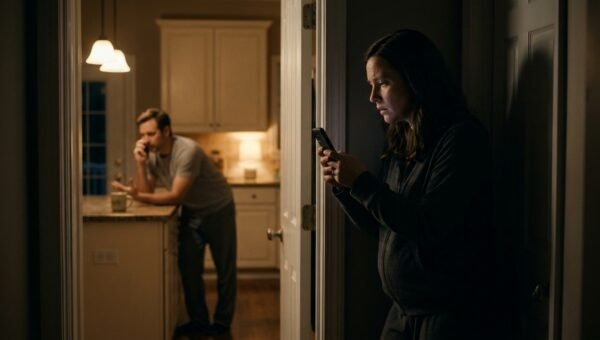
At dinner, after I took my plate into the kitchen, the copper misters above the sink caught the light from the stove. I sat at the small table by the window and waited until the voices in the dining room covered the sound of my phone.
I called Vic. “I’m putting daily operations in your hands. The paperwork is ready. Don’t change anything with the crews until Ben confirms account access.”
There was a short pause. “Understood.”
I called Ben next. “Start the access change. Trey comes off the operating account.”
“I’ve got the forms open,” Ben said.
“And the credit line?”
“I can send the guarantee suspension for your signature now.”
The company line had been backed by my name because Trey said he needed it for equipment purchases. Ben had found charges with no equipment to show for them. I signed the guarantee suspension on my phone. The bank confirmed Trey’s access to the primary account was gone. The company could still pay its people. The crews could still work.
Trey just couldn’t use my name as a spare key.
I called Clark. “Vic is authorized to direct our work under the current agreement. The crews and terms stay the same. I’m standing behind it.”
He didn’t ask me to explain. “Then I’ll keep the schedule as planned,” he said. “Vic can call me Monday.”
“Thank you.”
For a few minutes, nothing happened. Then a phone buzzed in the dining room. Another followed.
Candace’s voice came through the door. “Try the other card.”
A moment later Trey said, “It shouldn’t be doing this.”
Footsteps crossed the hall. The kitchen door opened hard enough to hit the wall. Trey stood there with his phone in one hand.
“Dad. What happened?”
“What do you mean?”
“The company card’s declined. The account says I don’t have access.”
“Ben removed your access.”
His mouth tightened. “You did this tonight?”
“I did it before you could move anything else.”
Candace came in behind him. Stuart and Connie stopped just outside the kitchen. Candace’s voice had lost the sweetness it had carried at the table.
“You’re making a scene over a payment problem.”
“It isn’t a payment problem,” I said. “The company will make payroll. Vic has authority to run the work. Clark knows that.”
Trey stepped closer. “You can’t just hand the business to Vic.”
“I can assign operational authority. I did.”
Candace looked at me. “We had a plan for spring.”
“No spring transfer has been approved.”
Trey looked at his phone again. “The credit line is frozen.”
“Your access is gone. My guarantee is gone. The company isn’t paying for your personal spending anymore.”
“You don’t trust your own son?”
I looked down at my plate, then at the chair I’d carried into the dining room years ago when the conservatory roof still leaked in hard rain. “I trusted you with more than I should have.”
Nobody answered. The rain ticked overhead. Then the doorbell rang.
I set my napkin beside the plate and got up. Ben and Dan were waiting on the porch, damp from the rain and carrying black leather binders. I knew who was there, but seeing them made the whole thing real in a way my phone calls hadn’t.
Ben held out one binder. “We have the verified charges and the bank records.”
Dan had another. “And the revocation papers.”
“Come in,” I said.
Trey had followed me into the hall. Candace and her parents stood behind him. I opened the door wide and let Ben and Dan pass. No one spoke while the rain blew in around their shoes.
I led them into the dining room. The Thanksgiving meal sat half-eaten on the table. Stuart was still in my chair. He got up when I came through with the binders, though he didn’t say anything.
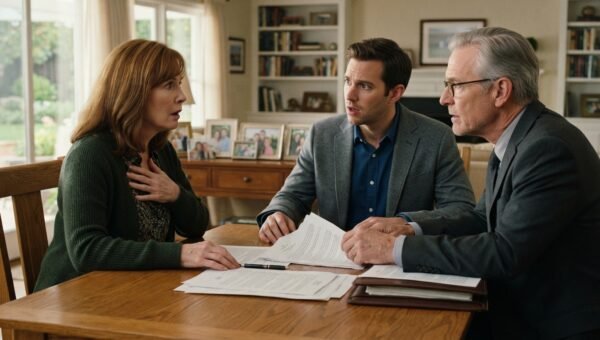
I put the binders on the table where his plate had been. Then I sat at the head.
“Let’s get the facts out,” I said.
Ben opened the first binder. He’d matched the company charges to bank records and betting account transfers. The amount tied to Trey’s personal gambling and other debts was $68,400. Some of the charges had been explained as equipment purchases. There were no equipment orders to support them.
Candace leaned over the table. “That doesn’t prove what you think it proves.”
Ben turned the binder toward her. “These are the bank records.”
Trey stared down at the pages. His hand was still wrapped around his phone. I recognized the same stiff grip he used when he was trying not to show he was scared.
Ben opened the second binder. Inside were emails and notes from an outside broker. Trey and Candace had started arranging a sale of fourteen acres on the southern edge of the orchard. There was also an unsigned listing agreement and correspondence about subcontracting the arboretum maintenance work.
The plan was to push me into an advisory retirement, sell the land, and turn over the arboretum job. The money would clear Trey’s gambling losses and consumer debts. Candace’s parents would move into the main house under the name of elder care.
I looked at Stuart and Connie. Connie had set her cider down. Stuart glanced at the chair he’d been sitting in, then away from me.
“Were you told about the sale?” I asked.
Stuart rubbed his thumb along the edge of his napkin. “Candace said the land was going to be sold.”
“Did you know Trey had put company debt behind it?”
“No,” Connie said. Her voice was small. “We didn’t know about that.”
Candace shook her head. “This was supposed to help the family. Trey was under pressure. You could have retired years ago.”
“I could have,” I said. “I didn’t.”
She gave a short laugh, but there wasn’t much behind it. “You’re making him look like a criminal in front of everyone.”
Dan spoke before I did. “Mr. Wynn is the sole legal owner of the company. Trey has no authority to sell land, transfer a contract, or make commitments in the company’s name. Any further attempt would be referred for legal action.”
Trey looked at Dan, then at me. His face was tight, and his voice came out rough.
“I was going to fix it.”
“By selling the orchard?”
“I thought I could pay it back before you found out.”
“You used company credit for betting.”
“I know.”
“You let me think I was training you to take over.”
He looked down at the binder. “I know.”
Candace reached for his arm. He pulled away, not hard, just enough that she had to drop her hand. I watched that happen and felt sorry for him. I also felt angry that I still felt sorry for him.
“I’m not paying off the debt,” I said. “I’m not hiding it, either.”
Trey rubbed both hands over his face. “What do you want me to do?”
I told him the terms. He would sign a debt acknowledgment and surrender all company signing power that night. Vic would run day-to-day operations. If Trey stayed, he’d work as an hourly foreman under Vic’s supervision. His wages would be garnished to repay the money. He’d have no executive authority and no access to company accounts.
“Or?” he said.
“Or Dan starts the full audit and we pursue recovery through the legal system.”
The kitchen clock ticked from somewhere down the hall. Nobody reached for a drink.
“You’d do that to your own son?” Candace said.
“I’m doing this because he’s my son. I won’t let him keep making it worse.”
Trey sat down. He read the acknowledgment while Dan sat beside him and went over each page. I didn’t rush him. I also didn’t tell him it was all right, because it wasn’t.
When he got to the last page, he looked up. “If I sign, I still get to work there?”
“If you tell the truth and follow Vic’s rules.”
He lowered his eyes again. “All right.”
His signature looked cramped, like he was trying to fit it into less space than the page allowed. Dan witnessed it. Ben took the signed copy and checked the account change forms one more time. There was no big speech. Just paper being turned, initials being added, and the quiet scrape of a pen.
Then I turned to Stuart and Connie. “You can’t move into this house. I need you to pack your things tonight.”
Candace stood up. “You can’t throw my parents out.”
“I can. This is my home.”
Stuart rose from the table. “We’ll go,” he said. He didn’t look at me when he said it. Connie put on her coat without finishing her cider.
Candace stayed in the hall with Trey while her parents packed. She didn’t apologize. I didn’t ask her to. She and Trey left with them that night. Trey took one bag and his work boots. I watched him set the boots by the door first, then come back for the bag.
He paused before he went out. “I’m sorry, Dad.”
I believed he was sorry. That wasn’t the same as trusting him.
“Be at the yard at six Monday,” I said. “Vic will tell you where to start.”
He nodded once and left.
The next few weeks were plain and hard. Ben finished the review. Dan filed the revocations. Vic took over the work, and Clark renewed the arboretum contract under the same terms. The crews kept their hours. The southern acreage stayed ours.
Trey showed up Monday. Vic put him on a crew and watched the time sheets. I didn’t go out there to check on him. I had to learn not to hover, and he had to learn that being my son no longer meant I’d cover every mistake.
Before dawn the next morning, I sat at the head of the cleared dining table with a quiet mug of coffee. The rain had washed the conservatory glass clean. Beyond it were the trees I’d planted thirty years ago.
The master keys to the service gates rested beside my mug. The southern orchard was still ours.