PART 1
The monitor beside my bed had a rhythm that felt like a clock ticking down. It was three in the morning, and the outside world was frozen under a heavy Indiana sleet. I was twenty-six years old, terrified, and entirely by myself.
My husband, Greg, had called four hours earlier to tell me the interstate was completely gridlocked because of a multi-car pileup near Fort Wayne. He said he was stuck in his truck, sixty miles out, and his battery was dying.
He told me to be brave and promised he was doing everything he could to get there. But the contractions were already coming so fast I could barely draw breath, and the labor room felt massive and cold.
Then the door swung open, and Nurse Evelyn walked into my life.
She was a small woman in her late fifties, wearing faded blue scrubs with cartoon ducks across the pockets and wire-rimmed glasses that kept sliding down her nose. Her hands were warm and dry. The second she took my hand, the terror stopped choking me.
“You are not alone in this room, sweetheart,” she told me, pulling a rolling stool right up against my mattress. “I have you. We are going to meet this little girl together.”
For nine straight hours, Evelyn never left my side. When the pain made me vomit, she held the plastic basin and wiped my face with a cool washcloth.
When my lips cracked, she fed me crushed ice from a little paper cup with a plastic spoon. She talked me through every single contraction, breathing in sync with me, counting out loud in a low, steady voice that kept me tethered to the bed.
Right near the end, the monitors went wild. The high-pitched beeping turned into a flat, screaming alarm. The room suddenly filled with doctors and other nurses, but Evelyn stayed locked on me. The umbilical cord was wrapped twice around my baby’s neck. Her heart rate had plunged into the thirties.
I started screaming, convinced my child was dying before she even took a breath. Evelyn leaned right into my face, gripped both my shoulders with incredible strength, and said, “Look at me, Clara. Push with everything you have left. Do not stop.”
With one final, violent effort, I pushed. Evelyn caught her. With lightning-fast hands, she slipped the cord over my daughter’s neck, suctioned her tiny airway, and rubbed her back until a sharp, miraculous cry cut through the chaotic room.
I was hemorrhaging and drifting in and out of consciousness. The doctors were working furiously between my legs. Through the haze, I could see Evelyn standing by the warming table under the bright heat lamp. She swaddled the baby tightly in a flannel blanket, held her against her shoulder, and softly sang an old church hymn. That sweet, trembling voice was the last thing I heard before the anesthesia took me under.
When I woke up hours later in recovery, Greg was sitting in the corner chair, drinking bad hospital coffee. He kissed my forehead and apologized again for missing the birth, blaming the weather and the highway department. Evelyn brought my daughter into the room, placed her in my arms, and showed me how to guide her to nurse.
I looked at the baby’s left wrist. There was a tiny, faint strawberry hemangioma right below the palm, shaped almost like a tiny crescent moon.
“She has a little mark,” I whispered.
“A little angel’s kiss,” Evelyn said softly, smoothing the baby’s fine dark hair. “She is a miracle, Clara. Never forget that.”
Three days later, we were discharged. I hugged Evelyn so hard my stitches ached. I told her I would never forget her face as long as I lived.
Three years passed. Life became a blur of toddler steps, preschool applications, and daily routines. My daughter, Lily, grew into a bright, funny little girl with curls that never stayed flat and a fierce, independent streak. The little red mark on her left wrist faded slightly to a pale pink, but it was still there, exactly where it had been on the morning of her birth.
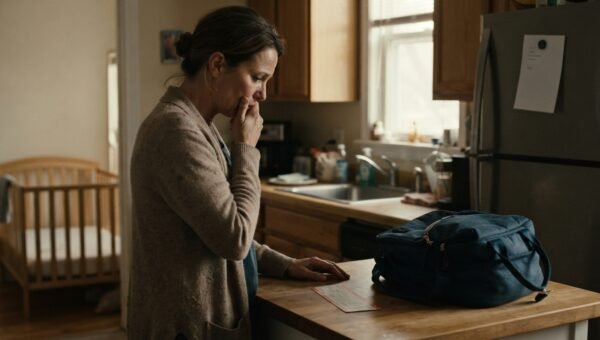
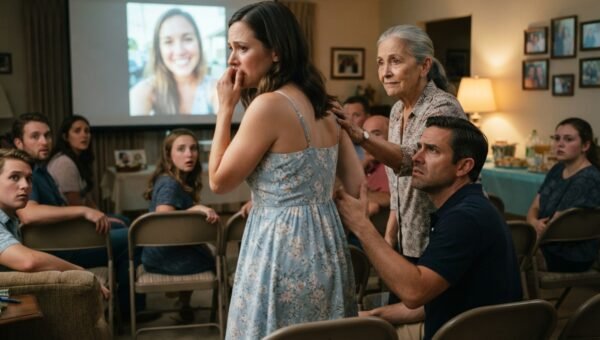
On a Tuesday afternoon in October, Lily was sitting on the living room rug, building a tall, crooked tower out of wooden blocks. I was sitting on the sofa folding laundry, with the local midday news playing quietly in the background.
The broadcast suddenly cut to a breaking news banner with flashing red letters.
The anchor’s voice became grave. An investigation spanning three counties and eight years had just culminated in a raid on a private adoption broker and medical staff across northeastern Indiana. The lead suspect had just been taken into custody outside her home in Auburn.
The screen cut to footage of police cruisers and unmarked federal vehicles blocking a quiet suburban driveway. Two female officers were escorting an older woman in handcuffs toward a squad car.
I dropped the towel I was holding.
It was Evelyn.
She looked older, her hair thinner and graying, but it was unmistakably her. The wire-rimmed glasses sat on the same crooked bridge of her nose.
The news anchor continued reading the report: “Authorities allege that Evelyn Vance, a former veteran labor and delivery nurse at St. Jude Memorial, was the primary inside operative for an illegal, high-dollar black market adoption ring. Over an eight-year period, Vance is suspected of facilitating the theft and unauthorized substitution of at least fourteen newborn infants from maternity wards, preying on vulnerable, isolated mothers.”
My blood stopped moving. The room seemed to tilt sideways.
Then the broadcast flashed an evidentiary photograph found during the morning raid on Vance’s home office. It was a digital photo of Evelyn smiling in an empty hospital hallway, holding a newborn wrapped in a standard hospital blanket.
The screen zoomed in on the baby’s tiny arm.
On the infant’s left wrist, clearly visible against the pale skin, was a distinct, crescent-shaped strawberry birthmark.
A caption beneath the photo displayed an exact date and timestamp: October 14, 2023, 4:12 AM.
That was the exact date and hour I gave birth.
I looked up from the television screen. Across the living room rug, my three-year-old daughter was giggling as her wooden block tower crashed to the floor, waving her left arm in triumph.
The mark on her wrist was identical.
My hands shook so violently I could barely unlock my phone. I dialed the tip line number flashing at the bottom of the news screen, my throat closing up so tight I could hardly form the words when a detective finally answered.
PART 2
“St. Joseph County Sheriff’s Department, Detective Miller,” a tired voice answered on the third ring.
“My name is Clara Vance,” I gasped, my chest heaving. “No, not Vance. Clara Reynolds. I’m sorry, I can’t breathe. I’m watching the news about Evelyn Vance. The nurse.”
The detective’s tone shifted instantly from routine boredom to sharp attention. “Ma’am, do you have information regarding Vance?”
“The photo on television,” I said, tears blurring my vision as I stared at Lily on the rug. “The picture of her holding a newborn with a birthmark on the left wrist. The timestamp said October 14, 2023, at 4:12 AM. That was my delivery room. That was my baby. But my daughter is sitting right here in front of me.”
There was a dead silence on the line for three full seconds.
“Where do you live, Mrs. Reynolds?” Miller asked, his voice dead serious.
“Granger. On Elm Ridge Road.”
“Do not leave your house,” he said. “I am sending two detectives to you right now. Do not talk to the media, do not post anything online, and do not let anyone inside until we arrive with badges.”
The line went dead.
I dropped the phone onto the cushion. My mind was spinning into total madness. If Evelyn had been stealing infants and swapping them, why did the baby in the police photo have the exact same birthmark as the little girl currently singing nursery rhymes on my living room floor? If Evelyn stole my baby, whose child was I raising? But if she stole a different baby, why did that newborn have my daughter’s exact mark?
None of the pieces fit together.
Ten minutes later, my husband Greg called.
“Clara? Are you home?” His voice was unusually tight, strained in a way I had never heard before.
“Greg, turn on the news,” I sobbed, clutching the receiver to my ear. “The nurse from Lily’s birth. Evelyn. She was arrested. She was stealing babies from the hospital.”
There was a strange, hitching pause on the other end. “I know,” he said quietly. “I saw it online at the office.”
“Greg, the police showed a picture of a baby from that morning. She had Lily’s birthmark. I called the sheriff’s office. Detectives are coming here right now.”
“You did what?” Greg’s voice snapped with sudden, terrifying fury. “Why the hell would you call the police without talking to me first?”
I pulled the phone back from my ear, stunned. Greg was a mild-mannered civil engineer. He never yelled. He had never once spoken to me in that tone in eight years of marriage.
“What are you talking about?” I whispered. “Our daughter might be part of a federal kidnapping ring. Why wouldn’t I call them?”
“Sit tight. Don’t say a damn word to anyone until I get there,” he snarled, and slammed the phone down.
A cold dread, entirely different from the fear I had felt watching the news, settled into the pit of my stomach.
Twenty minutes later, an unmarked black sedan pulled into my driveway, followed by two uniformed patrol cruisers. Detective Miller, a tall, gray-haired investigator with deep lines around his eyes, came to the door alongside a female detective named Harris. They showed their badges and stepped inside.
Miller sat at my kitchen table while Harris gently interacted with Lily in the adjoining room, keeping her occupied with coloring books.
“Mrs. Reynolds,” Detective Miller said, opening a manila folder. “We need to understand everything that happened on October 14, 2023.”
I walked him through every detail. The ice storm. Greg getting stranded on the highway. Evelyn holding my hand through nine hours of labor. The umbilical cord around the neck. My hemorrhaging and the emergency intervention. Evelyn singing to the baby by the warmer. And finally, waking up hours later with Greg at my bedside.
Miller listened without interrupting, writing notes in a small spiral notebook.
“Did you take photos in the delivery room?” he asked.
“I didn’t have my phone,” I said. “It died during labor, and Greg had the charger in his truck. But the hospital took an official newborn identification photo for the bassinet card. And Greg took a few pictures on his phone when he finally showed up.”
Miller pulled an eight-by-ten glossy print from his folder and laid it flat on the table. It was the photo from the television broadcast.
Up close, the details were terrifyingly clear. Evelyn was standing in a dim utility corridor behind the labor ward, holding a swaddled infant. On the baby’s left wrist was the distinctive crescent-shaped birthmark. In the background, visible on a digital wall clock above an emergency exit door, was the time: 4:12 AM.
“Mrs. Reynolds, according to hospital records, your daughter was delivered at 3:58 AM,” Miller said carefully. “You lost consciousness around 4:05 AM due to blood loss. By 4:20 AM, you were stabilized in post-op.”
“Then that’s Lily,” I cried, pointing at the photo. “That is my baby. Evelyn took that picture twelve minutes after she was born.”
“Look closer at the swaddle blanket, Clara,” Miller said gently.
I leaned in. The blanket in the photograph was plain white with a thin yellow border.
My stomach dropped.
St. Jude Memorial used blue and pink striped flannel blankets. Every mother in our town knew those blankets. I still had Lily’s original hospital blanket folded inside her baby memory box in our bedroom closet.
I ran upstairs, tore through the closet, and retrieved the wooden keepsake box. I brought it down and placed the blanket on the table. It was white with blue and pink stripes. Inside the box was also Lily’s original plastic hospital bracelet.
Miller examined the plastic band under the kitchen light.
“The bracelet says Infant Girl Reynolds,” Miller murmured. “Delivered by Dr. Nathan. Nurse of record: Evelyn Vance.”
“So what does the yellow blanket mean?” I demanded.
Before Miller could answer, the front door flew open.
Greg stormed into the foyer. His coat was half-unbuttoned, his breathing ragged, his briefcase swinging wildly at his side. He froze when he saw the two armed detectives sitting at the kitchen table.
“What is going on here?” Greg demanded, his face pale and slick with sweat. “Clara, I told you to wait for me.”
Detective Miller stood up slowly, towering over my husband. “Mr. Reynolds. I’m Detective Miller with the County Sheriff’s Department. We’re investigating the Evelyn Vance case. We need to ask you some questions about the night your daughter was born.”
Greg took a half-step backward toward the door. His eyes darted toward the living room where Lily was playing, then down at the file folder on the table.
“I don’t have anything to say without a lawyer,” Greg said, his voice cracking.
A terrifying silence gripped the room.
My husband had never been in trouble with the law in his life. He didn’t have a speeding ticket to his name. For him to demand a lawyer within ten seconds of seeing police in our home told me everything I didn’t want to know.
“Greg,” I whispered, stepping toward him. “What did you do?”
PART 3
Detective Harris stepped smoothly between Greg and the front door, blocking his exit with her arms folded across her chest.
Miller didn’t raise his voice. He simply opened a second folder on the table, revealing a series of bank statements and printed phone records.
“We executed search warrants on Evelyn Vance’s residence at six o’clock this morning, Mr. Reynolds,” Miller said calmly. “We seized her computer, her personal cell phone, and her financial ledgers. She kept meticulous records of every transaction she orchestrated over the last eight years. Every payout. Every wire transfer. Every customer.”
Greg leaned against the entryway wall, his knees visibly trembling.
“We know Vance wasn’t working alone,” Miller continued. “She worked with an unlicensed adoption broker named Arthur Pendelton operating out of Chicago. Pendelton matched wealthy, desperate couples with healthy newborns. Vance used her position in labor and delivery to identify babies whose mothers were young, single, heavily sedated, or completely alone in the delivery room.”
“Why would she target me?” I screamed, tears spilling down my face. “I wasn’t giving my baby away. I loved her from the second I knew I was pregnant.”
Miller looked at me with deep pity. “Because to Evelyn Vance, you were the perfect target. You were alone. Your labor was life-threatening. You were losing blood rapidly, and your husband was supposedly hours away in an ice storm.”
Miller turned back to Greg, his gaze turning to pure steel.
“Except you weren’t stuck in an ice storm, were you, Gregory?”
Greg slid down the wall until he was sitting flat on the hardwood floor, his face buried in his hands. A dry, pathetic sob escaped his throat.
“Tell her, or I will,” Miller ordered.
“I didn’t have a choice,” Greg wept, his voice muffled against his palms. “Clara, you don’t understand what happened. You don’t know what kind of trouble I was in.”
“What did you do with my baby?” I shrieked, lunging at him, but Detective Harris caught my arms and held me back with firm, steady hands. “Where did she go? Who is in my living room?”
“Lily is your baby,” Greg cried, looking up with red, tear-streaked eyes. “Lily is your biological child. I swear to God on my mother’s soul, Clara, Lily is yours.”
“Then why was Evelyn arrested with a photo of our baby in a strange blanket?” I demanded.
The truth, as Miller and Greg unraveled it over the next twenty minutes, was far darker and more twisted than a simple kidnapping.
Six months before Lily was born, Greg had fallen deep into an illegal sports gambling ring run out of an underground poker club in South Bend. By the time I was seven months pregnant, he had liquidated our emergency savings, maxed out three credit cards, and owed ninety thousand dollars to violent loan sharks who had begun showing up at his office.
Desperate and terrified, Greg had approached Arthur Pendelton through an acquaintance, seeking a fast, high-interest private loan. Pendelton didn’t offer a loan. Pendelton offered a trade.
A wealthy couple in Illinois had paid Pendelton a massive sum for a healthy newborn girl with specific physical traits. Pendelton had Evelyn Vance scouting the maternity ward at St. Jude. When Vance saw my medical chart, she coordinated with Pendelton. And Pendelton contacted Greg.
The arrangement was horrifying: Greg was to deliberately delay his arrival at the hospital during my labor, leaving me completely unattended. Vance would induce fetal distress or claim the baby had died during emergency delivery due to the cord strangulation. She would declare the infant a stillbirth while I was unconscious, spirit the newborn out through the basement service exit in a commercial laundry bin, and hand her to Pendelton’s courier.
In exchange, Greg’s ninety-thousand-dollar debt would be wiped clean, and he would receive an additional fifty thousand dollars in cash.
“You agreed to sell our daughter?” I whispered, my voice completely hollow. The room felt like it was running out of oxygen. “You told me you were stuck in traffic, and you were waiting for them to tell you she was dead?”
“No,” Greg wept uncontrollably. “No, Clara, please listen to me. I agreed to it because they threatened to burn our house down with you inside it. But when the night actually came, I couldn’t do it. I drove to the hospital. I sat in the parking lot at two in the morning, watching the snow fall. I was sick to my stomach. I knew what Evelyn was planning to do in that room.”
“Then what happened at 4:12 AM?” Miller asked.
Greg looked up at the detective, his mouth shaking. “At four in the morning, I snuck up the service stairs into the third-floor corridor. Evelyn had the baby in the yellow blanket. She was walking toward the fire exit to meet Pendelton’s driver. She had already signed the false stillbirth transfer log in the maternity ward.”
Greg wiped his nose on his sleeve, shivering.
“I stepped out into the hallway and blocked her path. I told her the deal was off. I told her if she took one more step toward the exit, I would tackle her and scream for the security guards. Evelyn panicked. She pulled out her phone, took a photo of the baby to prove to Pendelton that the child was born healthy and that the deal fell through because of me, not her. She told me Pendelton would kill us both.”
“And then?” Miller pressed.
“I ripped the baby out of her arms,” Greg sobbed. “I pulled off the yellow blanket and threw it on the floor. Evelyn ran back into the ward, terrified of being caught. She scrambled to doctor the hospital records, claiming the stillbirth code had been an administrative error caused by the chaos of your hemorrhage. She brought Lily to the nursery, put the official hospital band and striped blanket on her, and placed her under the warmer. When you woke up, the baby was in the bassinet. I saved her from the monster I made a deal with.”
“You didn’t save her,” I said, cold fury replacing my terror as I stared at the man I had slept beside for eight years. “You put her in the monster’s hands in the first place.”
ENDING
Detective Miller stood up and pulled a pair of handcuffs from his belt.
“Gregory Reynolds, you are under arrest for conspiracy to commit kidnapping, child endangerment, and obstruction of justice.”
Greg didn’t resist. He offered his wrists without a word, weeping silently as Miller clicked the steel cuffs around them. Harris escorted him out the front door, through the driveway where neighbors had begun gathering on the sidewalks, and placed him in the back of the cruiser.
I stood frozen in the hallway. My body felt completely numb.
Detective Harris returned inside and knelt beside me. “Clara, we need to perform an expedited DNA swab on you and Lily today. Not because we doubt what your husband said, but because we have to legally close the chain of custody and certify her identity for the federal indictment.”
Two hours later, a state medical technician took cheek swabs from both of让我 and Lily at the county family services office.
The seventy-two hours that followed were a waking nightmare. I couldn’t sleep. Every time I looked at Lily, I saw the face of the nurse who had sung her to sleep while waiting to smuggle her into a laundry cart. I saw the face of my husband, sitting in a dark parking lot, weighing our daughter’s life against gambling debts.
On Friday morning, Detective Miller called me into his office.
He handed me the official laboratory report from the Indiana State Police Forensics Division.
The DNA match between Lily and me was 99.998 percent.
She was mine. She had always been mine. The little girl sleeping in her car seat down the hall had never left my side, except for those terrifying twelve minutes in a dim hospital hallway where her life hung on the whims of two cowards.
The legal fallout moved with brutal efficiency.
Arthur Pendelton’s entire network was dismantled by federal authorities. Over the course of the following year, investigators located eleven of the fourteen children Evelyn Vance had stolen over her eight-year tenure, reuniting seven of them with their biological families and securing emergency custody protections for the others.
Evelyn Vance pleaded guilty to federal kidnapping, human trafficking, and healthcare fraud charges to avoid a life sentence. She was sentenced to forty-five years in a maximum-security federal facility without the possibility of parole. She will die behind bars.
Greg’s trial never happened. Facing overwhelming digital evidence, bank records, and Vance’s detailed ledgers, he accepted a plea agreement. He was convicted of conspiracy to commit kidnapping and sentenced to fourteen years in state prison.
The day after he was sentenced, I filed for an immediate, contested divorce and sole, permanent legal and physical custody of Lily. The judge granted every request without hesitation, terminating Greg’s parental rights entirely. I legally changed both mine and Lily’s last name back to my maiden name, Miller.
We sold the house in Granger. I packed up three years of memories, leaving behind every photograph that included Greg’s face, and moved four hundred miles south to a small, quiet town in Kentucky near my sister.
It took years of intensive therapy to stop checking the door locks five times every night. It took years to stop panicking whenever a medical professional touched my child.
Lily is seven years old now. She loves playing the violin, loves riding her bicycle through the neighborhood park, and has a laugh that can brighten the darkest room.
Sometimes, when she is sleeping, I sit on the edge of her bed and gently hold her left hand. The faint pink crescent mark is still there, resting quietly beneath her palm. It is no longer a symbol of terror or betrayal. To me, it is proof of survival. It is the mark of a child who walked through the darkest valley imaginable before she was even an hour old, and came out the other side safe in her mother’s arms.