The food bank line at St. Luke’s was where I saw the son I’d been telling people was doing fine.
It was a Tuesday, just after 10:00. I was sorting cans at the end of a folding table when I looked up and saw a man with a little girl holding his hand and a boy clutching his coat. The man had work boots with the toes worn down. His hands were rough and cracked around the nails. I knew him before he saw me.
Ethan.
He looked older than thirty-one, though I suppose so do I. The girl stood close to his leg, quiet and tired. The boy watched the volunteers, then watched me. Ethan saw where I was looking. His mouth moved once before he got the words out.
“Dad, I didn’t come…”
I’d had thirteen years to rehearse what I might say if I saw him again. None of it helped.
In 2011, Ethan was eighteen when he told me his girlfriend was pregnant. I remember the kitchen table, and the way he kept rubbing the edge of a paper napkin between his thumb and finger. I don’t remember what I ate that night. I remember the napkin.
I was scared. I was also proud of being the man in my family who “didn’t make excuses.” That’s what I called it. It was easier than admitting I didn’t know how to help my son become a father when I’d never been good at showing him what one looked like.
I took three hundred dollars from my wallet and put it on the table.
“Prove you’re a man by leaving my home.”
He looked down at the bills. Then at me. He didn’t shout or throw anything. He took a duffel bag upstairs, packed some clothes, and left before morning. I told myself the money was a start. That story let me sleep.
At the food bank, Ethan finally finished what he’d started to say.
“Dad, I didn’t come to ask you for anything. I didn’t know you worked here.”
The line kept moving behind him. I could hear a can roll inside a box and one of the volunteers asking where the pasta had gone. I wanted to explain that I’d only started volunteering two years earlier, but the words came out wrong.
“Can we talk somewhere private?”
Ethan looked at the kids first. “They need food.”
“Of course. I’ll make sure they get it.”
He didn’t nod. He didn’t tell me thank you. He just stepped aside with them, and I went to the shift lead to ask if I could take a break.
My voice sounded like it belonged to a man with a normal son.
The church office was small, with a box of forms on the desk and a coffee stain shaped like a thumbprint. The girl stayed near Ethan. The boy stood between them and the door, not rudely, just close enough to make sure he could reach his dad.
I said, “What’s your name, sweetheart?”
“Maya,” she said, barely above a whisper.
“And I’m Leo,” the boy said. His hand stayed wrapped in Ethan’s coat.
I knew Leo was the baby from 2011. I’d imagined him as a baby so many times that meeting a twelve-year-old boy felt like walking into the wrong room. He had Ethan’s serious eyes. I wanted to touch his shoulder, but I hadn’t earned that.
Ethan sat down and left a chair between us.
“How’s Sarah?” I asked.
“Getting better,” he said. “She’s home now.”
I didn’t know she’d been sick. That landed harder than I expected.
I had a dozen questions, but I’d spent years earning the right to ask none of them.
So I asked the one I could manage. “What happened?”
Ethan looked at the floor. “She got sick a few months ago. It got bad fast. I took unpaid leave to take her to appointments and stay with her after the hospital.”
He said the bills had eaten their savings. They’d kept up with rent until they couldn’t. He’d picked up shifts when he could, but there was only so much work he could do while helping Sarah and taking care of two kids. The food in their cupboards ran out before his next paycheck.
I asked where they lived.
“About twenty miles from here. By the industrial park.”
Twenty miles. Not across the country. Not in some far-off place where the story I’d told about him could be true.
“I thought you moved away,” I said.
Ethan looked at me then. “You told people I did.”
There wasn’t anger in his voice. That made it worse.
I had told my sisters and the people next door that Ethan found work out of state. Later, when someone asked, I said he was doing well as a contractor. I even called him an executive once, though I couldn’t say where he worked. I was afraid people would ask what kind of father lets his pregnant teenager leave with three hundred dollars.
I’d rather make Ethan the success in my story than admit what I’d done to him.
“I’m sorry,” I said.
He rubbed his palms on his knees. “You said I had to prove I was a man.”
“I know.”
“I was eighteen.”
“I know that, too.”
I started to explain what I’d been thinking. Then I stopped. Whatever came next would be an excuse dressed up as a reason.
“I was wrong,” I said. “I was scared and proud, and I used you to make myself feel strong.”
Ethan didn’t answer. Maya sat down beside him and leaned against his arm. He put a hand on her shoulder without looking away from me. It was such a small movement. I watched it anyway.
I asked about Leo. Ethan told me he’d started middle school and liked taking things apart, though putting them back together was less reliable. Leo gave me a quick look when Ethan said that.
“I can fix it,” Leo said.
Ethan smiled. “Eventually.”
For a few minutes, the talk felt almost ordinary. I found myself asking what kind of work Ethan did, and he told me about warehouse shifts, loading jobs, and a maintenance crew he’d joined when they needed extra hands. He and Sarah had married. They’d made a home. Leo was born, and then Maya came along.
I felt a kind of relief at that. It’s hard to admit. I’d pictured something bad enough to excuse my decision, and it hadn’t happened. They’d built a life without me.
Then Ethan said, “I’m not looking for money.”
I looked at the kids. “I can help with the bills.”
“No.” He said it quickly, then softened his voice. “I’m not saying no forever. I just don’t want this to turn into you paying so we can pretend nothing happened.”
It was the first time I understood that he wasn’t only protecting his pride. He was protecting the life he’d made from being turned into another thing I could judge.
“I don’t want that either,” I said.
He reached into his pocket and pulled out his wallet. It was old and soft at the edges. He opened it, worked something loose from behind a small photograph, and held out three folded bills. They were worn thin where they’d been creased.
I recognized them before he spoke. Three hundreds. The exact money I’d given him.
“I kept it,” Ethan said. “I didn’t spend it.”
I couldn’t make myself look away from the bills.
“I wanted to remember what you said,” he went on. “Not so I’d hate you. So I’d remember I had a kid depending on me, and I couldn’t do to him what you did to me.”
He knew. He knew what he had to be for Leo. He knew when he was eighteen, with my money in his hand and nowhere to go. He’d figured out how to stay, how to work, how to be there for both his children. I’d given him a test I’d never passed myself.
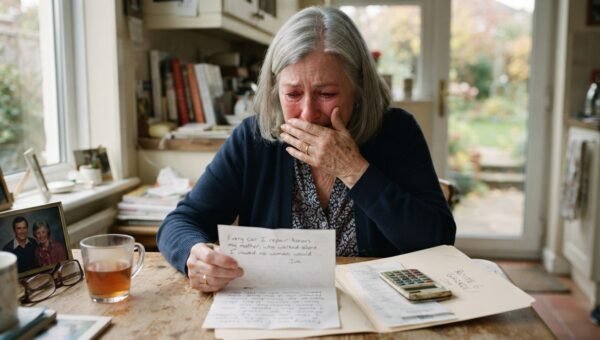
I covered my mouth with one hand. It wasn’t a tidy little tear. I was crying in that church office while my son held the bills I’d left him with.
“I’m sorry,” I said again. This time it barely came out.
Ethan folded the money and put it back behind the photograph. He didn’t hand it to me. He didn’t need to.
I told him what I’d told people. All of it. I said I’d lied because I couldn’t stand to say I’d thrown him out. I said I’d made his life sound grand so nobody would ask whether I’d bothered to find out if he was all right.
“I’m not asking you to forgive me today,” I said. “I’m asking if I can help in a way you choose.”
He studied my face for a long time. Then he said, “You can help carry the food to the truck.”
That was what I got. I took it.
The food bank workers packed proper groceries for the family, enough to help them through the week. I checked with the shift lead about delivery help and the next distribution day, and I wrote down the times so Ethan could decide what worked. I didn’t offer cash. I didn’t make a speech about what a grandfather should do.
Outside, Ethan’s truck had a dented tailgate and a faded work sticker in the back window. I carried a heavy crate of fruit toward it. My hands were shaking a little, which was inconvenient, but the crate was heavier than I expected.
Leo got to the truck first and held the door open.
“Careful,” he said. “It sticks.”
“I’ve got it,” I told him.
Ethan stood by the tailgate. He didn’t smile, but he didn’t leave, either. I set the crate down and asked if I could come by sometime, if he and Sarah were comfortable with that.
“Call first,” he said. “We’ll see.”
I said I would.
That evening, I called my sister and told her the truth. I told the neighbor, too, when he asked about Ethan. I said my son lived twenty miles away, worked hard, and had raised his children without me. I didn’t add anything to make myself sound better.
The next week, I called Ethan before I called by. I kept calling. Sometimes he answered. Sometimes he didn’t. I went to the next food bank shift and carried crates. There was no big family dinner, no sudden fix. Sarah was still recovering, and Ethan still had bills. Trust doesn’t get made on my schedule.
I think about that first Tuesday whenever I’m lifting something heavy. For years, my hands had only been useful for putting three bills between us and pointing him toward the door.
Now I carry the fruit crate while Leo holds the truck door open.