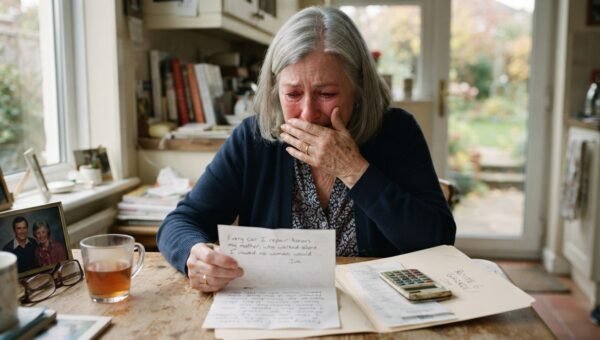
PART 1
By the time I realized the upstairs air conditioning had been turned off again, my blouse was already sticking to my back. It was nearly ninety-five degrees outside in Savannah, the thick Georgia humidity pressing against the windowpanes like hot wool, and I had a client presentation on Zoom in less than twenty minutes.
I wiped my neck with a paper towel, smoothed down my collar, and hurried downstairs to check the digital thermostat in the hallway.
The screen was completely dark.
I did not have to wonder who had touched it. My mother-in-law, Diane, was sitting at my kitchen island, sipping iced tea from one of my late mother’s crystal glasses and peeling peaches into a ceramic bowl.
She had the ceiling fan running on high above her head and the French doors cracked just enough to let in a warm, suffocating breeze.
“Diane,” I said, trying to keep my voice level as I walked into the kitchen. “Did you shut off the central air upstairs? I’m getting ready for an executive board call.”
Diane did not even look up from her paring knife. She sliced cleanly through the fruit, letting the skin drop into the sink.
“I turned it off,” she said casually. “Your husband and I agreed we need to save money. Leaving the compressor running all afternoon just so one person can sit at a desk is pure waste, Serena. You know how high the utility rates get in July.”
I stood there, staring at the side of her face. “Your husband?” I asked.
Diane smiled, that tight, practiced little smirk she had perfected over forty years of southern garden clubs and church committee meetings.
“Well,” she said, finally turning her pale blue eyes toward me, “it’s my son’s house.
Mark works hard to keep a roof over our heads. A good wife doesn’t run up electric bills while her husband is out at the office trying to build an estate.”
For two solid years, I had listened to those exact words.
Ever since Diane’s husband passed away and she sold her small patio home in Macon to move in with us, she had treated this four-bedroom historic colonial like her personal kingdom. She rearranged my spice cabinets the very first week. She packed away the framed photographs of my late father, claiming old black-and-white pictures made the front foyer feel like a funeral parlor. She dictated what time dinner was served, she criticized the way I ran my consulting practice, and she touched the thermostat three times a day.
And every single time I brought it up to my husband, Mark sat on the edge of our bed, took off his tie, and gave me the same tired, dismissive shrug.
“She’s an older woman, Serena,” Mark would tell me softly. “She lost Dad.
She needs to feel like she has a place in the world. Just humor her. It doesn’t hurt you to let her feel like she’s running things.”
I had humored her. I had swallowed my pride to keep the peace because I loved Mark, and because I thought he was just a devoted son caught between two stubborn women.
But hearing her say those four words out loud in the middle of a brutal heatwave snapped something inside me. It was not anger. It was a cold, absolute clarity that settled deep in my chest.
“Excuse me for a moment,” I said quietly.
I walked down the long corridor toward my private study at the back of the house. I closed the heavy oak door behind me, went straight to the built-in mahogany desk, and unlocked the bottom file drawer with a brass key from my ring.
Inside was a fireproof metal lockbox. I opened it, pulled out a thick manila folder, and withdrew the original blue-backed warranty deed from the county recorder’s office.
I took a deep breath, walked back into the kitchen, and set the document flat on the marble counter right beside Diane’s bowl of peaches.
Diane glanced down at the paper, then up at me with an irritated crease between her eyebrows. “What is this nonsense? I’m trying to make a cobbler.”
I leaned forward and placed my index finger on the second paragraph. “Read it.”
Diane sighed, wiped her sticky hands on a dish towel, and picked up the paper with the tips of her fingers.
She read the legal description of the parcel. Then her gaze dropped to the signature lines and the official county seal.
Her smirk vanished. The color drained from her cheeks so fast it looked as if someone had pulled a plug beneath her skin. Her mouth parted, but nothing came out.
The name on that deed was not Mark’s.
It was not Diane’s.
It was mine, and mine alone.
I had bought this house seven years ago, three full years before I even met Mark at a regional business conference. I had put down forty percent in cash from the sale of my first logistics firm, and the mortgage was entirely under my maiden name. When Mark and I married, we signed a clear prenuptial agreement keeping our pre-marital properties completely separate. Mark did not own a single brick, a single shingle, or a single blade of grass on this lot.
“You have lived under my roof for twenty-four months, Diane,” I said, keeping my voice dead quiet. “You have moved my things, insulted my father’s memory, and spoken to me like an unwelcome tenant. But this is my house. I pay the taxes. I pay the insurance. And I pay the electric bill. Do not ever touch my thermostat again.”
Diane’s hands began to tremble. The heavy paper shook between her fingers. She looked at me not with embarrassment, but with pure, raw panic.
“No,” she whispered. Her voice was cracked, completely stripped of its usual southern polish. “No, this is wrong. Mark told me… Mark told me he bought this place after his promotion. He said he was letting you live here while you got your little business off the ground.”
I frowned, caught off guard by the strange desperation in her eyes. “Why would he tell you that? You knew I owned a home when we met.”
Diane dropped the deed onto the counter as if it had burned her palms. She gripped the edge of the sink, her knuckles turning white.
“Because if you own this house,” she stammered, staring at the floor, “then what did he do with the three hundred and fifty thousand dollars I gave him to put my name on the title?”
PART 2
The kitchen went dead silent. The only sound was the low hum of the refrigerator and the ceiling fan spinning above our heads.
I stood motionless, trying to process the words that had just come out of Diane’s mouth.
“What did you just say?” I asked.
Diane looked up at me, her face pale and sunken. For the first time since she had walked through my front door two years ago, she did not look formidable. She looked like an elderly woman who had just realized the ground beneath her feet had given way.
“When I sold the house in Macon after Robert died,” she said, her voice shaking violently, “I walked away with four hundred thousand dollars. Mark came to me. He sat in my living room, Serena. He told me that instead of me living alone in an apartment, I should invest in this house. He told me he owned it, but he had an outstanding loan balance he wanted to clear.”
My heart hammered against my ribs. “Go on.”
“He said if I gave him three hundred and fifty thousand dollars, he would pay off the balance and have the county add my name as a joint tenant with rights of survivorship. He told me it was the safest place for my retirement. He said I would own half the property, and that it would keep me safe for the rest of my life.”
I stared at her. “When did you give him this money?”
“Two years ago,” she whispered. “Before I packed up the moving van. I wired it directly to the account number he wrote down on a legal pad.”
I felt sick to my stomach. My client presentation was completely forgotten. I turned around, walked into my study, and grabbed my phone. I dialed Mark’s cell.
It rang four times before clicking over to voicemail.
“Mark, you need to come home right now,” I said into the recording, keeping my tone perfectly controlled. “Diane and I are sitting in the kitchen with my property deed. Do not stay at the office. Come home immediately.”
I hung up, then sat down at my computer. Mark worked as an independent commercial insurance broker. Over the last two years, he had talked constantly about his firm expanding, about landing massive industrial accounts along the Savannah riverfront. He drove a brand-new leased luxury SUV, wore tailored suits, and always insisted on picking up expensive dinner tabs when we went out with friends.
I had never looked closely at his business accounts because our prenup kept our finances entirely divided. We had one joint household account where we each transferred two thousand dollars a month for groceries, utilities, and routine house upkeep. Everything else was separate.
I opened our joint bank portal on my laptop. Mark’s scheduled transfer of two thousand dollars had gone through three days ago, but when I looked at the transaction history, the deposit had bounced twice before finally clearing from an account named “Apex Logistics Holdings.”
Apex Logistics Holdings was not his brokerage firm.
I called my personal attorney, David Vance, who had handled my prenuptial agreement and the closing on my home. He answered on the second ring.
“Serena, what’s going on?” David asked.
“David, can someone file a fraudulent lien or an encumbrance against my property without my signature?”
David paused. “Not legally, no. If anyone tried to record a deed change or a second mortgage on a sole-ownership property without the recorded owner’s notarized signature, it would be void. Why? Has someone filed something?”
“I don’t know,” I said. “Can you run a title search on my parcel right now? Like, within the next ten minutes?”
“Give me fifteen,” David said. “Stay by your computer.”
I walked back into the kitchen. Diane was still standing in the exact same spot by the counter. She had pulled out her reading glasses and was reading the blue-backed deed over and over, as if staring at the words hard enough might make Mark’s name magically appear.
“He wouldn’t lie to me,” Diane muttered, more to herself than to me. “He is my son. I carried him. I raised him after his father lost his pension. Mark wouldn’t take my life savings.”
“Did he ever give you a closing document?” I asked gently. “A settlement statement? A copy of the recorded deed with your name on it?”
Diane looked at me blankly. “He said the county courthouse was backlogged. He said it took months for the registry to update public records. Whenever I asked, he brought home dinner and told me not to worry my head about paperwork.”
Before I could answer, my phone buzzed on the counter. It was an email from David Vance, followed immediately by his incoming call.
I hit speakerphone. “David, what did you find?”
“Serena, your title is completely clear,” David said. “There are no liens, no secondary mortgages, and no filings. You are the sole recorded owner, exactly as it was when you closed. But you need to listen to me carefully.”
“I’m listening.”
“While I was in the Chatham County records system, I decided to run Mark’s name through the civil court docket just to see if anything flagged.” David took a slow breath. “Mark has three active civil judgments against him. One from a private commercial lender for two hundred and ten thousand dollars, filed fourteen months ago. And two pending fraud lawsuits from former clients whose commercial policies he never actually bound. He was taking their premium payments and pocketing them.”
Diane let out a choked gasp, dropping her glasses onto the marble.
“How much total, David?” I asked, my voice barely above a whisper.
“Between the judgments and the pending claims? Close to nine hundred thousand dollars,” David replied. “Serena, if he took money from his mother under false pretenses, that isn’t just civil breach. That’s grand theft by deception.”
Just as David said those words, the front door clicked open.
Footsteps echoed in the entryway. Mark walked into the kitchen, loosening his tie, a bright, easy smile plastered across his face.
“Hey, what’s the big emergency?” Mark asked cheerfully, tossing his car keys onto the island. “You sounded so intense on that voicemail, Serena. I had to reschedule an important meeting with a harbor client.”
He stopped talking the second he looked at his mother.
Diane was staring at him with tear-streaked eyes, her chest heaving, the deed clutched in her right hand.
PART 3
Mark’s easy smile flickered, then vanished. His eyes darted from Diane to me, then down to the blue-backed document resting near his keys.
“What’s going on here?” he asked, his tone dropping an octave.
“You tell us, Mark,” I said. “Your mother just told me about the three hundred and fifty thousand dollars she wired to you two years ago to put her name on the deed to this house.”
Mark did not flinch. For a split second, I saw the calculations running behind his eyes, the smooth salesman instincts kicking in.
“Mom,” Mark said, taking a step toward her with his hands raised soothingly. “You misunderstand the timeline. We talked about this. The paperwork is complex with the county. I told you these things take time, especially with older historic properties.”
“Don’t lie to me!” Diane suddenly screamed, her voice cracking with a raw fury I had never heard from her before. She threw the document directly into his chest. “I just heard Serena’s lawyer on the phone! There is no paperwork! The house was never yours to sell! What did you do with my money, Mark? What did you do with my house from Macon?”
Mark caught the paper, his face turning dark. He looked at me, his jaw tightening. “You put my personal family business on speakerphone with your lawyer?”
“Your mother lives in my house, Mark,” I said evenly. “You used my address, my property, and my life to con your own mother out of her life savings. Where is the money?”
“It’s invested,” Mark snapped, his defensive shell hardening. “It’s in escrow accounts. I had business obligations to bridge. I had overhead, Serena! Do you think landing commercial contracts happens for free? I was protecting our family!”
“You weren’t protecting anyone,” I said. “David pulled the court records. You have judgments against you for nearly a million dollars. You didn’t invest her money. You used her retirement to pay off old debts and keep your leasing companies from repossessing your car.”
Mark stared at me, his skin turning a sickly shade of gray. The polished, successful professional he had pretended to be for four years completely dissolved right in front of us.
“You don’t understand how high-stakes insurance works,” he muttered, looking away. “A couple of big accounts went south during the supply chain crisis. I got squeezed. The lenders came after me personally because of personal guarantees I signed before we met. I had to keep the lights on until the port accounts paid out.”
He turned back to Diane, trying to take her hands. “Mom, please. It’s just a temporary cash flow problem. I’m closing a deal next month with a logistics group. As soon as that commission clears, I’m going to pay back every single dime with interest. I swear to God I will.”
Diane pulled her hands back as if she had been touched by a stranger.
“You left me with nothing,” she whispered. Her voice was terrifyingly calm now. “You told me I would be safe here. You told me this was our family home. You let me treat Serena like a guest in her own house because you were too cowardly to admit you were a thief.”
“Mom, don’t say that—”
“Get out,” Diane said.
Mark blinked. “What?”
I stepped between them. “She’s right, Mark. You need to leave. Right now.”
“This is my home too!” Mark raised his voice, stepping closer to me. “We’re married, Serena! You can’t just throw me out on the street because my business hit a rough patch! We have rights!”
“We have a prenuptial agreement that explicitly states this residence is my separate, non-marital property,” I said, looking him dead in the eye. “And you have five minutes to take your car keys and your laptop before I dial the Chatham County Sheriff’s Department and report both a domestic trespass and a felony wire fraud.”
Mark looked at me, then at his mother. Neither of us moved. Neither of us blinked.
He grabbed his keys off the counter, shoved his phone into his pocket, and walked out the back door without saying another word. The heavy screen door slammed shut behind him, followed seconds later by the roar of his SUV pulling out of the driveway.
When the sound of his engine faded into the humid afternoon air, Diane sank into one of the kitchen chairs. She buried her face in her aproned lap and began to sob, her shoulders shaking violently.
I stood there for a long moment, looking at the empty kitchen, the open bowl of half-peeled peaches, and the woman who had spent two years making my life miserable.
I walked over to the hallway wall, flipped the breaker switch, and turned the air conditioning back on. Then I walked back into the kitchen, pulled a clean chair up next to Diane, and sat down.
“Drink some water, Diane,” I said softly, sliding a fresh glass across the table.
She looked up at me through swollen, bloodshot eyes. “Why aren’t you throwing me out? I’ve been terrible to you, Serena. I thought… I truly thought Mark bought this place for us.”
“You were cruel to me, Diane,” I said honestly. “And we are going to have to talk about that. But you are a seventy-one-year-old widow whose own son just stole her entire future. I am not throwing you onto the street today.”
“What am I going to do?” she cried softly. “I don’t have a penny left. I don’t have anywhere to go.”
“Tomorrow morning, we go to David Vance’s office,” I told her. “We freeze whatever accounts Mark has left before he drains them. And then you are going to file a police report.”
ENDING
The next six months were the hardest, most exhausting months of my life.
The morning after Mark left, I drove Diane to David Vance’s office in downtown Savannah. We laid out every piece of evidence we had: the bank wire confirmation from Diane’s Macon sale, the handwritten notes Mark had scribbled on a legal pad detailing the fake title transfer, and the text messages where he repeatedly reassured her that her name was being processed at the courthouse.
David did not sugarcoat the reality. He told Diane plainly that recovering the full three hundred and fifty thousand dollars was highly unlikely. Mark had already burned through most of it, using over two hundred thousand dollars just to settle an emergency garnishment from a private equity lender and spending the rest on high-interest credit cards, luxury car leases, and keeping up appearances.
Diane sat in the leather armchair across from David, her spine straight, her hands folded neatly in her lap. The arrogant, sharp-tongued woman who used to rearrange my kitchen had completely disappeared. In her place was an elderly southern mother who had finally accepted the brutal truth about the boy she had raised.
“Do whatever the law requires, Mr. Vance,” Diane said quietly. “If my son belongs in prison, then that is where he should go.”
That afternoon, we walked into the Savannah Police Department and filed a formal criminal complaint for felony exploitation of an elder and grand theft.
When Mark realized criminal charges were imminent, he did not apologize. He sent me furious, desperate text messages accusing me of turning his own mother against him and ruining his career. He claimed that if I had just loaned him two hundred thousand dollars from my consulting business, everything would have been resolved and the family would have stayed intact.
I never replied. I handed every message directly to David Vance.
Three weeks later, Mark was arrested outside a coffee shop in Pooler.
The legal process moved with agonizing slowness, but the paper trail was too clear for Mark’s public defender to fight. Facing multiple counts of felony fraud, theft by deception, and elder abuse, Mark accepted a plea bargain to avoid a lengthy trial.
He was sentenced to five years in a state correctional facility, followed by ten years of strict probation, with a court-ordered restitution judgment entered against him for the full amount he took from his mother. We knew Diane would likely only ever see small monthly checks from prison labor and whatever wages he might earn after his release, but the official record stood: Mark was a convicted felon, and his mother was an acknowledged victim.
I filed for divorce the week after his arrest. Because of our airtight prenuptial agreement, the proceedings were straightforward. He had no claim to my house, my investments, or my business. By early spring, the marriage was legally dissolved, and I took back my maiden name on every official document.
The question of what to do with Diane was not simple.
Several of my friends told me I was out of my mind for not dropping her off at an extended-stay motel the day Mark left. They reminded me of how condescending she had been, how she had hidden my father’s photographs, how she had treated me like an intruder in my own home.
They were right about all of it. Diane had been arrogant and spiteful.
But I also knew what it was like to lose family, and I knew what real betrayal felt like. Throwing a penniless, broken seventy-one-year-old woman onto the street would not undo the past two years, and it would not make me feel any better about the failure of my marriage.
We sat down in the living room one evening after the divorce was finalized.
“Diane,” I said, “you cannot live here indefinitely. This is my home, and I need my peace back.”
Diane nodded slowly, looking down at her lap. “I understand, Serena. I have forty-two dollars in my checking account. I’ll call the local shelter tomorrow.”
“You are not going to a homeless shelter,” I said firmly.
Over the previous two months, I had worked with a social worker specializing in senior services. Between Diane’s modest monthly Social Security benefits and a small survivor pension from her late husband that Mark had not been able to touch, Diane had just enough income to qualify for a subsidized senior living community outside of Savannah.
It was a clean, quiet one-bedroom apartment in a complex with a garden courtyard, transportation services, and a community dining hall. I paid the first year’s security deposit and moving expenses out of my own pocket, and I helped her furnish the place with pieces she had kept in storage from Macon.
The day she moved in, I helped her hang her curtains and unpack her kitchen boxes.
Before I left, Diane reached out and took both of my hands in hers. Her fingers were paper-thin, spotted with age, and trembling.
“You had every reason in the world to hate me, Serena,” she said, tears welling in her eyes. “I came into your home with pride and bitterness, and I treated you terribly. You didn’t owe me a single kindness. But you gave me my dignity back when my own blood took it away.”
“You were wrong about the house, Diane,” I told her gently. “And you were wrong about me. But nobody deserves what Mark did to you.”
She pulled an envelope from her purse and handed it to me. Inside were the three framed black-and-white photographs of my father that she had packed away two years earlier. The glass was clean, polished, and unbroken.
“Hang them back up in your foyer,” she whispered. “Where they belong.”
I drove back to my house that evening just as the sun was setting over the marshland, painting the Savannah sky in deep shades of gold and violet.
I unlocked my front door, walked through the quiet foyer, and hung my father’s portraits right back on the center wall. Then I walked upstairs to my study, opened the French windows to let the cool evening breeze flow through the house, and set the thermostat exactly where I wanted it.
For the first time in years, the house was completely, beautifully mine.