PART 1
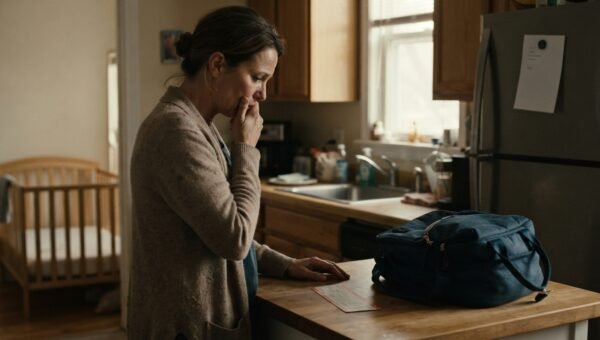
The envelope from his company had arrived three days before Christmas, sitting on the corner of the microwave until Travis tore it open with a butter knife. It was an annual merit incentive check for $7,500 after taxes. I knew the exact figure because I handled our joint checking account, kept track of our property taxes, and had already budgeted every single dollar of that expected bonus toward our overdue heating fuel bill, our ten-year-old daughter Maya’s dental expander, and the property insurance premium due the second week of January.
We had talked about it in November. We had agreed on it at the kitchen table over cold coffee. But on December twenty-ninth, when I logged in to transfer the funds to pay the oil company, the balance was sitting at $412.18.
The deposit had cleared that morning, and two hours later, an outgoing wire transfer for $7,500 had emptied it right back out. The recipient was Evelyn Vance. His mother.
I sat in my parked sedan outside the grocery store that afternoon with the engine idling, staring at my banking app on my phone. Evelyn did not have an emergency. She lived forty minutes away in a paid-off brick ranch home, drove a late-model Buick, and received a comfortable state pension from thirty years as an administrative clerk. What Evelyn did have was an upcoming ten-day group tour to coastal Portugal with her garden club, an excursion she had spent all autumn complaining she might have to skip because her bathroom tile remodel had run over budget.
Travis had not asked me. He had not sent a text. He had simply sent our household safety net to his mother so she would not miss her trip, convinced that I would find a way to patch the holes like I always did.
I did not scream. I did not call him at work. Instead, I walked into the supermarket with my list, set the prime steaks and the fresh seafood back on the ice, returned the bottle of sparkling wine, and bought two bags of dry brown lentils, a sack of yellow onions, carrots, celery, a loaf of bakery French bread, and a bag of mixed greens. The total came to eighteen dollars and forty cents.
By seven o’clock on New Year’s Eve, the house smelled like bay leaves and simmered broth. Maya was sitting at the breakfast bar in her pajamas coloring in a sketchbook, while I ladled thick brown soup into three ceramic bowls.
The garage door rattled, and Travis walked into the kitchen. He was forty-two, tall, and still wearing his charcoal wool overcoat and a red silk tie he always wore on the final trading day of the year. He carried a silver paper party horn in his coat pocket and a wide grin on his face.
“Smells like dinner,” he said, tossing his leather briefcase onto the chair beside Maya. He bent down and kissed the top of her head. “Hey, baby girl. Ready to ring in the new year?”
“Mom made soup,” Maya said without looking up from her markers.
Travis stopped. He walked over to the stove, took the wooden spoon out of the pot, and stared down into the murky brown lentils. He turned to look at the dining table, where three plain white bowls sat beside a basket of sliced bread and a pitcher of tap water.
There were no candles, no chilled glasses, and no platter of the baked garlic lobster tails he had asked for the week before.
He let out a short, mocking laugh, looking directly at Maya before cutting his eyes back to me.
“This is what my wife serves after I work all year?” he asked, his voice dripping with condescending disbelief. “Lentil soup on New Year’s Eve? Where is the seafood? Where is the champagne?”
I wiped my hands slowly on the dish towel, folded it, and set it down on the counter.
“If lobster and champagne were what you wanted tonight,” I said, keeping my voice quiet and steady, “you should have thought about that before sending your whole bonus to your mother.”
His smile vanished instantly. His shoulders went rigid beneath his coat. He had clearly assumed I had not noticed the wire transfer yet, or that if I had, I would wait to confront him in private after the holiday passed. He expected me to apologize for embarrassing him in front of our daughter. He expected me to scramble, to make excuses, to offer to drive down to the twenty-four-hour grocery store to buy him a cut of meat on a credit card.
I did none of those things.
Travis had no idea that while he was treating my labor and our family security like an endless, disposable resource, there was an account at a local credit union across town with $31,480 sitting in it under my name alone. It was money from an inheritance left by my grandmother four years ago, preserved through disciplined quarterly compounding, and intended to buy the small, weathered bungalow on half an acre outside town that I had walked through two weeks earlier.
He thought I was trapped at this table, scraping the bottom of an empty pantry to keep up his appearances. But by midnight, he was going to learn that the soup was not a temporary shortage. It was the absolute end of the line.
PART 2
Travis did not take off his overcoat. He stood beside the kitchen island, his jaw working tight, watching Maya carefully as she set her marker down. He hated being exposed, but he hated being exposed in front of our daughter even more.
“Maya, go upstairs to your room and watch your tablet for a little while,” Travis ordered, his tone strained.
“She hasn’t eaten,” I said. “Sit down and eat your bowl, Maya. It’s warm.”
“I told her to go upstairs, Claire,” he snapped, his voice rising just enough to make Maya flinch.
I looked at my daughter, touched her shoulder, and nodded gently. “Take your bowl up to your desk, sweetheart. I will come check on you in twenty minutes.”
Maya picked up her bowl and bread, keeping her eyes glued to the floorboards as she slipped out of the kitchen and hurried up the carpeted stairs. The moment her bedroom door clicked shut above us, Travis rounded on me.
“Are you completely out of your mind?” he hissed, keeping his voice low but sharp. “Throwing my personal family business in front of our kid over a bowl of beans? You think that makes you look good?”
“Your personal family business?” I leaned back against the counter, my arms crossed over my chest. “You took seventy-five hundred dollars that was promised to our heating bill and our daughter’s orthodontist, and you wired it to a woman who is getting ready to spend two weeks drinking vinho verde in Lisbon. That is not personal business, Travis. That is household theft.”
“She is my mother!” he said, slamming his hand down on the butcher block. The wooden salt cellar jumped an inch. “She needed the money. She was short on her travel balance because of the contractor who took advantage of her on the plumbing. What kind of son would I be if I let her sit home alone while all her friends went on the tour she planned for eighteen months?”
“The kind of son who pays his own electric bill,” I answered directly. “The kind of father who doesn’t let his ten-year-old child sleep in a house where the furnace oil tank is at an eighth of a tank in January.”
“You always exaggerate,” he said, waving his hand dismissively as he finally unbuttoned his coat and threw it over the back of a barstool. “The tank isn’t empty. We have credit cards. We have the line of equity on the house. I will pick up two weekend consulting shifts next month and cover the expander before her February appointment. You make it sound like we are standing on the street corner begging for change.”
“We are standing on the street corner because you gave away the roof,” I said.
He pulled open the refrigerator, rummaged through the shelves, and pushed aside jars of pickles and leftover pasta looking for something better. Finding nothing, he slammed the door shut and grabbed a piece of the dry bakery bread from the basket, tearing off a bite with vicious irritation.
“I earned that bonus, Claire. Every single cent of it. Forty-five hours a week at the desk, commuting in the snow, hitting quarterly targets while you work twenty hours a week from the spare bedroom doing freelance bookkeeping.”
He said it like he had practiced the speech on the drive home from the office. It was his favorite weapon, brought out every time I questioned his spending.
“I work twenty hours because I take Maya to school, pick her up, cook every meal, clean this four-bedroom house, and manage every utility account that you never even know the passwords to,” I said. “And more importantly, Travis, I have been taking my freelance income and putting it into our shared checking account to cover the grocery bills that you decided were beneath your concern six months ago.”
He chewed the bread slowly, glaring at me. “My mother sacrificed everything for me after my dad died. If she wants to take a trip to Portugal, I am going to make sure she takes it. You have never liked her. You have resented her from the day we got married because she doesn’t pretend to be impressed by your sensible little system.”
“Her sensible little system is currently keeping the lights on in this room,” I said.
“Fine,” he sneered, pulling his wallet out of his pocket and pulling out a silver bank card. He tossed it onto the counter so it slid against the base of the fruit bowl. “Take this. Drive down to the prime butcher. Get the lobster. Get a bottle of Veuve. Put it on the card, cook dinner, and let us have a civilized evening like normal human beings.”
I didn’t reach for the card. I didn’t even look down at it.
“That card has a four-hundred-dollar limit left on it, Travis,” I told him plainly. “Because you charged three hundred and eighty dollars at the country club pro shop on Tuesday for your new golf driver. I checked the balance this morning when I was trying to figure out how we were going to buy oil.”
His mouth opened, then closed. For two seconds, a flicker of genuine shock crossed his face before he masked it with cold anger.
“You are spying on my personal accounts now?”
“I don’t have to spy. The statements come to my email address because you were too lazy to set up your own login three years ago,” I said. “The bread is on the table. The soup is on the stove. If you want dinner, serve yourself. I am going upstairs to help Maya with her reading.”
I turned my back on him and walked out of the kitchen. As I climbed the stairs, I heard him yank open the cabinet door, pull down a heavy ceramic mug, and pour himself a cup of water from the faucet. He thought this was a standard domestic skirmish. He thought I would stay upstairs until ten, come down after Maya fell asleep, accept a half-mumbled apology, and figure out how to juggle the bills on Monday morning.
He had no idea that Monday morning was already planned, and he was not on the schedule.
PART 3
At ten o’clock, the house fell completely quiet. Maya was fast asleep under her thick flannel quilt, her breathing slow and steady, her room kept warm by an electric space heater I had moved in from my office.
Downstairs, Travis was sitting on the living room sofa with the television muted, a glass of cheap bourbon on the coffee table, watching the crowds gather in Times Square on the screen. His phone was resting on his knee.
As I walked down the last step, his phone chimed. He glanced at the screen, a soft smile touching his mouth.
“Evelyn?” I asked, walking into the room.
He didn’t look up. “She just landed in Lisbon on the red-eye. Sent a picture of the sunrise over the harbor. Said she wouldn’t be standing there without me.” He looked over at me then, his expression hardened with defensive pride. “She cried when she called me from the boarding gate in Boston yesterday, Claire. A mother shouldn’t have to beg her children for a little joy at sixty-eight years old.”
“Did you tell her Maya doesn’t have her dental expander paid for?” I asked.
“Stop it,” he said, turning his head back toward the television. “I told you I will handle it. We will be fine.”
“No, Travis,” I said, stopping at the edge of the living room rug. “You will be fine. I am not doing this anymore.”
He let out a tired sigh, rubbing his temples with two fingers. “Can we please just get through the night without you acting like a martyr? It was one check. One single bonus check.”
“It wasn’t one check,” I said. “Last March, you took four thousand dollars from our emergency reserve to buy her a new deck awning so she could host her garden tea. In August, you paid for her transmission because she claimed she couldn’t afford it, while you told me we had to postpone replacing the tires on my car. You have transferred twenty-two thousand dollars out of our marital accounts to your mother over the last four years, Travis. Every single time our family got two steps ahead, you handed her the ladder.”
Travis set his drink down with a hard clink against the glass table. “I make the money in this house! The lion’s share of it! If I choose to honor my mother with the fruits of my labor, that is my prerogative. You have no right to audit my generosity.”
“You’re right,” I said quietly. “I don’t have the right to audit you. But I do have the right to stop funding you.”
I reached into the pocket of my cardigan, pulled out a folded set of white legal documents, and set them down on the coffee table beside his bourbon glass.
He glanced at them, his brow furrowing. “What is this?”
“That is a formal notice of legal separation, drafted by an attorney in town two weeks ago,” I said. “Along with a complete accounting of every marital dollar transferred to third parties without mutual consent over the last thirty-six months.”
He froze. His face went entirely pale, the smug certainty draining out of his eyes in an instant. He reached out with trembling fingers, picked up the first page, and read the heading.
“You went to a lawyer?” he whispered, his voice suddenly cracking. “Over a holiday bonus?”
“I went to a lawyer because you have treated me like an unpaid housekeeper and an endless line of credit while you play the generous patriarch for your mother,” I said. “I went because I realized two weeks ago that if Maya and I stayed with you, we would spend the rest of our lives paying for Evelyn’s leisure while our own lives fell apart.”
“Claire, wait,” he stammered, standing up so fast the sofa cushions shifted beneath him. “This is ridiculous. You can’t just throw twelve years of marriage away over money. We can talk about this. I will tell my mother she has to pay back the bonus. I will call her tomorrow morning.”
“You won’t call her,” I said. “Because she doesn’t have the money to give back, and you would rather die than tell her that your marriage is over because you couldn’t afford to play big shot.”
“We can’t afford a separation!” he argued, his voice turning desperate now, the arrogance completely gone. “Do you have any idea what maintaining two households will cost? You can’t survive on your little freelance checks, Claire. You can’t afford rent in this town. You will run out of money in ninety days and come right back here.”
I looked at him, feeling an overwhelming, liberating sense of stillness.
“I won’t run out of money, Travis.”
He frowned, suspicious and panicked. “What are you talking about?”
“When my grandmother passed away four years ago, she left me a thirty-thousand-dollar estate distribution,” I told him, watching his eyes widen in utter disbelief. “She told me on her deathbed to put it in an account with only my name on it, and not to tell you unless there was an emergency that threatened our daughter’s life.”
“You… you kept thirty grand from me?” he breathed, his voice thick with outrage. “While I was working myself to the bone? You had thirty thousand dollars sitting in an account while we were stressing over bills?”
“We were only stressing over bills because you were funneling twenty-two thousand dollars out of our checking account to buy patio furniture and river cruises for Evelyn,” I replied, my voice steady as stone. “My grandmother knew you better than I did, Travis. She knew the kind of man who would strip his own child’s future to buy praise from his mother. That money is still there. In fact, with interest, it is thirty-one thousand four hundred and eighty dollars.”
He sank back onto the sofa, staring at the papers in his hands as the television screen behind him began flashing bright graphics: ten minutes until midnight.
ENDING
Travis stared down at the separation agreement like he was trying to read a foreign language.
“You’re buying a house,” he said, reading the asset declaration section where my attorney had listed the pending purchase agreement. “You put down earnest money on a property?”
“The old miller’s cottage on North Creek Road,” I said. “Two bedrooms. A small yard with a maple tree for Maya. The closing is on the twentieth of January. I used part of my inheritance for the down payment. My freelance income easily qualifies me for the monthly payments, because I won’t be paying for your country club tabs, your golf drivers, or your mother’s European tours.”
“Claire, please,” he said, his hands shaking as he laid the pages back down. He reached out to take my hand, but I stepped backward, keeping two clear feet of space between us. “We can fix this. I swear to God I will cut her off. I will tell her not to ask for another dime. We will put every dollar of my salary into an account that requires your signature for any withdrawal over fifty dollars. Just don’t do this to our family. Not on New Year’s Eve.”
“You didn’t care about our family on December twenty-ninth,” I told him. “You didn’t care about Maya when you sent that wire. You only care now because the safety net is gone, and you just realized you’re going to have to pay your own bills on your own salary.”
The television blared as the countdown began in New York.
Ten. Nine. Eight.
Travis stood there in his wrinkled dress shirt and suit trousers, looking smaller and older than I had ever seen him. He had spent years relying on my silence, convinced that because I was patient, I was powerless. He had treated my frugality as a license to be reckless, never understanding that my frugality was the only reason his world had not collapsed years ago.
Seven. Six. Five.
“Where are you going tonight?” he asked, his voice hollow.
“Nowhere,” I said. “Maya is sleeping upstairs. I am going to sleep in the guest room. On Monday morning at eight o’clock, the oil truck will arrive to fill the tank. I paid for that delivery this afternoon out of my personal account, so my daughter will be warm for the next three weeks. On Tuesday, my movers are arriving to pack up my office and Maya’s bedroom furniture.”
Four. Three. Two.
“And what am I supposed to tell my mother?” he choked out, looking down at his phone on the table.
One.
The television erupted into cheers, music, and falling confetti. Outside in our suburban neighborhood, someone set off a small string of firecrackers down the street, their muffled pops echoing against the cold windowpanes.
I looked at the husband I had protected, managed, and excused for over a decade, and I felt nothing except the profound, clean quiet of relief.
“Tell her you bought her a trip to Portugal,” I said, “and it cost you your family.”
I turned off the living room lamp, leaving him sitting in the cold glow of the television screen, and walked upstairs to tuck the blanket around my daughter.