The last ordinary thing Mom said was that I’d bought the wrong dish soap. Then she gave me three days to clear my bedroom, and I had to decide whether to show her the sealed records pouch beside the sink.
I’d come in with a delivery of dish soap, paper towels, and canned food. The drying rack took up half the counter. My seedling trays were crowded onto the windowsill.
I was sorting cans when Mom folded the receipt and tucked it into her apron pocket.
“Vanessa needs your room for the nursery,” she said. “Have your things out by Thursday.”
I stopped with a can in my hand. “My room?”
Mom said it had the best light. Vanessa stood in the doorway with a tape measure, already checking the sloped ceiling. She said the cot would fit there, and I didn’t even use that corner.
I looked at the narrow upstairs window. Fog blurred the glass, and the delivery lane below it was wet and empty. I’d slept in that room for most of my life, including the years after Dad died. But Mom was talking about it as if I’d been borrowing it.
“Where am I supposed to sleep?” I asked.
“The enclosed porch,” Mom said. “Until you make another arrangement.”
The door frame on that porch collected condensation in cold weather. I knew because I’d wiped it down more times than I could count.
“No.”
Mom lifted her eyebrows. “You’re being difficult.”
“I bought a house last month. Four hundred fifty thousand dollars.” I kept my voice level. “I’m not moving onto the porch.”
Vanessa let the metal tape snap back into its case. “You bought a house? With what money?”
“I saved it,” I said. “While paying for this one, too.”
For four years I’d covered bills Mom called temporary. The electric bill when she said she was short that month. The kitchen extractor when it quit working. Groceries when she was “waiting on money.” I never called it a loan. I thought I was helping us stay afloat.
Those weeks became years. I kept the receipts in a drawer, not because I planned to collect, but because I’m the sort of person who keeps records. I didn’t like looking at the totals. They seemed rude somehow, like I was counting favors.
Mom’s mouth tightened. “This is my house. I decide how the rooms are used.”
I picked up the pouch. “What paperwork shows you own it outright?”
She looked at me, then at Vanessa. “We have a baby coming. This isn’t the time to start questioning everything.”
That answer was why I’d brought the pouch downstairs. I still didn’t open it.
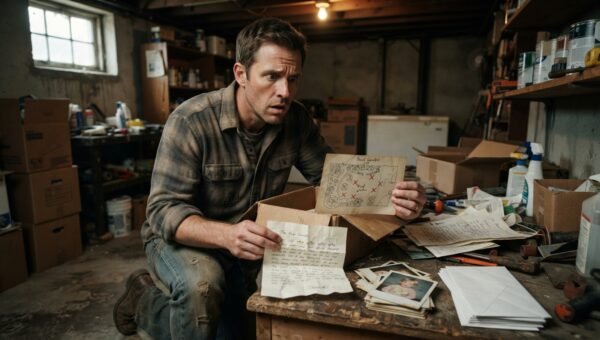
Two weeks earlier, I’d gone into the attic to look through Dad’s old tax box. I wanted a copy of a document for my own records. The box was in a metal storage chest that stuck when I pulled the lid up. One hinge made a little squeal. I remember that sound more clearly than I remember what I ate that day.
I found a transfer slip with a signature that didn’t look like Dad’s. He’d been gone for years by then, but I knew how he wrote his name. His capital A leaned forward. This one didn’t.
A summary sheet showed $186,000 from his inheritance account. The money was listed as distributed, but the notes didn’t say where it had gone.
I read the page once, put it back, then took it out again. I told myself there had to be an explanation.
I didn’t ask Mom right away. That wasn’t because I was brave or clever. I was scared she’d say I was accusing her, and then I’d spend another week defending the fact that I had questions. So I took the file reference number and went to the county recorder’s office.
The clerk found the deed. I paid for certified copies and sat in my car reading them. The house had been paid off four years earlier with a single lump-sum draft. The deed showed me as a recorded fifty-percent owner.
I read that line until I could say it without stumbling. Half. My name. No condition attached.
The following week, I went to the probate office and requested the estate records. There was the distribution authorization, with the same odd version of Dad’s signature. The bank routing confirmation showed the $186,000 transfer into an account controlled solely by Mom.
I took the documents home and put them in a secure pouch. I sealed it because I didn’t trust myself not to pull everything out and start a fight before I knew what I was looking at. I needed proof I could understand. I needed more than a feeling.
Now Mom was telling me to sleep on the porch in a house where I owned half the title.
I set the pouch on the kitchen table, between two cans of soup. Vanessa watched my hands. Mom stood with one palm on the counter.
“Claire, what exactly did you find?” she asked.
“Enough to ask who signed for Dad’s inheritance,” I said, “and where the money went.”
Mom said I was making a mess over nothing. Vanessa asked if we could talk after she had time to sit down. I pulled the pouch closer to me.
“No,” I said. “We can talk now.”
I broke the seal and laid out the papers. First came the certified deed, showing my name and my half ownership. Then the mortgage satisfaction record, dated four years earlier. Last was the probate transfer slip and bank confirmation.
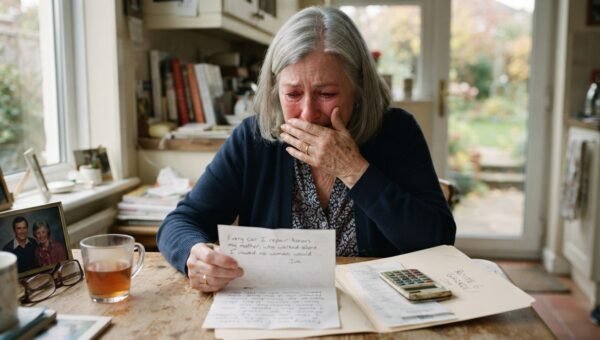
Mom stared at the signature. Her handwriting showed through in the loops and the way she crossed the last letter. She could have said the scan was blurry, but it wasn’t. I laid the slip beside the receipt she’d tucked into her apron pocket.
“You signed Dad’s name,” I said.
Mom’s fingers moved toward the paper, then stopped. “I handled the estate paperwork.”
“That’s not what I asked.”
She said the mortgage needed to be paid. Dad would have wanted the house protected. She said Vanessa had bills piling up and the family was in a bad place. Her voice got smaller as she named the reasons.
The money had paid off the mortgage, yes. That part was on the county record. The remaining inheritance went toward Vanessa’s debts. The deed had been recorded with my half interest, but Mom never told me. She kept the house in her control, and for years she told me we were nearly broke.
Vanessa leaned over the papers. “You said there was nothing left.”
Mom told her she’d been trying to keep everyone together. Vanessa looked at me, then at the grocery cans.
“You’ve been paying the electric?” she asked.
“And the water. A lot of groceries. The extractor.”
“I didn’t know,” she said.
I believed she hadn’t known every detail. I also knew she’d never asked who paid for things. She’d enjoyed having the room picked out before I’d even packed. Both things could be true.
Mom’s eyes filled, but she didn’t cry. She said she hadn’t meant for it to go on this long. She’d wanted to protect the house and help Vanessa, then she’d been too ashamed to tell me. I could hear fear in that. I could also hear the part where she still thought I should understand.
“I’m not taking the papers back,” I said.
Mom asked if I was going to have her arrested. I said I wasn’t pursuing criminal charges. I wasn’t saying what she did was fine. I was saying I’d let my lawyer handle the property and the estate records.
“I’ll be contacting you about a buyout or formal management of my half,” I said. “You don’t get to decide I’m a guest.”
The room stayed quiet long enough for the refrigerator to click off. Vanessa had the tape measure in her hand, but she wasn’t measuring anything now.
I told them I’d move into my own house on my schedule. Until then, I wasn’t sleeping on the porch or giving up my bedroom on a three-day deadline. I would also be taking my name off the utility accounts. I had the service notices in my folder and said I’d hand them over before I left.
Mom said she couldn’t afford all of it.
“I’ve been hearing that for four years,” I said. “I can’t keep paying it for you.”
It wasn’t a speech. I was tired, and my voice sounded plain. That might be why Mom didn’t have much to say back.
I packed my room over the next few days. I took down Dad’s framed drafting prints myself. One had a little nick in the corner from when I’d bumped it moving a dresser years ago. I wrapped it in a towel and set it with my boxes.
Vanessa didn’t ask me for the room again. She came upstairs once while I was taping a box shut and said she’d thought I was just living there because Mom allowed it.
“I know,” I said.
She looked at the box, then down at the tape measure she still had with her. “I’m sorry.”
I didn’t tell her it was all right. It wasn’t. But I didn’t want to make her apology into another argument either.
When the movers came, I left the room clean. I handed Mom the utility notices and told her my lawyer would be in touch about the house. She nodded once, without looking at the papers. My name stayed on the deed. The house still had to be dealt with, even after I moved out.
I didn’t file a police report. I didn’t forgive the lie just because I understood the fear behind it. I left my half-interest where the law said it was and stopped covering costs that weren’t mine to carry alone.
At my new house, the porch was dry and the windows had good light. I stood there with the brass key in my hand, turned it in the lock, and went inside.