I forged my father’s signature and took $186,000 from the account he left my mother. I know how that sounds. I did it, and I’ve spent six years making sure nobody asked the right question. There’s a reason I kept quiet, but it isn’t a good excuse.
Last Tuesday, Mom set a grocery bag on the kitchen table and told me I had three days to empty my bedroom. I was sorting cans beside a stack of seed catalogs.
The gutter estimate was under her elbow, curled up at one corner.
“Vanessa needs the room for the nursery,” Mom said. “You can take the cot downstairs.”
I asked if she meant three days, and she folded the bag shut. “The baby can’t sleep in the living room.” Vanessa came in with a paper tape measure and checked the window alcove. She said it was the only place for a crib, then looked at me. “You’ve had plenty of time to stop acting like a guest who forgot to leave.”
Mom nodded. I put the can down.
That was the thing. For years, every problem in that house had come to me dressed up as something temporary. The electric bill was late, so I paid it. The gutters needed work, so I found a repairman and covered the cost. When the boiler failed in January, I paid for that too.
I kept the receipts in a kitchen drawer. Nobody asked for them.
I had painted the bedroom myself and paid to replace its cracked window. I was proud of that window, which sounds silly now. The new one stopped rattling when trucks went by on the road near the old canal. Mom still called the room hers to give away.
“Where would I put my things?” I asked.
“The basement,” she said. “There’s room for a cot.”
“No.”
Vanessa let out a sharp breath. Mom crossed her arms and asked where I expected to go. I told them I’d bought a house. It cost $450,000, and I had a mortgage. Vanessa lowered the tape measure. Mom’s first question was why I hadn’t told her.
I said I didn’t need permission. That was true, but it wasn’t the whole truth. I hadn’t told her because I knew she’d ask how I got the down payment.
I’d had a ready answer for years. My savings. A good loan. I’d worked hard.
I had worked hard. I’d also taken money that wasn’t mine.
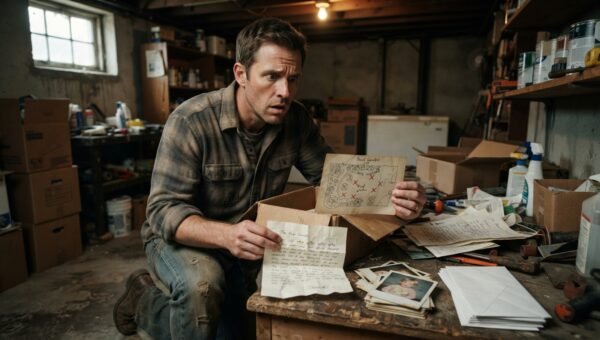
Dad died six years ago, after a stroke that made the last part of his life feel like paperwork and waiting rooms. I helped Mom sort his records because she was tired and couldn’t keep track of all the bills. Dad had left her an inheritance account with $186,000 in it. I knew the amount because I’d read the statement twice. I knew how much it could fix. The roof, the furnace, the bills that had been eating at her every month.
And I knew how much it could do for me.
Three weeks after Dad’s funeral, I was at the bank with a withdrawal form. I told myself I’d move the money into my account for a few days, then put it back after I found a place to live.
I forged Dad’s name. Mom had trusted me to handle his records. I used that trust like a key.
I didn’t put the money back.
I used most of it for the down payment on my house. I kept telling myself I would pay it back when I could. The more time passed, the harder it got to say that out loud. So I kept the old statements in a folder and the folder out of sight.
For a while, I thought maybe Mom would never look. Then the roof needed work, and I paid for it. The gutters came next. Every time I paid something, I let myself count it as proof I was still a good daughter. I did not count the money I’d taken. I was careful with that math.
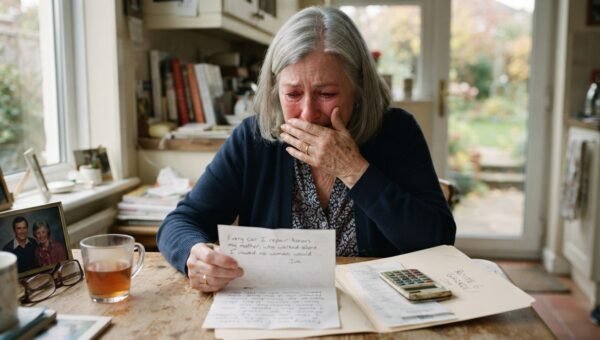
At the kitchen table, Mom pushed the estimate aside. “This is my house, Claire. I decide how the rooms are used. Don’t turn a family arrangement into a legal argument.”
I looked at the seed catalogs, the repair estimate, the grocery bag. I heard myself ask what record proved the house belonged only to her. It was a mean question, and I asked it anyway.
Mom’s face changed. Vanessa stopped pulling the tape measure through her hands.
“You know what I mean,” Mom said.
“I’m asking what proves it.”
She didn’t answer. I reached for my coat and felt the document sleeve inside. I’d brought it because I had spent the morning wondering whether to tell her. I hadn’t planned to tell her that way. I wanted to blame the room conversation for it, like the room had made me do anything.
“Last month I was looking through Dad’s old records,” I said. “I found a signature that doesn’t look like his.”
Mom went quiet. Vanessa asked what records. I said there was also $186,000 from Dad’s inheritance that nobody could account for.
Mom reached toward the sleeve. I covered it with my hand. She told me I couldn’t come in and accuse her. I said I wasn’t showing her the papers yet. My hand stayed on top of them, and I could feel the edge of the form through the sleeve.
This is the part where I want to say I was scared. I was. But I was also still trying to control what she saw and when she saw it. Even after all those years, even after bringing the papers there, I was guarding the same lie.
I took the sleeve out and opened it. The first page was the transfer form. I put it between the gutter estimate and the seed catalogs. The signature was Dad’s name in my handwriting. I’d practiced it on the back of an envelope before I signed the form. I remembered that envelope because I’d drawn a little line through the practice signature and tossed it in the kitchen trash.
Mom looked at the form for a long time. Then she looked at me.
“That money went into my house,” I said. “The down payment. I’m sorry.”
The words sounded smaller than the act. I had thought that if I ever admitted it, I’d explain the bills, the house, the years of helping. I didn’t. None of those things made the signature his.
Vanessa had moved away from the window. She held the paper tape measure against her stomach and didn’t say anything. Mom asked why I’d done it. I said I had wanted a life that felt like mine. I said I’d planned to pay it back. I didn’t say when.
Mom put one finger on Dad’s signature. “You let me thank you for paying the bills.”
I didn’t have an answer. I had let her thank me. I’d even told her not to worry about it. For years, I’d stood at the same table and watched her trust me with ordinary things: receipts, mail, the list of repairs. I never told her what I’d done with the biggest thing.
“I can sell the house,” I said. “I can pay it back.”
Mom shook her head once. Not no, exactly. More like she couldn’t take in one more offer from me.
I asked whether she wanted me to leave that day. She looked toward the staircase. Vanessa’s room would be upstairs now. The nursery was going to take the room I’d been claiming as mine, though I knew that wasn’t the same as being kicked out of my own house. I had a house. I just had no idea what it meant to go home with the truth sitting on the table.
“I’ll take my things,” I said.
Mom didn’t stop me. She didn’t tell me to stay, either. I packed two bags and left the seed catalogs where they were. The next morning, I called a lawyer and asked what it would take to make the money right. I didn’t ask how to keep the house. I’m not sure that counts for much.
Mom hasn’t called since. I keep checking my phone anyway. I also keep thinking about the line I practiced on that envelope, and how easy it was to make my father’s name look close enough.
Before I left, Mom said, “I kept waiting for you to tell me.”