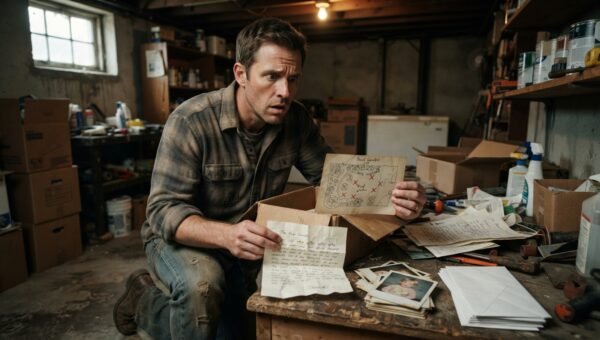
At 11:46 Sunday morning, my mother texted, “Bring the paint cards upstairs. We need to settle the west room.” I was carrying Dad’s old file box up from the basement, and I stopped halfway up the stairs with it digging into my fingers.
I’d already seen the cards on the dining table. Pale green and yellow. I knew what she meant, but I kept telling myself she wouldn’t actually make me move.
That was the same kind of thinking that had kept me paying her bills for six years.
The Sunday lunch dishes were still out when I walked into the west bedroom. Mom was standing by the window with Vanessa. My childhood desk was still wedged between the closet and the wall, and two boxes of Dad’s papers sat under it.
“You have until Wednesday,” Mom said. “Vanessa needs this room for the nursery.”
Vanessa held up a paint card. “This room’s big enough for the crib and the changing table.” She tapped the radiator with one fingernail. “The others are cramped. And Claire doesn’t need a whole bedroom.”
I looked at the boxes. I’d been meaning to sort them for years. I’d been meaning to do a lot of things, actually.
“Where am I supposed to go?”
“The attic,” Mom said. “We can clear a corner for you.”
Vanessa gave a little laugh. “You’ve always been good at making yourself comfortable wherever you land.”
Mom didn’t correct her. She rarely did. I set the file box on the desk and tried to keep my voice level.
“What if I don’t want the attic?”
Mom’s mouth tightened. “Don’t make this harder than it needs to be. Vanessa’s having a baby.”
“I know.”
“She needs support,” Mom said, glancing at her. “You can manage on your own.”
That was the part I understood perfectly. I could manage on my own. I’d said it to myself for years, like it was a compliment. After Dad died, I paid the heating bill because the furnace needed replacing, then the back steps because Mom said she was afraid she’d fall. I covered an insurance deductible, sent money for car repairs, and set up monthly transfers for utilities. It was never supposed to be permanent. But once I started, stopping felt like leaving Mom alone in the house Dad had loved.
I didn’t think of it as buying a place in the family. I just thought I was helping. Still, I remember the exact taste of the coffee I drank while setting up one of those transfers.
It had sat on the warmer too long and tasted burnt. I remember that better than I remember what Mom said when I told her I could cover the next bill.
I took a breath and slid my chair back. “I already bought a house.”
Vanessa lowered the paint card. “You did what?”
“A $450,000 house,” I said. “The closing papers are in my bag.”
Mom blinked, then put on a brittle smile. “Well, then, you can move sooner. But this house is still mine to arrange.”
I reached for the softened folder beside my coat. Its corners had gone dull from riding around in my bag all week.
“Is it?” I asked.
Her smile disappeared. “What are you implying?”
“I’m asking what document says you own it outright.”
“Put that away.”
“I’m not showing you anything yet.”
Mom looked at Vanessa. Vanessa wasn’t looking at the paint cards anymore.
I closed the folder before either of them could reach for it. I’d practiced that part in the car, which is embarrassing to admit. I’d also practiced being calm, and I wasn’t as calm as I wanted them to think.
“Claire,” Mom said, quieter now. “You don’t know what you’re talking about.”
“Maybe not. But I know what I found.”
Two weeks earlier, I’d been sorting Dad’s boxes in the west bedroom closet. I thought I was looking for an old insurance policy. Instead, I found a bank record showing $186,000 gone from Dad’s separate annuity. The withdrawal paperwork had his signature, but the date was October 19, six years ago.
Dad had been in hospice from October 12 through October 22. I knew that because I still had the hospital admission papers in the same box. For the last ten days, he’d been so deeply sedated he couldn’t answer a question or squeeze my hand. I remember the soft click of the oxygen machine. I remember the nurse telling me to go eat something. I remember Mom saying Dad was “resting,” as if that explained everything.
I put the papers back and went to the kitchen. Then I came back and checked the date again. I thought maybe I’d read it wrong. Maybe the form was filed later than it was signed. Maybe there was some explanation that didn’t make my mother a person who used Dad’s hand while he was dying.
But the notarized form said October 19. The annuity papers showed the full $186,000 had gone to an escrow account that paid Vanessa’s creditors. I found the cashier’s check stub in a different envelope. It named the same account.
I didn’t call Mom. I wanted to. Instead, I called Martin Vance, the probate attorney Dad had used. He’d retired, but he still had copies of the original file. I told him I had the dates and asked him to check before I did something I couldn’t undo.
Martin was quiet while I explained. Then he said, “Don’t confront anyone until you have certified copies.”
“Why?”
“Because your mother filed a different document with the county.”
He mailed the records and met with me the next day. Dad’s real will left Mom and me the house as tenants in common. I owned half. There was also a recorded remainder interest tied to maintaining the property. Mom had filed a single-survivor affidavit that claimed she owned it all.
Martin laid the certified will beside the title abstract. “This is your father’s signature,” he said, pointing to the real will. “That affidavit is not his.”
He also found a quitclaim transfer dated October 19, signed in Dad’s name. Dad couldn’t have signed it. The hospice chart showed he was non-responsive. Mom had used that transfer and the annuity authorization to move the money and hide my ownership.
I’d thought the worst part would be finding out she’d stolen from Dad. It wasn’t. The worst part was seeing my own bank transfers in the same file. I had been paying for repairs on a house I already partly owned, while Mom let me believe I was lucky to live there.
I could have used my savings to fight for the house right away. Instead, I closed on my own place for $450,000, using money I’d saved from work. I wanted a door I could close without asking anybody’s permission. Martin said I could pursue the forgery, but he warned me it would turn into a long fight. I told him I needed the title corrected, not a public war.
So on Sunday, I carried the folder downstairs.
The lunch table had been cleared except for the serving dishes. I laid out the hospice chart, the October 19 annuity form, the cashier’s check stub, the will, and the title abstract. I kept my hand on the edge of the table because it was the only way to stop myself from shoving the papers at Mom.
Vanessa leaned over the check stub. “What is this?”
“The $186,000 from Dad’s annuity,” I said. “It went to pay your creditors.”
Her eyes moved to Mom. “You said the business loan was settled.”
“It was,” Mom said.
“With Dad’s money,” I said. “While he was in hospice.”
Mom’s voice rose. “I did what I had to do to save this family from shame.”
“Dad was unconscious.”
“He wouldn’t have wanted Vanessa ruined.”
Vanessa’s face changed. Not dramatically. She just stopped touching the paint cards.
“You told me it was your money,” she said.
“I didn’t tell you that.”
“You let me think it.”
Mom looked at me. “I was trying to protect your sister.”
“I was paying the utilities. The repairs. The insurance. What were you protecting me from?”
She didn’t answer. She kept looking at the papers.
“You had no right to go through those files,” she said.
“They were Dad’s files.”
“Those papers don’t change who lives here.”
“Yes, they do.” I tapped the title abstract. “I own half the house. You filed a false affidavit saying you owned all of it.”
Vanessa looked from Mom to me. “You said this was your house.”
“I thought it was,” Mom said.
That was almost convincing. Almost. Then I remembered her telling me to clear a corner in the attic, like she had the right to decide where I belonged.
“You knew I was paying for a home I partly owned,” I said.
Mom shook her head. “You’re making this sound worse than it was.”
“It’s exactly as bad as it sounds.”
Nobody spoke. I felt the old urge to soften it for her. To say I knew she’d had a hard time, that she was scared, that she’d made one bad choice. I knew all those things. I also knew what happened when I made room for her reasons. She used that room to put me in the attic.
“I’m not moving upstairs,” I said. “I’m moving out.”
Mom sat down. “You just bought a house?”
“Yes.”
“And you were going to keep that from me?”
“I was waiting until it was mine.”
I showed her the keys and the closing papers. I didn’t say it to hurt her. I did want her to see that I had already made the choice without asking for permission.
Martin had prepared a legal memorandum and a formal acknowledgment for Mom to sign. If she signed and recorded the corrected title, I wouldn’t press criminal charges. I’d also stop every monthly transfer immediately. No more heating bill, repairs, insurance deductibles, or car money. If the house was ever sold, I’d receive my half.
Mom read the first page twice. “You’re threatening me.”
“I’m telling you what I’ll do.”
“What about family?”
I looked at the pale green cards still sitting on the table. “Family doesn’t get to decide I’m useful only when I’m paying.”
Vanessa didn’t speak. She looked tired and frightened, and I felt sorry for her. I still did. But I wasn’t going to clean up another debt.
Mom signed the acknowledgment after Martin explained what would happen if she refused. He filed the corrected title paperwork that week. I canceled the transfers from my phone before I left the house. The heating payment was scheduled for Monday. I stopped it.
I packed Dad’s files, his journals, my childhood desk, and his brass reading lamp before Wednesday. The paint cards stayed on the dresser. Mom didn’t help me carry anything, but she didn’t try to stop me either.
I’m not proud that it took a forged signature for me to see how far I’d let this go. I’m not proud that I still wanted Mom to tell me I’d done the right thing. But I didn’t go back to the attic, and I didn’t start paying again.
At my new house, Dad’s desk fits beside the study window. The brass lamp sits on top, next to my deed. No paint cards. No bills with Mom’s name on them.
The deed to my $450,000 house is the only paper on that desk with my name on it because I chose it.