My son called me a burden in my kitchen, and I thanked him for being honest.
“Sarah thinks you’re becoming a burden,” David said, setting down his coffee. “Honestly, Mom, I agree.”
He was thirty-two, standing there in a shirt I’d ironed the night before. His laundry basket was at the bottom of the stairs. His coffee mug had a little chip near the handle, and I remember that because Arthur used to say it was the only mug in the house that didn’t leak.
I looked at David. Then I said, “Thanks for being honest.”
He seemed to be waiting for more. An argument, maybe. An apology. I couldn’t tell. I only know he picked up his keys and left for work, and I left his mug in the sink.
The papers that ended up beside his plate on Sunday had been in a folder he’d never seen. I hadn’t looked at them in years. I didn’t even know if they would matter anymore.
That was the question I had to answer before dinner.
David moved back into the four-bedroom house after Arthur died. At first, I was grateful for the company. The house had been too quiet, and David was still my boy, though he’d been a grown man for a long time. He and Sarah became engaged while living there. I washed their clothes, cooked most nights, and didn’t ask them for rent.
I told myself that was what family did. I also liked having a reason to make a pot of soup big enough for three.
Sarah wasn’t rude all the time. That’s important to say. She could be warm when she wanted to be, and she once drove me to the pharmacy when I had a bad cough. But she talked about the house as if it were already David’s. She’d point to a wall and say, “That would look better opened up.” Or she’d talk about where she wanted to put a bigger table.
I didn’t correct her. I thought there’d be time.
The morning after David called me a burden, I found one of his work shirts on the laundry room floor. I picked it up out of habit, carried it toward the washer, and stopped. I put it back down.
Then I walked past the basket and into Arthur’s study.
Arthur had built that room himself. He’d put the desk together from lumber left over from the house, and the left drawer still stuck if you pulled it too fast.
In the bottom cabinet was a small tin strongbox. I had the key on my ring, though I’d forgotten what was inside.
The folder was yellow at the edges. It held a deed, trust papers, and a transfer agreement. I read the first page standing up. Then I sat down and read it again.
Arthur and I bought the land when we were young enough to think a full weekend of work was a treat. We poured the footings ourselves with help from his brother. I still remember the cement dust in my hair and Arthur laughing because I’d tracked it through the kitchen before we had floors.
We built that house together. But Arthur had handled most of the legal papers, and after he died I’d put the folder away with the things I couldn’t bear to sort.
The documents were plain enough. The home was held through a survivor’s trust.
I had sole control. David had no share in it, now or later. There was no promise that he would inherit it. If I chose to downsize, the home would be sold, and the money would go toward my own retirement.
I called Arthur’s attorney, Mr. Bell, that afternoon. He’d known us for decades. I could hear papers moving on his desk while I explained what I’d found.
“Do you have the original folder?” he asked.
“I’m looking at it.”
“Good. Bring it in.”
I did. He read the documents, then explained them in ordinary words. The trust was still in effect. I could sell the house on my own. Nobody else had a claim to it.
I asked him if that included David.
“It includes David,” he said. “He has no ownership interest.”
I looked down at the folder. I knew the answer now, but I still needed to hear it from someone who wasn’t me.
Mr. Bell asked what I wanted to do.
“I want to sell,” I said.
He didn’t rush to answer. “Then we’ll make a plan.”
I met with a real estate agent the next morning. The house was worth more than I expected, though I won’t put the number here. Seeing it on paper made the whole thing feel less like a thought I could take back. I signed the listing agreement. Mr. Bell prepared the notice giving David and Sarah sixty days to leave.
By then, David and Sarah had noticed I wasn’t doing their laundry. They noticed I wasn’t making dinner, too.
“Are you feeling okay?” David asked me Wednesday night.
“I’m fine.”
Sarah stood in the kitchen with paint swatches in her hand. She’d been talking about changing the cabinets. “We thought we could start with the kitchen,” she said. “It would make the whole place feel newer.”
I was eating a bowl of soup I’d made for myself. “That sounds like a lot of work.”
“Well, we’d do it,” she said, then looked at David.
I didn’t say the house wasn’t theirs. I let her keep talking. I wanted to see how far the assumption went.
David leaned against the counter. “We were going to talk to you about the downstairs room, too. It might make sense for you to use that as your space.”
I set my spoon down. “You mean move me out of my bedroom?”
“No. Not out,” he said. “Just somewhere smaller. It’s practical.”
Sarah turned one of the swatches over. “It could be nice. You’d have less to keep up with.”
I said nothing. I washed my own bowl and left theirs where they’d set them. That night, I slept in the room Arthur and I had shared, with the folder on the desk downstairs and the listing papers in my bag.
I cooked for myself the next two days. Eggs, toast, a baked potato. Nothing fancy. David and Sarah were grown, and there was food in the house. They could make a meal.
I won’t pretend I was above wanting them to notice. I wanted them to feel the empty space where my work had been. That wasn’t my finest impulse. But I’d spent years making it easy for them not to see the work at all.
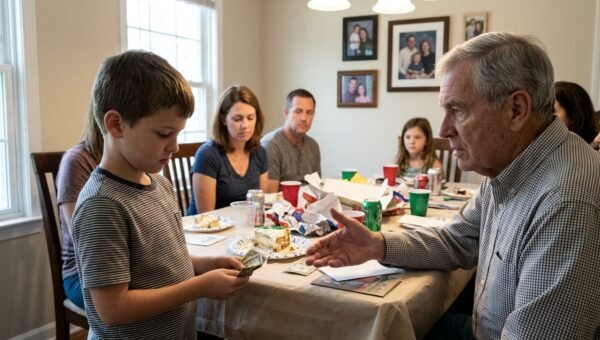
Sunday dinner was my choice. I invited them as usual and made roast chicken, mostly because I didn’t want the announcement to happen over takeout. I set out three plates. I put the envelope beside David’s.
He looked at it when he sat down.
“What’s that?” Sarah asked.
“Something we need to talk about,” I said.
David smiled, like he’d expected me to bring up the downstairs room. “We were going to talk about that tonight.”
“Before calling me a burden again, David, you need to understand something about this house.”
His smile went away.
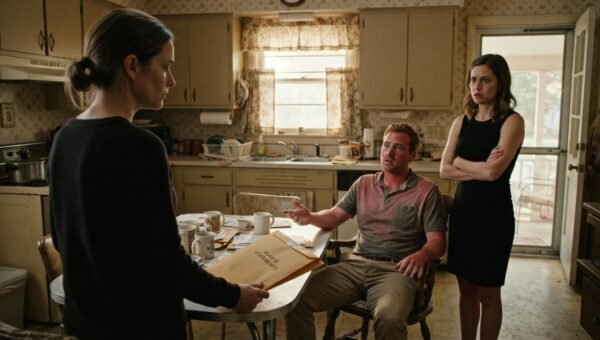
He opened the envelope. The first page was the notice of sale. Under it was the formal sixty-day notice to vacate. The trust papers were clipped behind them.
He read the top page once, then looked at me.
“You’re selling the house?”
“Yes.”
“You can’t just do that.”
“I can.”
He picked up the trust document. “This says nothing about me.”
“That’s right.”
Sarah reached across the table. “Evelyn, maybe we should all calm down and talk about what’s best.”
“I have talked,” I said. “I spoke with Mr. Bell. I checked the deed. The house is mine to sell.”
David’s fingers tightened on the paper. “I thought Dad wanted me to have it.”
“Your father wanted me to be secure.”
“I’ve been here for years.”
“You’ve lived here for years,” I said. “You haven’t paid rent. I’ve paid the mortgage, the taxes, the utilities, and the repairs.”
He looked at Sarah, then back at me. “We help around here.”
“Sometimes. I’ve also done your laundry. I’ve cooked your meals. I’ve ironed your shirts.”
I could hear my voice getting sharp, so I stopped for a second. I wasn’t trying to be cruel. I was trying not to back away from what I knew.
“You called me a burden,” I said. “But I was keeping your life comfortable.”
David pushed the paper away. “You’re overreacting to one conversation.”
“It wasn’t one conversation. It was what you both thought you could say because you believed I needed you.”
Sarah said, “I never said you needed us.”
“You said I was becoming a burden.”
“I didn’t mean it the way it sounds.”
“How did you mean it?”
She didn’t answer. Her eyes went to the envelope.
David stood up, then sat back down. “Where are we supposed to go in sixty days?”
“I don’t know,” I said. “You’ll have to find a place.”
“We can’t just get a lease right away.”
“You’re both working. You’ll figure it out.”
He gave a short laugh, but there wasn’t much in it. “So you’re kicking us out.”
“I’m selling my home. You have sixty days to move.”
The words sounded hard. They were hard. I didn’t dress them up.
Sarah folded her hands on the table. “We can pay you something. We can work out a rent amount.”
“Why now?”
“We didn’t think you wanted to be alone in the house.”
“I didn’t think living together meant I had to earn my place in it.”
David looked down at the notice. “You could’ve told me this before.”
“I didn’t know what I wanted until you told me what you thought of me.”
He had no quick answer to that.
I told them the sale was moving ahead. The agent had a listing date. The notice was real. Mr. Bell had checked every document, and there was no arrangement that gave David a piece of the house. I wasn’t asking them to agree. I was telling them what was happening.
They left before dessert.
The next few weeks were not easy, but they were clear. David and Sarah called landlords and found out how much rent cost when it wasn’t being paid by someone else. They had to decide what they could afford and what they could leave behind. They found a rental and moved out before the sixty days were up.
David didn’t speak to me for most of that time. Sarah sent one text saying she was sorry things had gotten “so tense.” I replied that I was sorry too, but I wasn’t changing the sale.
The house went on the market. It sold. I used the money to buy a small place near the lake, with fewer rooms and a porch I didn’t have to share. I’m moving in next week.
I don’t know what will happen with David and me. I love him. That part didn’t disappear just because I stopped doing his washing. But if we’re going to have a relationship now, it can’t be built around me making myself useful enough to keep.
This afternoon, I sat on the old front porch with a fresh cup of coffee. The sun came through the garden gate Arthur and I planted years ago. Inside, the laundry basket was empty.
I let it stay that way.