Grandma Clara’s kitchen was the only room in the house where nobody had moved anything after the funeral. Two days later, I was still there, staying in the house and trying to keep her cup from the sink because washing it felt like too much. Then my phone buzzed on the table.
“We’re in the Maldives.”
A minute later came, “We can’t access Grandma’s account.”
I didn’t answer. I was looking at the worn linoleum under my shoes, the same little split near the stove that Grandma kept saying she’d get fixed.
The $235,000 was safe, but I had not told my brother Evan where it was. I knew he would come home wanting an explanation. I didn’t know how he’d take the answer.
For fourteen months, I had been the one driving Grandma to appointments, sorting her pills, and checking whether the heat was still on. I lived close enough to stop by before work and again after. Some days she’d insist she was fine, then ask me to open a jar she’d been wrestling with for ten minutes.
Evan lived farther away. He came by now and then, usually with Leah, and he could be charming when he wanted to be. He’d bring flowers or a bag of groceries and stay long enough to make Grandma happy. I don’t think he set out to be cruel. He just had a way of treating anything unpleasant as somebody else’s job.
When Grandma’s hands got shaky, Evan told her he could help with online bills.
She trusted him. He said he’d set up automatic payments and an assisted-living reserve fund, so she gave him secondary digital access to the savings account.
I was relieved at first. I had too much to keep track of, and I thought it meant he was finally taking on something. But he didn’t come back to help with the bills. He didn’t ask what the doctor had said or whether Grandma had eaten. And a few weeks later, Grandma asked me why the electric bill was overdue.
“I thought Evan had that,” I said.
“So did I,” she told me. Then she folded the bill in half and put it under a magnet.
I wanted to call him right then. I didn’t. That’s on me. I was tired, and I didn’t want another family fight while Grandma was already scared of losing her home. So I paid the bill and told myself I’d bring it up when things were calmer.
Three months before she died, Grandma asked me to drive her to see Arthur Vance, the attorney she’d used for years. She had been thinking about Evan’s access, she said. She’d noticed the bills weren’t being paid and didn’t want anyone guessing what she meant to do with her savings.
Arthur went through the paperwork slowly. Grandma asked the same questions more than once, and he answered them each time without rushing her. She set up an updated revocable trust, named me as sole successor trustee and executor, and revoked Evan’s unmonitored account access. She also had a durable power of attorney, properly signed and notarized, in case she needed help with her affairs while she was alive.
I remember how she held the pen. Her fingers were stiff, so I steadied the paper while she signed. When we left, she told me she didn’t want Evan to feel punished.
She wanted the money used for her care, the house, and the hospice clinic she’d liked.
“He’ll be angry,” I said.
“He can be angry,” she answered. “The bills still need paying.”
I didn’t tell Evan about the meeting. Grandma was clear that she wanted Arthur to handle the notice and the legal steps. I knew keeping quiet could look bad later. I did it anyway. At the time, it felt like one less thing to make Grandma carry.
At the funeral, Evan and Leah came dressed in black. They hugged me, spoke to a few relatives, and left early. I watched their car pull away before the last folding chairs had been put back. Later I learned they’d flown to the Maldives using credit cards. I didn’t know then what they thought the trip would be paid with.
Two days after the service, I got Evan’s texts. I read them again at Grandma’s kitchen table. I could have written back that the account had been secured under the trust. Instead, I called the bank.
There were three attempted wire transfers. The requests had come from an IP address in South Asia and were pointed toward a third-party credit portal. The bank’s fraud department had flagged them. Evan’s digital credentials were frozen, and the $235,000 had been moved into the estate escrow account under the trust arrangements.
The woman from the bank asked me to confirm my authority. I read the trust information and the notarized power of attorney details from the folder Arthur had given me. My voice sounded steady, which surprised me. I kept one hand on Grandma’s table while I answered.
I asked the bank to send the fraud alert records to Arthur. Then I called him. He told me not to argue with Evan over text and not to move anything else without checking with him first. The account was protected. The money had to stay accounted for, not become anybody’s quick fix.
I put the confirmation receipts in the binder with Grandma’s trust papers, the bills, and the list of what she wanted done. Her medical costs were still coming in. The hospice clinic endowment was written down in her own handwriting. There was house insurance, property tax, and the cost of keeping the place from falling behind while probate moved along.
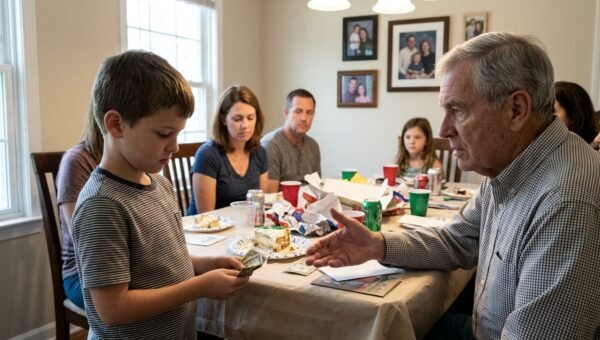
A few days later, Evan came home from the Maldives. He didn’t knock. He pushed through the screen door, crossed the worn linoleum, and dropped into Grandma’s chair at the table. Leah stayed beside him, one hand on her tote strap. Her tan was still fresh against her black dress.
“Where’s the money?” Evan asked.
I told him it was in the estate escrow account.
He said I’d moved it without asking him. I reminded him that Grandma had named me trustee and executor, and that his account access had been revoked months before she died. He said Grandma had only meant for me to help, not take control.
I kept the binder closed for a moment. I wanted to be fair, but I also wanted to tell him he hadn’t earned the right to sit in her chair and bark orders. Instead, I asked if he knew about the three attempted transfers.
His mouth tightened. Leah looked at him, then at me.
“That’s not what those were,” he said.
I opened the binder and slid the bank records across the table. I showed him the attempted transfers, the bank’s fraud notice, and the confirmation that the money had been secured. I put Arthur’s letter beside them. It said plainly that the funds were part of the estate and not available for personal spending.
Evan leaned over the papers. His hand stayed on the table, but he stopped pointing.
He told me the trip was already charged and that the balances were due. He said he’d expected to pay them off once Grandma’s money was released. Then he asked me to wire enough to cover the travel balance while the rest got sorted out.
There it was. Not a delay in paperwork. Not concern about Grandma’s bills. He’d planned to use her savings to cover his luxury credit lines, and when he couldn’t get to the account, he panicked.
“I’m not sending you her money,” I said.
He asked if I was really going to let him drown over a vacation. I told him I hadn’t booked the trip, used the cards, or tried to empty Grandma’s account. I had kept the money where it belonged.
Leah backed away from the table. She said she thought Evan had everything handled. He didn’t look at her. I don’t know whether she knew what he planned to do with the money before that moment. I only know she left his side when the papers made it plain he had no claim to the account.
Evan said I was making him look like a thief. I told him I wasn’t the one who made three transfer attempts. That was more than I should have said, probably. But I was done trying to make the truth sound gentle enough for him to hear.
I showed him the estate inventory and the notice from Arthur. The $235,000 was being held for Grandma’s outstanding medical bills, estate expenses and taxes, the hospice memorial gift she’d asked for, and the care of the house until it could be settled through probate. It wasn’t mine to hand over. It wasn’t his either.
He pushed back from the table and told me I’d turned Grandma against him. I told him she’d made her own choices, with an attorney beside her. That was when he started talking about needing the house key.
I held out my hand.
He stared at it for a few seconds, then dug the brass key out of his pocket and dropped it into my palm. It was warm from him. I asked him not to come back without arranging it through Arthur. He said I couldn’t keep him away from his own family’s house.
“I can keep you from walking in,” I said. “The estate will be handled legally.”
He left with Leah. Nobody apologized. I heard the screen door slap behind them, and then I locked it.
The money stayed in escrow. The bills got paid through the estate, and the house was kept up while the legal work continued. I stopped being the person Evan could call when he needed something covered. We haven’t spoken since except through Arthur.
That is the part people think should feel good. I suppose it does, some days. Mostly, I miss Grandma and hate that her kitchen became the place where I had to prove I wasn’t stealing from her.
I sat alone at the clean kitchen table under the warm afternoon light. Her wall clock ticked above me. The brass key Evan surrendered rested in my hand on the worn floral tablecloth.