PART 1
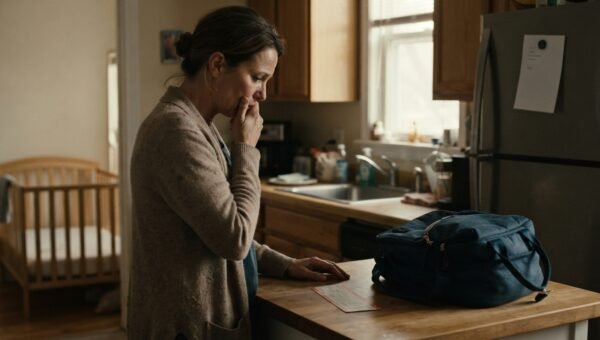
The white envelope was sitting on the kitchen counter next to my car keys when I got home from the clinic.
My six-year-old son, Toby, had printed his name on the front in red crayon, but his first-grade teacher, Mrs. Albright, had written a note on the back in ballpoint pen: “Mailed this home directly so you could see his holiday wish list early.”
I smiled as I slid my finger under the flap. I was expecting a request for Legos or the red dirt bike he had pointed at in the department store catalog all through November.
Money was always tight. I made $34,000 a year working the intake desk at an outpatient physical therapy clinic, but I had saved eighty dollars in an envelope taped behind my dresser mirror just for his Christmas.
I pulled out the folded sheet of wide-lined elementary school paper.
Toby’s pencil handwriting was uneven, but the words were clear:
“Dear Santa, I don’t want toys. I want my mom to stop crying at night. I want the man who yells at her to go away. He broke the kitchen table. He says bad words. Mommy says it’s our secret. But I don’t like secrets.”
I read it once. Then I read it again. The third time, my hands shook so hard the thin paper fluttered against my fingers.
The man was Greg. He had been living with us in our two-bedroom rental house for nine months.
I looked over at the kitchen table. It was an old pine drop-leaf table my grandmother had given me when I first moved out on my own.
Two weeks ago, Greg had slammed his heavy ceramic coffee mug down during an argument about his share of the electric bill, cracking the center board clean down the grain. He said the wood was rotten anyway. He said if I kept a better house, things wouldn’t break.
That night, after Greg slammed the front door to go cool off at a bar, Toby had come out of his bedroom in his dinosaur pajamas. He saw me down on the linoleum, picking up the yellow ceramic shards. I had pulled him onto my lap, wiped my nose on my sleeve, and told him everything was fine. I told him grown-ups just got loud sometimes when they were tired. I told him it was our little secret because we didn’t want to make Greg feel bad.
I thought I had protected him. I told myself Greg was just under pressure because his brother’s landscape business was slow in the winter.
I told myself it wasn’t that bad because Greg had never hit me. He only hit walls. He only kicked baseboards. He only leaned down until his face was two inches from mine and told me how lucky I was that an ordinary woman with a kid had anyone willing to look at her.
My cell phone rang on the counter. The caller ID showed the elementary school’s main line.
I cleared my throat, trying to smooth out my voice. “Hello?”
“Mrs. Walker? It’s Claire Albright. Toby’s teacher.” Her voice was quiet, stripped of the cheerful tone she used at parent drop-off.
“Hi, Mrs. Albright. I just got the envelope. Thank you for sending it.”
There was a pause on the line. Long enough that I could hear the hum of the refrigerator behind me.
“I read the letter before I mailed it, Mrs. Walker,” she said gently. “As an educator, I am required by state law to make a report to child protective services when a student discloses violence in the home.
But I called you first because of what happened during afternoon recess.”
My stomach tightened into a knot. “What happened?”
“Toby wouldn’t go out to the playground,” Mrs. Albright said, her voice dropping lower. “When I asked him why he wanted to stay inside by my desk, he said Greg told him that if he told anyone what happens in that house, he would make Mommy hurt so bad she couldn’t walk.”
PART 2
The room seemed to lose all its air.
“Mrs. Walker? Are you there?” Mrs. Albright’s voice crackled through the phone speaker.
“I’m here,” I whispered. My throat felt like dry paper. “He said that to Toby?”
“Yes,” she said. “At one o’clock today. I filed the mandatory report at one-thirty. An intake caseworker has already been assigned. I wanted to give you notice because they will be reaching out, and I needed to know if you and Toby were safe to go home tonight.”
“Greg isn’t home,” I said. My mind was racing across every evening of the last three months, every time Toby had flinched when a cabinet door shut too hard, every time he had clung to my leg when Greg walked into the room. I had convinced myself that quiet meant safe. I had convinced myself that keeping Greg calm with dinner ready at six and the television low was protecting my boy.
“I’m at the school right now,” Mrs. Albright said. “Toby is in the after-care program in the cafeteria until five. If you need help getting your things, there are resources.”
“No,” I said, and for the first time in nine months, my voice didn’t wobble. “I will handle it. I’m coming to get him right now.”
I hung up the phone.
Greg’s truck was at his construction side-job until six in the evening. That gave me two hours.
I didn’t cry. The panic that usually paralyzed me when Greg raised his voice was completely gone, replaced by a cold, sharp focus. I walked into the hallway and dragged two large laundry baskets out of the closet.
I went into Toby’s room first. I packed his winter coats, his school shoes, his clothes, and the handmade blanket his grandmother had crocheted for his first birthday. I took his school records from the top shelf of the closet, his birth certificate, and his social security card from my small metal lockbox.
Then I went to my room. I took my work scrubs, my winter boots, and the envelope behind the mirror with the eighty dollars.
On the dresser sat the spare set of keys to the house. The lease was in my name alone. I had lived in that rental for three years before Greg moved in. When he moved his toolboxes and his recliner into my living room, he promised he would pay half the rent. In nine months, he had given me four hundred dollars total, always claiming his client checks were held up or his truck needed a new alternator. My savings had vanished just trying to keep the lights on and the landlord paid.
I carried the baskets out to my ten-year-old sedan, stacking them in the trunk and across the back seat.
Then I walked back inside and looked at the kitchen table. The crack in the pine ran six inches down from the edge. Greg had threatened my child. He had used my safety as a weapon to silence a six-year-old boy.
I pulled my phone out of my coat pocket and dialed my landlord, Mr. Henderson. He was a retired mail carrier who lived three streets over.
“Mr. Henderson, it’s Clara Walker from 412 Elm,” I said when he answered.
“Afternoon, Clara. Rent check cleared fine yesterday, you’re all set.”
“I need the locks changed today, Mr. Henderson,” I said plainly. “Greg is no longer living on the property. He has never been on the lease, and he made a threat against my son. If I pay for the deadbolts, can you meet a locksmith here before five?”
Mr. Henderson went quiet for a second. “I’ll be there in twenty minutes with my own drill, Clara. You don’t need to pay a locksmith. I keep spare deadbolt sets in my garage.”
PART 3
By four-fifteen, Mr. Henderson had installed two new heavy-duty brass deadbolts on the front and back doors. He handed me the four new silver keys.
“Where are you going, Clara?” he asked, looking at the empty kitchen and my packed car in the driveway.
“My sister’s house in Dalton,” I said. “Just for tonight. Until the police report is filed and Greg knows he can’t step foot on this lawn.”
“I’ll be sitting on my front porch across the street when he pulls up,” Mr. Henderson said, wiping his thumb on his work jeans. “If his truck idles in this driveway for more than thirty seconds, I’m calling the sheriff.”
I left Greg’s clothes in two black garbage bags on the front porch, along with his work boots and his coffee mug. Underneath the mug, I weighted down a piece of paper. It wasn’t a long letter. I didn’t give him an explanation to argue with, because Greg lived on arguments. He won them by getting louder until other people gave up.
I wrote: “The locks are changed. The police and child services have been notified of what you said to Toby. If you come near this house or my job, I will have you arrested on sight.”
I drove straight to the elementary school.
The cafeteria was almost empty when I walked in. Toby was sitting at a long folding table with Mrs. Albright, coloring a picture of a snowman with a broken blue crayon. When he saw me standing in the doorway, he didn’t run like he usually did. He sat still, watching my face to see if I was angry.
That look broke whatever lingering hesitation I had left in my body.
Mrs. Albright stood up. She held out a manila folder. Inside was a copy of her incident report and the name and direct number of the county caseworker, Sarah Martinez.
“She will call you tomorrow morning at nine,” Mrs. Albright said softly. “You did the right thing coming right away.”
“Thank you,” I said.
I knelt down in front of Toby’s chair. He looked down at his shoes.
“Did Santa get my letter?” he asked in a small voice.
“I got it, baby,” I said. I reached out and took his small, cold hands in mine. “And you don’t ever have to keep a secret for me again. Not ever. We are going to Aunt Jenny’s house tonight.”
He looked up, his brown eyes wide. “Is Greg coming?”
“No,” I said firmly. “Greg doesn’t live with us anymore. He’s never coming back into our house.”
Toby let out a long breath, his shoulders dropping two inches as if a physical weight had been lifted off his chest. He didn’t ask about his toys. He just put his arms around my neck and buried his face in my coat collar.
Greg called my phone forty-two times between five-thirty and eight that night.
At first, the voicemails were furious. He yelled that I was crazy, that I was throwing away a good thing over nothing, that he would take his tools and leave me with nothing. By seven o’clock, his tone shifted to pleading. He said he had just been stressed, that he loved us, that he would fix the kitchen table on Saturday.
I didn’t answer a single call. I sat at my sister’s kitchen table with a legal pad, writing down the exact time of every voicemail, transcribing his words so I could hand the record to the magistrate the next morning.
ENDING
The temporary protective order was granted at ten o’clock the following morning at the county courthouse.
The judge read Toby’s letter, looked at the photos of the cracked pine table, and reviewed the transcripts of Greg’s voicemails. The order gave Greg thirty days to arrange police-escorted retrieval of his remaining furniture, and barred him from coming within five hundred feet of me, Toby, our house, the elementary school, and the clinic.
When Greg showed up with two sheriff’s deputies the following Tuesday to load his recliner and his television into his brother’s truck, I sat on Mr. Henderson’s front porch across the street with a warm cup of coffee. Greg kept looking over at me, waiting for me to walk across the asphalt, waiting for me to apologize or offer him a way back in.
I didn’t move. I didn’t wave. I just watched until the red taillights of his truck turned the corner onto the highway.
It took three months of strict budgeting to pay back the rent Greg had dodged, eating rice and beans and picking up four extra weekend shifts at the urgent care desk in town. My bank balance didn’t have much room for error, but the house belonged to us again.
On Christmas morning, Toby didn’t have a red dirt bike under the tree. He had a set of second-hand plastic building bricks I found at a yard sale for twelve dollars, two new pairs of jeans, and a paperback book about dinosaurs.
When he came into the kitchen, the sunlight was coming through the blinds, hitting the drop-leaf pine table.
Two days before, Mr. Henderson had come over with a clamp and a bottle of wood glue. Together, we had pressed the split board back into place, sanding the rough top until the surface was smooth again. You could still see the dark scar where the wood had parted, but the joint was solid. It didn’t rock when you set a plate down.
Toby climbed onto his chair and ran his fingers over the repaired line in the wood.
“It doesn’t hurt anymore, Mom,” he said, looking up at me.
“No, buddy,” I told him, setting a bowl of warm oatmeal in front of him. “It doesn’t.”