The stiff edge of my cuff scraped my forearm, and I flinched hard enough to tip the carton in my hands. I was carrying framed photographs across my grandfather Arthur’s riverside apartment, trying not to drop the one of my mother laughing on a beach. Arthur caught the box before the frames slid out.
Then he saw my arm.
My sleeve had ridden up. Purple marks circled my skin, some fading and some new.
Arthur set the carton on his drafting table. His hands stayed on the edges of the box.
“Who did that, Emily?”
I tried to answer, but my throat shut down. I’d spent so long finding ways not to make Vivian angry that telling the truth felt like another way to get in trouble.
“Vivian,” I said. “She grabbed me.”
Arthur’s mouth tightened. He didn’t raise his voice.
“When?”
“Over a box of Mom’s things. She said I had no right to keep it.”
“And Richard?”
“He was in the next room.”
I looked down at the pictures. My mother had sand on her cheek in one, and Grandpa was holding me as a baby in another. I can still remember the smell of the cardboard box, dusty and a little sweet, like an old closet.
“Dad heard us,” I said. “Later he told me Vivian said I’d done it to myself.”
Arthur took one slow breath. He moved closer, but he didn’t touch me.
“You can stay here,” he said. “But will leaving put you in more danger?”
“I don’t know. She’ll say I stole something. Dad will believe her again.”
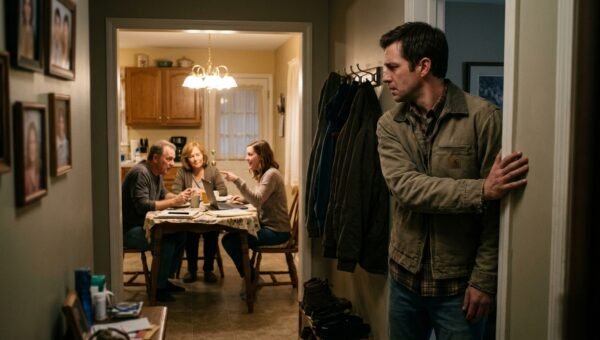
For nearly two years, Vivian had made our house feel like I needed permission for everything. She could be kind in front of neighbors, then pinch my wrist hard enough to leave marks once the door shut. She decided which of Mom’s boxes I was allowed to open. The rest stayed behind the locked hall closet.
If I complained, she’d say I couldn’t accept my father’s marriage. Richard believed her. Or maybe believing her meant he didn’t have to do anything.
A few days before I went to Arthur’s, Vivian accused me of taking a small brass key from Mom’s desk. I told her I hadn’t touched it. She grabbed my arm and dragged me toward the desk, saying I had to confess. When she let go, Dad appeared in the doorway.
He looked at me. Then he looked at Vivian’s tears.
“Just apologize,” he said.
That was the point where I stopped waiting for him to notice on his own. I still didn’t know what the key opened. I only knew Vivian was scared enough to hurt me over it.
Arthur crossed to the fireproof cabinet beside his drafting table. He unlocked it and took out a folder, then a sealed envelope with my mother’s signature across the flap. I’d seen it before, years ago, when Arthur would check the cabinet. He’d never opened it in front of me.
“Your mother left this with me,” he said. “She wanted it kept until there was a reason to review the trust.”
He broke the seal and read the first page. His expression changed, not with surprise exactly, but with recognition.
Then he turned the paper toward me.
Mom had named me her sole beneficiary. She’d set up an irrevocable trust so her savings, family heirlooms, and the money in my childhood account would belong to me when I reached adulthood. Arthur had been managing it.
He put the trust document beside a list of recent disbursements.
“This money was not hers to use.”
I stared at the figures, then at the signatures below them. Several withdrawals had been approved using Richard’s authority over a household buffer account, but the requests were written in Vivian’s hand.
“Grandpa, what did she take?”
“Forty-two thousand, four hundred dollars,” he said. “Over eighteen months.”
I actually asked him to say it again. Not because I hadn’t heard. I guess I wanted the number to change if I made him repeat it.
Arthur had kept careful records. He showed me the deposits Mom had made for my education and basic support, then the requests that moved the money out. The written signatures were supposed to be mine or Arthur’s, depending on the type of payment. They weren’t.
“Could she just do that?” I asked.
“No. She had no authority to direct your trust.”
He called the account manager while I sat at the table. The woman on the phone confirmed five wire requests had come from Vivian’s personal email and gone to bank accounts Vivian controlled. Arthur wrote the details in his sloping handwriting.
I stayed quiet until he hung up.
“Can you prove she signed these?”
“We can show the bank the records,” he said. “They’ll make their own report. We’ll get a lawyer involved before anyone signs anything.”
He wasn’t promising a quick fix. I appreciated that. For once, nobody was telling me to calm down or keep the peace.
Arthur asked if I’d let him photograph my arm. I almost said no. I hated the idea of having my bruises turned into evidence. But I thought of Dad in the doorway, choosing Vivian’s tears over what he could see.
“Okay,” I said. “Take them.”
He used an old 35mm camera he kept in a desk drawer. The shutter made a dry little click. He took a picture from each side, then asked me to hold a ruler beside the marks for scale. It felt silly and awful. Still, I held my arm steady.
After that, we called a lawyer and the bank. The lawyer told us not to handle anything alone and to keep copies of every record. Arthur asked whether I wanted him to go with me to the house.
“I do,” I said.
The next morning, we drove over. I had slept badly, and on the ride I kept thinking I could ask him to turn around. I didn’t. I was tired of leaving my mother’s things behind because Vivian had decided I didn’t deserve them.
Arthur stayed close while I went inside. Vivian came into the dining room with a practiced sad look.
“Emily, I’m glad you’re home,” she said. “I’m sure we can sort out this little misunderstanding.”
I nearly let her set the tone. That was what I used to do. I’d hear the soft voice and start wondering if I’d made too much of things.
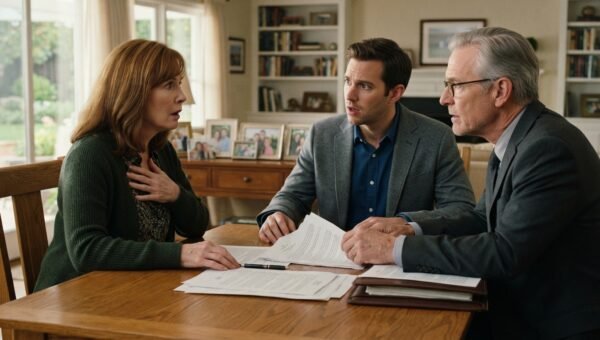
Arthur placed the bank statements and forged vouchers on the table. Then he laid down the photographs of my arm.
“Let’s deal with the records,” he said.
Vivian looked at the papers. Her mouth moved once before she spoke.
“This is being twisted,” she said. “I was managing the household.”
“You weren’t managing Emily’s trust,” Arthur said.
Dad came in from the kitchen. He picked up one voucher, then set it down again.
“What is this?” he asked.
“Five unauthorized transfers,” Arthur said. “The bank traced them to Vivian’s email and accounts. The total is $42,400.”
Richard looked from him to Vivian. “You said those payments were for the house.”
“Some of them were,” Vivian said. “We had expenses.”
Arthur didn’t argue over each one. The records showed the transfers had gone toward Vivian’s old credit card debt and private contractors hired for renovations. She’d told the bank she was acting as my legal custodian. She wasn’t.
Dad rubbed his forehead. “I didn’t know it was this much.”
I’d heard that kind of sentence before. It always made him sound like the person who’d been hurt.
“You knew she was hurting me,” I said.
He looked at the pictures. “I thought you two were fighting.”
“You saw my arm.”
“I didn’t know what to do.”
That was when I understood he had known enough. He just hadn’t wanted the trouble of taking my side. He knew. He knew and told me to apologize anyway.
Vivian started crying. Dad moved toward her, then stopped when Arthur slid the lawyer’s letter across the table. It laid out the bank’s findings and the next steps. Vivian could make immediate arrangements to repay the money and surrender any claim to Mom’s estate and belongings, or the lawyer would file the records with the authorities. A police report about the assault would be made separately. Nobody could promise what the outcome would be.
“I can’t pay that today,” Vivian said.
“You can sell the car and your separate assets,” Arthur replied. “The agreement gives you a deadline. If you don’t follow it, the lawyer moves forward.”
She looked at Dad. He didn’t answer for her this time.
Then he turned to me. “Please. Let’s keep this in the family. We can work things out.”
I could feel the old urge to make his life easier. To say I was angry but not that angry. To tell him it was fine, even though it wasn’t.
I pushed my chair back.
“You don’t get to call this family,” I said.
The room went quiet. I didn’t take it back.
Vivian signed the restitution agreement after speaking with the lawyer. She agreed to repay the $42,400 from her own assets and surrender any claim to Mom’s things. The bank continued its review, and the fraud report went forward. Signing one paper didn’t make the rest disappear. It did mean the money and the house would no longer be handled on Vivian’s say-so.
I went upstairs with Arthur to get the boxes and my clothes. Dad followed us to the hall closet but didn’t help. Vivian handed over the key ring without looking at me.
I packed Mom’s photo albums, her sewing tin, and the small wooden box she’d kept letters in. I also took my own things. Nothing dramatic. Jeans, school papers, a hairbrush with too many strands wrapped around it. The ordinary stuff was what made leaving feel real.
Before we left, I went to Mom’s desk. I found the little brass key behind the radiator, where it must have fallen during Vivian’s struggle with me. My hands shook when I fitted it into the narrow lock inside the desk.
The compartment opened.
Inside were Mom’s bank passbooks, original deposit receipts, and duplicate signature cards. The records matched the transfers in Arthur’s ledger down to the cent. They showed the money leaving my account and the false signatures Vivian had used to move it.
I handed the passbooks to Arthur. He made copies before we left.
The next few months were mostly calls, forms, and waiting. Vivian sold her car and other separate property to begin repayment. The money went back into my protected account. The bank’s records and Mom’s documents supported the fraud case, and I gave my statement about the bruises. I didn’t go back to live with Dad.
I moved into Arthur’s apartment. I started making plans for college without asking Richard for money. The first time I paid for a book from my own account, I checked the balance twice. I’m not proud of that, but it takes a while to stop feeling like somebody can reach in and take what’s yours.
Dad called a few times. I answered once. He said he missed me and wished I could understand how hard the situation had been for him.
“I do understand,” I said. “That’s why I’m not coming back.”
I ended the call before he could ask me to smooth things over again.
The brass key now rests on Arthur’s sunlit drafting table beside the framed picture of Mom laughing on the beach. The window is open, and the river breeze lifts the corner of the photograph.