PART 1
The Sunday dinner was supposed to be a celebration for Clara and her fiancé, Brian. We were sitting around my dining table, the good linen napkins out, the roast chicken resting on the carving board. Clara was laughing, waving her left hand as she described their plans for a small wedding in June.
That was when the afternoon sun caught the stone on her finger.
My breath caught in my throat. I did not mean to stare, but my eyes locked onto the diamond.
It was an oval cut, just over two carats, set in four delicate platinum prongs. But it was not the shape or the size that made my stomach drop. It was the flaw. On the far edge of the stone, right against the girdle near the top left prong, there was a minute, flat chip. It looked like someone had shaved off half a grain of sand.
I knew that chip better than my own face. My father had bought that diamond loose in Antwerp back in 1974. When he had it set for my mother, the setter accidentally struck the edge. My father refused to have it recut because he said life was never perfectly symmetrical anyway. When my mother passed it down to me for my engagement to Thomas thirty years ago, that tiny flat nick became my private touchstone. I used to rub my thumbnail over it whenever I was anxious.
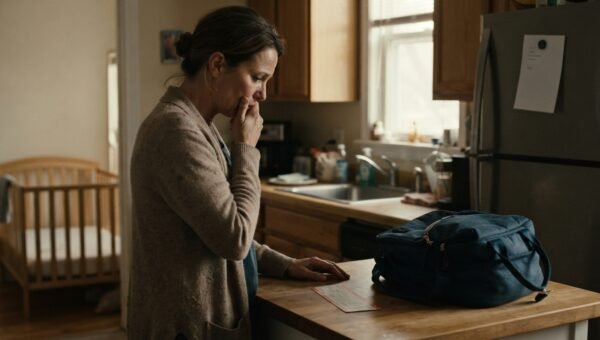
Sixteen years ago, during a weekend trip to Cape Cod, Thomas came back from walking the dog along the dunes and told me the worst news. He had taken my ring to clean it in the cottage bathroom, slipped it into his pocket, and realized too late that his pocket had a tear along the seam. We spent three days on our knees in the sand with metal detectors and garden rakes. We never found it. I cried for two solid months. Thomas was so devastated that he bought me a plain gold band to replace it, and neither of us ever spoke about the lost heirloom again.
Now, sitting across from me, my twenty-nine-year-old daughter was wearing it.
“Clara,” I said, my voice shaking before I could catch myself. “Where did Brian buy that ring?”
Brian looked up from his plate, smiling pleasantly. “A boutique shop in Boston, Mrs. Miller. Over on Newbury Street.”
“Let me see your hand, honey,” I said, standing up from my chair.
Clara smiled, extending her fingers across the table. But the moment I leaned down and brought the stone close to my eyes, the smile vanished from her face. I took her hand gently and ran the edge of my thumb across the girdle. There it was. That exact, microscopic rough edge.
“Thomas,” I whispered, looking toward my husband at the head of the table. “Look at this. Look at the edge.”
Thomas did not get up. He set his fork down deliberately, wiped his mouth with a napkin, and frowned. “Martha, don’t start. It is an engagement ring. Let the kids enjoy their moment.”
“No, look at it!” I insisted, my chest tightening. “The chip near the prong. It is my mother’s stone. Clara, your father said this diamond was lost at the beach sixteen years ago.”
Clara jerked her hand back from my grip as if I had burned her. Her face went pale, then flushed a furious red. “Are you serious right now, Mom? You think Brian stole your old jewelry? He saved for two years to buy this for me!”
“I am not saying Brian stole anything,” I stammered, looking between them. “I am saying this is the stone. I know it. I would know it anywhere in the dark.”
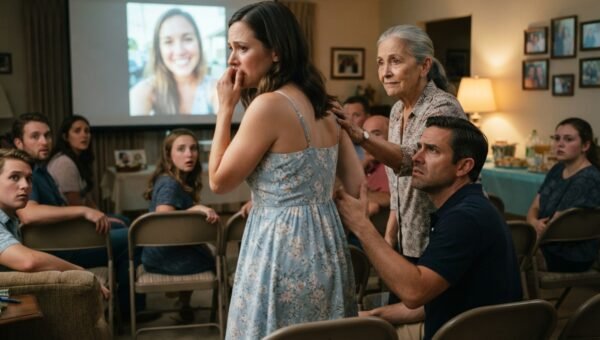
“You are trying to ruin this for me,” Clara said, tears instantly springing to her eyes. She stood up, knocking her chair back against the sideboard. “Every time something good happens to me, you have to find a way to make it about your past, your grief, your family. Brian, take me home. I can’t do this.”
Brian looked utterly bewildered. He got up, apologized quietly to Thomas, and followed Clara into the hallway. Within two minutes, the front door slammed shut.
I stood frozen in the dining room, looking at the two half-filled wine glasses. Thomas remained seated, cutting a small piece of chicken and chewing it slowly.
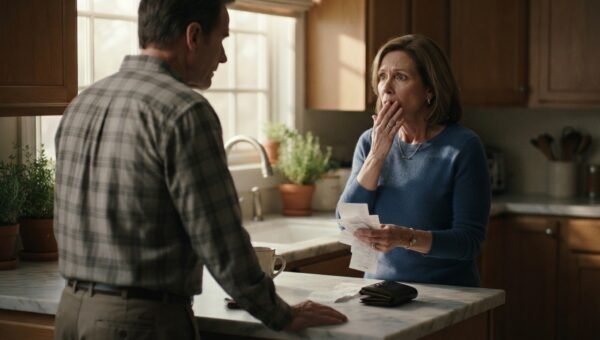
“You need to apologize to her tomorrow, Martha,” he said calmly, not meeting my eyes. “You made a scene over nothing. Oval diamonds look alike. You imagined the chip because you never let that beach trip go.”
“I did not imagine it, Thomas,” I said, my voice trembling with an anger I had never felt toward him in thirty years. “I know my own mother’s ring.”
The next morning at nine o’clock, I walked into the jewelry shop Brian had named on Newbury Street. I had the original appraisal paperwork from 1988 folded in my purse, complete with the laser inscription number my father had recorded when the diamond was certified.
PART 2
The boutique on Newbury Street was quiet and smelled of polishing wax and expensive leather. A middle-aged man with silver hair and thin glasses greeted me from behind a glass display counter. His name tag read Marcus Vance.
I did not waste time with polite small talk. I pulled the faded yellow appraisal certificate from my purse, laid it on the glass, and asked if he had recently sold an oval diamond ring to a young man named Brian Hughes.
Marcus frowned slightly, looking at the paper and then at me. “Mrs. Miller, store policy protects our clients’ privacy. I cannot simply discuss purchases made by other people.”
“The stone Brian bought carries a microscopic inscription,” I said, keeping my hands steady against the glass. “GIA number ending in 4082. It has a flat nick on the upper left girdle. It belonged to my mother, and it went missing sixteen years ago. Please. Just look at the serial number under a loupe in your logbook. If I am wrong, I will walk out and never come back.”
Marcus looked at me for a long moment, sensing the absolute certainty in my voice. He nodded once, turned to his desktop computer, and brought up his inventory archive. Then he walked into the back room, returning two minutes later with an oversized black binder containing signed service tickets.
He opened the ledger and turned the monitor toward me.
“The stone was not sold to Brian Hughes,” Marcus said quietly. “Brian only paid for the setting and the labor. He brought the loose diamond in himself six months ago. He told us it was a family heirloom given to his fiancée.”
My stomach lurched. “Brian brought the loose stone?”
“Yes,” Marcus said. “He asked us to mount it in a four-prong platinum band. But when our jeweler checked the stone under forty-power magnification to log its condition, he recorded the laser registry number. It matches your certificate. It is the exact same diamond, Mrs. Miller.”
I had to grab the edge of the counter to keep my balance. “Where did it come from? Who brought it to you before Brian?”
Marcus turned the paper page in his black binder. “We have the original intake record from sixteen years ago. The diamond was brought here to be unmounted from its original white gold band and placed into a velvet display case.”
He slid the binder around so I could see the yellowed receipt.
The date on the top was August 14, 2010. Exactly three weeks after Thomas told me he lost the ring in the dunes at Cape Cod.
My eyes moved down to the customer signature line. The handwriting was uneven, childish, and slanting slightly upward.
It did not say Thomas Miller.
It read: *Clara Miller*.
Underneath the signature, written in neat script by the clerk who took the order, was a small pencil note: *Customer age 14. Accompanied by father. Cash transaction. Stone released to father.*
“Are you all right, ma’am?” Marcus asked, his voice suddenly full of concern.
I could not answer him. I could barely draw air into my lungs. My fourteen-year-old daughter had signed the intake slip for my missing diamond three weeks after my husband claimed the ocean breeze and shifting sands swallowed it whole. And Thomas had been standing right beside her, paying cash to have it stripped from its setting.
PART 3
I drove home with my hands gripping the steering wheel so hard my knuckles turned white. My thoughts were spinning out of control. Thomas had spent thirty years being the steady, quiet rock of our household. He was an accountant, a man of routine and careful planning. He did not lie. He did not gamble. Yet for sixteen years, he had watched me grieve my mother’s heirloom, knowing full well it was sitting in a drawer or a safety deposit box. And Clara had been part of it. My sweet, teenage daughter had known all along.
When I pulled into the driveway, Thomas’s car was parked outside. He worked from home on Mondays, his office situated at the far end of the second-floor hallway.
I did not take off my coat. I walked straight up the stairs, pushed open his office door, and slammed the copy of the 2010 jeweler’s intake slip onto his desk.
Thomas looked up from his double monitors. His eyes dropped to the paper, recognizing the boutique’s letterhead immediately. He did not flinch. He did not gasp. He simply leaned back in his leather desk chair and let out a heavy, tired sigh.
“You went to Boston,” he said.
“Clara signed this,” I said, my voice cracking. “She was fourteen years old, Thomas. You told me you lost my mother’s ring in the sand. You watched me crawl through sea grass until my knees bled. You let me cry for months. And three weeks later, you took our fourteen-year-old child to Newbury Street to hide the evidence? What kind of monster does that?”
Thomas stood up slowly. He walked past me, closed the office door firmly, and walked over to the floor safe tucked in the corner behind his bookshelf. He spun the combination dial, pulled the heavy steel door open, and reached inside.
When he turned back around, he held a small, black velvet box.
He placed it on the desk between us and clicked it open.
Inside, resting against the black satin, was an oval cut diamond.
I stared at it, frozen. The size, the cut, the fire of the stone—it was completely identical to the one on Clara’s finger.
“What is that?” I whispered.
“Neither stone is the one your mother gave you, Martha,” Thomas said, his voice flat and painfully steady. “The ring your mother gave you is at the bottom of the Atlantic Ocean, exactly where I said it was.”
“Then what are these?” I cried. “Why did Clara sign that receipt? Why does the stone on her finger have the exact same chip on the edge?”
Thomas looked at me, his eyes dark with an old, buried sorrow. “Because when I dropped your mother’s ring off the pier that afternoon, I panicked. I knew how fragile you were back then. Your mother had just died six months earlier. You were barely getting out of bed. If I told you I had dropped her ring into deep water, I thought it would destroy you completely.”
He paused, swallowing hard.
“So I lied. I told you I lost it in the dunes to buy myself time. I went to three different dealers in Providence that same week trying to find an identical match. I found two rough stones cut by the same bench jeweler in the eighties. But neither of them had the chip you were always touching. So I took a jeweler’s file, and I chipped them both myself.”
My mouth opened, but no sound came out. “You… you manufactured the flaw?”
“I made two because I was terrified I would ruin one,” Thomas said. “I took Clara with me to Boston because she found the receipt in my jacket pocket before I could get the stone mounted. She caught me. She was fourteen, and she thought I was having an affair or buying jewelry for someone else. I had to tell her the truth. I told her I was trying to fix a horrible mistake to save your heart.”
“Then why didn’t you give it to me?” I demanded, tears streaming down my face. “Why keep it hidden for sixteen years? Why did Clara have it?”
“Because Clara told me not to do it,” Thomas replied softly. “That day at the shop, when they unmounted the replica to prep it, Clara looked at me and said, ‘Dad, if Mom ever finds out you faked grandma’s ring, she will never forgive you. A fake ring won’t bring grandma back, and it will turn your whole marriage into a lie.’ She was only fourteen, Martha, but she was smarter than me. She begged me not to give it to you. She told me to let you mourn the real ring and buy you the gold band instead.”
“Then how did Brian get it?”
“Look beneath the ring,” Thomas said gently. “Call Clara and tell her to come over. Tell her to take the ring off and look at the underside of the inner platinum band.”
ENDING
Clara arrived forty minutes later. Brian was with her, waiting nervously in his car at the curb while Clara came inside alone. Her eyes were red and puffy from crying. She thought she was walking into another fight.
Instead, I was sitting at the kitchen table, the two velvet boxes sitting in front of me alongside a small jeweler’s loupe Thomas had kept in his desk.
“Sit down, Clara,” I said quietly.
She hesitated, looking at her father standing by the sink, then slowly pulled out a chair.
“Take the ring off, sweetheart,” I told her.
With trembling fingers, Clara slid the platinum band off her left hand and laid it on the table between us. I picked it up, turned it over, and held the loupe to my eye.
On the inner curve of the shank, right beneath the setting of the diamond, a short sentence was laser-etched into the metal in tiny, crisp capital letters:
*TO CLARA, LOVE DAD — FOR WHEN YOU FIND YOUR PERSON.*
I lowered the loupe and looked at my daughter.
“When you were twenty-one,” Clara whispered, looking at the floor, “you told me a story about how your mother gave you her ring before she got sick. You said an heirloom isn’t about the carbon or the gold. You said an heirloom is just an anchor for love passed down between women in our family. Dad held onto that stone for years in his safe. When Brian came to ask for his blessing last Christmas, Dad gave it to him. Brian couldn’t afford a two-carat stone on his teacher’s salary. Dad told him the whole story and gave him the loose diamond on one condition: that Brian have that inscription put inside the band.”
“Why didn’t you tell me yesterday?” I asked, my chest aching with a mixture of grief and profound relief.
“Because I was terrified,” Clara sobbed, burying her face in her hands. “I knew how much you loved the original ring. I thought if you realized Dad had bought a fake, and that I kept the secret for half my life, you would hate both of us. You looked at my hand yesterday with so much anger, Mom. I thought you would never look at me the same way again.”
I stood up, walked around the table, and pulled my daughter into my arms. She buried her face in my shoulder, weeping the way she used to when she scraped her knees on the driveway as a little girl. Thomas walked over, resting his hand gently against the back of my neck.
The diamond my father bought in Antwerp is gone. It has been resting at the bottom of the ocean off Cape Cod for sixteen years, covered in silt and salt water. The stone on my daughter’s finger is not an antique. It has no history reaching back to Belgium or my mother’s wedding day.
It was bought by a desperate husband who wanted to spare his grieving wife more pain, and it was saved by a fourteen-year-old girl who understood honesty better than her father did.
I picked up the ring from the table, took Clara’s left hand, and slid the band back onto her finger. The tiny, deliberate chip caught the light once more. For sixteen years, I thought that chip represented a family tragedy. Now, seeing it properly, I realized it was the mark of two people who loved me enough to protect me, even when they got the steps all wrong.
“Go tell Brian to come inside,” I whispered, kissing the top of Clara’s head. “We have a wedding to plan.”