PART 1
The driver side door was crushed so far inward that the metal touched my hip, but my only thought was getting my hand into the backseat.
My daughter, Clara, was six weeks old. She was strapped into her rear-facing carrier behind the passenger seat, crying so hard she could barely catch her breath. A delivery van had blown straight through a red light at the corner of 4th and Elm, spinning my sedan across two lanes of midday traffic before we came to a stop against a concrete barrier.
The paramedics had to pry my door open with a crowbar. They checked Clara from head to toe on a stretcher while the tow truck driver hooked up the chains to my car. Her carrier had held firm, and the doctor at the emergency room later confirmed she had no injuries, not even a scrape. I was not quite as lucky. I had three cracked ribs on my left side, a severe sprain in my right wrist, and deep purple seatbelt bruises across my chest and collarbone that made every shallow breath burn.
My husband, Mark, was out of state. He works for a commercial heating company and was four hundred miles away in Ohio on an emergency furnace retrofit for a hospital. The soonest flight he could get home would not land until Friday night, nearly forty-eight hours away.
I was discharged from the hospital at four in the afternoon with an immobilized wrist, a prescription for prescription-strength ibuprofen, and a strict warning not to lift anything heavier than ten pounds.
Clara weighed nine pounds and twelve ounces. Just lifting her car seat out of the hospital lobby made my ribs pop with a sharp, sickening ache that forced me to sit on the floor while a nurse fetched me a cup of water.
I took a cab back to our apartment. By five o’clock, the reality of my situation settled in like lead. I could not twist to bathe Clara. I could barely brace myself with my left arm to change her diapers without crying out from the strain in my ribs. I had no vehicle, no way to run to the grocery store, and no way to manage two days of round-the-clock newborn care while barely able to stand up straight.
I picked up my phone and called my mother, Evelyn.
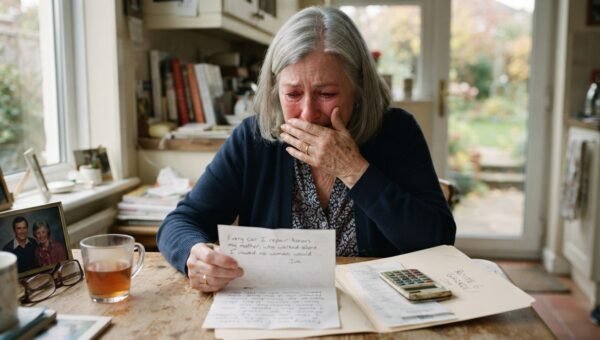
She lived twenty-five minutes away in a quiet subdivision in north county. She had retired two years earlier from the municipal water board and spent most of her weekdays tending her hostas or playing bridge at the community center.
If anyone had the time and the proximity to help me keep my baby fed and safe for two days until Mark walked through the front door, it was her.
She picked up on the fourth ring. Her voice was bright, hurried, and full of bustling background noise.
“Evelyn speaking,” she said.
“Mom,” I said, leaning against the kitchen counter so my weight stayed off my bruised left side. “I was in an accident a few hours ago. A van totaled my car.”
“Oh, for heaven’s sake,” she sighed, her tone shifting instantly from cheerful to irritated. “Were you looking at your phone, Sarah?”
“No. A van ran a red light. The hospital discharged us, but Clara is only six weeks old, and I have three cracked ribs and a sprained wrist. Mark can’t get a flight back until Friday night. I can barely hold her to nurse. I need you to stay with me for two days, Mom. Just two days until Mark gets home.”
There was a rustle of heavy tissue paper over the line, followed by the zipping of luggage.
“Well, that simply isn’t possible,” she said flatly. “You know perfectly well that Sandra and I are leaving tomorrow morning for Fort Lauderdale. Our cruise sails on Thursday.”
“Mom, please,” I begged, the desperation stripping every bit of pride out of my voice. “You’re driving down to the port tomorrow. You have travel insurance. I am stranded in an apartment with three broken bones and an infant I can’t physically lift without screaming. Can’t you postpone it? Or even just come stay tonight and tomorrow so I can find a temporary postpartum sitter?”
My mother let out a small, sharp breath of disgust.
“Your sister never gets into situations like this,” she replied coldly.
The words sat between us like a slap. My older sister, Allison, was an attorney thirty miles away. Allison had no children, drove a brand-new leased SUV, and never asked anyone for a favor.
“I didn’t choose to get t-boned by a delivery van, Mom,” I whispered.
“You’ve always been disorganized, Sarah, and now you expect me to forfeit a four-thousand-dollar vacation because your husband took a job out of town. You’re a mother now. You need to figure it out yourself instead of dragging me down with your drama. I have to finish packing my formal gowns.”
She hung up before I could answer.
I stood in my quiet kitchen, holding the phone against my ear until the screen went dark. In the next room, Clara began to wail for her evening bottle. I squeezed my eyes shut, pressed my bruised wrist against my side to brace my ribs, and forced my legs to move toward the nursery.
PART 2
Those next forty-eight hours were the longest of my life.
Every time Clara needed to be fed, I had to slide my good forearm under her head and keep my elbow locked against my waist so my ribs would not bear her weight. Changing her diaper took ten minutes because I had to manipulate the tabs using only my left hand and the fingertips of my splinted right hand. By midnight of that first night, my pain medication had worn off, and the simple act of leaning over her crib sent shooting spikes through my chest that made me nauseated.
At two in the morning, our downstairs neighbor, Mrs. Gable, knocked on the door. She was seventy-two and walked with a cane, but she had heard Clara crying through the ceiling vent. She came in wearing a quilted bathrobe, took one look at my pale face and the sling on my arm, and took over.
Mrs. Gable heated the bottles. She sat in the rocking chair rocking Clara so I could lie flat on the sofa with an ice pack pressed against my side. On Thursday afternoon, she walked down to the corner pharmacy to pick up my refill and brought back two cartons of chicken broth. She did not ask why my mother was not there. She just washed the bottles in the sink and told me to rest.
Mark arrived at nine on Friday evening. When he walked in with his duffel bag and saw my bandaged arm, my purple chest, and Mrs. Gable folding burp cloths on our coffee table, his face went completely gray. He hugged me so gently it felt like he was holding spun glass, then thanked Mrs. Gable three times and paid her two hundred dollars for her groceries and her time, though she tried hard to refuse it.
Once the baby was asleep and the apartment was quiet, Mark sat beside me on the edge of the mattress.
“Your mother’s car was gone when my cab drove past her street,” he said quietly. “Did she even come over before she left?”
“She left Wednesday night to beat the morning traffic to Florida,” I told him. My voice was completely flat. “She told me Allison never gets into situations like this, and told me to figure it out.”
Mark stared at the floor for a full minute without speaking. When he looked up, his jaw was set. “Okay,” he said. “Then that’s who she is.”
Two weeks went by. The bruising on my collarbone turned a sickly greenish-yellow, and the pain in my ribs settled into a dull, manageable ache whenever I took a deep breath. An insurance adjuster came out, inspected my crumpled sedan in the tow yard, declared it a total loss, and issued a settlement check to cover the loan payoff and a down payment on a modest used crossover.
My mother’s cruise was an eight-day itinerary through the Western Caribbean. She did not call once while she was at sea. She did not send a text asking if we had survived the week, or if Mark had made it home, or if Clara’s pediatrician had found any delayed concussion symptoms from the impact.
Then, on the second Tuesday after the wreck, my phone buzzed on the kitchen island.
It was a text from Evelyn:
*We are back from the port. The weather in Cozumel was simply divine. I bought Clara the most darling handmade embroidered bonnet in George Town. I’ll drive over around two to drop it off and hold her.*
I looked down at the text, then over at Clara, who was sleeping peacefully in her bassinet. I felt a quiet, hard certainty settle in my chest, colder and firmer than any anger I had ever felt.
PART 3
At precisely two o’clock, a car door slammed in the driveway.
I did not rush to unlock the deadbolt. I stayed seated at the kitchen table, a small stack of papers resting squarely in front of me. Clara was in the back room with Mark, who had taken the afternoon off to help me install the replacement car seat in our new vehicle.
The front door opened. Evelyn had a spare key that we had given her when we moved in two years earlier. She swept into the foyer smelling of coconut lotion and expensive gardenia perfume, carrying a glossy paper boutique bag and wearing a bright turquoise linen blouse.
“Oh, Sarah, you should have seen the water in Grand Cayman,” she began, stepping into the kitchen with her sunglasses perched on top of her head. “It was like turquoise glass. And the food on the ship was exceptional. Sandra and I had a private table right by the aft window every single evening.”
She set the boutique bag on the counter and looked around the room.
“Where is my granddaughter? I want to put this bonnet on her before the light changes. The colors are magnificent.”
“She’s resting in the back with Mark,” I said. My voice did not shake.
Evelyn’s smile flickered, just a fraction, as she registered the rigid posture of my shoulders and the black medical splint still wrapped around my right wrist.
“Well, you’re looking much better,” she said, waving a hand dismissively as if brushing away lint. “I told you that you were overreacting on the phone. Cracked ribs hurt, of course, but people manage them all the time. You always had a very low pain threshold as a child.”
“I had three broken bones, Mom. Clara had to be monitored for trauma. I could not physically lift my own child out of her crib to feed her.”
“And you survived,” she snapped, her tone hardening. “You found a way, didn’t you? Mothers do what they have to do. You can’t hold a grudge against me for living my own life. I booked that cruise four months ago. It was non-refundable.”
I reached forward and touched the stack of papers in front of me.
“That’s funny,” I said, sliding the top document across the oak table toward her. “Because while you were at sea, I had to sort through our family emergency contacts and our medical power of attorney files to make sure Mark’s name was primary on everything. And while I was looking for Clara’s birth certificate in the hall lockbox, I found the paperwork from your cruise booking last winter. You left your original confirmation folder in my filing cabinet when you asked me to print your boarding passes.”
Evelyn didn’t move. Her eyes dropped to the paper.
It was the complete terms and policy printout from the cruise line, highlighted in yellow ink.
“You purchased the Platinum Flex Protection plan,” I told her, speaking each word with complete, measured clarity. “Right here in section four. It allowed a full cash refund or an unconditional voucher for up to twenty-four hours before departure in the event of an immediate family medical crisis. You didn’t forfeit four thousand dollars. You wouldn’t have lost a single penny.”
She tightened her lips until they turned white. “That voucher would have taken six months to process, Sarah. I have been planning this trip with Sandra for half a year.”
“I know,” I said. “And that was your choice. But you told me on the phone that you couldn’t help because my sister never gets into situations like this. You made sure to remind me that I was a failure because someone hit my car.”
“I was stressed!” she said, raising her voice, her cheeks flushing red under her fresh tan. “You put me on the spot an hour before my ride arrived! You can’t expect me to drop everything every time your life gets chaotic. I am your mother, not your personal nanny!”
“You’re right,” I said, sliding a second small object across the wood.
It was a small brass key. The key to our front door.
“That’s yours,” I said. “And you need to give me back the copy you have on your ring.”
Evelyn stared at the key as if it were a scorpion. “What are you talking about? Don’t be ridiculous.”
“I am not being ridiculous,” I told her. “When my car was crushed and my baby was crying and I couldn’t move my arms, an elderly woman who lives below us came up and stayed the night because she heard a child in pain. You couldn’t even delay your drive by four hours to help me find a doctor.”
“Sarah, I brought her a gift! I am her grandmother!”
“Being a grandmother means showing up when the roof falls in,” I said. “Not dropping by two weeks later with a ten-dollar souvenir for a photo.”
ENDING
Mark walked out of the hallway into the kitchen. He didn’t yell. He didn’t curse. He simply walked over to the front door, opened it wide, and stood by the frame with his arms crossed over his chest.
Evelyn looked between the two of us. For the first time, the smug, superior irritation completely vanished from her face. She looked smaller, caught in the stark light of the kitchen with her bright tourist blouse and her expensive perfume that suddenly smelled completely out of place in our home.
She reached into her purse, pulled out her keychain, and unhooked our spare brass key. She tossed it onto the table. It made a sharp, clattering bounce before coming to rest next to the travel insurance policy.
“If you do this,” she whispered, her voice tight with venom, “do not expect me to come running the next time you need something.”
“Mom,” I said, looking her directly in the eyes. “I will never ask you for anything ever again.”
She grabbed her designer boutique bag off the counter, turned on her heel, and walked out the door. Her sandals clacked sharply against the concrete steps as she marched down to her car. Mark closed the heavy door behind her and turned the deadbolt until it clicked.
The silence that followed was not heavy. It felt clean.
That evening, Mark and I put Clara to bed in her nursery. I was able to lift her on my own, though my ribs still let out a dull, aching protest when I set her gently onto the mattress. She curled her small fingers into tiny fists, sighed in her sleep, and drifted off under the warm glow of the nightlight.
In the kitchen, the brass key still sat on the wooden table next to the folded paper. I picked the key up, walked over to the junk drawer by the refrigerator, and dropped it into an old envelope marked for the lockbox.
I knew my mother would tell Allison her own version of what happened. She would say I was ungrateful, that I had thrown a tantrum over a vacation, that I was punishing her for taking a trip she had earned. But for the first time in my life, her opinion had no weight in my house.
I turned off the kitchen light, walked into the living room, and sat down on the couch next to my husband to watch the evening news.