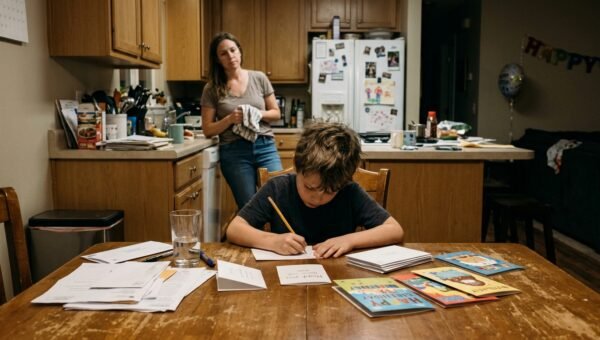
I was reaching for the recipe box when it slid off the pantry shelf and hit the floor. The bottom cracked open, and old cards fanned across my feet. I bent to pick them up, then saw a piece of wood hanging loose under the base. Four years after Brenda threw that box at me and took Mom’s house, I found out it had been hiding the one thing Brenda couldn’t take.
The box was scratched and greasy at the corners. Mom had kept it by the stove for as long as I could remember, with recipes in her small, slanted handwriting. I knew the card for her cornbread by the brown butter mark near the word “milk.” I don’t know why I remember that. Maybe because I’d made it for her so many times when she got too tired to stand.
When I lifted the loose panel, a folded deed and a bundle of stock certificates slid out. Under them was a note. I saw “Arthur Miller” in Mom’s handwriting and stopped moving for a minute. I still had the box balanced on one knee, like I was afraid the contents might fall away again.
Four years earlier, Brenda had stood in Mom’s kitchen with a power of attorney in her hand. The paper was signed 21 days before Mom died.
By then Mom was confused some days and sharp on others, and Brenda had started coming around more often, always arriving alone and closing the bedroom door behind her.
I’d been staying with Mom most nights. I helped her wash up, kept track of her pills, and drove her to appointments. Brenda said I was making Mom dependent on me. I said someone had to be there. We both knew I’d been there for years.
That day, Brenda handed me the recipe box. I remember the little blue bowl on the counter, because Mom had left a spoon in it with the oatmeal dried on. Brenda shoved the box against my chest hard enough that I had to catch it with both hands.
“Take this kitchen junk and get out.”
I asked what she was talking about. Brenda held up the power of attorney and told me the house was hers to manage now.
She said Mom had agreed. I looked past her toward the hall, but Mom was in her room and didn’t come out. I wish I’d gone to her anyway. I was angry, and I was ashamed that I couldn’t make Brenda stop.
The house was worth $310,000. I’d lived there most of my life, except for the years I tried to make a separate life and came back when Mom needed help. Brenda said she was going to sell it. I didn’t have a lawyer, and I didn’t know what a power of attorney could or couldn’t do. I left with the recipe box and two bags of clothes.
For four years, Brenda rented the house out and tried to sell it. I heard about the tenants from a neighbor, then saw the listing online. The price was still $310,000. I was working split shifts at the feed store and picking up cleaning jobs when I could.
I told myself I didn’t want the house badly enough to fight my sister over it.
That wasn’t the whole truth. I was tired, and Brenda had always been good at making me feel like asking for anything meant I was greedy.
I unfolded the deed on my kitchen table. It was dated 1994. There was an attorney’s seal near the bottom and a docket number I didn’t recognize. Mom’s note was tucked inside the fold, written on the back of a grocery list.
“Take this deed straight to Judge Miller if Brenda ever tries to steal my house.”
The stock certificates were for $95,000. They were in my name, not Mom’s. I checked twice. Then I put everything back in the box, wrapped it in a dish towel, and called the number I found for Arthur Miller’s office.
A woman answered and told me Judge Miller was in chambers. I said my mother was Eleanor, and I had a deed he’d signed in 1994. The woman asked me to wait. A few minutes later, Judge Miller came on the line.
“Bring the box to my office,” he said. “And don’t call Brenda yet.”
I drove there the next morning with the box on the passenger seat. The courthouse was across the street from his former law office, and I kept glancing between the two buildings as I parked. I felt silly carrying an old recipe box into a place full of people with briefcases. Then I remembered the deed inside it and held on tighter.
Judge Miller was older than I remembered, with white hair and a slow way of getting up from his chair. He didn’t greet me with a big speech. He set the box on his desk and looked at the deed for a long time.
“That’s my signature,” he said.
He took a folder from a locked cabinet. Inside were copies of the deed, a notarized counterpart, and a ledger with Mom’s name written at the top. He said Mom had come to him in 1994 after Brenda took money their father had set aside for emergencies. Brenda had already received help from Mom more than once, including cash and money for a business she never paid back.
Mom had also been trying to keep the house. She’d worked two jobs and used her own savings and a small inheritance from her father. I’d given up the money I’d saved for college to help pay off the remaining private mortgage note. At the time, Mom said she’d repay me when she could. She never did, and I never asked her to.
Judge Miller explained that Mom had made a life estate deed. She could live in the house for the rest of her life, but the remainder belonged to me. The deed was recorded. The paper in the recipe box was my copy, not the only proof.
“She wanted you to have the house,” he said. “She also wanted a record that couldn’t be talked away.”
I sat there with my hands in my lap. I’d been mad at Mom for years in ways I didn’t like admitting. I thought she’d let Brenda take the house because Brenda had always been louder, more certain, and better at acting like a decision had already been made. I hadn’t known Mom had done this for me.
Judge Miller said the power of attorney couldn’t transfer property Mom had already conveyed. Brenda’s transfer into an LLC was improper. The county records showed Brenda had tried to put the house under her control, and the listing showed a closing scheduled in two weeks.
I had to ask him to repeat that last part. Two weeks. Brenda was close to selling a house she didn’t own.
I expected him to tell me to call a lawyer and leave it at that. Instead, he brought in a separate attorney from his former firm and gave her the archived copies. He explained that because he was now a judge, he couldn’t act as my lawyer or decide the case himself. But he could verify the records and provide a sworn statement about what Mom had signed and why.
The attorney filed an emergency notice against the property, a lis pendens, to stop the sale while the title was sorted out. She also requested a full accounting of the rents Brenda had collected. The county records and the bank trail showed that Brenda had tried to divert dividends from the stock account too. Mom had named me as the beneficiary, and the certificates in the box matched the account records.
A day later, Judge Miller asked Brenda to come to his former office for a meeting with our attorneys. I almost didn’t go. I knew how she could make me doubt myself, even when I was holding proof in my hands. But leaving would have meant she got to tell the story again, and I was done letting her do that.
Brenda walked in carrying a folder and sat without looking at me. She said the sale was a done deal and the house had been hers to handle under Mom’s power of attorney. Then she saw the copies of the deed and stopped.
Judge Miller laid out the recorded deed, the notarized counterpart, the lis pendens, and the stock records. He spoke plainly. Brenda could sign a quitclaim and a settlement, give up every claim to the house, and repay the money taken from the rents and dividends. Or the documents would go to the county prosecutor along with the evidence of the false transfer.
Brenda looked at me, not him. She said Mom had been confused and that I’d taken advantage of her. I asked why she’d waited until Mom was too sick to argue with her.
She didn’t answer. She looked down at the deed.
The attorney explained the terms line by line. Brenda’s face tightened as the list of rent payments came out. She had collected money for four years while I was struggling to pay rent on a small place outside town. I can’t say that made me feel good. It made me feel sick, mostly. But I wasn’t going to rescue her from what she’d done.
Brenda started crying when she signed. It wasn’t the kind of crying that asks forgiveness. She looked furious with the pen, the papers, me, probably Mom too. I watched her sign away every claim.
She asked if I’d take a cash payment instead and let her keep her part of the sale. The offer was less than what she’d taken from the rents. I said no. It was the first time I’d ever said no to Brenda without adding an apology after it.
The sale was stopped. The lockbox came off Mom’s porch. The county records were corrected, and the house was put in my name alone. The $95,000 in stock was transferred into my verified account. Brenda repaid the part of the rental money the settlement required, and our contact ended there.
I didn’t call her after. She didn’t call me. I used to think that meant I’d failed to keep my family together. Now I think I spent a long time trying to keep something together that Brenda had already decided was hers to break.
I moved back into Mom’s house. The garden had gone to weeds, and one kitchen cabinet door sagged, but the place still smelled faintly like the lemon cleaner she used. I fixed the cabinet, pulled the dead vines out by the back steps, and put the cornbread card back in the recipe box.
The box had split along one side when it hit my pantry floor. I glued it and polished it as best I could. The deed is in a safe place now, not hidden under the recipes. The box sits squarely in the middle of Mom’s kitchen counter, beside my morning coffee, right where she used to keep it.