PART 1
“You’ve always treasured worthless things, Sarah,” my sister Claire said, shoving the cardboard box across Mom’s kitchen table.
She did not even look at me when she said it. She was too busy flipping through the deed paperwork with our brother, Wayne.
Mom had been buried four days earlier. For four long years, I had slept on the sagging pull-out sofa in Mom’s front room, administering insulin, pureeing squash, washing stained bedding, and spoon-feeding her while she drifted in and out of dementia.
Wayne lived forty minutes away and visited on Easter if the weather was nice. Claire lived two towns over and claimed the smell of Mom’s medical supplies gave her migraines, so she stayed away entirely except to drop off expired canned goods or ask if Mom had signed her updated paperwork yet.
Then the will was read in attorney Miller’s small downtown office.
Claire got Mom’s four-bedroom colonial house, completely paid off, plus $145,000 in liquid savings. Wayne got the forty-acre timber property outside town that our grandfather bought in the fifties.
I received twelve ceramic farm-animal-shaped spice and pantry jars.
When the lawyer read that clause out loud, Claire let out a dry little chuckle into her silk scarf. Wayne just stared at his boots, clearing his throat and pretending to find a scuff mark terribly interesting. Neither of them offered me a penny to help cover the back taxes on my own small duplex, which I had nearly lost after cutting my library hours down to part-time so Mom wouldn’t end up in an understaffed county home.
“You can take them today,” Claire had told me when we stopped by the house to grab my remaining toiletries. “Actually, take them right now. I have a contractor coming on Monday to gut the kitchen. Everything on those open shelves is going into the dumpster anyway.”
I didn’t answer her. Arguing with Claire was like trying toReason with a gravel road. I packed my clothes, lifted the dusty cardboard box holding the twelve heavy, painted jars, and carried it down the front steps I had swept every single morning for four years.
That evening, my duplex felt so quiet it made my ears ring. The kitchen counter was small, barely wide enough for a dish rack and a cutting board, but I lined the ceramic animals up along the laminate back-splash. There was a speckled hen, a cow with chipped horns, two sheep, three ducks, a pair of roosters, two goats, and a round, pink pig meant for lard or brown sugar.
They were coated in forty years of cooking grease and wood-stove soot.
I filled the sink with hot water and lemon dish soap, grabbed an old rag, and started scrubbing them one by one. I wanted them clean because they had sat above Mom’s stove my entire childhood, back before our father walked out, back when Mom used to hum old hymns while frying corn fritters on Tuesday nights.
The rooster came clean first. Then the cow.
When I reached for the pig, I noticed how heavy it was compared to the others. It was easily four times the weight of the rooster. I gave it a gentle tilt toward the dishwater.
Something inside gave a soft, muffled thud.
I set it down on a dry tea towel. The ceramic lid was shaped like a pig’s snout and ears, fitted with a faded rubber seal that had dried into crusty orange rings. I gripped the sides, gave it a firm twist, and pulled.
The lid popped loose with a dull suction sound.
Tucked tightly into the neck of the jar, shoved down with deliberate force, was a faded yellow dishcloth with blue stitching along the hem. It was the cloth Mom kept by the kettle.
I reached in with two fingers and tugged the cloth free.
Underneath it wasn’t lard, sugar, or ancient pennies. Tightly rolled and banded with thick black electrical tape was a cylinder of dense, pale parchment, and beneath that, nestled in the bottom belly of the ceramic pig, sat a flat metal key stamped with the logo of First National Union Bank.
PART 2
The parchment crackled faintly when I unrolled it across the kitchen table.
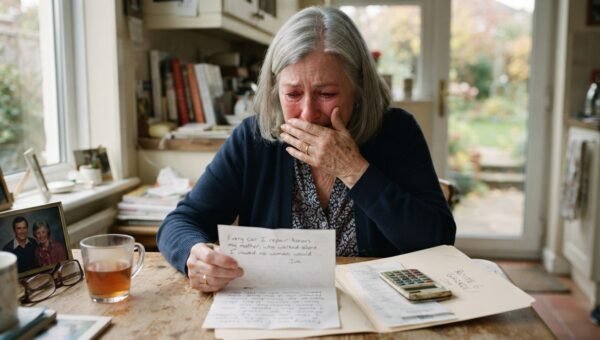
It was not a lawyer’s official draft. It was three pages from a yellow legal pad, written in Mom’s shaky, deliberate handwriting with blue ballpoint ink. The date at the top of the first page was October 14, three weeks before she suffered the stroke that took away her ability to speak.
“My dear Sarah,” the first page began. “If you are reading this, Claire has taken the house and Wayne has taken the timber, just like they demanded when they brought that young notary into my bedroom while you were at the grocery store.”
My hands started shaking so badly the paper fluttered against the table.
The letter went on to explain what had happened on a rainy Tuesday two months prior. Claire had shown up with a mobile notary and a revised will already drawn up, cornering Mom while I had run to the supermarket to pick up adult briefs and prescription drops. They told Mom that unless she signed over the property and the accounts to protect them from Medicaid recovery, the state would seize the house and throw her into a state ward. Mom had been frightened and confused, but she wasn’t completely gone yet. She had signed the paper Claire shoved in front of her, but the moment they walked out the door, she knew what they had done.
The second page explained the key.
“The $145,000 in the checking account was all Claire saw,” Mom wrote. “She never looked at my cedar hope chest. She never knew your father carried a paid-up private whole life annuity that matured in July. Safe Deposit Box 414 at First National Union is in both of our names, Sarah. You signed the signature card with me ten years ago when your father passed. The contents belong entirely to you. Take this key and take the duplicate deed filed in the red folder inside. Let Claire have the house. The foundation has been cracked since 2018 and the roof is rotting. Do not pay for her mistakes.”
Attached to the back of the yellow paper was an official bank receipt dated July 9, stamped by First National Union Bank, confirming the deposit of a certified cashier’s check for $218,400 into Safe Deposit Box 414, along with the original title deed to an unencumbered commercial rental lot on Route 9 that our grandfather had deeded directly to Mom before he died.
Mom had kept her mouth shut for three full months, watching Claire swagger through the rooms measuring for new drapes, watching Wayne demand the keys to the timber gate. She had given them exactly what they fought over, knowing it was hollow, while quietly protecting the daughter who stayed to wash her back.
I sat alone at my kitchen table until past two in the morning, listening to the hum of my refrigerator, reading that letter four times until the words burned into my memory.
At eight sharp the next morning, I drove down to First National Union on Main Street. The manager, a gray-haired man named Mr. Henderson who had gone to school with my older brother, took one look at my driver’s license, checked the signature card in his heavy steel ledger, and led me into the quiet, carpeted vault.
“Your mother told me you’d be in eventually, Sarah,” Mr. Henderson said softly, sliding the long metal box out from the wall. “She was very clear that this box was never to be listed under the probate inventory because it was established as a joint tenancy with right of survivorship back in 2014.”
I sat in the small private booth and opened the box.
Everything Mom wrote was there. The cashier’s check had been converted into a joint high-yield certificate of deposit bearing my name alone, worth exactly $218,400. Beside it lay the clear commercial deed for the Route 9 parcel, currently leased to an agricultural supply company for $1,800 a month on a ten-year contract.
I didn’t call Claire. I didn’t text Wayne.
I took the documents, went to an independent estate attorney two counties over, and had every record verified, registered, and secured under my sole legal name. Then I went home, washed the remaining ceramic jars, and put them in a neat row above my modest stove.
Two weeks later, my phone rang. It was Claire.
PART 3
“Did you take Mom’s jewelry box?” Claire snapped without saying hello. “The mahogany one that used to sit on her vanity?”
“Mom gave that to our cousin Martha two Christmases ago, Claire,” I said calmly, leaning against my kitchen counter. “You would have known that if you’d come to dinner.”
Claire scoffed. “Well, it’s not here. And neither is the title for the riding mower. Wayne took that already, the selfish pig. Look, the contractor pulled off the basement drywall this morning. Did you know the north foundation wall is bowing inward? He says it’s going to cost at least $45,000 to dig out the perimeter and put in steel piers. Did Mom ever mention that to you?”
“She mentioned it,” I said.
“Why the hell didn’t you fix it while you were living here rent-free?” Claire yelled. “You lived off her for four years while Wayne and I paid our own mortgages! Now I have this money pit, and the probate lawyer says the $145,000 in savings has to sit in escrow for four months because of outstanding medical bills from county hospice!”
“I didn’t live rent-free, Claire,” I replied, my voice steady. “I gave up my full-time salary and my pension contributions to change her diapers so she wouldn’t die alone in a ward. You chose the house. You hired the notary to make sure you got it.”
Claire went dead silent on the line.
“What did you say?” she whispered.
“I know about the Tuesday in October, Claire. I know you brought the notary while I was buying groceries. Mom knew what you were doing. She just didn’t have the energy to fight you.”
“She didn’t have anything else to give, Sarah!” Claire fired back, her voice climbing into an ugly, shrill panic. “She gave Wayne the timber and me the house! You got the junk you deserved! You always were the charity case of this family!”
“I have Safe Deposit Box 414, Claire.”
The silence on the line stretched out so long I could hear the faint sound of a truck passing on the road outside her window.
“What is in that box?” Claire demanded. Her voice cracked. “Mom didn’t have another box. I went through all her dresser drawers. I found every account statement!”
“She opened it with me in 2014, with right of survivorship,” I said plainly. “Her annuity payout was deposited there in July. Along with the deed to the Route 9 commercial lease. None of it is part of the estate. None of it touches probate. And none of it belongs to you or Wayne.”
“You stole that from us!” Claire screamed. “That’s estate property! I’m calling Miller right now! We’re contesting it! You manipulated her while she was senile!”
“Call whoever you want,” I said. “Mr. Henderson has the signed survivorship card from twelve years ago, long before Mom ever got sick. And Mom left a dated letter explaining exactly why she did it, including the names of the mobile notary you hired and the threats you made about Medicaid. If you want to challenge it in front of a county judge, I will gladly bring that letter into open court.”
Claire started to say something, but her breath caught in her throat. She hung up hard enough to rattle the speaker.
Twenty minutes later, Wayne called.
His tone was completely different. It was soft, hesitant, the voice he used whenever he wanted to borrow Dad’s pickup truck back in high school.
“Hey, Sarah,” he muttered. “Claire just called me in a complete rage. She said some crazy stuff about an annuity and the Route 9 land. That can’t be right, can it?”
“It’s completely right, Wayne.”
“Sarah, come on,” he pleaded. “The timber land is tied up in a conservation easement I didn’t know about. I can’t log it for another six years, and the property taxes are four grand a year. Claire won’t give me a dime from the savings account. We’re family. Mom wouldn’t want you hoarding everything while Wayne and Claire are sinking.”
“Mom begged you to visit her on her seventy-eighth birthday, Wayne,” I said, looking out my small window at the autumn leaves blowing across the driveway. “You told her your hunting club had a mandatory meeting. You didn’t come. You didn’t call. When she asked for you at the end, I had to hold her hand and lie to her, telling her you were stuck in traffic.”
“I was busy, Sarah! I have a life!”
“You had forty minutes of driving, Wayne. That was the distance between you and your mother. Now don’t call this number again unless it’s an emergency.”
I hung up the phone and turned it completely off.
ENDING
Six months passed before the dust finally settled.
Claire tried to bluster with attorney Miller, but the moment Miller reviewed the 2014 bank documents and Mom’s handwritten letter, he told her in plain language that contesting a survivorship account with proof of undue influence regarding her own notary stunt would only open her up to personal liability. She backed down.
She ended up having to sell Mom’s house in an ‘as-is’ cash sale to an investor because she couldn’t afford the foundation repairs, walking away with barely half of what she thought the house was worth after paying off Mom’s final hospital deductibles. Wayne put the timber acreage up for sale at a steep discount just to get out from under the tax assessment.
Neither of them has spoken to me since November.
I didn’t spend the $218,400 on anything reckless. I paid off the remaining $34,000 balance on my modest duplex, replaced my ten-year-old sedan’s worn brakes, and put the rest into a safe, conservative index fund to rebuild the retirement savings I had drained while taking care of Mom. The monthly $1,800 rental check from the Route 9 property pays my utilities, my property taxes, and my groceries, allowing me to stay at the local library three days a week doing work that actually brings me peace.
Yesterday morning, I spent an hour cleaning my kitchen.
The twelve animal jars sit in a neat line above my spice rack, completely spotless now. The morning sun catches the chipped horns on the little cow and reflects off the glazed white feathers of the hen. In the center sits the round pink pig, empty now, its lid resting loosely in place.
Claire thought Mom had left me worthless junk. But Mom had known my sister better than anyone else alive. She knew Claire would look at those jars, see only clutter, and hand over the one thing that held the truth.
Every time I brew my morning tea, I reach up and tap the ceramic snout of that little pig. It isn’t about the money, though the money saved my life. It is knowing that while I stood in that quiet room wiping Mom’s brow, she was looking back at me, seeing everything, and making sure I would never have to be at anyone’s mercy again.