The second coffee was already paid for when Marcie set it beside my pie. I hadn’t ordered it. I was sitting alone in Booth 4, the same booth where Richard and I had our first date, and the man by the window had been waiting since noon.
I’d come in at 1:15 on Thanksgiving Day. That morning, Richard had told me he couldn’t come because his mother expected us at home.
So I ordered the cherry pie we used to share and tried not to look at the empty seat across from me.
For years, Richard hosted Thanksgiving and let his family call me “the helper” while I cooked. I thought I was finally taking one small day back. I didn’t know he’d already tried to take the table from me, too.
Marcie gave the coffee a little push toward me. “That’s from Walter,” she said, nodding toward the window booth. “He’s been here a while.”
The man stood up slowly. He was older than I remembered, of course, but I knew him before he reached us. Walter had owned the diner when Richard and I were young. He used to bring our coffee without asking because we never had enough money to order a second cup.
“Celia?” he said. He used my maiden name.
I touched the handle of the coffee cup. It was warm, and my fingers were cold from the drive. “I haven’t heard that in a long time.”
“I figured you might still answer to it,” he said. “Mind if I sit?”
I said yes. I was trying to understand why a man I hadn’t seen in twenty-five years had waited for me on Thanksgiving. Walter looked at the slice of pie and then at the empty side of the booth.
“You ordered the cherry,” he said.
“Richard used to like it.”
Walter nodded. He didn’t say anything about the empty seat. That was kind of him.
The diner smelled like coffee and the cinnamon from the pie case. The vinyl on the booth had a split near my knee. I remembered it because Richard had put his finger in the crack on our first date and said the place was held together by good coffee and stubbornness.
We were twenty-five years younger then. I’d been working at a pharmacy, and Richard had just started at a small insurance office.
We were broke enough to split pie, but we talked like we had all the time in the world. He told me we’d make decisions together. I believed him. I suppose I wanted to.
“Walter, why were you waiting for me?” I asked.
He glanced toward the counter. Marcie was taking an order from a family with two little kids. Walter waited until she was busy, then rested both hands on the table.
“Richard came by around eleven-thirty,” he said. “He wanted me to cancel your reservation.”
I stopped holding the cup and set it down. The coffee gave a small shake in its saucer.
“He said he couldn’t come because his mother expected him at home.”
“I know,” Walter said. “He told the staff you were being dramatic and would be home cooking where you belonged.”
For a second, I couldn’t make myself look at Walter. I looked instead at the pie fork, which had a tiny bend at the end.
I remember that detail. I don’t know why. Maybe because it was easier than taking in what he’d said.
Walter explained that he’d come in that morning to help the holiday crew get ready. He was retired, but he still checked on the place. The new owners were short-handed, and Marcie had asked him to cover the front for a while.
When Richard came in, Walter had been near the back. He heard enough to know he wasn’t asking to change a reservation. He was trying to make sure I wouldn’t have one.
“He wrote something on the reservation card,” Walter said. “I kept it.”
I wanted to ask why. But Walter had been watching Richard and me for a long time, even if he hadn’t seen us in years. He said his sister had spent her life being useful to a man who let everyone else treat her like she was lucky to be there. Walter said he’d watched it happen and hadn’t said much at the time.
“I should’ve spoken up for her,” he said. “I didn’t. I’m not doing that today.”
He reached into the pocket of his cardigan and brought out a yellow card. The paper was folded once. I knew Richard’s handwriting before Walter opened it. I knew the forward lean of the letters, the way he never closed the top of his lowercase a.
The note said: “Canceled. She’ll be home to cook where she belongs.”
I read it once. Then again.
There was no misunderstanding in those words. No rushed message. No bad day at work. Richard had driven to the diner while I was getting dressed, canceled the table I’d reserved two weeks earlier, and left that note like he was making a grocery list.
I had spent years explaining him to myself. He didn’t mean it like that. His mother was hard to manage. Thanksgiving mattered to Evelyn. Richard hated conflict. Those explanations had become so familiar I could say them before anyone asked.
I’d been doing the same thing for the word “helper.” Evelyn started using it years ago, when Richard and I began hosting Thanksgiving at our house. She’d come in with her purse and a list of instructions, and I’d be at the stove before the turkey was done thawing.
“Where’s my helper?” she’d call from the dining room.
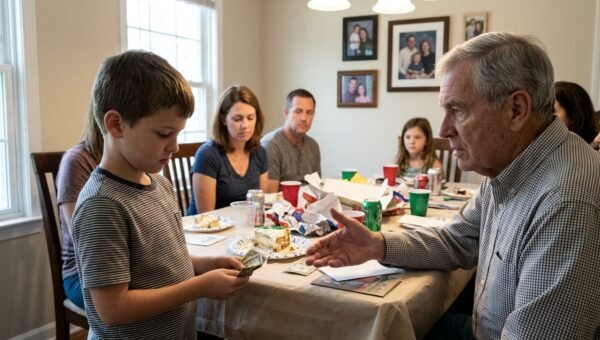
At first I laughed because I thought it was a joke. Richard laughed too. That made it harder to say anything. Then it became what she called me every year. She’d ask me to bring another dish, refill the water, check the rolls. I’d spend fourteen hours moving between the kitchen and dining room, while Richard talked with his brothers and sat with his mother.
The first year, he did help. He carved the turkey and took out the trash. After that, it seemed to become my job, and I let it. I’m not saying I had no part in that. I kept smoothing things over because I wanted the day to go well. I wanted Richard to see what I was doing without my having to ask.
He saw. He just didn’t think it was something he needed to change.
Two weeks before Thanksgiving, I told him I wasn’t cooking this year. I’d called the diner and reserved Booth 4 for one o’clock. I picked that place because of our first date, though I didn’t tell myself that was the whole reason.
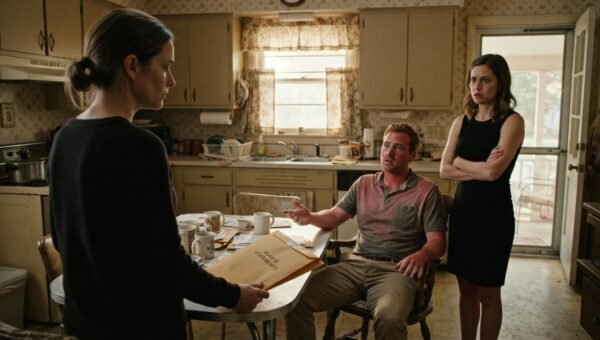
Richard looked up from his phone and said his mother expected us at home. I told him she could come to the house, but I wasn’t making dinner. He said I was making a big deal out of one holiday. I said I’d spent years making a small deal out of it.
That morning, he tried again. I was putting on my coat when he said we had to host Evelyn as usual. I told him I was going to the diner. He said he couldn’t come because his mother expected us at home.
“Then stay,” I said.
I didn’t shout. I don’t think I’d ever seen him look so sure I’d change my mind.
At home, there was no turkey in the oven. No bowl of potatoes by the sink. I’d left the kitchen clean the night before, and it stayed that way. Richard sat in the living room while I got dressed. The house was quiet enough that I could hear the zipper on my bag.
I drove to the diner alone. I almost turned around at the light by the hardware store. I don’t know. I think part of me still expected Richard to call and say he’d changed his mind. He didn’t.
Back in Booth 4, Walter sat with me while I read the card. He didn’t tell me what to do. He didn’t say I deserved better or that everything would be fine. He just let me sit there with the proof.
“Did he say anything else?” I asked.
“Only that you’d come around.”
That was worse than the note, in a way. He’d been so sure my choice didn’t count. He thought I’d be upset for an hour, then go home and do what I’d always done.
My phone started ringing in my purse. Richard. I let it stop. A few minutes later, it rang again. Then a text came through. I didn’t open it.
Walter looked toward the purse. “You don’t have to answer.”
“I know,” I said. “I know.”
But I still reached for it. My hand had the old habit. I’d spent so long trying to stop bad feelings before they spread through the family. I was always the one smoothing out the day. I’d even gotten good at telling myself that was the same as being loved.
I took the phone out. Richard had called twice. Evelyn had called once. I could imagine the dining room at home, people arriving, Evelyn asking where I was, Richard claiming he didn’t know. Then I pictured the kitchen and the empty counters. There was no food to save, no dinner to rescue.
I called him.
He picked up after the second ring. “Where are you?”
“At the diner.”
“You’re still there?”
I looked at the yellow card. Walter sat quietly across from me, letting me take the call myself.
“Your note says, ‘Canceled. She’ll be home to cook where she belongs.’”
He didn’t answer right away.
“You went there?” he said.
“I’m reading what you wrote.”
“I was trying to keep things from getting out of hand,” he said. His voice sounded tired, like I was making his day harder.
In the background, I heard Evelyn say something about there being no dinner. She sounded angry. I heard a chair scrape, then Richard told her to wait.
“You told me you couldn’t come because your mother expected you at home,” I said. “But you came here to cancel my table.”
“It was a stupid note.”
“It was your note.”
He started to explain that I’d made the whole thing difficult. Then he said I could come home and they’d figure out something to eat.
That was when I stopped waiting for him to say the right thing.
“The helper has officially quit,” I said.
Richard went quiet. I heard Evelyn again, louder this time. I hung up.
The phone rang as soon as I set it down. I turned it off. Not just silent. Off. It felt like a small thing, but my thumb hovered over the button for a few seconds before I pressed it.
Walter didn’t clap or smile like I’d done something brave. He asked if I wanted more coffee. I said yes. He poured it from the pot Marcie had left nearby.
We talked a little. Not about whether I’d leave Richard. Not right then. Walter told me he’d kept the diner open after his wife died because he liked having somewhere to go in the morning. He asked if I had a place to stay. I said there was a bed-and-breakfast a few miles away, and I could call from the pay phone by the register.
“You can take the time you need,” he said.
I was nearly sixty, and I’d spent a long time acting like my time belonged to whoever asked for it first. I’d wanted Richard to notice. I’d wanted Evelyn to be grateful. I’d wanted to be invited to sit down after cooking the food.
I had been waiting for a thank-you that would make the years feel fair. It wasn’t coming.
At the counter, I called the bed-and-breakfast and booked a room for the long weekend. I told the woman I needed three nights. I didn’t give her a reason. Then I called a lawyer’s office and left a message asking for an appointment about a separation.
I wasn’t ready to know what every next step would cost. I was ready to stop going back for one more night of pretending.
When I returned to the booth, the pie was still there. My phone was off in my purse. The coffee had cooled, so Marcie brought me a fresh cup without asking for money.
I took my house key off my ring and left it on the table beside the yellow reservation card. Richard could find it when he came looking for me. I didn’t leave a speech. I didn’t leave an apology.
Walter walked me to the door. I thanked him for keeping the table.
“I’m glad you came,” he said.
Outside, the air had that sharp November bite that makes your eyes water a little. I drove to the bed-and-breakfast and checked in under my own name. I told the woman at the desk I’d be staying through Sunday.
I didn’t go home that night. I didn’t turn my phone back on. Richard and Evelyn had an empty dining room and no Thanksgiving dinner, and I had no plan to fix it for them.
The next morning, I sat by the window in my room and ate the rest of the cherry pie I’d wrapped to take with me. It was a little dry by then. Still sweet.
I ate it slowly, with no one calling me back to the kitchen.