PART 1
The water was still lukewarm when Clare called. My knees were pressed against the bath mat, my jeans soaked at the cuffs, and the air smelled like strawberry bubblegum shampoo. Maya was six, splashing suds up to her elbows and making little soapy beards on her chin.
“Look, Mom, I’m an old sea captain,” she said, giggling.
My phone started buzzing against the porcelain edge of the sink. I wiped my right hand on a faded yellow towel and answered on speaker.
“Clare? Can you hold on five minutes? I’m just rinsing Maya’s hair.”
There was a ragged hitch on the other end of the line. Clare was breathing fast, the kind of shallow, jittery breath she always took when she was about to make an excuse for something she had already done.
“I’m sorry,” Clare whispered. Her voice sounded brittle, like dried paper. “I had to do what’s right for the kids. CPS will be there tomorrow morning.”
The line went dead with a soft click.
I stood there holding the phone against my ear for three or four seconds, listening to the flat silence before the call screen reset. In the tub, Maya was scooping foam with a plastic yellow cup.
“Mom? You got soap in your sleeve.”
“I see it, baby,” I said. My voice sounded thin to my own ears, like someone else speaking from the hallway. “Lean back for me. Keep your eyes squeezed tight.”
I rinsed her hair with the plastic cup. I wrapped her in the oversized green bath towel with the frayed hem, carried her into her bedroom, and helped her into her flannel pajamas with the little gray foxes on them. I read her three chapters of the book about the mouse who lived in a bakery, tucked the quilt under her chin, and waited until her breathing settled into that deep, rhythmic hush of a sleeping child.
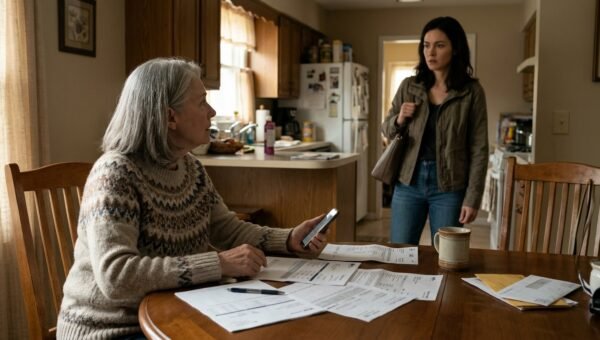
Then I walked into the kitchen and sat down at the table.
Clare was my younger sister by four years. For eight months, she and her eight-year-old boy, Toby, had been living in my spare bedroom down the hall. Our parents passed away when I was twenty-two and Clare was eighteen, leaving us an older split-level home with a cracked concrete driveway in a quiet suburb of Cincinnati.
Clare never held down a steady job for more than six months at a stretch. She bounced from cashier gigs to salon apprenticeships, always leaving because a manager was unfair or the hours cut into her personal life. When her landlord evicted her in October after three months of unpaid rent, I took her in. I bought Toby’s school shoes, packed his lunch every morning alongside Maya’s, and never asked Clare for a single dime toward groceries or the electric bill.
The only tension had started two weeks ago.
Clare’s ex-boyfriend, a man named Marcus who had spent eighteen months in county jail for grand larceny and domestic battery, had gotten released. Clare wanted Marcus to move into my basement. She said Marcus was a changed man, that Toby needed a father figure under the same roof, and that Marcus could do odd jobs around the yard to earn his keep.
I told her no. I told her clearly, sitting right at this kitchen table.
“Clare, you can stay here as long as you need to get on your feet,” I had told her. “Toby has a home here. But a man with a violent record is not sleeping under the same roof as my daughter. That is not up for discussion.”
Clare had slammed her coffee mug onto the counter, her eyes hot and wet with fury. “You think you’re so much better than everybody else, Nora. You think you’re the queen of this family because you pay the property taxes. Well, you don’t own me, and you don’t get to dictate my happiness.”
Three days later, Clare packed two duffel bags, pulled Toby out of third grade without telling me, and moved into Marcus’s rundown rental duplex across town. That was on a Thursday.
Now it was Tuesday night. And she had just told me Child Protective Services was coming for Maya.
I spent the next six hours on my feet. I didn’t sleep a wink. I scrubbed the kitchen counters until the laminate smelled like lemon bleach. I threw out two bruised apples from the fruit bowl. I folded Maya’s clean laundry that had been sitting in the wicker basket near the dryer. I organized her pediatric immunization records, her dental receipts, and her school attendance reports into a crisp blue folder and set it by the front door. I checked every lock on the windows. My stomach felt like an iron weight swinging inside an empty cage.
At 7:00 A.M. sharp, the authoritative pounding came.
Three heavy thuds rattled the brass knocker against the wood of my front door.
I took one slow breath, smoothed down my sweater, and opened it.
Standing on the porch was a tall woman in a dark gray wool coat carrying a thick leather binder, flanked by two uniformed county police officers. The woman had short, silver-streaked hair cut blunt at her jawline and a county identification badge clipped to her lapel.
“Nora Vance?” she asked.
“Yes,” I said.
“My name is Agent Miller with Hamilton County Job and Family Services,” she said, her voice completely neutral, neither hostile nor kind. “We have received an urgent report regarding the immediate welfare of a minor child, Maya Vance. These officers are here to assist me. We have an emergency removal petition signed by an on-call magistrate based on allegations of severe neglect, active substance use, and an unsafe domestic environment.”
Behind her, the cruiser at the curb had its yellow parking lights blinking against the morning frost.
My mouth went completely dry. “There’s no neglect here. There’s no substance use. My sister called you, didn’t she?”
“Ma’am,” Agent Miller said, stepping onto the threshold. “We are legally required to execute this order and take temporary physical custody pending an emergency shelter hearing. Where is Maya right now?”
PART 2
The next twenty minutes felt like someone had removed all the air from the house.
I didn’t yell. I knew from ten years of working as an office clerk for a county transit authority that if you raise your voice at an officer with an order, you lose your child on the spot and you leave in handcuffs.
“She is asleep in her bed,” I said, keeping my hands visible, resting flat against the doorframe. “You can come in. But you need to let me wake her up gently. She is six years old. She has never seen a police officer inside her house.”
Agent Miller gave a brief nod to the older of the two officers, a burly man with graying temples named Officer Harris. “You may wake her, Ms. Vance. Officer Harris will accompany you to the doorway of the bedroom.”
I walked down the hallway with my legs trembling so violently I had to brush my fingers along the drywall to steady myself. Maya was still tucked under her fox quilt, her hair messy from sleep, hugging a faded stuffed rabbit.
“Maya,” I whispered, kneeling by her mattress. “Time to get up, sweetheart.”
She blinked, rubbing her eyes with her little knuckles, then looked past my shoulder at Officer Harris standing in the doorframe. Her eyes went round and wide.
“Mom? Did I do something wrong?”
“No, baby. Not a single thing,” I said, pulling her into my chest. “We just have to take a little ride down to an office this morning to answer some questions. Put on your sneakers and your pink fleece.”
While Maya put her sneakers on, I walked Agent Miller into the kitchen. I laid the blue folder on the table.
“Here is her birth certificate,” I said, pointing with a finger that wouldn’t stop shaking. “Here is her immunization record. Here is her pediatric chart from Dr. Henderson showing she has had every regular checkup since birth. Her last dentist appointment was three weeks ago. Her school attendance report shows three absences all year, all excused with doctor notes for the flu. There are no drugs in this house. You can search the pantry, the medicine cabinet, the basement, every single drawer.”
Agent Miller opened the blue folder. She didn’t look impressed, but she looked thorough. She turned each page slowly.
“Ms. Vance, the referral did not come from an anonymous caller,” Agent Miller said, looking up from the medical chart. “It came from a direct family member who signed a sworn affidavit stating that you have an unmanaged opioid dependency, that drug paraphernalia is kept within reach of the child in the living area, and that you left Maya locked outside on the back porch in freezing temperatures three nights ago.”
“Three nights ago?” I stared at her. “Three nights ago Clare moved out to Marcus Reed’s apartment. Maya was inside eating chicken pot pie and doing her spelling homework with me. I have the grocery receipt from that night, and Maya’s teacher checked her spelling packet the next morning. Clare lied to you.”
“Why would your sister sign a sworn affidavit risking a perjury charge if it weren’t true?” Officer Harris asked from the doorway.
“Because I wouldn’t let her felon boyfriend move into my basement,” I said, looking straight into his eyes. “Ask her about Marcus Reed. Ask her where she’s living right now.”
Agent Miller closed the binder. “We have to follow the magistrate’s order, Ms. Vance. An emergency shelter hearing is scheduled for tomorrow afternoon at two o’clock in Family Court. In the meantime, Maya will be placed in emergency kinship care, as requested in the petition.”
My chest seized. “Kinship care? With who?”
“With your sister, Clare Vance,” Agent Miller said. “She was vetted as the primary emergency relative placement. She has a furnished bedroom for Maya, and she agreed to assume temporary physical custody until the magistrate reviews the home study.”
The trap snapped shut right in front of me.
Clare didn’t want Maya taken away by the state. Clare wanted Maya in her possession. Under county kinship assistance rules, an emergency relative caregiver who took in a dependent child from a single parent received an immediate expedited stipend of $1,250 a month, plus food assistance vouchers. More importantly, Clare knew that the split-level house we grew up in was titled solely in my name because our mother had deeded it to me after Clare walked away from the family five years earlier. Clare had told Marcus she would find a way to get the house back or force a partition sale if I didn’t cooperate.
“You are handing my daughter over to a woman living with a convicted felon,” I said, my voice dropping to a harsh whisper. “Marcus Reed has an active probation warrant or conditions prohibiting minors in his residence. Did you run his name?”
Agent Miller paused. She looked down at her intake sheet. “The address provided for kinship placement is 412 Maple Street. The lease is under Clare Vance’s name only. There was no mention of an adult male residing at the address.”
“He lives there,” I said. “He drove the U-Haul van when she left my driveway.”
“If an unauthorized adult with a disqualifying criminal history is on the premises, that is a violation of the emergency placement agreement,” Agent Miller said cautiously. “However, the court order mandates temporary placement with the vetted relative pending tomorrow’s hearing. You cannot stop this transfer today, Ms. Vance. If you obstruct us, you will be arrested, and the child will go to an emergency shelter with strangers instead of family.”
I had to stand on the front porch in my slippers and watch them put Maya into the back of a county sedan. Maya looked out through the rear window, her face pressed against the glass, clutching that gray stuffed rabbit. She wasn’t crying yet, but her mouth was trembling, trying to be brave because she thought I was right behind her.
I didn’t scream. I didn’t collapse on the grass. I went back inside, closed the door, and went straight to work.
PART 3
I called an attorney named Greg Vance, my second cousin on my father’s side who handled estate and family matters in the city. He answered on the second ring.
“Greg,” I said. “Clare filed a false report. She got an emergency shelter order. They took Maya two hours ago.”
Greg didn’t waste time on sympathy. “Who has Maya right now?”
“Clare. At the rental on Maple Street. Greg, Marcus Reed is there. Clare swore to CPS that she lives alone. She’s collecting an emergency placement voucher, and she’s trying to build a case that I’m unfit so she can squeeze me for the house.”
“Do you have a copy of the intake petition?” Greg asked.
“Agent Miller left me the court docket number and the hearing notice for tomorrow at two o’clock.”
“Listen to me carefully,” Greg said. “Do not go to Maple Street. If you go there, Clare will call 911, claim you are harassing or threatening her, and you’ll spend the night in the county jail. If that happens, the magistrate will grant her full temporary custody tomorrow without blinking. We need hard, objective proof that Marcus Reed is residing in that home with Maya present before tomorrow’s two o’clock docket.”
“How do I prove that in twenty-four hours?”
“Marcus is on probation,” Greg said. “He reports to the District Three probation office on Ninth Street. If he moved into a residence where an unmonitored child is placed, his probation officer needs to know immediately, and CPS needs to see the police report before the magistrate sits down.”
I hung up the phone. I knew Marcus had an old habit that Clare had complained about when they first started dating. Every morning between 8:30 and 9:00, Marcus walked down the corner from whatever apartment he was staying in to buy a pack of cigarettes and a twenty-ounce coffee from the nearest convenience store. He didn’t have a valid driver’s license because of two prior DUIs.
I didn’t go to Maple Street. Instead, I drove to the corner convenience store three blocks away, parked across the street near a self-service car wash, and waited.
At 8:42 A.M., Marcus Reed walked through the glass doors of the Quick-Stop on the corner of Maple and 5th.
He was wearing a heavy black work jacket with the logo of a local auto salvage yard where he worked under the table. He bought his cigarettes, walked back outside, and crossed the street toward Maple.
I didn’t follow him on foot. I stayed in my car, drove past the house at 412 Maple Street at fifteen miles an hour, and saw what I needed to see. Marcus’s beat-up maroon Ford Ranger, the one with the cracked rear taillight and the mismatched front fender, was parked directly in the single-lane driveway behind Clare’s sedan. Sitting on the front porch steps was Toby, and right next to him was Maya, wearing her pink fleece jacket, holding her rabbit in the cold morning air while Marcus unlocked the front door and walked inside.
I pulled into the parking lot of the public library two blocks away and called Officer Harris directly. He had given me his card before leaving my house that morning.
“Officer Harris, this is Nora Vance,” I said. “You were at my home at seven o’clock.”
“Yes, Ms. Vance. I told you, you have to attend the court hearing tomorrow.”
“Marcus Reed is inside 412 Maple Street right now,” I said steadily. “His truck is parked in the driveway. The license plate is Ohio tag G-K-R 4-8-1-2. He is on active felony probation out of Hamilton County for domestic violence. Maya and Toby are sitting on the front porch while he is inside the house. Agent Miller told me having an unauthorized felon in the home violates the emergency kinship placement. If you don’t believe me, call Marcus’s probation officer, Officer Miller down at District Three, or run the plate yourself.”
There was a silence on the line. Officer Harris took a slow breath. “Stay where you are, Ms. Vance. Do not go near that property.”
“I am sitting in the library parking lot on 8th Street,” I said. “I am not moving.”
Twenty-five minutes later, two patrol cars and Agent Miller’s gray county sedan pulled up in front of 412 Maple Street.
I watched from the end of the block. Officer Harris walked up the driveway and checked the registration on the maroon truck. Then he walked up to the front door with Agent Miller beside him.
The door opened. Clare came out first, wiping her hands on an apron, her face defensive and tight. Then Marcus stepped onto the porch behind her, wearing an undershirt, looking furious. He started waving his hands, pointing toward the street, his voice carrying down the quiet residential block.
Officer Harris didn’t argue. He pulled a radio from his shoulder, spoke into it, and within two minutes, the second officer had Marcus turned around against the porch railing with his hands cuffed behind his back.
Marcus had failed to register his change of address with his probation officer, and having an unvetted child under his roof was an immediate, non-negotiable probation violation.
Clare stood on the porch with her hands over her face, screaming at the officers as they led Marcus to the back of the patrol car.
Agent Miller walked down the wooden steps holding Maya by one hand and Toby by the other. She walked them directly to her county sedan, opened the rear door, and had them sit inside out of the cold.
Then Agent Miller took out her phone and dialed my number.
“Ms. Vance,” she said when I picked up. “Where are you?”
“I’m at the library parking lot on 8th,” I said.
“Come pick up your daughter.”
ENDING
When I pulled up to the curb, Clare was still standing by her mailbox. Her hair was wild from the wind, her mascara smudged down her left cheek.
She glared at me as I got out of the car, her teeth clenched so tight I could see the muscles jumping in her jaw.
“You ruined everything, Nora,” she hissed, keeping her voice low so the officers wouldn’t hear. “He was going to get a job at the freight terminal next month. We were going to get our own place. The county was going to pay me twelve hundred dollars a month for taking Maya. You have everything, and you couldn’t even let me have that.”
I looked at her. I had spent eight months buying her son’s shoes, keeping her warm, paying the gas bill, and making excuses for her laziness because our mother had told me on her deathbed to look after Clare. I had carried her through three broken relationships and four unpaid utility shutoffs.
“I gave you a home, Clare,” I said. “And you tried to use the state to steal my daughter so you could pay your boyfriend’s rent.”
She looked away, down at the frozen grass near the curb. She didn’t apologize. She didn’t say she was sorry for lying on a sworn affidavit. She just turned around and walked back up the porch steps, letting the storm door slam shut behind her.
Maya saw me through the window of Agent Miller’s car and threw the door open before the caseworker could even unbuckle her seatbelt. She ran across the patch of winter grass, her little pink sneakers pounding against the frozen ground, and hit my knees so hard I nearly lost my balance.
“Mom,” she sobbed, burying her face into my wool coat. “I wanted to come home. She told me you had to go to the hospital. She lied to me.”
“I’m right here, baby,” I said, lifting her up and holding her against my chest. Her rabbit was tucked under my arm, its gray ear cold against my neck. “You’re coming home right now.”
Agent Miller walked over and handed me a carbon-copy release form. Her face looked tired, the professional neutrality cracked around the edges.
“The emergency petition is officially withdrawn, Ms. Vance,” she said. “The magistrate has been notified. The referral has been marked as malicious and unsubstantiated. We are placing Toby with his paternal grandmother in Dayton this afternoon until Clare’s living situation is formally reviewed by the court.”
“Thank you,” I said.
We drove home in silence. Maya fell asleep before we even turned onto our street, her head resting against the car seat, worn out from six hours of terror she never should have had to endure.
I carried her into the house, laid her down in her bed, and pulled the fox quilt up over her shoulders. Then I walked into the kitchen, picked up the yellow bath towel that was still damp from the night before, and hung it neatly over the towel bar in the bathroom.
I changed the locks on my front and back doors that afternoon. Clare called three times from a blocked number two days later, but I didn’t answer. I didn’t listen to the voicemails. I deleted them, sat down at the kitchen table, and helped Maya with her spelling words while the stew simmered on the stove.