PART 1
The cement mixer backed into the lane at seven in the morning on a Thursday, beeping so loud it rattled the storm windows in my kitchen.
I was standing at the counter with an unbuttered piece of toast in my hand, looking through the lace curtains. Two men in neon vests were unloading wooden framing boards, while my neighbor, Wayne Miller, stood on the grassy shoulder directing them with a clipboard.
Wayne bought the four-acre lot next to mine two years ago after old Frank Patterson passed away. He ran a commercial excavating business down near the highway, drove a spotless white dually pickup with oversized tires, and had spent the last eighteen months trying to turn our quiet stretch of county road into a subdivision spur.
My farm sat on fourteen acres of bottomland that had belonged to my family since before the state highway was paved. The driveway was packed gravel and crushed limestone, running straight out between two rows of sugar maples to the county blacktop. It was the only way in or out of my property.
When I opened my front screen door and walked down the porch steps in my slippers, Wayne saw me coming. He handed his clipboard to one of the laborers, stuck his thumbs into his work belt, and walked toward the property line with a heavy, deliberate stride.
“Morning, Clara,” he called out, his voice carrying over the rumble of the diesel engine. “Might want to move that little Buick of yours down toward the county ditch before noon. After today, this strip is closed off.”
I stopped at the edge of my gravel, twenty feet from him. “What are you talking about, Wayne? This driveway has been here sixty years.”
“Doesn’t matter how long you’ve been driving on it,” he said, tapping a fresh wooden stake he had driven into the sod right in the middle of my car path. “I pulled the county tax map on Tuesday. According to the GIS coordinates the clerk has on file, Patterson’s old boundary line cuts right through the middle of your turn-in. You’ve been trespassing on my parcel by twelve feet. I’m putting up a six-foot reinforced retaining wall along my legal boundary to secure the slope for my new equipment shed.”
“You can’t block my driveway,” I said, keeping my hands steady inside my cardigan pockets. “You know very well this lane belongs to this house.”
Wayne laughed. It was a short, barking sound that had no humor in it. He stepped closer, leaning his thick shoulders forward until I could smell the stale tobacco and menthol on his jacket.
“Look at you, Clara,” he said, dropping his voice so the workers wouldn’t hear, but making sure every word hit me hard. “You’re seventy-two years old, living alone on Social Security in a drafty farmhouse. You can’t afford four thousand dollars for a private boundary surveyor, let alone fifteen grand for a real estate lawyer to fight me in county court. You’re going to surrender this ground because you don’t have the cash to stop me. Pack up, sell me the back pasture for twenty cents on the dollar like I offered last spring, and go find yourself a nice senior apartment in town.”
Before I could answer, he turned on his heel and waved his arm toward the mixer. “Pour it!” he yelled.
I stood there in the gravel dust as the metal chute swung out. The gray slush poured between the wooden forms, burying the center of my driveway beneath wet concrete, twelve inches thick and four feet wide.
Wayne turned back to look at me, grinning like a man who had already cashed the check.
What he didn’t know was that while he was busy staring at free internet maps on the county website, I had something sitting three feet from my kitchen stove that he had never factored into his scheme.
PART 2
I didn’t yell. I didn’t reach for the garden hose, and I didn’t call him names. When you have lived through seventy-two winters in this valley, you learn that screaming at a bully only gives him the show he is waiting to watch.
I turned around, walked up my porch steps, and let the screen door click shut behind me.
Through the kitchen window, I watched them work for the next four hours. They drove steel rebar into the ground, poured section after section of quick-set concrete, and leveled the top with aluminum trowels. By noon, a solid, waist-high barrier stretched thirty feet across my crushed stone, effectively cutting my car off from the blacktop road. If an ambulance or a fire truck needed to reach my front door, they would have had to drive through a ditch and a stand of second-growth timber.
Wayne stood by his tailgate eating a sandwich from a foil wrapper, looking up at my house every few minutes to see if I was peeking through the glass. He wanted to see me crying. He wanted to see a frightened widow reaching for the phone to call him and beg for an easement.
Instead, I walked down the short hall into my walk-in pantry. Behind the rows of canned peaches, pickled green beans, and quart jars of stewed tomatoes sat an old cast-iron floor safe. My father had bought it from a railway depot in 1948. It was painted dark green with gold pinstripes that had flaked off around the dial, and it weighed nearly four hundred pounds.
I knelt down on a braided rag rug, turned the brass dial three times left to twenty-four, twice right to sixty-one, and pulled the heavy lever down. The bolts slid back with a dull metallic clunk.
Inside, beneath my mother’s silver flatware and our family cemetery deeds, lay a long cylindrical tin tube with a screw-off cap.
I took the tube into the kitchen, sat at the wooden table, and twisted the cap open. The paper inside was heavy linen vellum, yellowed at the edges and smelling faintly of paraffin wax and cedar sawdust. I unrolled it slowly, using my salt and pepper shakers to weigh down the corners.
It was not a modern digital sketch. It was an official state-certified land grant and boundary survey completed during the reconstruction of State Route 9 in the autumn of 1952. The state had purchased a sliver of my father’s frontage to widen the culvert, and in exchange, the governor had personally signed and sealed an executive land boundary deed clarifying the farm’s northern and western corridors forever.
Right there, drawn in crisp black India ink with hand-measured surveyor chains and iron pins, was the driveway.
The boundary didn’t just include my gravel lane. The state survey proved that my family’s legal property line extended twenty feet farther north into what Wayne thought was his gravel shoulder. Wayne hadn’t just built a wall across my driveway; he had poured five tons of reinforced concrete six feet deep inside my deeded acreage.
I picked up my landline telephone and made two calls.
The first was to the county building and zoning department. The second was to Sheriff Jim Crawford, whose father had bought feed corn from my husband every October for thirty years.
“Jim,” I said when he answered the county desk. “I need you to come out to the old Miller place tomorrow morning around ten. Bring your tape measure, and bring the chief building inspector.”
PART 3
By Friday morning, the concrete was bone dry and chalky white. Wayne had brought over two of his sub-contractors and a cooler of soda to celebrate. They were standing by his truck, laughing and admiring the solid gray wall that completely blocked my car in its turnaround.
At ten o’clock sharp, two vehicles turned off the blacktop and parked on the public shoulder just outside Wayne’s wall. One was the green-and-white county sheriff cruiser. The other was a white county sedan with the gold seal of the building commissioner on the door.
Wayne’s laughter died instantly. He set his can down on his truck bumper, wiped his hands on his trousers, and strutted toward the road with that same chest-out walk.
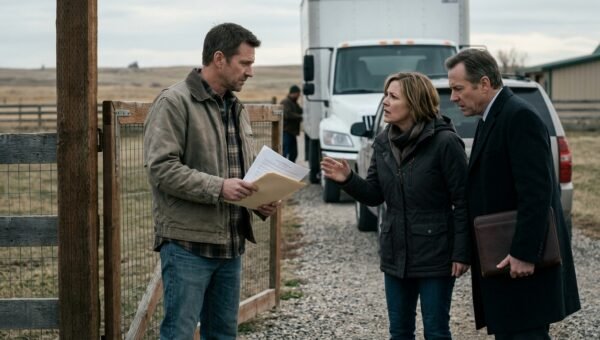
“Morning, Sheriff,” Wayne said loudly, trying to sound helpful. “If you’re here about the dispute, I already told the old lady she’s welcome to walk through the trees. My survey line is solid. I have the county parcel map right here on my phone.”
Sheriff Crawford didn’t look at Wayne’s phone. He adjusted his duty belt, tipped his hat toward my front porch, and waited.
I stepped out through the screen door. Beside me stood Harold Vance, the senior county building inspector, who had arrived twenty minutes earlier to review the vellum roll on my kitchen table. Under his arm, Harold carried a heavy steel clipboard and an orange surveyor’s transit on a wooden tripod.
I walked down the steps, stopping five feet from the wall, looking directly at Wayne over the top of the wet-cured masonry.
“Wayne,” I declared, my voice carrying clear and crisp through the cold morning air, “you should have checked the pantry safe before you rented that cement mixer.”
Wayne’s face twitched. “What safe? What is she talking about, Harold? Her property ends twelve feet behind that wall. The county web portal—”
“The county web portal has a disclaimer on the bottom of every single page, Wayne,” Harold Vance interrupted, his voice dry and flat. “It specifically states that digital GIS boundary overlays are approximations for tax assessment purposes only, not legal boundary determinations.”
Harold stepped past Wayne, pulled a yellow fiberglass measuring tape from his pocket, and hooked the metal end to an ancient, lichen-covered iron pipe that sat nearly flush with the dirt near Wayne’s equipment shed.
“This is the 1952 state highway marker,” Harold said, pointing his pen at the rusted iron. “Registered under executive state seal number 4418, signed by Governor Stevenson himself when Route 9 was straightened. Clara has the certified original parchment, and I just verified the county vault’s microfilm copy thirty minutes ago before I drove out here.”
Wayne looked between Harold and the rusted pipe, his mouth hanging open like an unlatched gate.
“The real property line,” Harold continued, walking twenty feet into Wayne’s cleared dirt lot and planting an orange flag, “is right here. Clara Mae doesn’t just own her driveway, Wayne. She owns the land you poured this wall on, plus another eight feet of that gravel pad you just graded for your new storage barn.”
Sheriff Crawford stepped up beside Wayne, resting his thumb lightly on his leather belt.
“Which means, Wayne,” the sheriff said quietly, “you have committed an unlawful trespass, built an unpermitted permanent structure on private property without owner consent, and blocked emergency vehicle access to an occupied residence. That’s a class-one county violation, plus willful destruction of private roadbed.”
Wayne went completely gray. The smug, bullying tone vanished, replaced by a sudden, frantic stammer.
“Wait a minute… Harold, come on. It was an honest mistake. The map online showed—”
“You had no permit on file,” Harold said, writing something on a bright pink carbon-copy ticket. “You didn’t submit an engineered plot plan. You didn’t pull an encroachment waiver. You have forty-eight hours to completely remove this entire structure, haul away the rubble, and restore Clara’s gravel surface to its original condition at your sole expense. If that wall is still standing by Sunday at noon, the county will hire an outside demolition firm, send you the five-figure bill, and Sheriff Crawford will file formal criminal trespass charges.”
ENDING
The celebration was over.
Wayne’s two helpers didn’t say a single word. They loaded their shovels into the back of their truck, climbed inside the cab, and backed out onto the county road before Harold had even finished writing the citation.
Wayne stood alone in the dirt, clutching the pink violation slip in his fist. He looked over the gray concrete wall at me, his shoulders slumped and his face burning with a humiliated, bitter silence. He didn’t offer to buy my back pasture. He didn’t say another word about my age, my savings account, or my drafty house.
By one o’clock that afternoon, Wayne had brought back his largest excavator with a hydraulic breaker attachment.
I sat on my front porch in my green wooden rocker with a cup of hot black tea, watching through the trees as the steel chisel hammered into the concrete he had spent two thousand dollars pouring the day before. The loud, rhythmic pounding echoed through the valley, breaking the barrier into jagged gray chunks that his crew had to load by hand into the bed of a dump truck.
It took them two full days of sweat, exhaust, and diesel smoke to haul away every last scrap of stone.
By Sunday evening, Wayne had spread three truckloads of fresh crushed limestone over my drive, graded it smooth with his skid-steer, and rolled it flat until it was wider and cleaner than it had been in thirty years. When he finished, he drove his machinery back onto his own ground, parked behind his shed, and shut off the lights.
On Monday morning, Harold Vance drove out one last time to inspect the work. He hammered a fresh steel post into the earth, twenty feet beyond my gravel, marking the true legal line where the state survey said it had always been.
I walked back inside, took the linen vellum from the table, and rolled it carefully into its metal cylinder. I carried it into the pantry, put it back into the green cast-iron safe between the silver flatware and the old deeds, and turned the heavy brass dial until it clicked.