PART 1
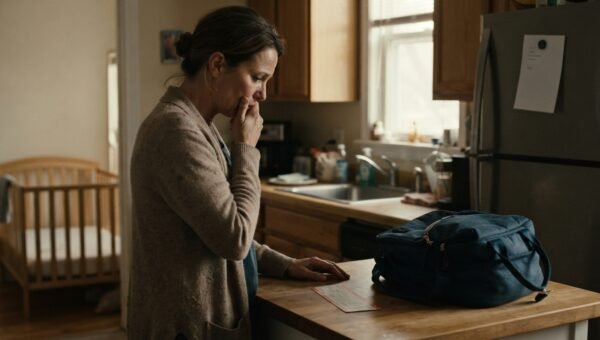
I found the card on the Tuesday before Thanksgiving while looking for a pair of thick wool socks to wear around the house. Greg always kept his winter spares rolled up in the back left corner of his top dresser drawer. When I reached all the way back, my knuckles bumped against a stiff rectangular envelope tucked flat beneath the drawer liner.
I pulled it out without thinking much of it, expecting maybe an old anniversary card he had saved or something from our daughter.
But the envelope was fresh, crisp, and completely blank on the outside. Inside, there was a pastel card with gold foil flowers.
On the inside flap, in Greg’s neat, unmistakable handwriting, were the words: “To the love of my life. Happy Birthday, December 12.”
My birthday is in March. We had been married for twenty-eight years.
I stood there by his dresser with my heart hammering against my ribs so hard it made my ears ring. He hadn’t signed his name, but nobody else in this house wrote with that sharp, left-leaning cursive using a black fine-point pen. He had bought it early, written in it, and tucked it away where he thought I would never have a reason to look.
My first instinct was to scream, to march down to the kitchen where he was reading the morning paper, throw the paper in his lap, and demand to know who December 12 belonged to.
But twenty-eight years teaches you something about human nature. If you show your cards before you hold any proof, people lie. They make up ridiculous excuses. They tell you it was a joke for a coworker, or a greeting card he bought for a friend going through a divorce, or some pathetic story that makes you look crazy for asking.
So I slid the card back into its envelope. I lifted the liner paper, laid it exactly where I had found it, smoothed the felt, and rolled the heavy socks back into place over the corner.
Then I walked down the stairs, poured my coffee, and sat across from him at the kitchen table. He looked up, smiled, and asked if I wanted the section of the paper with the crosswords. I looked at his face, the graying hair at his temples, the laugh lines around his eyes, and realized I did not know the man sitting five feet away from me at all.
For three weeks, I didn’t say a single word. I kept our routine entirely normal. I cooked dinners, I went to my shift at the clinic library, I folded his shirts, and I watched him.
Every evening, I waited for him to slip up. But Greg was disciplined. His phone was always locked with a six-digit passcode he had changed six months earlier, claiming his company required stricter security updates for his work emails. His laptop stayed in his leather briefcase. On paper, nothing was out of the ordinary, except for the quiet, steady cash withdrawals I started noticing when I looked closely at our joint checking account.
Over the past two years, there had been regular cash withdrawals of four hundred, five hundred, sometimes eight hundred dollars at a time from random ATMs around the county. Whenever I had asked about them in passing months ago, he had brushed it off, saying he preferred paying cash for lunch, gas, and his weekend golf rounds because it kept our monthly credit card statements simpler.
I had trusted him completely. I had never questioned a single transaction.
The morning of December 12 finally arrived on a chilly Thursday.
Greg was up early, shaving before seven. He came down wearing his good flannel shirt and dark jeans, smelling like the cologne he usually reserved for our dinner dates. He drank his coffee standing at the island, checking his watch every few minutes.
“I have some errands to run today, Martha,” he said, keeping his eyes on his mug. “A few things for the garage, and I need to stop by the supply shop out past the interstate to pick up some parts for the heater before the weekend freeze.”
“Will you be back for lunch?” I asked, keeping my voice completely even as I wiped the counter.
“Probably not,” he said, pulling on his winter coat. “The supply place is usually packed on Thursdays. Don’t wait on me. I’ll see you later this afternoon.”
He walked out the kitchen door at ten in the morning. I heard the garage door grind shut, followed by the quiet hum of his truck pulling down the gravel driveway.
The second the sound faded, I walked straight up the stairs to his bedroom dresser. I pulled out the socks, lifted the liner, and reached into the corner.
The card was gone.
PART 2
The fact that the card was gone hit me like cold water, but it gave me the exact confirmation I needed. He hadn’t changed his mind. He hadn’t thrown it away. He had taken it with him to deliver it.
I didn’t panic. I went into his small home office down the hallway.
For the past three weeks, I hadn’t dared touch his computer or rifle through his desk while he was anywhere near the house. But now I had hours. I sat in his desk chair and pulled open the bottom file drawer where he kept our old tax folders, utility statements, and car titles.
I began pulling out every folder, checking behind the hanging dividers. Down at the very bottom, shoved behind the metal rails where a file would only slip if someone intentionally forced it back there, was a slim brown accordion folder with no label.
I pulled it out and set it on the desk.
Inside was a small stack of papers that made the room spin.
The first document was a receipt from a local jewelry shop dated three days prior. A gold pendant necklace, paid in full with a cashier’s check for twelve hundred dollars. The customer name was Greg Miller, but the contact phone number listed was his private personal cell.
Beneath the jewelry receipt was something far worse. It wasn’t love letters or motel receipts. It was legal paperwork.
I was looking at a residential property deed for a house located at 418 Orchard Lane, a small street in the neighboring township about twenty miles west of our town. The deed listed Greg Miller as the sole owner. It was dated three years ago.
Attached to the deed were printed mortgage statements from a regional lender I had never dealt with. Every single month for thirty-six months, a payment of fourteen hundred dollars had been drafted from an account at an independent credit union. Stapled behind the latest statement was a recent property tax assessment addressed to him at that Orchard Lane property.
I sat back in his leather chair, my hands shaking so violently the papers rustled against each other.
Four years ago, Greg had told me we needed to pull forty thousand dollars out of our joint high-yield savings to put into a private, high-return certificate of deposit through his business network. He had told me it was a locked-in retirement vehicle that would mature in five years with guaranteed interest. I had signed the withdrawal transfer without a second thought because I trusted my husband of a quarter-century.
He hadn’t put it in a retirement certificate. He had used our life savings as the down payment on an entire house.
I looked at the property documents again. Right in the margin of the latest tax bill, in his handwriting, was a short note: “Key under fake stone by water meter. Roof inspection due Dec.” And right below that was an entry: “Claire’s birthday dinner reservation 6:30.”
Her name was Claire. And he hadn’t just bought a card. He had built an entire parallel life, twenty miles away, funded straight out of the money we had spent decades setting aside for our old age.
I took out my phone. I photographed every single page, front and back, making sure the timestamps, account numbers, and signatures were crystal clear. Then I replaced the papers in the accordion folder, slipped it back down behind the metal rails exactly as I had found it, and grabbed my coat and car keys.
It took me twenty-five minutes to drive over the township line.
Orchard Lane was a quiet, tree-lined cul-de-sac with small, well-kept ranches from the late nineties. As I turned onto the street, my stomach knotted so tight I could barely breathe.
I pulled my car to the curb three houses down and looked through my windshield.
Sitting in the driveway of 418 Orchard Lane was Greg’s silver pickup truck.
PART 3
I sat in my parked car with the engine idling quietly, watching the house.
The front yard had a small wreath on the door. Greg’s truck was parked close to the garage, right beside a navy blue compact sedan with a university parking pass in the rear window. Through the living room window, I could see warm lights on. For a split second, a woman with dark shoulder-length hair walked past the glass carrying a serving platter, followed shortly by Greg, who was laughing and holding a bottle of wine.
They looked comfortable. They looked settled. They looked like a couple celebrating a birthday in their own home on a Thursday afternoon.
I could have marched up to that porch, pounded on the door, and caused a scene right there in front of the neighbors. Every nerve in my body wanted to tear through that front door and scream at both of them. But looking at that house, paid for with the forty thousand dollars we had saved from my years of night shifts and his overtime, a strange, cold clarity washed over me.
If I confronted them on that lawn, it would turn into yelling, crying, denials, and immediate damage control. He would move money. He would hide documents. He would transfer accounts before I could even figure out what bank held the mortgage.
Instead, I put my car in reverse, turned around at the end of the cul-de-sac, and drove back toward our town.
I didn’t go home. I drove directly to the commercial strip near the courthouse and walked into the office of a family law attorney whose name I had seen on community boards for years. I sat in her waiting room for forty minutes until she had an opening between appointments.
When I sat down across from her, I placed my phone on the desk and opened the photos of the deed, the mortgage statements, and the cashier’s check receipts.
“My husband bought this house three years ago with forty thousand dollars taken from our joint marital funds,” I told her, my voice dead calm. “He has been paying fourteen hundred dollars a month out of a hidden account ever since. I need to know my legal rights before four o’clock today.”
The attorney spent thirty minutes reviewing the photos. She explained that in our state, real property acquired during the marriage using marital funds is marital property, regardless of whose name is on the title. By concealing the asset and using joint money to service an undisclosed debt, he had committed a massive breach of fiduciary duty to the marital estate. She told me exactly what steps we would take to freeze the accounts and file for immediate discovery.
“Go home,” she advised me quietly. “Act normally. Do not threaten him. Do not tell him you’ve seen a lawyer. Let him think you only know what he cannot deny.”
I left her office at three in the afternoon, drove home, and sat down at the kitchen table with a notebook.
At exactly four o’clock, the garage door rumbled open.
Greg walked into the kitchen through the utility room door. He had taken off his heavy coat, carrying it over his arm. His hands were completely empty. No bags from the hardware store. No heater parts. No grease on his fingers. No receipts sitting on the counter.
He smiled his familiar, easy smile. “Hey. It got colder out there than I thought.”
“How were the errands?” I asked, looking up from the table.
“Long lines at the supply place,” he sighed, opening the refrigerator to grab a bottle of water. “Took forever to track down the valve I needed, but I finally got it squared away.”
“Did you get everything you needed?” I asked.
“Yes,” he said, taking a long drink and leaning against the counter. “Everything’s taken care of.”
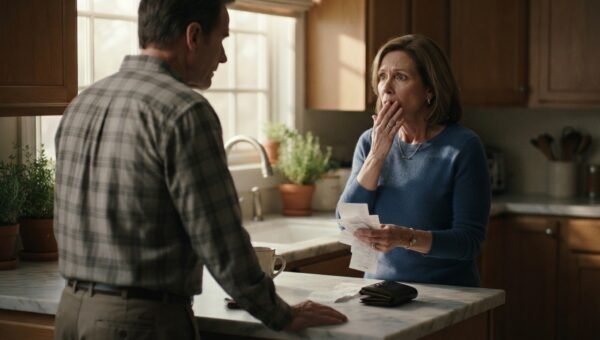
“Good,” I said, folding my hands together on the table. “Because while you were gone, I found the card. And I found the address you wrote inside it. And I drove there.”
ENDING
The glass bottle in his hand slipped slightly against his palm before he caught it against the counter edge. The color drained from his face so fast it looked like he had been slapped with ice water. His mouth opened, but no sound came out for several seconds.
“You… you went to her house?” he stammered, his voice dropping to a harsh whisper.
I looked directly into his eyes and shook my head slowly.
“No, Greg,” I said. “I went to our house. The one you bought with forty thousand dollars stolen from our joint retirement savings. The one you’ve been paying fourteen hundred dollars a month on for three years while telling me we needed to cut back on groceries and cancel our anniversary trip. The one I didn’t know existed until this morning.”
He went completely rigid. “Martha, wait. Please, let me explain. It’s not what you think. Claire was in a terrible spot with her credit, and I was just trying to help an old colleague get on her feet as an investment—”
“Stop,” I said, holding up one hand. “Do not say another word. You wrote ‘to the love of my life’ in a card for her birthday today. I saw you through the living room window holding wine while she cooked. I have photographs of the deed, the mortgage, the property tax assessments, and the cashier’s check from three days ago for her necklace.”
He stepped toward the table, reaching out his hands, looking entirely shattered. “Martha, twenty-eight years. You can’t just throw twenty-eight years away over a mistake. We can fix this. I’ll sell the house. I’ll bring the money back into the joint account tomorrow morning, I swear to you.”
“You won’t sell anything,” I told him, standing up from the chair. “Because by tomorrow afternoon, my attorney will have a lis pendens filed against that property, and your secret credit union accounts will be frozen under court order.”
He stared at me as if he were seeing a ghost. For twenty-eight years, he had known me as the quiet, agreeable wife who handled the house, trusted his spreadsheets, and never probed into his drawers. He had never seen me look at him without warmth.
“Pack one bag,” I said, pointing toward the stairs. “Take what you need for a week. If you aren’t out of this house in twenty minutes, I will call the sheriff’s department and have you removed for domestic disturbance.”
“This is my house too, Martha!” he suddenly snapped, desperation turning his voice brittle. “My name is on this deed!”
“And my name has equal claim to both of them,” I replied, holding my ground. “Every single dollar you gave that woman came out of my life, my labor, and my retirement. Pack your bag, Greg. Or the neighbors can watch you leave in the back of a cruiser on your girlfriend’s birthday.”
He looked at me for another ten seconds, searching my face for any sign of hesitation or tears. When he saw none, his shoulders caved in completely.
He went upstairs. Ten minutes later, he came down carrying a duffel bag and his briefcase. He didn’t look at me as he walked through the kitchen, opened the door, and pulled it shut behind him.
The legal battle took fourteen grueling months.
When the financial discovery forced all his records into the open, we found out he had met Claire four years earlier when she worked as an outside vendor for his firm. When her lease was up, he offered to purchase the Orchard Lane house in his name to give her a permanent place to stay, promising her that once our daughter was completely through graduate school, he would leave me and move in with her full-time.
He had lied to both of us. He told her the divorce was already being quietly negotiated, and he told me our retirement was safe in a private certificate of deposit.
The judge had zero patience for his financial deceit. Because he had actively concealed marital property and dissipated our joint funds, the final settlement awarded me our primary home completely free and clear of any encumbrance. The court ordered the Orchard Lane house sold immediately by an independent receiver, with seventy-five percent of the net proceeds transferred directly to me to reimburse the stolen down payment and the three years of mortgage payments he had funneled out of our family.
Claire had to vacate the property within thirty days of the order. I heard through a mutual acquaintance that she left the state entirely once she realized Greg had neither the money nor the courage to protect her.
Greg now lives in a rented one-bedroom apartment near the interstate, working well past his planned retirement age because his pension and 401(k) were heavily divided to square the debt he owed me.
Last week, I sat on my back porch drinking coffee in the quiet morning sun. The deed to my home is in my safe, solely in my name. I survived the worst betrayal a woman can endure after nearly three decades of marriage, and I survived it not by crying or begging, but by keeping my head, taking my evidence, and claiming every single thing that belonged to me.