My twelve-year-old daughter lied about going to Washington, D.C. I found out because the school returned my $300.
Principal Miller’s email came in while I was standing at the kitchen counter with a grocery bag open. “We missed Sarah on the trip. Enclosed is your $300 refund.” I read it twice. Sarah had posted pictures on Facebook two weeks earlier, smiling in front of the White House like she’d had the best weekend of her life.
I tapped through them again. There she was by the fence, then beside a sign, then grinning at whoever had taken the photos. The trees behind her had yellow leaves. It was April. I don’t know why I noticed that before anything else, but I did.
I checked the photos’ details on my phone. They’d been taken three years earlier, during an October family trip. Sarah had been nine. I remembered the photo now, though I’d forgotten we’d saved it. I’d told myself to stay calm, then went straight to her room.
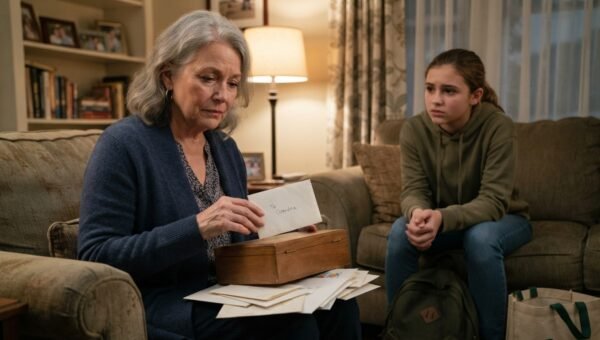
The desk drawer stuck unless I lifted it a little. Sarah had done that since we bought the desk, and I’d meant to fix it for months. I found a bus ticket to Oak Creek, four hours away, and a return pass. There was also an envelope with my mother’s handwriting on it.
For seven years, I’d kept that handwriting out of my house.
I’d stopped speaking to Evelyn after a family fight I can barely tell in order anymore.
There were old hurts on both sides, and I was sure she’d taken someone else’s side over mine. I said things I can still hear if I let myself. She said things too. At some point, I told her not to call again.
I believed I was protecting myself. Then I had a child, and protecting Sarah became a reason I used for not changing anything. I told her we didn’t see my mother. I didn’t tell her much about why. When she asked once, I said, “It’s complicated,” which is a neat way to shut a kid down without sounding mean.
Sarah didn’t push, at least not where I could see. I thought that meant she’d accepted it. It didn’t.
I picked up the envelope. It had been mailed from Oak Creek. Inside was a short letter in Sarah’s handwriting and a note from Evelyn, with a landline number at the bottom.
I read Sarah’s letter first. She wrote that she hoped Grandma was feeling better, and that she’d see her soon.
The ticket in the drawer had been bought with Sarah’s own savings. There was a little list tucked beside it, in her careful school-print: fare, food, return. The school trip money was not in that list. I’d learn later that she’d planned for the school to refund my check when she didn’t show up. I was still trying to understand why there was a ticket at all.
The phone rang once before I hung up. I wasn’t ready to hear Evelyn’s voice. So I dialed the number on the envelope instead.
A woman answered. I said my name, and she went quiet for a second. Then she said, “I’m Mrs. Gable. Evelyn’s neighbor.”
I told her I’d found Sarah’s ticket and needed to know if Sarah was safe. Mrs. Gable said Sarah was with her and had been the whole time.
She’d agreed to watch her while Sarah visited Evelyn, who was in hospice care.
“She’s safe,” Mrs. Gable said. “I wouldn’t have let her come alone.”
I put my hand on the counter. The grocery bag was still open. I could smell the plastic it came in, that faint dusty smell from the stack under the sink.
“Is Evelyn there?” I asked.
“She is. She’s been asking when you might come.”
That made me mad, which was unfair. I’d been the one who stopped calling. I was also scared enough that I couldn’t sit around sorting out what was fair.
I asked Mrs. Gable to tell Sarah I was coming. Then I grabbed my purse and keys. I called my sister to say I needed someone to check on the house, and started the four-hour drive to Oak Creek.
The first hour, I kept thinking of reasons Sarah shouldn’t have done this. She’d lied about the trip. She’d traveled without telling me. She’d let me see fake proof and think she was somewhere she wasn’t. All true.
But I kept coming back to that envelope. Sarah had written to my mother without me knowing. She’d learned where Evelyn was from old family papers, then figured out how to get there. I had told her nothing, so she’d found out what she could on her own.
I remembered the attic boxes. Sarah had asked if she could look through them a month earlier, supposedly for a family tree assignment. I’d said, “Just don’t make a mess.” I hadn’t asked what she was looking for. At the time, that had seemed like an ordinary question.
I stopped once for gas and didn’t buy anything. I couldn’t make myself eat. The whole drive felt like one long shift where the clock kept moving but nothing got easier. I wanted to be furious when I saw her. I also wanted to check her face for every sign she was hurt.
Mrs. Gable met me at the cottage door. She was a small woman with reading glasses on a cord, and she held the door open without asking me in. I could hear a TV low in another room.
“She’s with her grandmother,” she said.
I walked down the short hall. Sarah sat beside the bed, holding Evelyn’s hand. My mother looked smaller than I remembered. Her hair was thin, and her eyes were closed. A glass of water sat on the table. Sarah had one of Evelyn’s hands in both of hers.
Sarah looked up at me. She didn’t get up. Neither did I.
“Mom,” she said.
I asked her to step outside with me. She glanced at Evelyn, and I hated that I’d made her choose between answering me and staying beside her grandmother. Mrs. Gable said she’d sit with Evelyn, so Sarah followed me to the porch.
I was trying to start with the school trip, but the words came out wrong. “You lied to me.”
Sarah looked down at her shoes. “I know.”
“You got on a bus alone.”
“Mrs. Gable was there.”
“Not on the bus.”
She rubbed her thumb along the side of her hand. “I saved my birthday money. And my allowance.”
I asked why she hadn’t asked me. She looked at me then. She wasn’t acting brave. She looked twelve, tired and worried, with a loose thread hanging from one sleeve.
“Because you would’ve said no.”
I wanted to tell her she didn’t know that. But I did know. I’d made sure she knew what my answer would be by never letting the subject get far enough to ask.
I said, “You could’ve told me she was sick.”
Sarah blinked hard. “I didn’t know how to say it.”
There was a pause. I could hear the TV through the window, some game show clapping for someone. Sarah’s voice got very small.
“I didn’t want her to be somebody I only heard about after she died.”
I can’t dress that up. It was a terrible thing to hear from a child. It was also true.
I’d spent seven years telling myself there would be time, or that not speaking was cleaner, or that Evelyn had made the first move wrong. I had let my daughter grow up with a blank space where her grandmother should have been. Sarah had filled it in the only way she could think of.
I told her she was grounded from going anywhere without me. I took her phone for two weeks. I wasn’t going to pretend those choices were fine just because I understood why she made them.
She nodded. “I know.”
“But I’m not taking you away from her.”
Sarah’s chin shook once. She covered it by looking down.
I went back inside. Evelyn opened her eyes when she heard me. For a second I was standing there like a visitor who’d gotten the wrong room. Then she said my name.
I sat down. I didn’t know what to say first, and neither did she. I told her I was sorry I’d stayed away. She said she was sorry too. We didn’t fix seven years in one afternoon. We did hold hands, though, and she asked me about my work and whether I was still making that bad coffee I used to bring over.
“Worse now,” I said.
She smiled a little. I laughed, then cried, which embarrassed me. Sarah stayed beside the bed and kept one hand on the quilt.
When it was time to go, I told Evelyn we’d come back. I meant it. I asked Mrs. Gable to help arrange a weekend visit, and I wrote down the details so nobody had to guess or sneak around. Sarah rode home with me.
I didn’t lecture her the whole way. I did tell her the lying had put her in danger, even with Mrs. Gable looking after her. She listened. Then she asked if she could see her grandmother again soon.
“Yes,” I said. “We’ll plan it together.”
The consequences stayed. The phone stayed in my desk for two weeks, and Sarah stayed grounded from unsupervised travel. But we started talking about Evelyn. Not just the argument. The family before the argument, the old photos, the parts I’d chosen not to tell.
A few weeks later, I drove them both back to Oak Creek. I took a picture in the spring daylight. No White House, no borrowed past. Just Evelyn’s hand, Sarah’s hand, and mine together on the quilt.
I put the framed photo on Sarah’s desk.