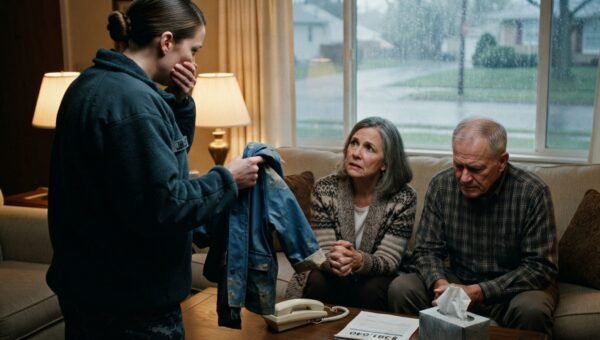
Why do I still remember taking off my suit jacket before I went into Clara’s ICU room, when I wasn’t the one who had been hurt?
I think I wanted to look less like the man who’d just walked out of a port authority meeting and more like her husband. The jacket was folded over my arm. My badge was still clipped to it. I remember the corner digging into my palm, which is a stupid thing to remember, but there it is.
Clara was under bright hospital lights with bruises across her face and arms. I couldn’t get a clear answer from the nurse about when she’d wake up. She told me Clara was being watched closely and that the doctors would speak with me as soon as they could. I nodded like I understood. I didn’t, not really.
Her father, Marcus Moretti, was in the hallway with his eight sons. They weren’t whispering. They were laughing about my suit and the way I stood there without shouting. Marcus saw me look over and said, “That suit doesn’t make you a man.” I didn’t answer him. I could hear Clara’s heart monitor through the partly open door, and that was all I could pay attention to.
I’m not proud of how long I stood there. I wanted to hit him. I wanted to hit all of them, though I knew I wouldn’t get near Marcus before his sons piled on.
More than that, I knew Clara would have to live with what happened after I made a scene. So I walked away from the room and went down the stairs.
Clara and I had been married four years. Her family never liked me, mostly because I didn’t come from their circle and didn’t act the way Marcus thought a man should act. I had a regular title, a regular office, and I was careful about what I said about my work. Clara knew the whole picture. Her family didn’t.
I worked in shipping and logistics. That was what I told people, and it was true, just not the whole truth. I controlled the largest share of the city’s commercial port operations and could make decisions that affected nearly every major freight route through the terminals. I’d spent years keeping a low profile because loud men attract the wrong kind of attention. Marcus mistook that for weakness.
Clara told her family she was pregnant a few weeks before the assault. She also told them she was done letting Marcus decide where we lived, who we saw, and what she could do. She’d tried to say it calmly. I know because she told me afterward, sitting at our kitchen table and rubbing the edge of a chipped mug with her thumb.
“Dad thinks I’ll change my mind,” she said.
“Will he let you?”
“He’ll have to.”
I didn’t like how sure she sounded. But I also didn’t want to talk her out of being free. We agreed we’d stop going to family dinners and let the calls go unanswered for a while. I thought that would be enough distance. It wasn’t.
The doctor told me later that the baby hadn’t survived the injuries. I don’t remember the exact words he used. I remember a blue pen in his shirt pocket and a little ink mark on his thumb.
I remember him saying he was sorry. I remember asking if Clara knew, then asking him again because the first answer didn’t seem to stick.
I had nothing useful to say to the nurse, so I went back down the stairs and called Nolan Reed, the director who ran port operations with me. My hand was shaking enough that I had to tap his name twice. When he answered, I said, “Suspend every Moretti account and contract we control. Now.”
Nolan was quiet for a second.
“Do you want legal on the line?”
“Yes. And get every hold documented.”
I didn’t yell. I didn’t threaten. I gave him one instruction, then stayed on the phone while he called our legal counsel. They confirmed the contracts allowed us to suspend access while we reviewed security concerns and unpaid commercial exposure. I told them to use the rules exactly as written. Nothing extra. Nothing that could be called a favor or revenge.
I knew what the instruction would do. Marcus’s companies depended on our terminals for their imports, their warehouses, and the deliveries they had already promised. I also knew that if I made the order without a legal record, he’d turn the whole thing into a story about a jealous son-in-law. So I sat on a stairwell step and listened while counsel read out the account names.
Then I said yes.
By early morning, the first shipments were flagged. At the warehouse, a truck driver called one of Marcus’s sons to say his delivery had been stopped at the terminal. A second call came in about a container that wasn’t cleared to unload. Nolan sent me a short message with the first list of holds, and I read it while Clara was still asleep behind the ICU doors.
The family’s businesses weren’t just inconvenienced. The freight they needed couldn’t move, the orders they’d made couldn’t be filled, and their partners started calling for answers. Their lenders had already been watching their overdue accounts. Once the contracts froze and the goods stopped moving, the lenders froze several commercial lines while they reviewed the risk.
That part wasn’t something I ordered. I knew the difference mattered. I also knew Marcus wouldn’t care.
Nolan called from the operations center and told me customs had flagged the Moretti manifests for review. He sounded tired, not excited. I appreciated that. I didn’t want anybody celebrating. My baby was gone. There was no version of this where the port stopping their business made that less true.
By late morning, Marcus had started calling port executives. I know because two of them forwarded the calls to Nolan and asked what they should say. Marcus still thought there was a higher person he could reach, someone who would undo the hold if he asked the right way.
Nolan told me he’d spoken to him once.
“Marcus asked who signed off,” he said.
“What did you tell him?”
“I said you did.”
I didn’t answer right away. I was outside Clara’s room, still wearing the same shirt I’d worn to the meeting. I’d been awake long enough that the collar felt rough against my neck.
Marcus got to the port office that afternoon. I went there because I wanted to look him in the eye and because I didn’t trust myself to hear the story later from someone else. I brought the finalized impoundment notices and the documents showing the suspension had been done under our contracts. I wasn’t there to threaten him. I was there to make sure he couldn’t pretend he didn’t know what had happened.
His sons were with him. One kept pacing. Another had his phone pressed to his ear, saying the same thing over and over: “Try them again.” Marcus saw me come through the lobby and pointed at my suit.
“You think this makes you important?” he said.
I set the papers on the counter. “No. The contracts do.”
He looked down at the notices, then up at Nolan, who was standing beside me. Marcus had spent years thinking the port was a place where he could call in a favor. He didn’t understand that the people he’d been calling worked for me.
He tried one more time to get Nolan to reverse the order. Nolan said he couldn’t. Marcus looked at me then, as if I’d finally stepped into the room he’d been waiting for me to enter.
I didn’t give him a speech. I didn’t need one. Nolan handed him the final notice, and Marcus took it with both hands. His sons stopped pacing. One of them asked what they were supposed to do about the containers already in transit.
I had no answer for them. I wasn’t going to help them save the business that had paid for the life they used to control Clara.
A little later, Marcus tried calling the port’s main office again. I heard Nolan answer. He listened, then said, “Mr. Vance does not take calls from trespassers.” He hung up before Marcus could respond.
That was the first time I saw Marcus understand that my quiet had never meant I was powerless. It only meant I didn’t need to announce what I could do.
The legal part moved on a different track. Clara’s medical records and the hospital security footage backed up what she’d told me, along with what staff had seen. The police had enough to seek warrants for Marcus and his sons. The charges covered the assault and the harm done to Clara and her pregnancy. I let the lawyers handle the port side and gave the detectives everything they asked for.
The officers arrested Marcus and all eight brothers. The arrests didn’t happen in some dramatic line in front of me. I heard about them from our lawyer while I sat beside Clara’s bed. I remember looking at her hand on the blanket and trying to decide whether I should tell her the whole thing as soon as she woke up.
I didn’t know what she’d want first. The truth about the baby, or the truth about her family being in custody. I hated that both answers had to come in the same hospital room.
When Clara opened her eyes, it was near dawn. The room had gone quiet except for the machines. I was sitting beside her with my jacket folded over the chair, the badge still clipped to it. She looked at me for a long time before she spoke.
“Is the baby gone?”
I held her hand. I didn’t try to soften it.
“Yes,” I said. “I’m so sorry.”
She shut her eyes again. I stayed there. After a while, she opened them and asked if Marcus could come in.
“No,” I said. “He can’t come near you.”
She nodded once. She didn’t ask me what I’d done to his business. I told her when she was ready, and she listened without interrupting. When I finished, she squeezed my fingers and said, “I don’t want to see them again.”
“You won’t have to.”
I meant it. We moved out of the house we’d shared near her family and stayed somewhere private while Clara recovered. The legal case kept going. The Moretti businesses lost their port access, then their partners, then the money they’d counted on to stay open. Marcus and his sons faced the charges without Clara having to sit across from them.
I won’t pretend I felt clean about any of it. Part of me wanted them to lose everything. Part of me knew that wanting it didn’t bring our baby back. I kept working. Clara kept healing at her own speed, which was slower than I wanted and faster than some days seemed possible.
Months later, we sat together in a place where nobody had a key but us. Clara had her old chipped mug on the table. She ran her thumb over the rough edge the way she used to. I still think about how ordinary that looked.
At dawn that first morning, Clara’s fingers closed around mine while the port lights kept moving beyond the hospital glass.