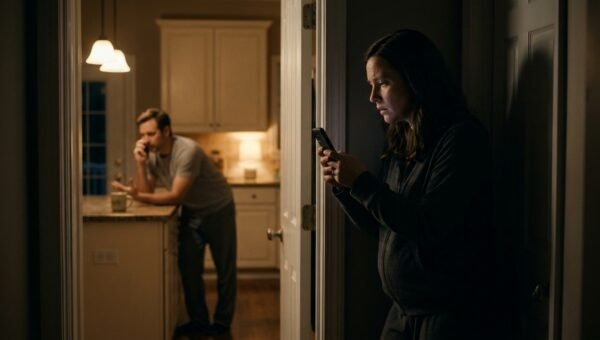
At my ten-year party, Brenda asked who wanted the last square of sheet cake, and I said I was fine. Steve put a small envelope in my hand. “Spend it all in one place,” he said, smiling like he’d done something kind.
Inside was a ten-dollar Starbucks gift card. On the back, in black Sharpie, he’d written “$10.” One dollar for every year I’d worked at Cross Point Software.
I remember the edge of the paper plate bending under my thumb.
I remember the cake was dry and had those little sugar sprinkles that stick to your teeth. I smiled at Steve and said thank you. Nobody laughed. Brenda from HR looked down at her shoes.
I wish I could say I stood up for myself right then. I didn’t. I put the card back in the envelope and went to my desk.
For ten years, I’d been the person who knew which parts of our software could be changed safely and which parts would break if somebody rushed. I fixed bugs after hours, kept delivery dates from turning into guesses, and wrote down what actually happened when a launch went sideways. Steve was my director. He talked about the team’s wins in meetings, usually with himself in the middle of the story.
I wasn’t blameless. I let him. I told myself I was doing the work because I cared about the product, and because I didn’t want to be the kind of person who kept score.
That’s a nice story to tell yourself right up until somebody hands you a ten-dollar card.
That Tuesday evening, the company email arrived. Cross Point had been acquired by Apex Solutions. The note said the transition team would review departments, budgets, and leadership roles. Nobody at my table spoke for a minute.
I went home with the envelope in my purse. I took the card out while I was putting away my keys and turned it over in my hand. The Sharpie had bled a little into the card. I rubbed the mark with my thumb, which did nothing.
By Wednesday morning, everyone had the next email. CEO Adrienne Lee and a transition team would arrive in three days to evaluate leadership redundancy. I read it twice. Then I checked the project calendar. Steve was already walking toward my desk.
“Close your door,” he said.
I didn’t have a door. I had a desk in the open office and a low divider that stopped at my ribs. Steve leaned down beside me and lowered his voice.
“We need to clean up the old delivery records,” he said.
“Clean up how?”
“Some dates are wrong. The milestone reports don’t line up.”
I looked at him. “They don’t line up because the reports were changed.”
His mouth tightened. He glanced toward the next row, then back at me.
“Don’t make this bigger than it is,” he said.
I’d seen him ask for changes before. A number shifted here, a task marked complete there, a bug moved to a later release so a quarterly report looked better. I’d always thought he was shaving the corners, not building a false picture of the whole department.
Now he wanted me to alter historical project metrics and audit logs so Apex would see on-time work where we’d missed dates, and clean budget sign-offs where the spending had gone somewhere else.
“Just make the dates match,” he said. “And fix the utilization numbers.”
“I can’t change an audit log.”
“You can make a corrected copy.”
“That isn’t the same thing.”
He gave me a small, tired smile, like I was being difficult about something simple. “We’ve done this before.”
I hated that he was partly right. I had once changed a label in a report after he told me a number was a formatting mistake.
I hadn’t checked the source file. It turned out to be more than formatting. I’d let that go because I was afraid that being right would cost me my job.
That morning, I didn’t yell or quit. I told Steve I’d look at the records. He walked away satisfied.
I sat there with my hands flat on the desk. My face felt hot, but my voice had stayed normal. That part bothered me. I’d spent years being calm for other people, so they could keep working while I fixed whatever was about to fall apart.
I opened the shared drive and checked the original server logs. The timestamps were still there. The first report said one release had shipped eleven days late after we found a serious bug. Steve’s version marked it on time. The budget file showed money moved out of that project two weeks before he signed off on its final testing.
I didn’t know yet if that was a mistake or a pattern. So I checked another project.
That one had a milestone marked complete before the team had even finished testing. I found the bug list, the open tickets, and an email from Steve asking me to “keep the dashboard green” until the quarter closed. I remembered that email. At the time I’d read it as an ordinary request from a director under pressure.
Thursday was spent with my normal work open on one screen and the old reports on the other. I didn’t want anyone to notice what I was doing, which made me feel like I was doing something wrong even though the records were company records. I printed a few comparisons, then changed my mind and put them back in the tray.
I knew enough about our access rules to understand the risk. Taking company data offsite could get me fired. But the old logs could be edited by people with admin access, and Steve had that access. I put copies of the relevant records and his messages on an encrypted drive I owned. I’m not proud of that choice. I was scared, and I wanted something he couldn’t quietly rewrite.
I made a table with three columns: what Steve had submitted, what the system recorded, and what the team had actually finished. It took most of Thursday night. By the end, I had years of missed dates, unresolved bugs marked complete, and budget reports that didn’t match the approvals underneath them.
There were times when Steve had simply made a bad call. I could see that. The trouble was that the same bad calls kept making his numbers look good and my team look slow.
On Friday morning, the Apex team arrived earlier than the email said. I knew Adrienne Lee from the company profile and a few calls. She had a plain way of asking questions that made it hard to hide behind business words.
She sat with the engineering leads and asked what was stable, what wasn’t, and which systems depended on people who were still at Cross Point. I answered what I knew. I didn’t bring up Steve’s records. Not yet.
Steve stopped at my desk before lunch. “Those corrected sheets are ready?”
“No.”
His smile went away. “You said you’d look at them.”
“I looked.”
He bent closer. “I need the signed versions before the audit meeting.”
“I’m not signing them.”
For a second, he didn’t say anything. Then he tapped the divider with two fingers.
“You know what happens if you make this a fight.”
“I do.”
“You’re ten years in. You don’t want to start over.”
He was right about that, too. I had a mortgage and a car that needed new tires. I’d built my life around having a steady paycheck. I also knew he was counting on me to choose that life over the truth.
“I’m going to speak with Adrienne,” I said.
Steve stared at me, then walked toward his office. He left the door open. I watched him sit down and pick up his phone. I could have gone straight home, deleted the drive, and pretended I hadn’t seen anything. I thought about doing exactly that.
Instead, I printed the comparison I’d made and took my notes to the conference room. Adrienne was there with two people from her team. I asked if I could speak with her privately.
Steve came out of his office as I reached the table.
“Hold on,” he said. “We’re already reviewing this.”
I looked at Adrienne. “I have the original logs and the reports Steve asked me to change.”
Steve’s face tightened. “That’s not what I asked.”
“It is.”
Adrienne pushed her chair back. “Let’s see what you have.”
I put the folder on the table. My hands were steady. I still noticed the paper plate bending under my thumb from Tuesday, which made no sense at all.
I showed them the first project: Steve’s report said it had shipped on time. The server log showed the actual release date, eleven days later. The bug tracker showed the issue that held it up. Then I showed the budget record and the timestamped email where Steve asked me to keep the dashboard green.
Adrienne read the pages without speaking. Steve reached for the folder.
“Those numbers were preliminary,” he said.
“They were signed,” I said.
He turned to me. “You’re making this sound deliberate.”
I pointed to the next comparison. “This one was signed after the date was changed.”
Adrienne looked at him. “Did you ask her to alter the historical logs?”
Steve’s jaw worked before he answered. “I asked her to correct a few inconsistencies.”
“You asked me to change the dates and utilization numbers,” I said. “I saved the message.”
I took out the email printout. There was no fancy explanation for it. His name, the time, and the words were right there.
“Nobody will look that close,” he had written.
Adrienne closed the folder. “We’re done here.”
Steve tried once more. “I’ve kept this department running.”
“I kept the systems running,” I said. “The logs show that.”
That was the first time I’d said it in a room where somebody important could hear me. My voice shook on the last word. I let it.
Adrienne asked Steve to come with her and the transition lead. He looked at me as he passed. I kept my eyes on the folder.
The meeting lasted less than an hour. I don’t know all the words that were said in there, and I wasn’t asked to sit through it. When Adrienne came back, she told me Steve had been terminated for cause and would not receive severance. She asked me to stay while they reviewed the department’s reports.
I said yes. I was still scared. That didn’t go away just because I’d finally done the thing I should have done years earlier.
Brenda came to my desk near the end of the day. Her eyes were red, though she hadn’t been crying much.
“I should’ve said something Tuesday,” she said.
“Yeah,” I said. “You should’ve.”
She nodded. She didn’t ask me to make her feel better, and I didn’t.
Steve packed his things into a cardboard box. He carried it out past the same people who’d watched him give me the card. Nobody laughed. Nobody clapped, either. It was just quiet, and the copier kept making that clicking sound it always made when it was low on paper.
A week later, Adrienne asked me to lead the new software division as senior director. The offer came with a substantial raise and the authority to set priorities without Steve’s approval. I read the letter twice before I answered.
“I want the engineering team protected from this kind of reporting,” I said.
“That’s part of the job,” Adrienne said.
I took it. I stayed through the transition, helped stabilize the legacy software, and made sure the remaining engineers had a real schedule instead of numbers designed to impress somebody upstairs. Cross Point didn’t become a perfect place. The work was still messy. But the numbers were ours again.
The ten-dollar card sat in the envelope in my desk through the first week of my new job. I could’ve thrown it away at home. I didn’t. I carried it into the corner office after the desk had been cleaned, turned it over once, and saw Steve’s Sharpie mark.
Then I put it in the center drawer and turned the key.