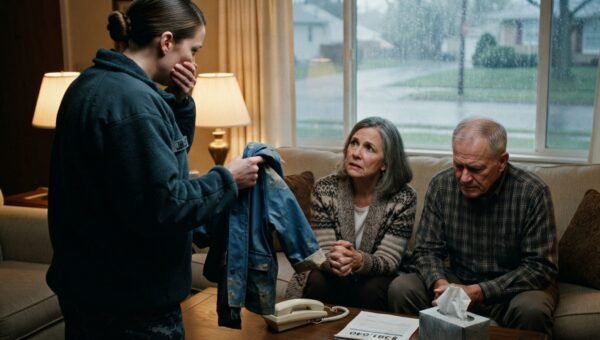
The marble foyer still had funeral dirt on it when Vivian told me to pack. I was holding Dad’s gold watch in my coat pocket, and my suitcase was bumping across the floor behind me.
“Pack your bags. You’re not staying here.”
It had been a few hours since we buried Arthur Vance. People had gone home with the little white cards from the service. I was still wearing the same black shoes, the ones that pinched my left toe, and Vivian was standing between me and the stairs like she had been waiting for the house to empty.
I didn’t shout. I didn’t ask how she could do that to me on that day. I looked at the suitcase, then at the watch pushing against my fingers through the coat lining.
“Fine,” I said.
That was when she smiled, just a little. She thought the matter was settled. She didn’t know why I had said fine.
I had grown used to Vivian speaking as if a decision had already been made. She married Dad when I was thirty-one. She was polite in front of other people, careful with names and table settings, and very good at making a request sound like a rule. Dad was seventy-two then. I was old enough to know he could make his own choices, so I tried to be decent about it.
For a while, we managed. Vivian liked the house quiet. Dad liked people dropping by. I came over most Sundays, and Dad saved me the end piece of whatever bread he’d bought from the bakery.
He said it had the most crust. Vivian said he did that because I was his child. She wasn’t wrong.
The house was his before it was hers. That distinction mattered to me, but I did not say it out loud. I wasn’t proud of how often I let her correct me in it.
I pulled the watch out when I reached the bottom stair. The gold had warmed against my hand. Dad had worn it daily, though the clasp was loose and he never got around to fixing it. When he gave it to me, he’d said I could have it after he was gone. I remember asking him not to talk like that.
He just closed my fingers over it.
The watch reminded me of Samuel’s office, and of what Dad had asked me to do there.
It was about six weeks before the funeral. Dad had been tired, but clear.
Samuel was sitting across the table with a stack of papers and a small reading lamp that made the room feel like a place where nobody should raise their voice. I had gone because Dad said he needed me to hear something directly.
He told me he had moved his investments, worth about $28 million, and his Manhattan commercial building into a private trust. I remember that number because I asked Samuel to say it again. I thought I had misheard him.
“It’s about twenty-eight million,” Samuel said. “The building is included separately in the trust.”
Dad was not giving Vivian nothing. That was the first thing he wanted me to understand. She would receive a monthly stipend for the rest of her life, and she could remain in the house, but those rights came with conditions. She did not own the house outright. She did not own the trust.
Dad had been plain about what he expected the money to do. Part of it would support his family. Part would go to the causes he’d already chosen. He’d talked about the library fund and two local programs for kids. He’d said he didn’t want anybody turning his name into a private cash drawer.
I won’t pretend I never thought about the money. I did. I hated myself for thinking about it, then thought about it again. Twenty-eight million is a hard number to hear and then file away as if it means nothing. But I had my own life. I wasn’t waiting for Dad to die so I could get rich.
Samuel explained the ninety-day rule. While the estate was being settled, I had the right to stay in the guest suite for ninety days. Vivian could not force me out during that time. If she tried to banish me, she would lose her own right to live in the house and receive the stipend.
“Does she know?” I asked.
“Not the full terms,” Dad said. “She knows there are conditions.”
I said it seemed cruel to keep that from her. Dad looked down at the papers. He didn’t answer right away.
“She has had chances to understand what I mean,” he said. “I’m not making this decision today.”
I wanted to argue with him. I wanted to tell him that maybe he was being unfair, or maybe I was just hoping he would make the family easier for me. I didn’t say either thing. I was scared of taking his last months and turning them into a fight about paperwork.
Samuel told me the clause was part of the master will, not a note he could explain away. He also said he had filed the related documents. Dad had made the choice. I had to live with it, at least until I understood it better.
Standing in the foyer after the funeral, I understood enough.
Vivian was still looking at my suitcase. She asked if I planned to make this harder than it needed to be. I said I wasn’t trying to make anything hard. My voice sounded too calm, even to me.
I took out my phone and called Samuel.
Vivian’s expression changed when she heard his name. It was small, but I saw it. She said this was a private family matter and I could speak to him later. I put the call on speaker.
“Samuel, please make sure Dad’s will is followed exactly.”
There was a pause while he checked something. I could hear paper moving on his end. Then he asked where I was.
“In the foyer. Vivian told me to leave.”
Samuel said he would be there shortly. He also told me not to leave the house, and to keep my phone on speaker. Vivian made a sharp little sound and told me not to turn this into a scene.
“I am not making a scene,” I said. “I am staying where I’m allowed to stay.”
She said I was twisting my father’s words. I wanted to answer that she hadn’t even read them. I didn’t. It would have felt good for a second, and then I would have heard myself saying it for the rest of the day.
The doorbell rang while Samuel was still on the call.
Vivian looked toward the front door. I had heard the courier’s step on the porch, then the bell, but I didn’t know what the envelope would contain. Samuel did. He told me not to open it without him.
A courier handed me a certified envelope with Vivian’s name on it. I signed for it and brought it inside. Vivian watched my hand the whole time. She said it was probably some routine estate notice and asked me to give it to her.
I kept it in my hand.
That envelope was not very heavy. I remember the little rough patch on its corner where the paper had caught on something. I remember it because I kept rubbing it with my thumb while I waited for Samuel. I was trying to look steady. I wasn’t.
Vivian said the house was hers now. She said Dad had promised her it would be. I did not know if he had used those exact words. I had heard him say she would be provided for. I had also heard him say the house was part of the estate plan. There was a difference, and I had let myself avoid it.
Samuel arrived before I could work up the nerve to answer. He came in carrying his briefcase, still wearing his dark coat. He looked at Vivian, then at the envelope.
“Please sit down,” he said.
She didn’t sit. She asked why he was there and whether he planned to help me take the house from her. Samuel said he was there to make sure the will was followed. His voice was calm, in the way it gets when someone has already decided there is no point arguing.
He opened the certified envelope and checked the notice inside against a copy in his briefcase. Vivian asked what it said. He told her it was formal notice of forfeiture under the ninety-day clause.
She said that made no sense. She’d only told me to leave. She had not changed the locks or thrown my things outside. I felt myself wanting to help her find a way around it. That was an old habit. I wanted to make the room less uncomfortable, even when I was the reason she was uncomfortable.
Samuel read the terms aloud. Vivian had tried to evict me during the protected settlement period. That act ended her right to reside in the house and canceled her monthly allowance. The filing had been completed and sealed before the funeral ended. The certified envelope was formal notice of what had already taken effect.
Vivian blinked at the paper. Then she looked at me.
“You planned this,” she said.
I told her I had not. Dad and Samuel had planned it. I had found out about the clause weeks earlier, but I hadn’t known what Vivian would do. I hadn’t wanted to believe she would use the first hours after the funeral to put me out.
She said Samuel couldn’t take a home away from her with a letter. She said she would sue. She asked if I understood how expensive that would be, as if I were still a kid she could scare into leaving the room.
Samuel said the filing was valid and the trust had control of the assets. He reminded her that the $28 million portfolio and the Manhattan building were not shared probate property. They were under the trust, and I was the one named to govern it. Her stipend had been conditional. Her claim to the house had been conditional.
She said Arthur had told her she was safe.
Samuel answered that Dad had made sure she would be cared for, not that she would own everything.
I don’t know if that was the exact sentence Dad would have used. It was close enough. The difference between cared for and given everything sat in the foyer with us.
Vivian’s mouth tightened. She asked me to tell Samuel to stop. I didn’t. I was not the one who could stop it, and I was tired of acting as if I had to soften every consequence for her.
I said she could arrange a standard time to pack her belongings. She would have a fair amount of time to leave, and the estate staff would help keep track of what belonged to her. But she could not stay in the house, and there would be no more monthly allowance.
She stared at me like I’d said something obscene. I had not raised my voice. I had not threatened her. I had only repeated the terms she had triggered.
“You’d put me out after all these years?”
I almost said, You put me out first. I kept that one in my mouth. It would not have changed the papers, and it would have made the moment about who could hurt whom more.
The next hour was practical. Samuel called the estate office. A member of the estate security staff came to the house, and Vivian was given time to pack. She took the guest room key off the ring and set it down too hard on the table. I watched her carry two bags upstairs.
She did not ask me to help. I didn’t offer.
I had thought there would be some big feeling when I took the house keys. There wasn’t. The key ring was cold and heavier than it looked. I held it while Samuel explained what would happen with the trust, the building, and Dad’s charitable plans. My name would be on the papers. His instructions would guide the work.
That was the part I kept thinking about after Vivian left. Not the money. Not the house. Dad had spent his last year setting things up so his wishes would be carried out after he couldn’t speak for himself. He had also made a choice about me, and I could not make that choice into something gentle just because I missed him.
Vivian left with her bags and the estate staff beside her. She didn’t look back at me. I didn’t chase her. The door closed, and the house was quiet in the ordinary way a house gets quiet when there is nobody else in it.
I stood in the foyer with the watch in one hand and the keys in the other. For a few seconds, I felt nothing but tired. Then I fastened Dad’s watch around my wrist.
The second hand swept forward, steady and unbroken. I kept the keys.