PART 1
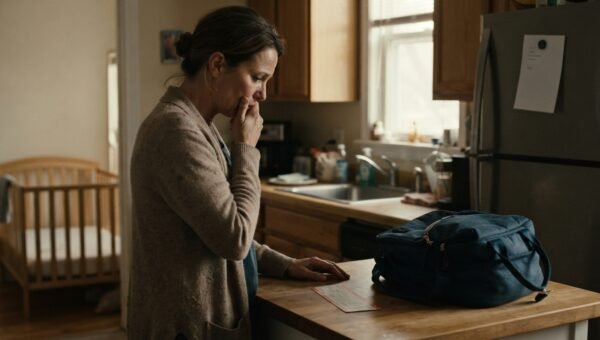
My son Mark came to my kitchen on a Tuesday evening and asked to borrow $24,000 to keep his restaurant from folding before Christmas.
He sat at the round maple table where he used to do his algebra homework, twisting a paper napkin into tight strings. He told me suppliers were threatening to cut off deliveries, the holiday bookings would carry him through January, and he would pay me back every single dollar by March.
His voice shook just enough to make me feel sick to my stomach.
I was sixty-two, working thirty hours a week managing records at a dental clinic, and my entire liquid cushion was $27,400 in an ordinary savings account at Oak Ridge Community Bank. If I gave him $24,000, I would have barely enough left to cover two months of my own mortgage and electric bill. But Mark was my only child. When his father died nine years ago, Mark had helped me carry the heaviest boxes down to the basement, and I had promised myself I would never let him drown if I had a rope to throw.
I didn’t sleep that night. By nine the next morning, I drove to the branch on 4th Street, sat in the waiting area until the teller window cleared, and walked up to Evelyn Clark. Evelyn had lived three houses down from me on Elm Street for fifteen years before she moved across town.
She knew my voice, she knew my late husband, and she handled my account whenever I came in.
I slid my withdrawal slip across the counter.
“I need a cashier’s check made out to Oak Street Grill for twenty-four thousand dollars,” I told her quietly.
Evelyn picked up the slip, swiped my debit card, and typed on her computer. She stopped typing. She looked at the monitor for a long time, her eyebrows pulling together, before she glanced up at the lobby behind me.
“Marian,” she said, lowering her voice, “step into the side office with me for a minute.”
My chest tightened. I thought the bank had put a security hold on the transfer, or maybe the system was down. I followed her into the small glass-walled room where loan officers usually took applications. Evelyn closed the door completely, walked around the small desk, and sat down with a stack of printed ledger sheets.
“Did you write a check yesterday?” she asked.
“No,” I said. “I haven’t written a check since I paid my car insurance on the third.”
Evelyn leaned forward and turned the top page toward me. “You’ve already written him eight checks this year. Each carried your signature, but I had written none of them. The withdrawals totaled $19,600.”
I looked down at the row of debits. Starting in late April, there were withdrawals every few weeks: $2,200, $2,500, $2,400, $2,800, right up to a check cleared just six days ago for $2,700. All made payable to cash or deposited into an affiliated business account.
Evelyn pulled up the scanned image of the most recent check on her screen. There was my name, Marian Vance, written in dark blue ballpoint pen along the bottom right line. The loop on the capital M was a little too rounded, the crossbar on the A sat just a little too high, but if you glanced at it quickly during a busy morning rush, you would swear I had signed it myself.
“Marian,” Evelyn said gently, “if you didn’t authorize these, we have to file an affidavit of fraud right now. We freeze the account immediately.”
“Wait,” I whispered. My hands were trembling so hard I had to press my palms against the edge of the desk. “Give me until tonight. Please. Don’t file anything until tomorrow morning.”
“These cleared your account, Marian. If someone stole your checkbook—”
“Just give me until tonight,” I repeated.
I left the bank without the cashier’s check. Instead, I had eight printed copies of canceled checks in my purse, totaling $19,600 that had vanished from my balance without me ever getting an alert, because I had set up paperless statements two years ago and rarely opened the email attachments.
I drove home, sat in my parked car in the driveway for twenty minutes, and then picked up my phone. I dialed Mark.
“Come to dinner tonight,” I said when he answered. “Seven o’clock. Just you. We’ll talk about the money.”
He sounded relieved. “Thank you, Mom. You don’t know what this means.”
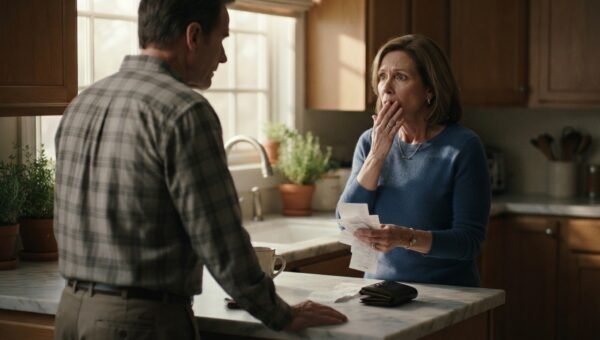
At a quarter past seven, Mark walked into my dining room, smelling like grill smoke and onions. I hadn’t cooked a full meal. I had set out bread, a pot of vegetable soup, and two water glasses. Right beside his plate, face down, were the eight photocopies from Evelyn.
“Eat first,” I said.
He sat down, but his knee was bouncing under the table. He took two spoonfuls of soup, set his spoon down, and looked across at me. “Mom, if we do the transfer tomorrow morning, I can meet payroll by Friday. The distributor said they’ll hold the produce order until two o’clock.”
I didn’t answer. I reached across the table, took the eight papers, and turned them face up in front of his bowl.
Mark looked down. The bounce in his leg stopped instantly. His eyes moved from the dates to the amounts, and then down to the blue-ink signatures.
He didn’t yell. He didn’t ask what they were.
He stared at the signatures, swallowed hard, and whispered, “Mom, I thought you knew.”
Before he could explain, the front door swung open with a heavy thud against the baseboard.
His wife, Claire, walked straight into the dining room. Her coat was unbuttoned, her purse hung off her elbow, and in her right hand she was holding a fresh paper check from my box, made out to cash for $3,000.
She slammed it down on the table right over the soup bowl, torn clean in half, and pointed her finger straight at Mark’s face.
“You set me up,” she said, her voice shaking with rage. “You told me your mother gave you permission to take what you needed, and you let me walk into that branch yesterday like a thief!”
Mark jumped up from his chair so fast it scraped against the wood floor. “Claire, shut up! Don’t do this here!”
My phone buzzed against the granite countertop next to the bread basket. I picked it up with a numb hand.
It was Evelyn from the bank.
“Marian,” Evelyn said, her voice completely different than it had been that morning. “I pulled the branch security footage from the drive-thru and the lobby counter for all eight deposits. Neither Mark nor Claire deposited that money.”
PART 2
The room went dead silent except for the hum of the refrigerator.
Claire was breathing hard, her hands clenched into fists by her sides. Mark was standing half-turned toward the doorway, his mouth open, looking between his wife and me.
“Evelyn,” I said into the phone, keeping my voice as flat as stone, “repeat what you just told me.”
“I stayed late to pull the camera archives for the fraud file,” Evelyn said. “I looked at the transactions from October, August, and July. Mark didn’t cash those checks. Claire didn’t cash them either. It was a young girl. Blonde hair, early twenties, driving a silver Honda Civic. She used your debit card PIN at the drive-thru for two of them, and for the others, she walked straight up to window four.”
My mind spun backward through the last six months. A silver Honda Civic.
“Evelyn, did she show ID?”
“She had a temporary authorization note with your name on it for the counter withdrawals, Marian, and she had your actual debit card. Teller four thought she was your granddaughter running errands for you.”
I didn’t have a granddaughter.
“I’ll call you back,” I told Evelyn, and hung up.
I laid the phone face down next to the torn $3,000 check. I looked at Mark, and then I looked at Claire.
“Sit down,” I said.
Neither of them moved.
“I said sit down.”
Claire pulled out the wooden chair across from Mark and dropped into it. Her face had lost all its color. Mark slowly sank back into his seat, but his eyes wouldn’t meet mine. He kept staring at the bowl of cooling soup.
“Claire,” I said, “start from the beginning. Why were you holding a check from my checkbook?”
Claire swallowed. She looked over at Mark, but he was staring fixedly at his hands.
“Six months ago,” Claire began, her voice tight, “Mark told me you agreed to invest in the catering side of the restaurant. He said you didn’t want to do a lump-sum loan because of tax reasons, so you told him to write small checks from your extra account whenever vendor invoices were due. He gave me two checks in September to deposit into the payroll account. He told me you signed them at your house on Sunday dinners.”
“And the check you just tore in half?” I asked.
“He gave it to me this afternoon,” Claire said, a crack showing in her anger. “He told me to cash it at the drive-thru on my way here because the produce supplier wouldn’t take a company card. But when I pulled into the bank parking lot on 4th Street, the teller told me the account was flagged for a signature discrepancy and that you were in the branch this morning. That’s when I realized he’d been lying to me. I thought he was using me to steal from you so his name stayed off the paper.”
“I didn’t steal it!” Mark shouted suddenly, slamming both palms down on the maple wood. “None of that money went into my pocket! Not a dime!”
“Then who has the silver Honda, Mark?” I asked.
The words hit him like cold water. The anger vanished from his shoulders, and he collapsed back into the chair like an empty sack.
“Who drives a silver Honda?” I asked again.
“Chloe,” he whispered.
“Who is Chloe?”
“She’s the assistant manager at the restaurant,” Mark said, his voice barely audible over the kitchen clock ticking. “She’s twenty-three. She’s been doing our book entries and inventory since February.”
Claire let out a harsh, bitter laugh and covered her mouth with her hand. “You gave your mother’s checks to a twenty-three-year-old girl?”
“I didn’t give her the checks!” Mark pleaded, turning toward Claire. “Listen to me! Just listen for one second! Last winter, the walk-in freezer died. We lost eight thousand dollars in meat in one weekend. I was behind on the payroll taxes from the previous quarter. The IRS sent a notice of intent to levy the business account. If they froze the business account, the doors closed that Monday.”
He turned back to me, his eyes bloodshot.
“Mom, you left your spare purse in my office back in March. When you came to help me organize the front host stand for the spring festival. You forgot your purse behind my desk, and you didn’t come back for it until the following week.”
I remembered that week. I had thought I left my purse in my own closet. When Mark brought it back to me, I had checked my wallet, seen my credit cards and my driver’s license, and never thought another thing about it. I hadn’t checked the zippered side pocket where I kept the reserve box of duplicate checks.
“I didn’t take the checkbook, Mom,” Mark said, his voice dropping into a desperate cadence. “I swear on Dad’s grave, I didn’t touch it. But Chloe saw where it was. Chloe knew we were drowning. Two weeks later, Chloe came into my office with twenty-two hundred dollars in cash. She told me she had a private investor who wanted to put micro-loans into local businesses. She said the investor wanted five percent interest paid back in cash every month, but would cover our shortfalls whenever an invoice bounced.”
I leaned forward, the eight printed sheets between us. “Mark, look at those signatures. That is my name.”
“I never saw the checks, Mom!” Mark cried. “Chloe handled the supplier deposits! She said the cash was coming from an uncle of hers in town! When the money showed up in our operating ledger, it was logged as an owner capital injection! I thought she was managing a private loan!”
“You’re a thirty-four-year-old grown man,” I said, each word hitting the table like iron. “You own a business with six employees. You’re telling me a twenty-three-year-old girl handed you twenty thousand dollars in mysterious cash, and you never once asked for a single contract, a receipt, or a name?”
Mark buried his face in his hands. He didn’t answer.
Because the answer was already sitting in the room: he had known something was crooked, but as long as the kitchen stayed open and the meat arrived on Tuesdays, he had chosen not to look.
PART 3
I stood up from the table. My knees felt stiff, but my head was clearer than it had been all day.
“Get in your car,” I told Mark. “We’re going to the restaurant.”
“Mom, the kitchen is closed, the staff went home at eight—”
“Get in your car,” I repeated. “Claire, you come with me.”
We drove down Oak Street in two separate cars through the dark. The streetlights flickered against the damp pavement. My little town looked different to me tonight; for thirty years I had walked these sidewalks believing that trouble only happened to families on television, or to people who made reckless choices with strangers. I had never imagined that the danger would walk right out of my own hall closet and sit down in my son’s office.
We pulled up behind Oak Street Grill at eight-thirty. The neon sign in the front window was turned off, but a single light was burning in the back office near the delivery bay.
Parked beside the dumpster was a silver Honda Civic.
Claire saw it first. She grabbed my arm as we got out of the car. “She’s in there right now.”
Mark unlocked the back delivery door with his brass key. The kitchen was cold and smelled of grease, stainless steel cleaner, and stale lemon wedges. We walked past the fryers and the long prep counters, our shoes squeaking on the red quarry tile.
The door to the manager’s office was cracked open two inches.
Inside, a young woman with a messy blonde ponytail was sitting at Mark’s desk. She had an open cash bag in front of her and three manila folders spread across the green blotter. She had her headphones around her neck, singing quietly along to something only she could hear.
Mark pushed the door open.
Chloe looked up, startled, her hand immediately covering a slip of paper on the blotter. When she saw Mark, then Claire, then me standing in the narrow doorway, her face changed. The casual ease dropped away.
“Mark?” she said, slipping her headphones off completely. “I thought you were off tonight. I was just finishing up the week’s register reconciliation.”
I walked past Mark and stood right in front of the desk. I laid the eight photocopies of the bank checks directly on top of her manila folders.
“Those are copies of my personal checks,” I told her. “Nineteen thousand six hundred dollars drawn from Oak Ridge Community Bank. The teller has security footage of you cashing them at the drive-thru window using my debit card PIN.”
Chloe looked down at the papers. She didn’t flinch. She didn’t cry. For a girl of twenty-three, her eyes were unnervingly steady.
“I don’t know what you’re talking about, Mrs. Vance,” she said smoothly. “Mark asked me to deposit business funds. If there’s an issue with your account, that’s between you and him.”
“Don’t lie, Chloe!” Mark shouted from the door. “You told me the cash came from your uncle! You told me it was a private bridge loan!”
Chloe let out a short, cold breath and looked up at Mark with utter contempt.
“A bridge loan?” she sneered. “Mark, you couldn’t get a bridge loan from a loan shark. You were four months behind on the commercial lease. The landlord came in here in March and told me personally that if the rent wasn’t paid by the tenth of every month, he was padlocking the front doors. You were hiding in the walk-in cooler crying like a child.”
Mark flinched as if she had slapped him.
“You left your mother’s purse on that credenza for five days,” Chloe continued, pointing a manicured finger at the wooden shelf behind her. “Her checkbook was sticking right out of the zipper. I didn’t steal it at first. But when the meat vendor refused to unload the truck on April twenty-fourth, I took one check. Just one. I wrote it for twenty-two hundred, signed her name, and brought the cash back so we could open for dinner.”
“And the other seven checks?” I asked.
Chloe looked right at me. “Every time the restaurant was about to go under, Mark would walk around this office with his head in his hands saying, ‘If only I had another two thousand, if only I had another three thousand.’ He never asked where the cash came from because he didn’t want to know. He took the envelopes off this desk every single time, signed the vendor receipts, and looked the other way.”
“You forged my signature eight times,” I said. “You stole nineteen thousand six hundred dollars of my life savings.”
“I kept his business alive,” she said, leaning back in the rolling chair. “And half of that nineteen thousand didn’t even go to the vendors. Check the register logs from August. Two thousand eight hundred went straight into Mark’s personal checking account so his truck didn’t get repossessed.”
Claire gasped and turned toward Mark.
Mark couldn’t look at either of us. He leaned his forehead against the metal doorframe and let out a long, shuddering sob.
He hadn’t forged the checks himself, but he had lived on stolen bread and pretended it was a miracle. He had let his twenty-three-year-old employee commit bank fraud to cover his incompetence, taking the cash while keeping his own hands technically clean, right up until the well ran dry and he came to my kitchen table asking for another $24,000 to cover the hole before the bank caught on.
I turned back to Chloe.
“Open the drawer,” I said.
“What?”
“Open the bottom desk drawer and give me the rest of my checkbook.”
Chloe stared at me for three seconds, realized no one was going to defend her, and reached into the bottom metal drawer. She pulled out the small blue vinyl checkbook cover containing the remaining checks, along with my spare debit card that had expired two months ago.
I took them and put them into my coat pocket.
“Get your things,” I told her. “If you are in this building in five minutes, I will call the police chief on his personal cell phone from this desk.”
Chloe didn’t argue. She packed her purse, picked up her car keys from the blotter, and walked out the back delivery door without looking back.
ENDING
The grill kitchen was dead quiet after the back door clicked shut.
Claire stood near the dry-storage racks, her arms crossed tight over her chest, staring at Mark with an expression that told me their marriage had just fractured beyond any simple repair.
“I’m going home to pack a bag,” Claire said quietly. “Don’t come home tonight, Mark. Sleep on the booth cushions.”
She walked out into the night, her footsteps echoing down the alleyway until her car engine started and faded into the main road traffic.
Mark remained against the doorframe, his shoulders shaking. He looked up at me, his eyes swollen and red.
“Mom,” he choked out, “I’m sorry. I swear I was going to pay it back. I thought if we could just make it to the Christmas banquet season, the catering orders would bring in forty thousand, and I would put every cent back into your account before tax time.”
“You weren’t going to pay it back, Mark,” I said, my voice steady, stripped of all tears. “You were going to drown, and you were going to drag me down to the bottom with you so you wouldn’t have to admit to this town that you failed.”
“What am I going to do?” he whispered. “The suppliers won’t deliver tomorrow without cash. The restaurant is finished.”
“Then it’s finished,” I said.
The words felt heavy in my mouth, but they were the truest words I had spoken in ten years.
“I am not giving you twenty-four thousand dollars,” I told him. “And tomorrow morning at eight-thirty, I am walking into Oak Ridge Community Bank with these check copies, the checkbook, and the security logs. I will file the fraud affidavit against Chloe. If the bank investigates and questions you about the cash deposits, you will tell them the exact truth, under oath, or you will face the charges yourself.”
“Mom, please—”
“I worked thirty-two years to put twenty-seven thousand dollars in that account, Mark,” I said. “Your father worked two jobs until his back gave out so we wouldn’t lose our home. I love you, but I will not spend my old age eating cold cereal in a rental apartment so you can pretend to be a businessman on Oak Street.”
I turned and walked out of the kitchen, leaving him standing alone under the harsh fluorescent lights of the prep station.
The next morning, I was at the bank five minutes before the doors opened. Evelyn let me in through the side entrance. We sat in the small glass office with the branch manager and a regional investigator. I signed the sworn affidavits detailing the eight forged checks. Because the bank had failed to verify the signature against my signature card for multiple counter withdrawals, the fraud division began the process of reimbursing my account for the $19,600, while their legal team prepared the criminal filing for Chloe’s unauthorized transactions.
Mark closed Oak Street Grill that Friday. A simple hand-lettered sign went up in the window: *Closed for Business.*
He didn’t fight the bank’s investigators. He gave them the ledger records, the vendor invoices, and the text messages showing Chloe’s payments. He was not charged criminally, but the restaurant’s LLC was liquidated to pay off the back taxes and supplier debts, leaving him with thirty-eight thousand dollars in personal guarantees he will be paying off for the next decade.
Claire moved into an apartment near the hospital where she works as an intake clerk. They haven’t filed for divorce yet, but they live two miles apart and speak only through their lawyers about the lease settlements.
Mark took a job working the line at a steakhouse forty miles north, in the next county. He works forty-five hours a week on his feet, earning an hourly wage, driving an eight-year-old sedan with a cracked windshield.
He came to my house last Sunday. It was the first time he had visited since that night in October.
He didn’t ask to come inside. He stood on the front porch with his hands shoved deep into his jacket pockets, the cold autumn wind blowing dry oak leaves across the steps between us.
“I brought you this,” he said, pulling an envelope from his coat.
I opened it. Inside was a cashier’s check for $250, made out to Marian Vance.
“It’s from my first two weeks of tips,” he said, looking down at the gray porch floorboards. “I know the bank credited your account back. But that nineteen thousand was yours, and I lived off it for six months. I’m going to send you two hundred and fifty dollars on the first and the fifteenth of every month until I’ve paid back every dime that kept my doors open.”
I looked at the check in my hand.
I didn’t tell him that the bank had already recovered the funds through their insurance bond. I didn’t tell him that he didn’t legally owe me the money anymore.
“All right, Mark,” I said softly. “I’ll open a separate ledger for it.”
He nodded once, turned, and walked down the brick path to his car without asking for a cup of coffee or an invitation to dinner.
I stood on the porch until his taillights disappeared around the corner onto Elm Street. Then I walked back into my warm kitchen, placed the $250 check on the center of the clean maple table, and locked the front door behind me.