PART 1
My daughter Nora runs the history room at the old Carnegie library, and I spent most of my working life developing photographs for the county paper. Last Thursday, she called me in to look at a flood picture before the museum board voted to take it down.
The picture showed a man at the river gate on the night the water rose over Main Street in 1993. Nora’s caption called him her father, my late husband, Dale.
The town had praised Dale for helping close the gate before the flood reached the school.
A local donor, Mr. Bell, wanted the picture removed. He said the man was his father, not Dale, and that the caption turned a frightened teenager into a hero at someone else’s expense. If the board removed the exhibit, the museum might lose a grant tied to its flood-history project. Nora had worked on it for two years.
She set the framed print on the table between us. “I need you to tell me if this is Dad.”
“I can’t tell from this copy.”
“You took the original.”
“I took a lot of pictures that night.”
She looked at me as if I had already answered. “You used to know every frame you developed.”
That stung because she was right. I had saved the negatives from that assignment in a labeled envelope, but I hadn’t looked at them since Dale died.
For years, Nora had told school groups the story of her father at the gate. I had never corrected her. I hadn’t been sure enough, and part of me had wanted her to keep a story that made her proud of him.
At home, I found the envelope in the bottom drawer of my desk. The negatives were curled at the edges, but the frame numbers were still visible. I placed the strip on my old light box and worked slowly, matching the frames to the prints in Nora’s exhibit.
The first showed rain blowing sideways across the road. The next showed a pickup with its headlights on. In the third, a man stood at the gate with one hand on the wheel. His face was turned from the camera.
I remembered the night: wet cuffs, a dead flash, the police chief shouting for me to get behind the barricade.
I remembered Dale arriving after midnight, soaked and furious that I had gone near the river. But memory is not the same as proof. I could not swear when he arrived, only that he had come home before sunrise.
I called Nora and told her I had found the negatives. She came over after closing, still wearing her museum badge. We compared the original strip with the framed print. The details matched: the bent railing, the truck’s broken taillight, the clock tower reflected in a puddle. The print was not altered.
Then I noticed the small metal watch on the man’s wrist. Dale had worn a plain leather band. Mr. Bell’s father, according to the photograph Nora had shown me, had a silver watch with a square face. The image was grainy, but the watch looked square.
Nora leaned closer. “So it’s Mr. Bell’s father?”
“I don’t know.”
“That’s what the board is going to ask.”
She told me Mr. Bell had offered to keep funding the history room if the caption came down.
He had also offered to donate his father’s papers, including a notebook from that flood. Nora said she thought the exhibit should stay, but she didn’t want to accuse a man without enough evidence. If she lost the grant, the library could cut her hours and close the room on weekdays.
I understood why she was trying to make the picture fit. I also knew the board would treat my word as certainty because I had taken it. So I wrote down what I could verify: the date, the negative number, and the fact that the print matched the original. I refused to identify the man.
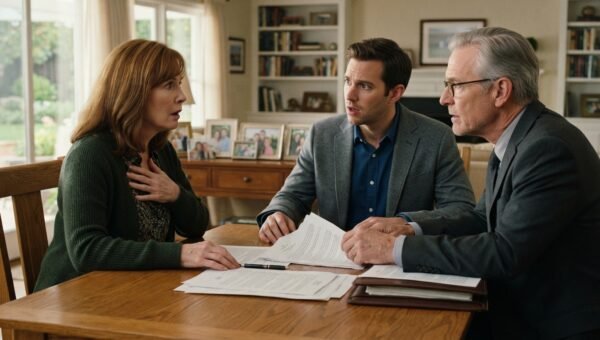
At the meeting, Mr. Bell sat beside Nora with his father’s notebook in a clear sleeve. The board chair thanked me for coming, then said a second image had turned up in the county archive. She slid it across the table, face down.
When she turned it over, she pointed to the hand on the gate and asked whether I recognized the ring.
PART 2
The second print was sharper than mine. It had been taken from the north bank, likely by the road commissioner’s clerk who kept municipal records. The angle caught the gate mechanism under the emergency floodlights, cutting straight through the downpour.
On the left hand gripping the rusted wheel, a wide silver band showed clearly. It had a notched ridge along the center.
It was Dale’s wedding ring.
I knew that ring because I had bought it for ninety-five dollars at a jeweler in South Bend two weeks before we married. When Dale lost weight twenty years later, he refused to resize it and wrapped clear fishing line around the bottom of the band to keep it snug. You could see the pale coil around the metal right there in the exposure.
“That’s Dale’s ring,” I said.
Mr. Bell set his pen down on the oak table. “A silver band isn’t a fingerprint, Mrs. Miller. My father wore silver jewelry his entire life. The notebook here proves he was assigned to the spillway crew.”
He slid the clear sleeve toward the board members. It was an open ledger page dated October 14, 1993. His father’s handwriting listed names and hours, but under the entry for ten o’clock that evening, there was a single pencil note: “Sent young Miller to clear debris from the river latch. Lever jammed.”
Nora picked up the sleeve. Her hand was steady, but her voice was tight. “My dad wasn’t on the road crew, Mr. Bell. He worked at the lumber yard.”
“He was twenty-one years old and lived two blocks from the canal,” Mr. Bell answered quietly. “Half the young men in town were drafted to help when the dike cracked. My father was the superintendent. He didn’t abandon the gate. He was the one who sent Dale.”
The room stayed quiet for a long moment. Nora looked at me, waiting for me to back her up. For twenty years, her version had been clean and heroic: Dale Miller had stood alone against the rising river, saved the lower town, and walked home without asking for credit. That was the story she had put on the museum wall. That was the story that brought in school field trips and made her feel close to a father who died of a stroke before she finished college.
“Mr. Bell,” I said, “if your father sent Dale to the latch, where was your father standing?”
“At the control shack,” Mr. Bell said. “Coordinating with the fire department.”
I looked down at the second photograph again. In the background, past the figure with the silver ring on the wheel, the control shack door stood wide open. Inside, illuminated by a yellow hurricane lamp, another figure was leaning over a desk, holding a radio handset to his ear. On his left wrist, resting against the edge of the logbook, was a silver square-faced watch.
PART 3
Neither man had stolen anything from the other.
They were both in the picture. One was turning the heavy wheel in the mud while the river tore at his boots, and the other was working the radios inside the shack, calling for sandbags to keep the high school from flooding.
I pointed to the open doorway in the back of the print. “Bring that under the lamp, Nora.”
Nora pulled the county print closer under the reading light. Her fingers traced the faint silhouette in the shack. She looked at Mr. Bell, then turned the photograph so he could see it under the bulb.
“The watch,” Nora said softly. “The square watch is in the shack.”
Mr. Bell pulled his reading glasses down his nose and leaned in. He did not speak right away. He stared at the small, grainy figure inside the lighted doorway for nearly a full minute. When he sat back, the stiff edge in his posture was gone.
“My father’s log says he left the shack at eleven to check the south levee,” Mr. Bell said. “He never mentioned who closed the latch. He just wrote that the latch was secured.”
“Dale came home at two in the morning,” I told them. “His hands were cut up and black with grease. He never called himself a hero. He just said the river was nasty and that old man Bell gave him hell for breaking a pry bar.”
Mr. Bell let out a dry, quiet laugh. “That sounds like my father. He accounted for every tool down to the cotter pins.”
The board chair cleared her throat and tapped the table. “Nora, the grant application requires historical accuracy in all permanent panel text. What is the committee’s recommendation?”
Nora looked down at her father’s ring in the print, then at the ledger page Mr. Bell had brought. She did not argue to keep her original caption. She had spent two years building the exhibit on her father’s solitary bravery, but she cared more about the actual record than an easy legend.
“The caption is wrong,” Nora told the board. “It shouldn’t say Dale Miller saved the town alone. It should say Dale Miller and Arthur Bell secured the municipal gate together. Arthur held the communications line open while Dale broke the jammed wheel free.”
She looked at Mr. Bell across the table. “If you still want to donate your father’s flood papers, we can display the original ledger right beside the two photographs.”
Mr. Bell looked at Nora, then down at the sleeve in his hands. “I’ll do you one better. I will cover the cost of reframing the entire flood gallery so the county print hangs next to your mother’s original negative.”
ENDING
The board voted five to zero to update the panel and keep the exhibit in place. The grant funding went through the following month, securing Nora’s position and keeping the history room open six days a week.
Three weeks later, I walked down to the Carnegie library on a Tuesday morning. The new panels had just gone up on the north wall.
There were two photographs now. On the left was my original black-and-white print from 1993, showing the rain, the truck, and the dark figure at the gate. On the right was the sharper county shot showing Dale’s ring on the rusted iron wheel and Arthur Bell inside the lighted shack with the radio. Between them, rested inside a sealed glass case, was the page from Arthur’s ledger.
Nora was standing near the door, watching an elderly couple read the new text. She walked over and stood beside me, our shoulders touching.
“You really didn’t know?” she asked quietly. “All those years?”
“I knew he worked hard that night,” I said. “And I knew he was bruised when he climbed into bed. The rest of it was just town talk. People like to make a single man carry the whole story.”
Nora touched the edge of the glass case. “I like this better anyway. It feels real.”
I looked at Dale’s hand frozen on the wheel under the floodlights. He hadn’t been a legend or a savior. He was just a twenty-one-year-old boy in a soaked jacket doing what an older man told him to do in the middle of a storm, hoping the water wouldn’t reach his own street. That was enough.