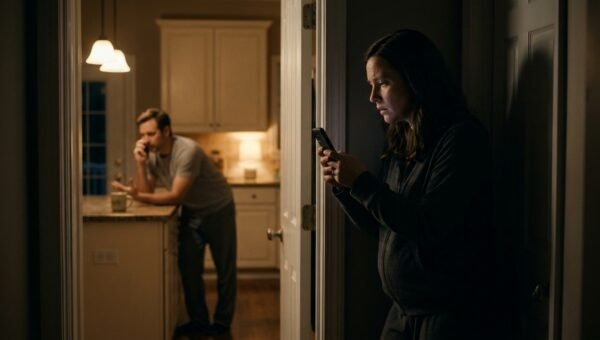
I had one hand on the call button and the other around my phone when the balance changed to $12.41. I was still in a hospital gown, with a plastic bracelet cutting into my wrist. The joint account had held $86,214 when I checked it that morning.
I called Emil. He picked up on the fourth ring.
“Where did the money go?”
“I moved it somewhere safe.”
“Where?”
“I’m on my way to the airport.”
I looked at the empty paper cup beside my bed. He’d brought me ice less than an hour earlier. I still had the little plastic spoon.
I’m Ilona, and I was fifty-six then. I work as a forensic analyst for a regional bank. I look at financial records when somebody says money went missing, or the numbers don’t fit, or a person is lying about what they did with an account.
Emil knew this. He used to call it “your number job.” It didn’t sound mean at the time. Or maybe I decided it didn’t, because we’d been married twenty-four years and I was good at making excuses for him.
I wasn’t in the hospital for anything serious. I’d had my gallbladder out, but I had a fever afterward and they kept me another night. The nurse had told me to stay put and drink water. Emil had said he’d bring clean pajamas and the charger I’d left at home.
He brought the charger. Then he said, “I have to run one errand.”
I asked him to stay until the doctor came back. He said he couldn’t. He looked tired, not cruel. I remember that because I kept replaying his face later, looking for a warning I could say I’d seen.
I didn’t see one.
For most of our marriage, Emil handled the bills. I made more money, but I was the one who liked a clean kitchen and a paid mortgage, not the one who wanted to log in every week. He’d sit at the table with his reading glasses and sort the mail into piles. I thought that was his way of helping.
My mother called it “his little office.” She liked him. She liked that he made her tea without asking which mug she wanted.
I did too.
The thing is, there had been small changes for years. A savings transfer here. A new online account there. Emil always had a reason.
A tax payment. A better rate. A card we needed to close. Once, I asked why our emergency fund had dropped by $4,700.
“House stuff,” he said.
I didn’t check. I was tired, and he sounded annoyed that I’d asked. That was enough to make me stop.
I’m not proud of that. I knew better. I just didn’t want to be the wife who treated every small thing like evidence.
Back in the hospital room, I called him again. It went to voicemail.
I called my bank. I gave the woman on the phone my account number and asked if she could stop the transfer.
“I’m sorry,” she said. “The money’s already been moved.”
“Can you tell me where?”
“Not until we verify the receiving account.”
I gave her my information. I answered the security questions with a dry mouth and a voice that sounded normal enough to fool me.
She said she could open a case, but she couldn’t promise a freeze.
I thanked her. Then I wrote down the case number on the back of my meal menu.
That was the first time my job helped me. Not because I could reach into the bank’s system or pull secret information. I couldn’t. I wouldn’t. I knew how easy it was to ruin a case by getting clever in the wrong way.
It helped because I knew what to ask for, and what not to touch.
I called my sister Marta. She got to the hospital with my pajama bag still over her shoulder.
“What happened?”
“Emil took the money.”
“Did he say where?”
“No.”
She looked at my phone. “Is he coming back?”
I said I didn’t know. Then I called him a third time, because apparently I needed to hear the same thing three times before I believed it.
He answered this time.
“I’m going to Boston,” he said.
“With who?”
He didn’t answer right away. I could hear traffic and somebody speaking near him.
“Don’t do this right now, Ilona.”
I sat up too quickly and had to put my hand on the bed rail.
“Who are you with?”
“Corinne.”
I’d met Corinne twice. She worked with Emil at a construction supply company. She was younger than me, but not by much. The first time she came over, she brought a lemon cake and asked if I was still doing “bank stuff.”
“Just the numbers,” Emil had said, before I could answer.
I remembered that line so clearly I could hear the scrape of his chair on our kitchen floor.
I didn’t yell. I didn’t ask how long. I said, “You used our account.”
“I’ll put it back.”
“When?”
“We’ll talk when you’re home.”
The call ended.
Marta put a hand on my shoulder. I pulled away. Not because she’d done anything wrong. I just didn’t want anyone touching me while I was trying to keep my voice steady.
“I need my laptop,” I said.
“You’re supposed to rest.”
“I’ll rest after I know where the money went.”
The hospital had a little table that rolled over the bed. I put my laptop on it, opened my email, and checked the account alerts. One alert had been sent at 12:47. The money had gone out in three transfers, not one.
I copied the times and amounts onto the back of the menu. $31,600. $29,814. $24,800.
The numbers bothered me. They were too neat in some places and too odd in others. A person moving money fast might send it all at once. A person trying to make the transfers look routine might split it up.
I didn’t know which kind of person Emil had become.
Marta sat in the chair and watched me type.
“Can you find it?”
“I can make a list of what to ask the bank.”
“That isn’t what I asked.”
I didn’t answer. I didn’t know yet.
The next morning, a nurse brought me toast I didn’t eat. I called the bank again. The fraud case had been assigned, but the person handling it couldn’t tell me anything about the receiving accounts.
So I called a lawyer.
I didn’t have one. I found a family-law office in Kettering and got an appointment that afternoon. Marta drove me there after my discharge. I still had the hospital bracelet on because I’d forgotten to take it off. The lawyer noticed, but didn’t ask about it.
Her name was Renee. She let me talk for five minutes, then asked me a question that made me stop.
“Do you have proof he planned this before you went into the hospital?”
I told her about the old transfers. I told her about the account alerts. I told her Emil had said he was flying with Corinne.
Renee said, “We can ask the court to preserve the money.”
“Can we stop him from spending it?”
“If we can show where it went and move quickly.”
I had my work notebook in my bag. I didn’t use it for work information. It was a plain notebook where I kept household dates, repair costs, odd bills, and things I didn’t trust myself to remember. I’d written down the old transfers because they bothered me, then told myself I was being silly.
Renee read the list.
“Why didn’t you bring this sooner?”
“Because I thought I was being a bad wife.”
She didn’t say anything. I was glad. I didn’t need a lecture, even if I deserved one.
The bank called me that evening. They’d found that the money went to two accounts. One was a savings account. The other was an investment account opened online three weeks earlier.
The investment account was in my name.
I asked them to repeat it.
“It’s under your name,” the investigator said. “The application was submitted from a device we can’t verify as yours.”
I sat at my kitchen table with my coat still on. The house was quiet. Emil’s reading glasses were on the counter beside the mail. I had left them there because I didn’t know what to do with them.
“Did I open it?” I asked.
“No.”
“Can you freeze it?”
“We’ve restricted access while we review the application.”
There it was. The first door shutting.
I called Renee. She said she’d file an emergency request first thing in the morning. I sent her the bank’s case number, the transfer times, and copies of every alert I had. Then I opened the joint account history and went back through the last three years.
I found more transfers. Not huge ones. $1,200 here, $2,600 there. The same short note each time: reserve, taxes, repair. It was like reading my own old excuses in Emil’s handwriting.
At 9:18 the next morning, I got a text from him.
“You’re making this worse than it needs to be.”
I wrote, “You opened an account in my name.”
He didn’t answer for twenty-six minutes.
Then: “I was keeping the money safe.”
That line almost made me laugh. Almost.
I called the bank’s fraud investigator and gave her the details of the old transfers. She asked me to send records, not theories. So I sent the records. The account that Emil had opened in my name held $61,414. The other held $24,800. Together, the two accounts held the exact amount taken from our joint account.
For the first time, I had a full trail.
I made a chart because that is what I do when my head is too full. Date, amount, source, destination, account holder. The small transfers from earlier years showed how the balances had been built. The three hospital-day transfers showed where the last chunk went.
I kept checking the math. Then I checked it again.
Marta brought me soup. She set it beside the laptop and said, “You’re not eating.”
“I will.”
“Ilona.”
“I will.”
I ate some. The soup had too much black pepper. I remember that, though I don’t remember what I watched on television that night.
Renee got an emergency hearing for the following week. Emil came back from Boston two days before it. He called and asked to meet at the house.
I said yes. Maybe I wanted to see whether he’d look ashamed. Maybe I wanted him to say something that would make the years before this feel real again.
He came alone. His suitcase was in the trunk, he said, because he’d gone straight from the airport. He smelled like the mint gum he chewed when he was nervous.
“I didn’t want you to find out like this,” he said.
“How did you want me to find out?”
He looked down at the table.
“I thought I could sort it out.”
“You opened an account in my name.”
“I was going to tell you.”
“When?”
He rubbed the side of his thumb with his finger. He used to do that when we were waiting for the doctor to call about my mother. I had loved that small habit once. I hated seeing it then.
“I didn’t want to lose the house,” he said.
“Then why did you take the money?”
“I panicked.”
“You flew to Boston.”
He looked at me. “Corinne needed me.”
I don’t think he meant it as a cruel line. That almost made it worse.
I asked how long it had been going on. He said a year. Then he changed it to “a while.” I didn’t ask again. I knew I might not like the exact number, and exact numbers were the only thing I could use.
He said, “You know I never meant to hurt you.”
I said, “I know you meant to keep the money.”
He stared at the table.
I had printed the bank alerts and the account records. I set them in front of him, but I didn’t slide them dramatically or anything like that. I just set them down. My hand shook a little. I put the other hand over it until it stopped.
“You have a hearing next week,” I said. “Renee will talk to you there.”
“You’re really doing this?”
“Yes.”
I didn’t say it loudly. I didn’t need to.
At the hearing, the judge ordered the accounts preserved while the case moved forward. The bank had already restricted the account opened in my name, and the court order locked the other account too. Renee told me to keep copies of everything and not contact Corinne.
I didn’t. I wanted to. I even typed her name into my phone once, then deleted it.
I’m not proud of how much I wanted to ask her what she thought she was doing. But I knew it wouldn’t put the money back. It would only give Emil another story about me being unreasonable.
The case took months. The bank confirmed that Emil had used my old email address and a saved password to open the investment account. He had moved the money there because the name on it was mine. He thought that would make it harder for anyone to connect it to him.
It didn’t.
My records helped Renee show that all $86,214 had gone from the joint account into those two accounts. No cash withdrawal. No missing piece. The judge ordered the funds held for division, and the bank restored the money to a joint legal account while the divorce was settled. Emil didn’t get to take it with him.
He got the house after we agreed on a buyout. I got my share of the equity and the money we’d traced. I didn’t get the marriage back, or the years I’d spent pretending I hadn’t noticed the small transfers.
The final bank letter came on a Thursday. I was home alone. I opened it at the same kitchen table where Emil used to sort the mail into piles.
The first page listed the restricted account. The second page had the balance: $61,414, held under my name. His last transfer was sitting there, frozen, in an account he’d opened for me without asking.
My hospital bracelet was still in the drawer beside the table. I’d kept it by accident, I think. I placed the letter on top of it and read my name once more.