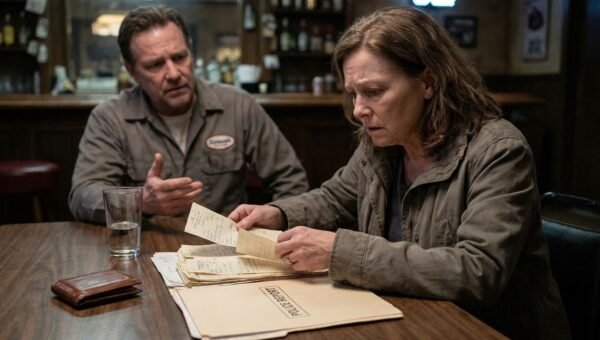
Dad’s checking and savings accounts were emptied three days before his funeral. My brother, Dean, said Dad had given him the PIN for groceries. The amount was $154,000. I remember the number because I wrote it on the back of a funeral-home receipt, then folded the paper until the ink rubbed off on my thumb.
Dean had already taken Dad’s truck, his guns, and his coin books. I was so tired of arguing that I let him.
That’s the part I’m not proud of. I told myself we could sort it out later, which is what I said every time Dean got loud enough to make me want to leave.
A few days after the funeral, Dean told me to clear the Christmas decorations out of the attic before he listed the house. He said it like he was assigning me one last chore. I said okay. I didn’t go up there until July.
Dad’s house was outside Bakersfield, where the attic gets hot enough to make you rethink every choice you’ve ever made. There were eleven boxes. I knew because I counted them twice, not because it mattered. The box marked LIGHTS was the last one I opened.
I’d been putting it off because Christmas was Dad’s thing. He kept the old decorations in their original boxes and saved every twist tie, even the rusty ones.
When I was a kid, he’d hand me the tangled lights and say I had the patience for it. I usually didn’t. I’d get mad and drop them in his lap.
Dean had stayed with Dad more than I had in the last year. That was true, and I hated that it was true. Dean was the one who’d run to the store, picked up prescriptions, and sat at the hospital when Dad was admitted. He also mentioned those things whenever anyone brought up money.
I’d visit after work and bring Dad a sandwich from the deli near my place. We’d sit at the kitchen table, and he’d tell me the same story about his first truck. I’d heard it so many times I could say the next line before he did. I never thought that meant I loved him more than Dean did. I just didn’t think visits were a bill.
At the funeral, Dean told people Dad had been confused near the end. He said it gently, almost like he was protecting him. I didn’t challenge him. I was grieving, and I knew I’d sound petty if I questioned the son who’d been there every day.
The money came up because the bank called me. Dean had transferred the funds out in several transactions before Dad’s death. He said Dad had told him to use the PIN for errands, and that the cash was his for taking care of Dad. He said it as if there were no gap between buying groceries and taking every dollar.
I asked him if Dad had really said that. Dean said I hadn’t been around enough to know. I can’t say he was wrong about the first part. I can say Dad never told me he’d given Dean permission to empty the accounts.
After the funeral, Dean was already talking about selling the house. He said it was too much for either of us to keep up, and we could both use the money.
I didn’t want it sold before we’d gone through Dad’s things. Dean said the estate couldn’t sit around waiting for me to feel ready.
So I swallowed it. Then I went up to the attic in July because the realtor was coming to look at the place and Dean wanted the boxes gone.
The LIGHTS box was full of cords, old bulbs, and those plastic clips Dad used to hang lights along the porch. One strand had a plug with a prong bent sideways. I used to bend it back with my thumbnail, which was a bad idea. I was doing that when I felt something stiff tucked under the cords.
It was a key taped to a card.
Dad’s handwriting was small and slanted. I knew it before I read the words. The card said: “FIRST FEDERAL, BOX 22. YOUR NAME IS ALREADY ON IT.”
Under that, he’d written, “He will take the easy money. You take the patient money.”
I sat on the attic floor for a while. I don’t know how long. The card didn’t explain the $154,000 or the truck or the guns. It didn’t say what Dad knew, or when he knew it. But the line about easy money sounded too much like a person who’d watched this coming.
I put the key in my pocket and climbed down. Then I called First Federal. The woman on the phone said she couldn’t tell me anything until I came in with identification. I almost left it alone. It felt like opening a fight Dad had already had with Dean, and I was tired of being the person who made things worse by asking.
But I’d spent years telling myself I was patient when sometimes I was just afraid of a scene. So I drove to the bank the next morning.
The teller checked my ID, typed for a minute, then asked me to confirm my address. She said my name had been on Box 22 since 2019. I asked if Dad had added me himself. She said the records showed he had. I had to ask her to repeat the year.
2019. Dad was still driving then. He still fixed his own coffee and got irritated if anyone tried to carry his laundry. He’d never mentioned the box.
The bank brought it out to a small room. The key turned without a fight. Inside were bearer certificates worth $180,000 and another envelope with Dad’s name on it. My hands were shaking enough that I had to set the envelope down before I opened it.
There was a note explaining that the certificates were meant for me. Dad had signed and dated it when he put my name on the box. He’d written that I’d visited because I wanted to see him, not because I expected anything. Then, near the bottom, he wrote: “He will take the easy money. You take the patient money.”
I read it twice. I didn’t feel happy. I felt like I’d been handed proof that Dad had seen something ugly in Dean and let me keep thinking it might not be true.
I took the papers to an estate attorney named Paula. She didn’t make any promises about the certificates or the bank money until she’d checked the records. She did say the box access and Dad’s signed note mattered, and that Dean couldn’t just sell the house because he’d decided to. The title was still in Dad’s name, and the estate needed proper handling.
Paula asked me to bring anything that showed Dad was thinking clearly in 2019 and near the end. I went back to the house and searched his desk. I found old bills, a ledger in his blocky handwriting, and a folder with appointment notes and test results. I wasn’t looking for a magic paper saying Dad was fine. I was trying to see what Dean had been telling people.
The ledger had dates and amounts, including the day Dad added me to Box 22. A page from that month noted that Dean had asked for money again. It didn’t say what for. Dad had written, “Says it’s temporary. Same as last time.” Below it was a note about the bank box and the certificates.
I found more notes from the year Dad died. He’d written down his appointments and what the doctor said. His handwriting stayed steady. The medical notes didn’t show a loss of capacity. Dad had been tired and in pain near the end, but there was nothing in the records to support Dean’s claim that Dad had been confused for months.
That was when the whole thing got bigger than the money. Dean hadn’t just said Dad was confused after the fact. He’d used that story to make his own choices sound like Dad’s choices. I’d believed some of it because it was easier than admitting Dean could take care of Dad and take advantage of him at the same time.
Paula got the bank records for the withdrawals and filed to stop the house sale while the estate was reviewed. The listing was put on hold. The bank also flagged the transfers for investigation because Dean’s PIN access didn’t prove Dad had authorized him to move the money after Dad died. None of it happened overnight. There were forms, calls, and one long wait while Paula checked every date.
Dean called me after he found out about the hold. He said I was trying to steal the house from him. I told him I was asking the estate to account for what he’d taken. He said he’d been there for Dad when I wasn’t. I said I knew he had been. I also told him that didn’t make the account his.
He kept talking over me. Finally, I told him I had the bank records, the signed note, and Dad’s ledger. I said the house wasn’t being sold until the estate was settled. He went quiet for a second, then said Dad had told him to use the money.
I asked him when. He said he couldn’t remember exactly. Then he said Dad had been confused anyway.
That was the first time I said it out loud. “Dad was never confused. He was watching you.”
Dean hung up. I stood in the kitchen with the phone still against my ear, listening to the empty line. I wanted to call him back and make him say it again. I didn’t. I had spent enough years trying to get Dean to admit things he already knew.
The estate process took months. The house stayed off the market while the accounts were reviewed. Dean had to answer for the $154,000, and the records showed the withdrawals happened when Dad could no longer have authorized them himself. I can’t say the money was all recovered. It wasn’t. But his claim that it was a gift didn’t hold up, and he lost the power to handle the estate as if it were his.
The certificates were recognized as Dad’s planned gift to me, backed by the dated note and his records. I secured them through the bank and followed Paula’s advice about what to do next. The $180,000 gave me room to make choices I hadn’t had before. It didn’t make the years with Dean feel different, or make Dad’s last months less hard.
Dean and I don’t talk now. I don’t feel proud of that, exactly. I just can’t keep letting him turn my silence into permission.
The last time I went to Dad’s house, I checked the rooms before I locked the front door. I still haven’t decided what to do with the place. The safe deposit key was in my pocket, beside Dad’s card, and the note had softened at the fold from being handled.
I put the key away. “Patient money,” Dad had called it. This time, I didn’t hand it to Dean.