The knock came while I was on one knee beside the front hall table, wiping up a streak of cleaner. David wasn’t due home for at least three more hours. I opened the door and saw his face, and my first words were, “Why are you home so early?”
“I wasn’t feeling well, so my boss let me leave early,” he said. Then he walked past me and headed straight for our bedroom.
I stood there with the damp rag in my hand. That was not like David. He usually stopped to kiss me, or at least asked what I was cleaning before putting his work shoes on the rug I’d just done. I followed him because the house felt wrong all of a sudden, though I couldn’t have said why.
I’m fifty-two, and I’ve lived in this old textile town in South Carolina long enough to know how a house sounds when someone familiar comes home. The screen door rattles. The floorboard by the hall gives one quick squeak. David’s steps always drag a little on the right because of an old ankle injury. This man’s steps didn’t.
Still, the face was David’s. Same dark brows, same small crease beside his mouth, same hair that never stayed neat after a shift. I told myself a person can walk differently when sick. I told myself I was making a fuss over nothing. That’s what I do when I don’t want to seem difficult.
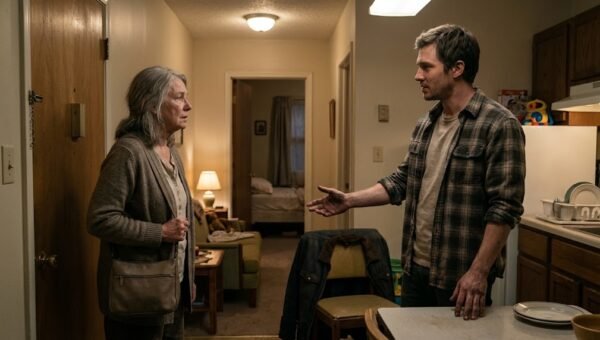
He went into our bedroom without taking off his shoes. David never did that. I started to call after him, then stopped when I heard a drawer slide open. Our bedroom wasn’t where he went when he felt sick. He went to the couch and asked me to bring him water.
“Do you want me to get you something?” I asked.
He didn’t turn around. “I’m fine.”
The answer came too fast. I kept one hand on the doorframe and watched him look along the closet shelves. David knew exactly where his clothes were, but this man was looking behind the folded blankets. He lifted a stack, set it down crooked, then checked the lower shelf.
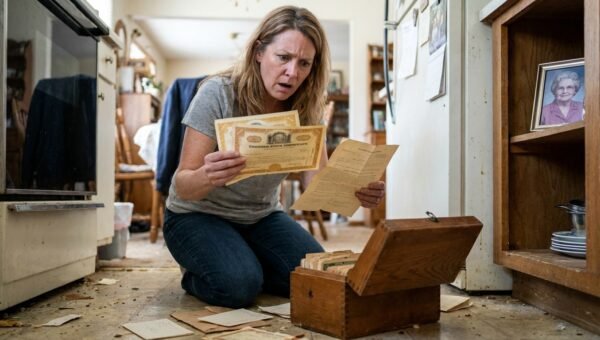
I knew what he was looking for. A small steel lockbox sat behind the blankets, tucked under an old quilt. David kept his mother’s diamond bracelet in there, along with the appraisal and some papers from her estate.
We’d talked about moving the box to a bank deposit box, but never got around to it. I didn’t know the exact value of the bracelet. I just knew it was worth enough that David worried about it.
I watched the man reach for the quilt. “What are you looking for?”
He finally looked at me. “My old watch.”
That wasn’t where David kept his watch. And the watch he wore every day was still on his wrist.
For a second, I wanted to laugh. It felt easier than asking why my husband was lying to me in our bedroom. I even thought maybe he’d taken something for a headache and was confused. Then he looked away and went back to the shelf.
The lockbox was hidden in a place David had shown me years ago, after we bought the house. He’d said the previous owner had left a loose board in the closet, but it wasn’t loose anymore.
We’d put the box behind the blankets instead. I didn’t think anyone else knew that. Still, the man’s hand was already near it.
I stepped closer. “What happened to your ring?”
He glanced at his left hand. David’s wedding ring was a plain gold band he wore every day, even when it left a little red mark in summer. This man had no ring. He tucked that hand into his pocket.
“I took it off at work,” he said. “My hand’s been bothering me.”
There were a dozen reasons that could be true. I knew that. The answer still sat wrong with me, like a loose thread I couldn’t stop touching.
Then I heard a phone buzz in the kitchen.
David’s phone was on the counter. He’d left it there that morning because he was charging it before work. I remembered putting a dish towel beside it. The man in our bedroom heard the buzz too, because his head turned toward the hall.
I didn’t look away from him. “Your phone’s in the kitchen.”
“I’ve got another one.”
“You said your boss let you leave early.”
He sighed as if I were making this harder than it needed to be. “I’m tired. Can we not do this?”
That was when I stopped calling him David in my head. Not out loud. I still wasn’t ready to say it. But I knew this wasn’t the man who’d left our house that morning.
I took a step into the hallway and pulled my own phone from my pocket. My hands were steady enough to unlock it, which surprised me. I called David’s number.
The phone in the kitchen rang. The man in the bedroom didn’t look toward it this time. He watched me.
“Pick that up,” I said.
He started to move toward me. I backed into the hall, keeping the door between us as much as I could. “Who are you?”
His face changed, but only a little. His mouth tightened. He didn’t look surprised. He looked annoyed that I’d made him stop.
I felt foolish for what I asked next, but I needed one answer only David would know. On the morning we signed the papers for this house, I’d left him a note in his lunch bag. It was a private joke from the day we first saw the ugly green kitchen. I asked what I’d written.
He said, “I don’t know what you’re talking about.”
David would have known. He’d brought that note home and stuck it to the fridge for years. I’d seen it so many times that I could still picture my handwriting, with the lopsided heart above the words.
The man took another step toward me. “Move.”
I backed out into the hall and reached for the bedroom door. This house had a strange old lock on that door, with a keyhole on the outside. The previous owner had used the room as an office, David told me. We kept the key in a little drawer by the linen closet, mostly because it was there and neither of us had thought to remove it.
I slammed the door. The man hit it from the other side before I got the key in. The wood jumped against the frame. I turned the key once, then again, and ran for the kitchen.
He hit the door again. “Open it.”
I called 911 and gave the address. My voice sounded thin and too polite. I told the dispatcher a man had gotten into my house and was locked in the bedroom. Then I went out the front door and stood on the porch, phone in hand, watching the driveway.
The dispatcher stayed with me. I could hear the man shouting through the closed door, but I couldn’t make out every word. One sentence came through clearly.
“I knew you’d open the door.”
I was still standing outside when a car pulled in. David got out, took two steps toward me, and stopped when he saw my face.
“What’s going on?” he asked.
I told him there was a man in the bedroom. Then I told him the man had his face.
David looked past me toward the house. “What did he say?”
“I asked who he was. He wouldn’t answer.”
David went very still. Then he said the name, quietly. “Arthur.”
I didn’t know that name belonged to anyone in David’s family. I’d met his mother and his aunt. I’d seen old pictures from when he was young. Nobody had ever mentioned a twin.
David told me Arthur was his identical twin. They hadn’t spoken in ten years. They’d fallen out over their mother’s estate, and David had decided he didn’t want Arthur in his life anymore. He said he was ashamed of how the family had handled it, and he thought it was better not to bring the whole thing into our marriage.
“Better for who?” I asked.
He didn’t answer. He kept looking at the house.
The police arrived a few minutes later. I stayed outside with David while two officers went in. Arthur was still in the bedroom. The lock had held. He came out in handcuffs, looking at me as if I’d broken a promise.
One officer asked if I knew him. I said no. Then I corrected myself. “I know who he is now.”
The police found the lockbox partly pulled from its hiding place. The quilt was on the floor, and the papers had been moved around. Arthur had not gotten the bracelet. He had come in while David was at work, using the face I trusted to get through my front door.
David told the officers Arthur had been asking about the bracelet and the estate for months. He said Arthur must have watched him leave for work and figured out his routine. It was hard to listen to that while looking at the same face I’d opened the door to. David said he hadn’t told me because he thought the past was finished.
Arthur was arrested for burglary and impersonating David. The officers took the lockbox as evidence, and later gave the bracelet back. Nothing was missing. The case moved on without me needing to do much beyond give a statement and sign papers.
That night, David sat at the kitchen table while I made tea neither of us drank. He apologized for keeping Arthur a secret. I told him I believed he was sorry. I also told him that those were two different things.
“I didn’t think he’d come here,” he said.
“I didn’t think he was you.”
Neither of us had a good answer after that. For a while, I kept checking the hall before I went to bed. David arranged for new locks and an alarm. I said I was glad he did. I was glad. I also found myself listening to his footsteps when he came home, and I hated that I did it.
The bedroom lock was still unbroken, catching the afternoon light, when the sirens came up the driveway.