PART 1
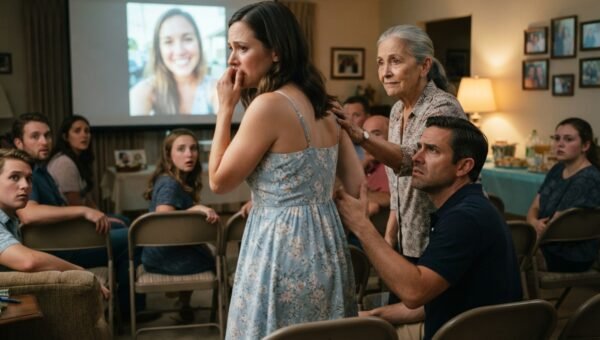
The man who stepped into the receiving line had dried salt from road slush crusted on the cuffs of his khakis. He did not look at the guest book. He did not take a paper prayer card from the basket on the pedestal. He walked straight toward the front row of folding chairs near the casket, stopped two feet from where we were standing, and asked, “Which one of you is Ruth?”
“I’m Ruth,” I said. My voice was raspy from three days of answering relatives on the phone.
The man didn’t look at me. His eyes were fixed on my younger sister, Clara.
Clara was standing beside me in a black wool coat that had belonged to our mother. When the man spoke, her fingers tightened around the strap of her handbag until the leather creased white.
“I have an envelope for you,” the man said to Clara, still ignoring my outstretched hand. He pulled a long, narrow envelope from his jacket pocket. It was not sealed. A blue corner of an Amtrak passenger ticket was sticking out of the top fold.
Before I could reach for it, Clara snatched the envelope out of his fingers. She shoved it into the side pocket of her coat so fast her knuckles hit the zipper with a hard snap.
“You have the wrong family, sir,” Clara said. Her voice was too loud for the small chapel.
Two of my cousins turned around from the third pew. “My sister’s husband just died. Please leave.”
The man looked confused, but he did not apologize. He looked down at a scrap of yellow legal paper in his palm, then looked back at Clara’s face. “The name was Ruth Miller. Train forty-two out of Harrisburg. The day he passed.”
“My husband was David Miller,” I told him, stepping between them. “I am Ruth Miller. Who are you?”
“Nobody,” the man said quietly. He glanced at Clara once more, shook his head, and turned down the center aisle without another word. The side exit door clicked shut behind him.
Clara would not look at me. She kept her hands buried deep in her coat pockets. When I asked her what the ticket was, she told me the man was clearly confused or working a scam on grieving families. She said people read the county obituaries and show up to shake down widows for small cash.
She talked fast, straightening the plastic flower arrangements on David’s casket, telling me to focus on greeting his former coworkers from the lumber yard.
David and I had been married for twenty-two years. We lived in a two-story Dutch colonial outside Lebanon, Pennsylvania. He had worked thirty-one years managing shipments at the mill, and I had worked twenty-eight years as a clerk in the township tax office. We did not take fancy vacations. We did not have secrets, or so I had believed until the morning David collapsed on the gravel driveway with a massive coronary while carrying out the trash.
The rest of the service passed like water running under ice. I shook hands. I nodded when David’s supervisor said David was the most dependable man on the loading dock. But every few minutes, my eyes went back to Clara’s coat pocket.
When the burial ended at Saint Luke’s cemetery, the cold wind was picking up off the ridges.
The crowd scattered quickly to their heaters. Clara told me she would drive our mother back to the assisted living center and meet me at my house with the casseroles people had dropped off.
I walked alone down the asphalt path toward my Buick.
The man from the chapel was sitting on the front bumper of a gray sedan parked two stalls away from mine. When he saw me coming, he stood up and pulled a heavy brown leather suitcase from his back seat.
“I didn’t mean to cause a scene in there, ma’am,” he said, setting the suitcase down on the gravel between us. “My name is Thomas Vance. David gave me three hundred dollars in cash four weeks ago. He paid me three hundred dollars to hold this until today, and then deliver it to the real Ruth after the burial.”
PART 2
The gravel crunched under my black pumps as I stopped three paces from the suitcase. It was an old piece of luggage, scuffed at the corners, with two brass latch locks that David had kept on the top shelf of the hallway closet for as long as I could remember.
“What do you mean, the real Ruth?” I asked. My hands were shaking inside my gloves.
Thomas Vance pulled up his jacket collar against the wind. “David worked with my brother down at the rail spur years back. He came to my shop last month. He told me his heart wasn’t right. He said if anything happened to him, I was to take this bag and the ticket, go to the funeral home, and hand them to the woman he named Ruth.”
“I am Ruth,” I said again, though the words felt strange and thin in my own mouth.
“He gave me a picture so I wouldn’t mess it up,” Thomas said. He pulled a folded sheet of photocopy paper from his wallet and handed it across the space between us.
It was a copy of Clara’s driver’s license photo from five years ago. Beneath it, in David’s unmistakable cramped handwriting, were the words: *Ruth Miller. Give her the bag and the ticket.*
My chest tightened until it was hard to draw in the cold air. “Open it,” I told him.
“He didn’t give me a key, ma’am. He just said to give it to her.”
I stepped forward, knelt directly on the wet gravel, and pushed the spring latches. They were not locked. They popped open with a dull metallic thud.
Inside the lid, neatly folded, were four dresses. They were cotton day dresses, size ten. My size. One of them was navy with small yellow flowers, a dress I had bought at the mall in Lancaster twelve years ago and thought I had lost during our basement remodel. Beneath the clothes lay a framed five-by-seven photograph in a plain silver dime-store frame.
I picked up the frame. The glass was cold.
The picture showed Clara and David standing on the stone steps of the courthouse in Hagerstown, Maryland. Clara was wearing a simple cream-colored suit. David was wearing a dark blue blazer I had never seen in my life. In the photo, Clara had her arm looped through his elbow, and both of them were holding up a white legal certificate with a gold seal. On the back of the cardboard backing, written in blue ballpoint ink, were four words: *David and Ruth, 1998.*
Nineteen ninety-eight was four years before I ever met David at the township zoning board.
The gravel behind me made a sharp, grinding noise.
I turned around. Clara was standing twenty feet away, near the open door of her car. She had left the engine running, and gray exhaust was curling into the gray sky. She was not wearing her coat. She had left it in the front seat.
Her left hand was bare. She had already taken off her wedding band, the gold band our mother had handed down to her when Clara married an insurance adjuster named Mark fifteen years ago. Clara had divorced Mark six years back, but she had never taken that ring off until today.
She didn’t look at the dresses. She didn’t look at the open suitcase on the ground.
She looked past me, straight at Thomas Vance.
“Is the four o’clock train still running?” Clara asked him. Her voice didn’t shake at all. “Is it still waiting at the depot?”
PART 3
Thomas Vance looked between the two of us, his face tightening with the sudden realization of what he had stepped into. He stepped backward toward his car door. “It leaves Harrisburg at four-ten, miss. The ticket is open. That’s all I know.”
He got into his sedan, started the engine, and pulled out of the cemetery lane without waiting for either of us to say another word.
I stood up from the gravel, holding the silver frame against my stomach. My knees were wet and dirty from the road slush.
“Ruth was our grandmother’s middle name,” I said. The words came out slow and flat. “Mother gave it to you as your legal middle name on your birth certificate. But nobody ever called you that. Nobody except David.”
Clara looked at the gray exhaust rising behind her car. She reached into her pocket and pulled out the envelope Thomas had handed her in the chapel. The Amtrak ticket was tucked inside with a printed confirmation slip. The destination was Chicago, with a sleeper connection to Portland, Oregon.
“We were twenty-four,” Clara said. Her eyes were dry, but her lips were pale. “He didn’t have a permanent job at the mill yet. He worked odd shifts on the freight docks. We drove down to Maryland on a Saturday morning because you didn’t have to wait three days for blood work down there. We signed the papers. We got the certificate.”
“You were married to him,” I said.
“For six months,” Clara whispered. “Then he took a job three states away, and we had an argument in a parking lot outside a diner in Frederick. He walked off. I came home. We never filed the divorce papers because neither of us had the four hundred dollars to pay a lawyer to track the other one down. After two years of silence, I assumed the state voided it or he filed on abandonment. When he came back to Lebanon four years later, he met you at the township office.”
“He married me,” I said, my voice rising. “In our church. With our mother in the front pew.”
“I know,” Clara said. “I sat in the third row. When he walked down that aisle and saw me standing next to Mother, his face went completely gray. After the reception, while you were in the powder room changing into your traveling clothes, he pulled me into the coat closet by the kitchen. He begged me not to say anything. He told me he loved you, that he couldn’t undo what he did, and that if anyone found out, he would go to prison for bigamy and lose his pension at the yard.”
I looked down at the photograph in my hands. The woman in the cream suit was twenty-four, smiling into the autumn sun on those courthouse steps.
“He kept the suitcase packed,” I said, the realization settling into my ribs like lead. “He had my size clothes in there. Why did he have my clothes?”
“Because he was a coward, Ruth,” Clara said, and for the first time, her voice broke. “Two months ago, his doctor told him the blockages in his arteries were too deep to stent. He knew he wasn’t going to make it another year. He called me from a pay phone by the depot. He said he had lived twenty-two years terrified that the county records would catch up with him. He said he wanted to leave Lebanon before he died, sell his share of the camp up in Potter County, and take me to Oregon like we planned when we were kids.”
“He packed my dresses,” I repeated. The repetition felt like the only anchor I had against the wind.
“He didn’t pack them for me,” Clara said softly, pointing at the open lid. “He packed them because he had lost his mind with guilt. He told me he couldn’t tell which one of us was his real wife anymore. He bought the train ticket in the name of Ruth Miller. He told me if I met him at the station on the first of the month, we would leave. If he died before the first, he said Thomas would give me the ticket so I could leave on my own.”
She held the ticket out toward me. The paper fluttered in the freezing air.
“He died on the driveway,” Clara said. “The morning he was supposed to drive to the station.”
I looked at the blue ticket. I looked at my sister, whose face had carried this rot through twenty-two years of Sunday dinners, Thanksgiving turkeys, and backyard birthdays. She had sat across our dining room table every month, watching David pass the potatoes, watching him kiss my cheek when he came in from the garage, knowing every single day that the man sitting at the head of the table had signed a book with her in Maryland first.
“Did you sleep with him?” I asked. “After he married me?”
Clara looked me square in the eye. “Not once. Not a single time. But I let him stay in that house with you because I didn’t want our mother to know what a fool I had been at twenty-four, and because he paid my rent for three years after Mark left me. That was the price he paid to keep me quiet. Two hundred and fifty dollars a month, mailed in cash from a post office box in Harrisburg.”
ENDING
The wind died down, leaving the cemetery completely silent except for the low hum of Clara’s car engine.
I knelt back down on the gravel. I took the framed photograph out of the silver frame, tore the cardboard backing off, and ripped the picture into four clean pieces. I dropped the pieces into the bottom of the suitcase on top of the floral dress.
Then I closed the brass latches and stood up.
“Take your car,” I told Clara. “Go back to Mother’s place. Don’t bring the casseroles to my house.”
“Ruth,” she started, taking half a step toward me.
“My name is Ruth,” I said, and the word didn’t feel thin anymore. It felt heavy, like an iron stove. “The deed to the Dutch colonial is in David’s name and mine as husband and wife. If that Maryland certificate ever surfaces at the courthouse, the county will freeze the estate, and neither one of us will get a dime of the life insurance or the house. The lawyer told me yesterday that David had thirty-two thousand dollars in the mill credit union.”
Clara looked at the torn pieces inside the bag. She knew what county probate meant as well as I did. She had worked as a medical billing clerk for twenty years; she understood forms, signatures, and the state government.
“Give me the ticket,” I said.
She hesitated, her fingers trembling against the envelope, then she handed it to me.
I took the envelope, walked to the rear of my Buick, and unlocked the trunk. I lifted the heavy leather suitcase, set it inside beside the spare tire, and dropped the Amtrak ticket right on top of the latches. Then I slammed the trunk lid shut.
Clara stood by her running car for another minute, waiting for me to scream or cry or ask another question about the years in between. But there was nothing left to ask. David was in a concrete vault six feet under the frozen sod, beyond the reach of the Lebanon County sheriff, beyond the reach of the church council, and beyond the reach of any explanation that could make twenty-two years make sense.
“Are you going to tell Mother?” Clara asked.
“Mother is eighty-four years old and thinks David is an elder at the church,” I said, pulling my car keys from my purse. “I’m going to let her eat her dinner in peace.”
Clara nodded once, got into her car, and backed out onto the lane. I watched her taillights disappear past the cemetery gates toward the state route.
I didn’t drive to the train station in Harrisburg. I drove straight back to the Dutch colonial.
I walked into the kitchen, hung my coat on the peg behind the back door, and sat down at the table where David had left his coffee mug in the sink that morning. The house was cold, but I didn’t turn up the thermostat. I sat there in the quiet until the streetlights flickered on along the lane, listening to the refrigerator click on and off, knowing that the only thing David Miller had left behind that belonged entirely to me was the quiet.