I was looking for the spare blanket when my father called after eight years of silence. He asked if I could pick him up at the bus station. His car had broken down, he said, and he needed a place to sleep for one night.
I stood with the blanket over one arm and the phone against my ear. I’d spent years telling myself I was done waiting for Arthur to show up.
Still, I said I’d come. I was already rehearsing the rules in my head: one night, no promises, and no pretending the last eight years hadn’t happened.
It was raining when I pulled into the station. Arthur came out carrying one suitcase and a plastic grocery bag. He looked smaller than I remembered, though maybe that was just the old coat hanging off him. Before he got in, he asked whether my daughter still played the violin.
I said yes.
He reached into his coat and pulled out something wrapped in a music program.
I didn’t ask him what it was. Not yet.
When I was a kid, my father could fix almost anything with a screwdriver and a little patience. He wasn’t a warm, talk-about-your-feelings kind of man, but he came to my school plays and kept every drawing I brought home. Then his marriage to my mother fell apart, his work dried up, and the bills got ahead of him.
He left town after a fight about money and never came back.
At least, that was the version I had for a long time.
He was supposed to come to Clara’s first big violin recital the week he left. She was nine and had practiced the same short piece until she could play it without looking at the music. I’d saved him a seat. He didn’t show. Clara kept glancing at the back of the room until the recital ended.
I told her he must have had car trouble.
It was the first lie I told on his behalf. It wasn’t the last.
I took the blanket off the passenger seat and laid it across Arthur’s knees. He thanked me and held the wrapped bundle in both hands. His left hand shook a little. I noticed, then looked back at the wet road.
“What happened to your car?” I asked.
“It finally gave out,” he said.
That answer had a worn-down sound to it. I didn’t push. Not in the station lot, with Clara asleep at home and his suitcase taking up half the back seat.
I recognized the streets as we drove, though he’d been gone long enough that two stores had changed names and the old diner had closed. Arthur asked if the house was still on the same road. I said it was. He nodded like he’d expected that. His fingers stayed curled around the music program.
“Clara’s still practicing?” he asked.
“Most days.”
“That’s good.”
It was a small exchange, but I could hear the eight years sitting in it. I wanted to tell him she’d grown taller than I was, that she’d worked hard, that she’d needed him there. Instead, I asked whether he’d eaten.
“Not since lunch,” he said.
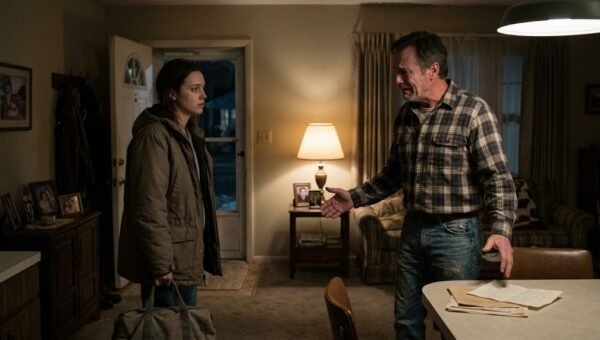
At home, I showed him the study where he’d sleep. It had a pullout bed and boxes of tax papers along one wall, so it wasn’t much of a guest room. He said it was fine. I set his suitcase beside the bed and went to heat soup.
He stayed near the kitchen doorway, like he wasn’t sure he was allowed to sit down. I put a bowl on the table. Then I saw the grocery bag tipped on its side, with a folded bus schedule and two transfer slips poking out.
One slip had a date from that afternoon. The other showed a one-way ticket.
I kept stirring the soup even though it was already hot.
The bag didn’t fit the story about a broken-down car. I could have left it alone for the night. That would’ve been easier, and honestly, I was tired of being the one who had to keep a conversation from turning bad. But I’d spent years covering for Arthur. I couldn’t do it again just because he was sitting at my table.
I set the spoon down.
“You came by bus,” I said.
Arthur looked at the slips. He didn’t deny it.
“Your car didn’t break down.”
“No.”
I pulled out a chair and sat across from him. My hands were on the table, flat. I wasn’t proud of how angry I sounded, but I was angry.
“Why say that?”
He rubbed his thumb over the edge of the bus ticket. His left hand shook more when he tried to keep it still.
“I didn’t know how else to ask.”
“Ask for what? One night?”
He looked at me then. “Yes.”
That was the line that stung. Not because it was cruel, but because it was so small. One night. Like the years between us could be folded down to the size of a blanket and put away in the study.
Arthur told me he’d sold his car. Six months earlier, a doctor had diagnosed him with Parkinson’s. It was early, the doctor had said, but his hands had started shaking and his balance wasn’t what it used to be. He’d been living alone two towns over, working odd custodial jobs when he could. Driving had started to feel unsafe.
He’d used most of what he had left to pay the deposit at a local veterans’ assisted-care place. He was due to move in the next day. He’d arranged it himself and had enough money for the room, he said. He wasn’t asking me to take him in.
“I thought I could manage longer,” he said. “Then I couldn’t.”
I watched his hand work at the paper ticket. It kept bending under his thumb.
“So why come here now?”
He glanced toward the bundle. “Because of that.”
The answer sat between us. I asked him what it was, and he said it belonged to Clara. Then he told me he’d kept it safe all these years. He hadn’t come to ask me for money or a place to stay past one night. He wanted to hand it to her himself while he still could.
I got up to put the soup back on the stove. I didn’t want him to see my face while I did it. That was the thing about anger. It gave me something to stand behind, and then the truth came along and made the anger less simple.
He told me he’d been ashamed after he left. He’d lost his job, then his marriage, and he figured I’d be better off without him showing up with nothing to offer. He said he kept thinking he’d call when he was doing better. The longer he waited, the harder it got.
“That doesn’t make it right,” I said.
“I know.”
“You missed her recital.”
“I know.”
He didn’t ask me to forgive him. I don’t know if that made me feel better or worse. He sat there in his damp coat, trying not to shake, and looked like a man who’d run out of excuses a long time ago.
I asked why the music program was wrapped around the gift. Arthur said it was the program from Clara’s recital, the one he’d missed. He’d found it among his things after he left town. He kept it, he said, because he couldn’t throw it away. I could tell he wanted to say more, but he stopped.
I brought him tea. We didn’t talk much after that. I let him sleep in the study, but I kept my bedroom door closed. That was the boundary I could manage that night.
In the morning, Clara came downstairs in socks, rubbing sleep from her eyes. She saw Arthur at the kitchen table and stopped.
I said, “Your grandfather’s here.”
She looked at me, then at him. I could see her working out which version of the story she was supposed to believe. For most of her life, I’d told her he lived far away and wasn’t able to visit. I hadn’t told her the whole ugly part. I thought I was protecting her. Maybe I was also protecting myself from having to say he’d chosen not to come.
Arthur stood up too quickly and caught the edge of the table.
“I’m sorry I missed your recital,” he said.
Clara didn’t answer right away. She pulled out a chair, but she didn’t sit. Arthur picked up the bundle and laid it in front of her.
“I brought you something,” he said.
He untied the string slowly. His left hand shook, so Clara reached over and held one end for him. Inside the folded program was an antique violin bow with a silver mount. Arthur said it had belonged to his mother. It was a Tourte-model bow, he explained, though he didn’t make a big deal of it. He’d carried it through years when he had almost nothing else. He wanted Clara to have it.
She looked at the old program under it. Her name was printed there in small type, followed by the name of the piece she’d played at nine.
“You kept this?” she asked.
“Yes.”
She picked up the bow carefully, as if she was afraid she’d hurt it. I could see her face change when she understood that he’d kept the paper from the night he didn’t come.
“I don’t know what to say,” she said.
“You don’t have to say anything.”
She went to get her violin. I almost asked her to wait, but I didn’t. She set the bow on the strings and played a short scale. Just one. The notes came out soft and a little uneven because she was still waking up.
Arthur listened without moving. His hands rested on the table.
After breakfast, I drove him to the residence. He had paid the deposit himself, and he showed me the paperwork in a plain envelope. The place was clean and modest, with a dining room and a small garden out back. It wasn’t what I would have picked for him, but he’d picked it. That mattered.
At the door, he thanked me for the ride. I told him I wasn’t ready to act like we were fine. He said he understood.
Clara had decided she wanted to see him again, but she didn’t want to promise anything big either. We agreed on Sunday phone calls and a visit once a month. If he missed a call, I said I wouldn’t make excuses for him. He said that was fair.
I shook his hand. He held on for a second, then let go. I leaned in and gave him a brief hug before I could talk myself out of it. It wasn’t forgiveness. It was just what I could do that day.
When I got home, Clara had set the bow across her music stand. The morning sun caught the polished wood. Beside it lay the old recital program and a small slip of paper with Arthur’s new room number written in steady blue ink.