PART 1
The yellow price stickers were stuck to almost everything in the front hallway when I pulled into Mom’s gravel drive.
A folding card table sat right beside the coat rack, stocked with rolls of blue painters tape, a black cash box, and printed signs that said CASH OR VENMO ONLY. Strangers were already wandering across the front porch with coffee cups in their hands, picking through the terracotta planters and peering through the living room windows.
Mom had only been at Meadowview Rehabilitation for eleven days. She broke her hip getting out of the garden tub on a Tuesday morning, went through three hours of surgery on Wednesday, and had just started walking with a walker between two parallel bars. Her nightgown was still folded neatly over the arm of her favorite floral recliner. Her prescription reading glasses were resting right on the coaster beside her Bible.
Yet my younger sister, Brenda, stood by the dining room archway wearing gardening gloves, slapping red neon round tags onto the cherrywood hutch.
“Brenda, what on earth is this?” I asked, pushing past a woman examining Mom’s brass coat hooks. “Mom is seventy-two. She is doing physical therapy twice a day to get back on her feet.”
Brenda did not even flinch. She pressed a circular tag marked $350 onto the glass front of the hutch, wiped her forehead with the back of her wrist, and pointed a ballpoint pen at me.
“She isn’t coming home, Clara,” Brenda said, her voice flat and completely devoid of doubt. “The rehab social worker already ran the numbers. Her Medicare coverage drops its percentage after twenty days, and long-term care insurance did not approve her supplement. It is eight thousand dollars a month for memory and physical decline care. That house note and the upkeep are eating us alive. I have power of attorney for her health and finances, and I am liquidating the property before the bank or the county puts a lien on it.”
“She does not have memory decline,” I snapped, feeling the blood rush hot into my temples. “She has a fractured hip. And she gave you financial power of attorney three years ago strictly to handle her annual property tax payments while she was visiting her sister in Arizona. She never authorized you to sell her life off.”
Brenda ignored me, turning to hand a receipt to an older man carrying Mom’s good cast-iron skillets.
I walked into the living room, my hands trembling with fury. In the corner, next to the television stand, sat the spare folding wheelchair Mom had used two summers ago when she sprained her ankle.
Brenda had stuck a price tag across the padded vinyl armrest: $75 FIRM.
Seeing that tag broke something inside me. I stepped up to the chair, ripped the adhesive sticker off, balled it up in my fist, and threw it into my canvas tote. Then I went through the room like a woman possessed. I ripped the $20 tag off Mom’s sewing basket. I yanked the $15 tag off the mantle clock our father had given her for their twenty-fifth anniversary. I pulled the stickers off the framed needlepoint samplers, the footstools, and the kitchen canister set.
A couple browsing through the hallway stared at me, then backed out toward the porch when they saw the look on my face. Brenda caught up to me in the hallway leading back to Mom’s bedroom.
“Stop tearing off my tags, Clara!” she hissed, grabbing my forearm. Her grip was tight, her nails digging right through the cotton sleeve of my sweater. “I paid two hundred dollars to run the classified ads and post this sale online.
The house goes on the MLS next Friday. The broker is already doing the comps.”
“Mom owns this house clear,” I said, shaking her hand off me. “Dad paid the thirty-year mortgage off in 2004 before he died. There is no note on this house, Brenda. What are you talking about?”
Brenda’s eyes flickered sideways toward the bedroom door. She pulled her chin back, smoothing down her denim shirt.
“Taxes and maintenance,” she muttered. “You don’t see the bills like I do.”
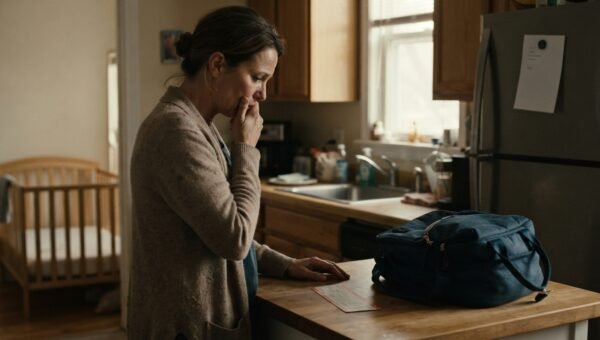
I stepped into Mom’s bedroom. The bed was made with the quilted blue spread she had sewn herself. On her dresser, the silver hand mirror and comb set lay bare, stripped of their velvet cases.
I looked up at the wall above the headboard.
Mom had hung an ordinary framed landscape there for forty years. It was a simple, muted watercolor of our county’s valley before the state utility company dammed the river back in the late 1960s to create Lake Oconee. It had hung in that exact spot for as long as I could remember. It was slightly faded from the morning sun, showing rolling green pastures, a cluster of timber barns, and a gravel road winding down into a river basin that no longer existed.
Right across the center of the glass, Brenda had stuck a wide piece of blue tape. On it, written in heavy black marker, were the words: NOT FOR SALE.
I stopped. Brenda was selling Mom’s wheelchair, her silver, her sewing baskets, and the furniture our father had built with his own hands. She was letting total strangers walk out the door with boxes of Mom’s winter coats for five dollars a pop. Why would she refuse to sell a dusty, faded watercolor that wasn’t worth twenty bucks at a yard sale?
I walked over to the bed, kicked off my slip-ons, and knelt on the mattress.
“Don’t touch that,” Brenda said from the doorway. Her tone had completely changed. It was no longer the sharp, impatient voice she used when arguing about money. It was cold, low, and laced with panic.
“Why?” I asked, reaching up. “Everything else has a price on it. Did you promise this to someone?”
“It belonged to Aunt Evelyn,” Brenda lied smoothly, stepping into the room. “Mom told me she wanted it returned to the family estate.”
Aunt Evelyn had passed away in 1988 and had never lived in Georgia.
I lifted the frame off the brass hook. It felt surprisingly heavy for a simple wood frame. As I lowered it to the quilt, I noticed the heavy brown backing paper had been sliced open along three edges with a clean razor blade and then taped back down with fresh clear packing tape. The tape wasn’t yellowed or brittle; it was brand new.
Brenda lunged forward to grab the frame, but I twisted my shoulder, blocking her. With my other hand, I peeled back the edge of the packing tape.
Folded flat between the cardboard backing and the watercolor paper was a thick sheet of linen drafting paper. I pulled it out and let it unfold across my lap.
It wasn’t a family heirloom or an old deed. It was a hand-drawn, stamped civil survey map dated August 14, 1967.
The top of the map read: *Basin Sector 4 – Pre-Inundation Topography and Structural Locations.*
It showed our family’s forty acres of timberland and the boundary line where the lake water now lapped against our shoreline. But right in the middle of the blue-shaded water area, roughly sixty yards off our dock where the water was fifty feet deep, the surveyor had drawn the outline of a second house. It was labeled: *Stone Foundation – Structure 12B.*
And running directly from Structure 12B, straight under the lakebed and up onto our dry land, was a solid red ink line. The red line ended at a small black circle marked on the high ridge behind Mom’s garden shed.
Beside the circle, written in faded fountain-pen script, were the words: *Capped Intake Well – Depth 48ft – Direct Access Conduit.*
“Give that to me,” Brenda shouted.
She reached across the bed and snatched the edge of the parchment. I pulled back, but the linen paper ripped along the bottom fold. Brenda jerked the map out of my hands, her knuckles pale, her face completely drained of color.
She didn’t look at the map. She crumpled it against her chest, backed out into the hallway, and slammed Mom’s bedroom door shut.
A second later, I heard her shouting in the living room. “The sale is over! Everybody out! Right now! Leave your items or put them on the porch, the sale is closed!”
People began muttering and shuffling toward the front door. The screen door banged repeatedly as strangers carried their purchases down the porch steps.
I stood in Mom’s bedroom, my heart pounding against my ribs, holding only the tiny ripped corner of the linen paper that had stayed between my fingers. On it was a single notation in my father’s distinct, block handwriting: *1971 – Sealed from inside.*
Before I could move, my cell phone buzzed violently in my jeans pocket.
I pulled it out. The screen showed Meadowview Rehabilitation’s direct line.
I swiped the screen and brought the phone to my ear. “Mom?”
“Clara?” Mom’s voice was thin, raspy from her pain medication, but urgent. She was breathing heavily, as if she had walked to the nurse’s station just to reach the hall phone. “Clara, are you at the house?”
“I am, Mom,” I said, trying to steady my breathing. “Brenda tried to have a sale, but I’m stopping it. I’m taking the tags down right now.”
Mom didn’t ask about her furniture or her dishes. Her voice dropped to a frantic whisper.
“Clara, the painting over my bed. The landscape. Is it still there?”
I looked at the empty brass hook on the wall, then at the frame sitting open on the mattress.
“I have the frame, Mom. But Brenda took the survey map that was hidden inside it.”
A sharp, ragged gasp came through the receiver, followed by absolute silence.
“Mom? Are you there?”
“Clara, listen to me,” Mom whispered, her voice shaking so hard her words barely held together. “Whatever Brenda tells you, whatever she does… do not let her open that well.”
PART 2
“Mom, what well?” I asked, clutching the phone against my ear. “The stone well behind the garden shed? Dad put a concrete cap and a padlock on that when we were kids. He told us the water was contaminated with sulfur.”
“It isn’t sulfur, Clara,” Mom whispered, her breath hitching as a nurse’s voice echoed distantly in the background of her ward. “Your father didn’t seal it to keep water out. He sealed it to keep what was down there hidden. Brenda found your father’s personal lockbox in the attic last month while I was still in the hospital with my hip. She knows what was down in Structure 12B before the utility company flooded the valley in sixty-eight. She thinks there’s money. She thinks she can hire an industrial pump and pull it out.”
“Pull what out?”
“The parish register and the safe,” Mom said, her voice breaking into a quiet sob. “Your grandfather was the county clerk when the valley buyouts happened. When the state condemned the lower valley, three families refused the state buyout checks. The money was delivered in cash to the old township depot and stored in the stone vault of the lower house. Then the dam gates closed two months early because of the autumn rains. The state claimed the funds were lost in the flood. But your father and his brothers knew the conduit stayed dry behind the bulkhead. Clara, the money isn’t the problem. If she opens that conduit, she will uncover why the Miller family never left that house.”
The line clicked. The nurse had clearly taken the receiver back, and the dial tone buzzed loudly in my ear.
I stood in Mom’s bedroom, my mind spinning.
Outside, car engines started and gravel crunched as the last of the yard-sale buyers drove away. I walked down the hallway into the living room.
The house was trashed. Drawers hung open, coat hangers lay scattered across the rug, and the cash box sat upside down on the card table. Brenda was nowhere in sight.
I walked through the kitchen out to the back porch. The screen door was propped open with a brick.
Across the overgrown backyard, past Mom’s dormant tomato patches and the old rusted wheelbarrow, stood the garden shed. Just beyond it, perched on the limestone ridge that overlooked the muddy expanse of Lake Oconee, was the old well.
It was four feet high, built from rough river rock held together by mortar that had crumbled over decades. Sitting on top of the stone cylinder was a circular precast concrete slab, six inches thick, secured with two rusted steel bands anchored into the rock with anchor bolts.
Parked beside the well was a yellow flatbed rental truck from the equipment supply yard in town.
Brenda stood next to the truck bed, talking to a man in heavy canvas work pants and steel-toed boots. Between them on the truck bed sat an industrial gas-powered generator, two heavy-duty electric demolition hammers, and a heavy tripod hoist rigged with steel cables.
“I don’t care about the noise,” Brenda was saying, waving a yellow contractor contract in his face. “The neighbors are half a mile away across the cove. Cut the bands with the torch, lift the slab with the hoist, and run the exhaust fan down the casing before you set the ladder.”
“Brenda, stop!” I yelled, jogging across the damp lawn.
The contractor looked up, resting a gloved hand on the torch tank. “Ma’am? Is there a dispute on this property?”
“There certainly is,” I said, stepping between the contractor and the well. “This property is deeded solely in our mother’s name, Ruth Vance. My sister has health care power of attorney, which does not grant her the authority to execute structural demolition or excavation without the owner’s written consent.”
Brenda turned on me, her eyes bloodshot, her hair coming loose from her ponytail. She held the crumpled linen survey in her left hand, along with a rusted brass skeleton key attached to an old lead tag.
“I have general durable power of attorney, Clara,” Brenda snapped. “I filed the updated paperwork at the courthouse on Monday morning while you were at work. I have the legal right to preserve, manage, and liquidate any assets on this parcel to cover her ongoing medical care.”
“Mom is not in hospice, Brenda! She broke a bone. She will be home in three weeks.”
“She will never walk without a walker again!” Brenda screamed, stepping directly into my face. Her breath smelled of stale coffee and anxiety. “Do you have fifty thousand dollars sitting in your savings account to pay for home nursing? Do you? Because I don’t. Dad left this map inside the false bottom of his sea chest. For fifty-eight years, this family sat on top of three hundred and twenty thousand dollars in uncirculated 1968 federal currency, locked in the water-tight masonry vault of Structure 12B. Dad never touched it because he was terrified of the state audit. But the statute of limitations on the valley buyout accounts expired in 1998. That money belongs to us. It belongs to Mom.”
“Mom just told me on the phone not to touch this well,” I said evenly, looking directly into her eyes. “She told me what happened to the Miller family.”
Brenda froze. The color drained from her cheeks, leaving her skin looking like damp parchment.
The contractor looked back and forth between us, then turned off the valve on his propane tank with a sharp hiss.
“Look, ladies,” the man said, taking off his work gloves. “I was hired to break a cap and set a ventilation shaft. I am not getting caught in the middle of family probate litigation. Call me when you have a court order.”
“I am paying you four hundred dollars cash just for the drop-off!” Brenda yelled at him, but the man was already climbing into the cab of his truck. He backed the rig down the gravel turnabout and disappeared down the road toward the county highway, leaving the hoist and the demolition hammers sitting on the grass.
Brenda stood shaking in the quiet yard.
“You ruined it,” she whispered. “You ruin everything, Clara. You always acted like Mom and Dad were saints. You never wanted to see the truth.”
“Tell me the truth, then,” I said. “What is down there?”
Brenda shoved the crumpled map into her coat pocket, picked up an iron pry bar from the equipment pile, and struck the rusted steel band on the well cap with all her strength. The iron rang out like a church bell, chipping a chunk of grey mortar from the rim.
“Grandfather wasn’t just the county clerk,” Brenda said, her voice dropping into a harsh, bitter rhythm. “He was the land commissioner who drew the condemned flood zones. The state paid him to buy out the farmers. The Miller farm sat right in the deepest pocket of the river bottom, where the dam wall was poured. Thomas Miller refused to sign the condemnation deed. He said the state under-assessed his timber by twenty thousand dollars. He told Grandfather he would barricade himself in the root cellar before he let them flood his land.”
She struck the steel band again. The rusted metal groan echoed across the cove.
“So what did Grandfather do?” I asked, a cold knot tightening in the pit of my stomach.
“The buyout deadline was October first,” Brenda said, leaning her weight against the pry bar. “If the titles weren’t clear, the state was going to audit Grandfather’s accounts. The water was already rising behind the coffer dams upriver. Grandfather and Dad went down into the conduit from this ridge on the night of September twenty-eighth. They went to deliver the final cash offer in person. Dad was nineteen years old, Clara. He wrote it all down in his journal. Every single word.”
“What did they do, Brenda?”
Brenda looked at me, her eyes filled with tears that looked more like fury than grief.
“Thomas Miller didn’t take the money,” she said. “They fought in the cellar. And when Dad and Grandfather climbed back up through the drainage conduit to this ridge, Grandfather poured twelve bags of quick-drying masonry cement down the lower hatch. Then he sealed this upper well with steel bolts and told the county sheriff that the Miller family had packed their truck in the middle of the night and left for Tennessee.”
PART 3
The wind came off the lake, bringing the sharp, muddy smell of decaying weeds and cold water.
I looked at the stone well, then out across the lake toward the open water where the old river channel ran beneath fifty feet of grey reservoir.
“Grandfather murdered them,” I whispered.
“Thomas Miller drowned when the dam opened,” Brenda corrected sharply, her voice trembling. “The state flooded the basin three days later. It was declared an abandoned homestead. But the vault down there—the masonry cold room—was built into the limestone bluff. Dad went down there through the lateral pipe in 1971 during the drought when the lake level dropped twenty feet. He reinforced the intake bulkhead with marine grease and lead seals. He knew the money was still in the lockbox. But he was too cowardly to bring it up, because the sheriff who succeeded Grandfather was Thomas Miller’s second cousin.”
“Dad wasn’t cowardly,” I said. “He knew it was blood money.”
“It’s three hundred thousand dollars, Clara!” Brenda screamed, slamming the iron bar against the concrete slab again. “Do you know what that means for us? That means Mom gets private nursing in a real home! That means I don’t lose my own house trying to pay her bills! The bank has a secondary lien on my home equity line because I covered her hospital deductibles two years ago! I am drowning, Clara!”
“So you decided to sell her bed and her clothes while she’s learning to walk again?” I yelled back. “You decided to play gravedigger on a crime scene?”
“I am finishing what Dad couldn’t do,” she said.
She dropped the pry bar, walked over to the electric demolition hammer, and yanked the pull-cord on the small gas generator the contractor had left behind. The engine sputtered, coughed blue smoke, and roared to life with an ear-splitting rattle.
Brenda picked up the thirty-pound breaker hammer, lifted the chisel point to the cracked concrete rim, and pulled the trigger.
The hammer slammed against the slab with rapid, deafening blows. Chips of stone and old mortar sprayed across the grass.
“Brenda, stop! You don’t know if that casing is stable!” I shouted, running forward.
The ground around the wellhead wasn’t solid earth. For fifty years, ground water had seeped along the old drainage line leading down into the submerged valley. The limestone ridge was riddled with karst pockets.
As Brenda bore the chisel into the center seam, the concrete slab didn’t just crack. It sheared cleanly across an old hairline fracture.
A sudden, deep hiss escaped from the rim—the sound of pressurized, stagnant air being sucked into a vacuum. The smell that billowed out was horrific. It wasn’t the smell of sulfur; it was the smell of damp lime, rotted timber, wet river mud, and decades of suffocating decay.
Brenda dropped the hammer. The tool continued to clatter against the stone until the vibration shook the remaining mortar loose.
With a sickening, heavy thud, the six-inch concrete cap tilted sideways, slid off its rusted anchors, and plunged down the open shaft.
It didn’t hit water immediately. It fell for three full seconds before striking iron with a booming hollow clang that resonated beneath our feet.
Brenda stood frozen, staring into the dark hole.
The generator chugged and rattled beside her, but the air above the open well seemed to vibrate with a low, unnatural hum. The suction of air from the lakebed was pulling cold, wet mist up through the stone pipe.
“Turn the generator off,” I said, my voice barely audible over the motor.
Brenda didn’t move. She stepped closer to the edge, pulling an LED flashlight from her pocket. She clicked it on and aimed the beam down the circular vertical shaft.
“There is an iron ladder,” she whispered, her voice dazed, completely disconnected from reality. “Dad bolted iron rungs into the limestone. It goes straight down to the horizontal conduit.”
“Brenda, step away from the edge,” I commanded, stepping carefully toward her. “The air down there is dead. There is no oxygen in a sealed shaft that deep. You will pass out before you hit the fifth rung.”
“The lockbox is in the alcove right behind the lower bulkhead,” she murmured, leaning forward. “Dad’s journal said he left it wrapped in vulcanized rubber right inside the hatch. It’s only forty feet down. I can hold my breath for forty feet.”
“No, you can’t!” I lunged forward, grabbed the collar of her denim jacket, and yanked her backward just as her boot slipped on the loose gravel around the rim.
She fought me, clawing at my arms, screaming with a high, desperate shriek that sounded like an animal caught in a fence.
“Let me go! It’s mine! It belongs to this family!”
We tumbled onto the damp grass together. The flashlight flew from her hand and landed near the lip of the well, its beam shining diagonally down into the black opening.
And then, through the sound of the rattling generator, a new noise rose from the shaft.
It was a wet, sliding sound, followed by the metallic groaning of old cast-iron rivets shearing under immense hydraulic pressure.
Fifty feet beneath the lake, the shifting of the concrete slab had disturbed the ancient seal Dad had placed on the drainage bulkhead in 1971. The weight of Lake Oconee—millions of tons of water—was pushing against a sixty-year-old iron gate that had just been unseated.
“Run!” I screamed, scrambling to my feet.
“The box—” Brenda sobbed, trying to crawl toward the lip.
I grabbed her by both wrists and dragged her across the grass away from the ridge, kicking her legs out of the equipment cords.
A loud, concussive boom echoed deep inside the earth, like a cannon firing underground.
A column of brown, foul-smelling lake water erupted out of the wellhead like an oil geyser, shooting twenty feet into the grey sky. It carried chunks of rotten wood, shards of limestone, and black river silt that splattered across the garden shed and rained down over the yard.
The ground beneath the wellhead gave way.
The entire limestone cylinder collapsed inward with a terrifying slurping roar as the subterranean conduit gave in to the pressure. The earth around the well swallowed the generator, the tripod hoist, and the demolition hammer in a swirling vortex of mud and rising lake water.
Within forty seconds, the roaring stopped.
Where the well had stood for nearly a century, there was only a churning, six-foot-wide sinkhole filled to the brim with murky, cold lake water. Floating on the surface of the pool, bobbing gently against the muddy bank, was an old, rotted wooden plank from a river-bottom barn that had been drowned before I was born.
ENDING
The sheriff’s deputies arrived forty minutes later, followed by two state environmental protection officers and a building inspector from the county.
I sat on the back porch steps with a wool blanket wrapped around my shoulders, watching the emergency vehicles line the driveway where Brenda’s yard-sale shoppers had been parked just two hours earlier.
Brenda sat on the tailgate of a county cruiser, her face covered in dried mud, her hands wrapped tightly around a paper cup of water. She wasn’t yelling anymore. She wasn’t talking about powers of attorney, or bank liens, or thirty-year mortgages. She was staring blankly at the sinkhole, her eyes completely empty.
The deputy who took my statement was young, but his sergeant was an older man named Miller—a man with the same broad jaw and pale grey eyes as the portrait of the old township clerk that still hung in the county library.
He walked the perimeter of the sinkhole with a high-powered spotlight, looking at the water bubbling up from the flooded fissure.
“The whole lower shelf collapsed,” Sergeant Miller said, walking up the porch steps to where I sat. He pulled off his hat and looked out toward the lake. “The diversion tunnel from the old sixty-eight survey blew out its lower intake. State engineers are going to have to pump hydraulic grout into that fissure from a barge to keep the lake from undermining this whole hillside.”
“Did you know about the structure down there?” I asked quietly.
Sergeant Miller looked down at his boots, then looked at me. There was no surprise in his eyes. Only the weary, heavy knowledge that small-town families carry across generations.
“My grandfather never believed Thomas Miller left for Tennessee,” he said softly. “Nobody did. But back in sixty-eight, the state had all the power, the land was already under thirty feet of water, and there wasn’t a judge in three counties who was going to stop a hydro-electric dam over one missing farmer.”
He pulled a small plastic evidence bag from his pocket. Inside was the ripped scrap of the linen survey map that Brenda had dropped in the grass when the well collapsed.
“Your sister told the deputy some wild story about three hundred thousand dollars in cash,” Sergeant Miller said. “She claimed it was in a metal strongbox inside the lower chamber.”
“Was there any cash?” I asked.
Sergeant Miller shook his head slowly.
“Your father came into the county clerk’s office in 1994, Clara. I was just a rookie deputy working the courthouse security desk. He handed a receipt to the county auditor for three hundred and twenty thousand dollars, stamped by the state restitution fund in Atlanta. He paid it back out of his own life insurance policy and his retirement fund over twenty-five years. He died with four hundred dollars in his checking account. There wasn’t any money down there. There hasn’t been for thirty years.”
He looked toward the police cruiser where Brenda sat shaking.
“Your father spent his whole life paying for what his father did,” Miller said. “He kept that map behind the painting so nobody would ever go looking for what wasn’t there.”
The county condemned the back five acres of the property that evening, declaring the shoreline an unstable erosion hazard. The house itself was spared, sitting high on the granite shelf two hundred yards from the water.
Two days later, I drove out to Meadowview Rehabilitation.
I carried Mom’s floral nightgown, her reading glasses, and the silver hand mirror Brenda had left behind on the kitchen counter.
When I walked into Room 114, Mom was sitting in a high-backed armchair beside the window, her walker parked within reach of her hands. Her hair was brushed, and her eyes were clear.
I set the bag on the nightstand, pulled up the vinyl visitor’s chair, and took her cold, thin hands in mine.
“The well is gone, Mom,” I said gently. “The lake took it.”
Mom looked out the window at the pine trees lining the highway. A single tear tracked through the wrinkles on her cheek, but her shoulders dropped, releasing a tension she had carried for half a century.
“Is Brenda in jail?” she asked.
“No,” I said. “The county fined her for illegal excavation without a municipal permit, and she owes the rental company for the equipment that went down the hole. She signed the power of attorney back over to me yesterday morning at the courthouse.”
Mom closed her eyes and let out a long, shuddering breath.
“Your father never slept through the night, Clara,” she whispered. “Every time it rained hard, he would stand at that bedroom window and look down toward the lake. He thought the water would eventually bring everything back up.”
“It’s over now, Mom,” I said. “The state is sealing the fissure with concrete on Monday.”
Mom turned her head, looked at the silver hand mirror resting on the table, and then reached out to squeeze my fingers. Her grip was stronger than it had been in years.
“Take me home next week, Clara,” she said. “We’ll put the furniture back where it belongs.”