PART 1
The digital thermometer read 104.5 degrees, and when I touched my two-year-old son Toby’s chest, his skin felt like a hot iron. It was two in the morning on a rainy Thursday, and his small body was shaking under the light cotton sheet.
I had been up since five the previous morning. Toby had been diagnosed four months earlier with severe autoimmune neutropenia, a condition that left him vulnerable to life-threatening infections from a simple scratch or common cold.
Every day since then had been a blur of liquid steroids, measuring syringes, disinfecting every counter three times, and doing endless loads of laundry so nothing contaminated touched his skin.
My husband, Mark, had made it clear early on where his boundaries were. He worked nine-to-five at a regional plumbing supply depot, and while I worked part-time doing medical billing from the kitchen table between Toby’s nap and treatments, Mark announced that the house, the cleaning, the cooking, and the medical care were on me. His only assigned task was daycare pickup three days a week from the specialized half-day medical center four miles from our house.
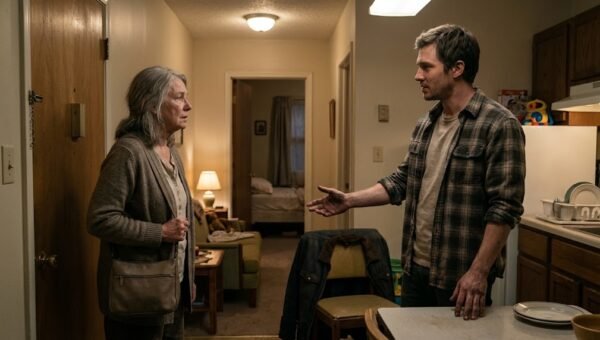
Even holding Toby seemed to irritate him. Two days before the fever hit, Toby had been crying from stomach cramps caused by his new antibiotics. I had grease up to my elbows scrubbing baked casserole off the stove and pleaded across the living room, “Mark, please, just pick him up and rock him for five minutes.”
Mark hadn’t even looked away from his phone screen. “I told you before we got married, Elena, I wasn’t ready for kids,” he snapped. “You pushed for this family. I work forty hours. Don’t dump him on me.”
Now, at 2:10 AM, Toby’s breath was shallow and fast, a raspy panting sound that terrified me. I ran into our bedroom, flipped on the bedside lamp, and shook Mark’s shoulder hard.
“Mark, wake up,” I said, my voice cracking. “Toby’s fever hit 104.5. He’s shaking. We have to go to St. Jude’s ER right now. Get up and drive us.”
Mark didn’t sit up. He pulled the down comforter up over his ears and muttered into his pillow, “Give him infant Motrin and let him sleep. Kids get hot. I have inventory at seven.”
“He doesn’t have an immune system, Mark! A fever this high can mean sepsis!” I pulled the blanket off his shoulders.
He yanked it back with a violent jerk, turned his back to me, and closed his eyes. “Then bundle him up and go, Elena. You’re the one who panics over every sniffle. Let me sleep.”
He was back to breathing heavily in less than thirty seconds.
I didn’t waste another second arguing. I wrapped Toby in a clean blanket, grabbed his blue medical binder containing his complete lab history, and carried him out into the freezing October rain. My hands were trembling so badly I dropped my car keys twice on the wet asphalt of the driveway before I got the doors unlocked.
The emergency department at county pediatric was bright, cold, and smelled of harsh iodine. The triage nurse took one look at Toby’s gray lips, heard his heart rate racing at nearly two hundred beats a minute, and yelled for a pediatric resident immediately. Within ninety seconds, three nurses had him on a gurney, running an IV into his tiny arm and placing cooling packs under his armpits.
“You did the right thing bringing him in tonight, Mama,” the attending doctor told me an hour later, listening to Toby’s lungs with a stethoscope while the fluids dripped. “His white count is practically zero and he has early pneumonia. If you had waited until morning, we would have been intubating him in the ICU.”
I sat in the plastic armchair beside Toby’s crib, holding his limp hand until the fever finally broke down to 101 around five in the morning. When his breathing smoothed out, a wave of exhaustion hit me so hard my vision blurred. I stepped out to the hallway nurse’s station to sign the formal admission paperwork.
“Mrs. Vance?” the administrative clerk said, adjusting her glasses as she pulled up Toby’s insurance file on her screen. “We need to verify the primary policyholder’s employer coverage. Did your husband update his records with our network when he switched shifts last month?”
“He’s been at the same supply warehouse for six years,” I answered, wiping my dry eyes. “Nothing changed.”
The clerk frowned at the monitor. “That’s strange. The primary subscriber listed under Toby’s dependent care isn’t his employer. It’s a supplemental private insurance plan billed directly to a personal credit card in Mark Vance’s name, but the billing address on file isn’t your home. It’s an apartment on Elmhurst Avenue.”
PART 2
The clerk turned the monitor slightly toward me. The address was clear as day: 742 Elmhurst Avenue, Apartment 3B.
It was twenty minutes from our house, on the north side of town. I knew that street because my sister used to live two blocks from there. It was an older brick complex, quiet and residential.
“Is there an error?” the clerk asked gently. “Should I update this to your home address on Pinecrest?”
“No,” I managed to say, keeping my voice level. “Leave it for now. Just run whatever insurance will cover Toby’s admission today.”
She nodded and handed me the admission clipboards. I went back into room 412, pulled the curtain shut, and sat in the dark next to Toby’s hospital bed. My phone showed five missed calls from unknown numbers, probably automated pharmacy alerts, but not a single text or call from Mark. It was nearly 6:30 AM. He had set his alarm for 6:00. He knew I had rushed Toby out into the rain with a 104.5 fever, and he hadn’t even checked if his son was alive.
Instead of calling him, I opened our joint bank account app on my phone. For three years, Mark had insisted on handling the primary checking account while I deposited my medical billing checks into a secondary household account for groceries and Toby’s therapy copays. Whenever I asked why money felt so tight despite his steady pay, he’d tell me that Toby’s formula and special sanitation gear were eating up our savings.
I had never looked closely at his individual credit card statements because he kept paperless billing under his own email. But sitting under the fluorescent lights of the pediatric ward, watching Toby’s chest rise and fall, I opened our shared tax folder saved on my cloud drive. In the 2025 W-2 and payroll summaries, there was a direct deposit split: sixty percent went into our joint account, but twenty-five percent went to an account at a credit union I had never heard of.
At 7:45 AM, my phone finally buzzed. It was a text from Mark:
*Did you get his meds? I’m heading into the warehouse. Don’t leave your mess on the kitchen counter like yesterday.*
No question about Toby’s fever. No asking which hospital we were at. Just an order about the kitchen.
I typed back: *Toby was admitted. Pneumonia and neutropenic fever. They are keeping him three days on IV antibiotics.*
Three dots appeared on the screen, vanished, and then he replied: *Fine. Call me when discharge is set. I can’t take off work for this.*
A cold, clear resolve settled into my bones right then. The panic that had ruled my life for four months, the constant walking on eggshells trying not to burden him, burned away.
That afternoon, my mother arrived at the hospital with clean clothes for me and Toby’s favorite stuffed rabbit. When she sat down by Toby’s crib, her eyes were red. “Elena, you look like a ghost,” she whispered. “Go home for two hours. Shower, get Toby’s extra clothes, and come back. I won’t leave his side.”
I didn’t go home to shower.
I got in my car, drove past our turnoff on Pinecrest, and took the highway north toward Elmhurst Avenue.
The rain had stopped, leaving the gray asphalt steaming under the cold afternoon sun. I pulled into the parking lot of 742 Elmhurst Avenue at 1:15 PM. It was a three-story brick building with exterior metal stairwells.
I walked into the small vestibule where the metal mailboxes lined the wall. I scanned the name tags slotted beneath each brass lock.
Apartment 3A: Miller.
Apartment 3B: Vance / Calloway.
My throat went bone-dry. Calloway was the maiden name of Brenda Calloway, a woman Mark had dated for two years in his late twenties before he and I met at our church potluck seven years ago. When we got engaged, Mark told me they had broken up because she moved to Chicago for nursing school and they had simply drifted apart.
I walked out of the vestibule, got back into my car, and parked across the street under an old oak tree where I had a direct line of sight to the front walkway and the apartment’s designated parking spaces.
At 1:40 PM, a silver sedan pulled into space 3B. A woman with short dark hair got out, carrying a grocery bag and holding the hand of a little girl wearing a pink preschool backpack. The girl looked to be around four years old. She had Mark’s sharp jawline and his unmistakable wavy auburn hair.
PART 3
I sat in my car for nearly twenty minutes, watching the upstairs curtains flutter as the little girl played near the front window.
My husband had told me over and over that he was never ready to be a father, that my desire for Toby was an unfair burden he had been forced to carry, that his only job was daycare pickups because he couldn’t handle the emotional weight of a child.
Yet he had a four-year-old daughter living twenty minutes away.
I didn’t march up the stairs. I didn’t cause a scene in front of that child. Instead, I drove directly to our house on Pinecrest.
I went straight to Mark’s home office in the spare bedroom, a room he always kept closed. I checked the top drawer of his desk. Locked. I went out to the garage, grabbed his flathead screwdriver from his toolbox, walked back in, and popped the cheap desk lock with one hard twist.
Inside was a fireproof file box. The key was taped to the bottom of the pencil tray.
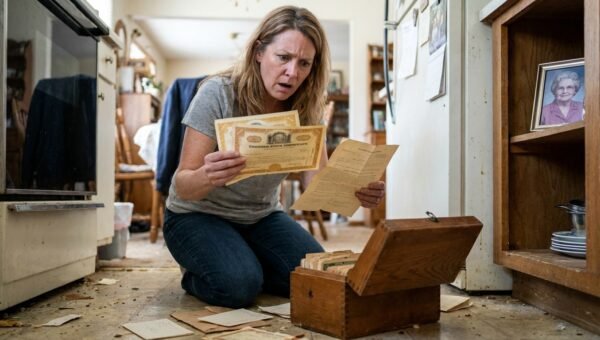
Within ten minutes, the entire hidden structure of my marriage lay scattered across the desk.
There was a voluntary paternity acknowledgment signed four years ago in Cook County, Illinois. There was a court-ordered child support agreement for $650 a month, paid from that separate credit union account. But worse than that was a lease agreement signed eight months ago: Mark was listed as the primary guarantor for Apartment 3B on Elmhurst Avenue, paying the $1,400 monthly rent out of his own pocket.
Toby’s medical copays had been bouncing because Mark was maintaining a second household. He hadn’t refused to hold Toby because he wasn’t ready to be a father. He had refused because Toby was proof of the life he was trying to starve so he could finance the one he had left behind in Chicago and quietly moved back into our backyard.
I took out my phone and photographed every single page: the paternity papers, the lease, the bank transfer receipts, and the child support orders. Then I locked the box, pushed the desk drawer shut, and packed two large suitcases with Toby’s clothes, my clothes, our birth certificates, and the titles to both vehicles. The minivan was in my name, paid off with money my grandfather had left me before he passed.
I returned to the hospital by 4:30 PM. Toby was awake, drinking apple juice from a sippy cup, his cheeks flushed with healthy pink again.
At 6:15 PM, Mark walked into room 412. He was still wearing his navy blue work polo and smelled of warehouse dust and cheap cologne. He didn’t look at Toby in the bed. He looked at me, irritated.
“I had to skip gym time to come by here,” he said, keeping his voice down to an aggressive whisper. “The doctor said out in the hall he’s stable. Why aren’t you packing him up?”
“He’s on an IV antibiotic drip for forty-eight hours, Mark,” I said, staying seated in the armchair with my hands folded in my lap.
“Well, you don’t both need to sit here running up a bill,” he said, pulling his car keys out of his pocket and tossing them between his hands. “Come home and make dinner. Your mother can sit with him. I’m exhausted.”
I pulled a single folded piece of paper from my purse and held it out to him. It was a printed copy of the lease agreement for 742 Elmhurst Avenue, with his signature circled in red pen.
Mark looked down at the paper. His fingers stopped fiddling with the keys. The irritated look on his face vanished, replaced by an ugly, flat stillness.
“What is this?” he asked, though his voice had dropped an octave.
“You told me at two in the morning to bundle our dying son into the rain alone because you had inventory at seven,” I said, looking him dead in the eyes. “You didn’t have inventory. You had a daycare drop-off for your four-year-old daughter at eight, didn’t you?”
He stepped back toward the hospital room door, his eyes darting to my mother, who was sitting silently in the corner holding Toby’s hand.
“Elena, you don’t understand what happened with Brenda,” he muttered, his face mottled with red. “She had nowhere to go when she came back from Chicago. I was trying to handle it without blowing up our family.”
“You didn’t protect our family,” I said, my voice completely steady. “You let Toby’s medicine run out last month because you said we couldn’t afford eighty dollars for the compound pharmacy. Meanwhile, you paid fourteen hundred dollars for an apartment on Elmhurst. You’re done.”
“You can’t just throw me out of my own house,” he hissed.
“The house is in my name and my mother’s name, Mark. My parents put down the eighty percent down payment before we married, and you know it. The locks are being changed tomorrow morning. Take your clothes tonight, or they will be on the driveway in trash bags.”
He stared at me, waiting for me to cry, waiting for the woman who spent four months apologizing for asking him to hold his own baby. When I didn’t blink, he turned without another word and walked out into the corridor.
ENDING
Toby was discharged three days later on Sunday morning.
The pediatrician gave him a clean bill of health regarding the pneumonia, though we had to keep him on strict isolation for another two weeks while his white blood cells recovered. When my mother and I carried him into the house on Pinecrest, the air felt different. It was quiet, clean, and completely devoid of the heavy tension that had filled every room for two years.
Mark’s clothes, golf clubs, and computer monitors were gone. He had come on Friday night while my brother stood watch in the kitchen, loaded his pickup truck, and left his house key on the dining room table next to the garage opener.
Through my attorney, we filed for an emergency separation and a formal review of our shared finances by Monday afternoon. Because Mark had diverted marital assets to pay the rent and private insurance for another household without my consent, our settlement agreement required him to sign over his remaining equity claim in our house to offset the money he had secretly spent.
His court-ordered child support for Toby was established based on his full warehouse wages, garnished directly at the payroll office before he ever saw a dime.
He didn’t fight for visitation. In the mediation conference six weeks later, his lawyer stated simply that Mark requested alternating holidays once Toby reached school age, but made no petition for weekly custody. He still couldn’t bring himself to do the work of caring for a sick toddler, and for the first time, I saw that as a blessing rather than a heartbreak.
Life didn’t become easy overnight. Toby still had rough nights, fever spikes that sent my stomach into knots, and long clinic visits where we sat for hours waiting for blood test results. But I was no longer doing the housework for an angry man while begging for basic human kindness.
One evening five months later, Toby was sitting on the living room rug, building a lopsided tower out of red and blue plastic blocks. His hair had grown in thicker, and his cheeks were round and bright.
He knocked the tower over, giggled, and looked up at me with his big brown eyes, holding up a blue square.
“Up, Mama,” he said, reaching his arms out.
I sat on the floor beside him, pulled his warm, healthy little body into my lap, and wrapped both arms around him. I didn’t have to ask anyone’s permission, and I didn’t have to apologize for needing him close. He rested his head against my shoulder, safe and breathing easy, and for the first time in two years, our home was entirely peaceful.