PART 1
My brother Burl handled Daddy’s money after the stroke. “One less thing for you to worry about,” he said. Daddy gets $1,900 a month. So why was his power cut off in February? Why was the fridge down to mustard and a heel of bread? I asked Burl. He didn’t look up from his phone. “Costs add up. You don’t see the half of it.” His new bass sat in the driveway.
I didn’t argue. I moved Daddy to my own house, opened an account only I could touch, and called a lawyer about guardianship. Monday morning, I walk into the courthouse with eleven months of statements showing exactly where Daddy’s money went.
I still keep that first electric bill on my kitchen counter under a coffee mug, just to remind myself how close I came to losing him. When Burl took over the checkbook in November of last year, right after the second stroke took the use of Daddy’s left hand, we all thought it was a blessing. I work sixty hours a week at the hospital billing office. Burl has a landscaping business that supposedly gives him flexible hours. He offered to stop by Daddy’s house every Tuesday and Thursday, pick up the mail, pay the insurance, and manage the pension check.
“You just focus on making sure Daddy takes his blood pressure pills,” Burl told me over a greasy diner table. “I’ll keep the lights on.”
For three months, I trusted him. Daddy didn’t complain much because his speech is still thick and slow, and he hates to feel like a burden.
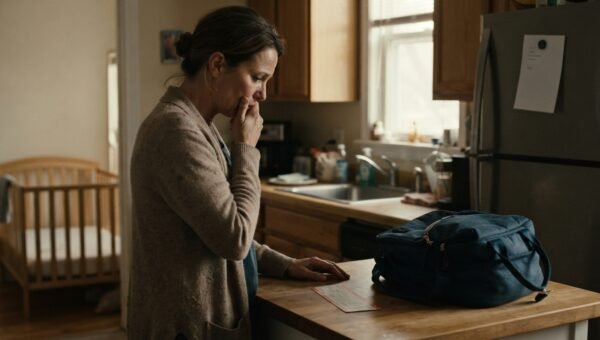
But on a Tuesday afternoon when I drove over to drop off a pot of beef stew, the house was freezing. I flipped the living room switch, and nothing happened. I walked back to the kitchen, opened the refrigerator, and found a half-empty jar of yellow mustard, a single dried-out heel of white bread, and nothing else. The milk carton was completely empty and smelled sour.
That was when I found the bright yellow shut-off notice stuffed inside an old coffee tin on the microwave. The bill was past due by ninety days. Over five hundred dollars in back charges.
When Burl rolled into Daddy’s driveway that evening in his dual-axle truck with a brand-new, top-of-the-line bass guitar case strapped into the passenger seat, I was waiting on the porch. I didn’t yell. I’ve learned that yelling at Burl just makes him dig in his heels like a stubborn mule. I simply held up the yellow paper.
“The power was cut off today, Burl,” I said, keeping my voice flat. “Daddy’s fridge is empty. Where did his pension go?”
He didn’t even drop eye contact from his phone screen. He gave that dismissive little huff he has used since we were kids. “Costs add up. You don’t see the half of it. Inflation is killing people, Sarah. Groceries cost a fortune now.”
“Groceries don’t cost nineteen hundred dollars a month, Burl. Especially not when he eats plain oatmeal and canned soup.”
“Ask me if I care to argue about this while I’m carrying tools,” he muttered, stepping around me and heading inside like he owned the place. He grabbed a spare jacket off the hook and walked right back out.
I didn’t argue with him then. That was my mistake in the past—letting him wear me down until I dropped it.
Instead, I drove straight to my house, packed up the spare bedroom, went back to Daddy’s, and loaded him and his clothes into my sedan. He sat in the passenger seat, staring out the window with that blank, defeated look that breaks my heart every time I see it.
“You’re staying with me now, Daddy,” I told him, squeezing his good hand.
“Your brother won’t like that,” he whispered.
“My brother doesn’t get a vote anymore.”
The next morning, I went down to the local credit union where Daddy has banked for forty years. Because I was already listed as an authorized caller on his medical directives, I sat down with the branch manager, sweet-talked her a little, and managed to secure copies of the account statements for the last year. I didn’t need a forensic accountant to see the bleeding. Every single month, the moment Daddy’s social security and pension deposit hit, a wire transfer went out to an account I didn’t recognize, followed by heavy ATM withdrawals at local bars and sporting goods stores.
I sat in my car in the credit union parking lot, staring at those numbers until my vision blurred. Then I looked up the number for a probate attorney who specializes in elder financial exploitation. By Monday morning, I had an appointment, an envelope full of bank statements, and a quiet determination that Burl was going to find out what happens when he pushes people too far.
PART 2
The lawyer’s office smelled like stale coffee and old paper. Mr. Henderson, a man with white hair and sharp eyes behind wire-rimmed glasses, laid Daddy’s bank statements across his mahogany desk like crime scene photos. He didn’t smile. Lawyers like him don’t waste time on pleasantries when the math is this ugly.
“Well, Ms. Miller, your brother wasn’t just paying household bills,” Mr. Henderson said, tapping a yellow highlighter against a row of figures. “Look right here. November twenty-third, two thousand. December nineteenth, twenty-four hundred. January fifteenth, eighteen hundred. These aren’t grocery runs. These are direct transfers to a personal loan service and heavy cash draws at a tavern outside county lines.”
“Can we freeze the account?” I asked, my fingers digging into the fabric of my purse.
“We can do better than that,” he replied. “We can file an emergency petition for temporary conservatorship, demand an immediate accounting of all disbursed funds, and slap him with a court order to preserve assets. But I have to warn you, once Burl is served, he is going to realize you aren’t just blowing off steam.”
“Let him realize it,” I said. “He left my father in a cold house with no food while he was out buying musical gear.”
Getting the temporary conservatorship took three agonizing weeks of phone calls, affidavits from Daddy’s doctor confirming his cognitive vulnerability after the stroke, and a formal sign-off from the Department of Social Services caseworker I had brought in to inspect Daddy’s empty refrigerator. During those three weeks, Burl left four angry voicemails on my phone. The first two were demanding to know why Daddy wasn’t at his house. The third was a rambling complaint about how I was interfering with family business. The fourth was downright nasty, threatening to cut me out of the family entirely if I didn’t drop whatever nonsense I was pulling at the bank.
I didn’t answer a single one of them. I saved the audio files directly to a secure folder on my laptop and emailed copies straight to Mr. Henderson.
By the time the sheriff’s deputy served Burl with the court summons at his landscaping yard on a Thursday morning, I was sitting at my desk at the hospital. My phone buzzed ten minutes later. It wasn’t Burl. It was Mr. Henderson.
“He’s been served,” the lawyer said calmly. “And he’s furious. He tried to claim he was just ‘managing investments’ for your father. The judge has scheduled a formal evidentiary hearing for next Tuesday at nine a.m. You and your father will need to be there.”
When I told Daddy that evening, we were sitting at my kitchen table eating chicken soup. He stopped stirring his spoon and looked down at the laminate surface.
“He’s your brother, Sarah,” Daddy said softly, his voice catching on the consonants. “I didn’t raise him to steal.”
“You didn’t raise him to neglect you either, Daddy,” I said, reaching across to cover his hand. “He made his choices. Now the court is going to make its choice.”
PART 3
The courtroom was small, smelling of floor wax and old wood. Burl sat at the defense table wearing a stiff button-down shirt that looked like he had pulled it straight out of the plastic dry-cleaning bag without ironing it. His lawyer, a young guy who looked like he had graduated law school about twenty minutes ago, was shuffling papers nervously.
When Mr. Henderson stepped up to present our evidence, he didn’t raise his voice. He didn’t need to. He simply laid out the timeline of Daddy’s stroke, the exact dates Burl gained power of attorney, and the corresponding ledger of unauthorized withdrawals. He put the utility shut-off notice on the judge’s desk alongside the receipt for Burl’s custom bass guitar, purchased three days after a major pension deposit.
Burl’s lawyer tried to object, arguing that the funds were used for “familial support and property maintenance.”
The judge, a stern woman with steel-gray hair named Judge Althouse, raised her eyebrows and looked directly at Burl. “Mr. Miller, please explain to this court how a four-thousand-dollar custom bass guitar and weekend tabs at a tavern constitute property maintenance for an eighty-two-year-old stroke survivor living without electricity.”
Burl shifted in his chair, his face turning a dark, mottled red. “The old man said I could have help with my business expenses! He told me I deserved it for taking care of him!”
“That is a lie,” I whispered, loud enough that the bailow gave me a warning look, but I didn’t care.
Mr. Henderson handed the judge a signed medical affidavit from Daddy’s neurologist. “Your Honor, as you can see from the cognitive assessment conducted three days prior to the power of attorney being signed, Mr. Miller senior lacked the legal capacity to consent to any financial transfers of that magnitude. Furthermore, the defendant never once spent a dime of those funds on the ward’s medical needs, food, or heating.”
Judge Althouse didn’t even deliberate. She looked down from the bench, her expression like granite.
“The petition for permanent conservatorship is granted in full to the petitioner, Sarah Miller,” she said, striking her gavel once with a sharp crack that echoed off the high ceiling. “Furthermore, the defendant is ordered to provide a complete forensic accounting of all funds withdrawn from the subject accounts within thirty days, and restitution hearings will be scheduled immediately. Case closed for today.”
Burl stood up so fast his chair screeched against the linoleum. He glared at me across the aisle, his mouth working silently as if he wanted to shout, but his lawyer pulled him back down by the sleeve.
ENDING
We left the courthouse through the side exit to avoid the reporters and the general foot traffic. The morning sun was bright, bouncing off the brick facade of the municipal building and warming the sidewalk. Daddy walked slowly, leaning on his aluminum quad-cane, taking careful steps as he adjusted to the fresh air.
As we reached my car, a battered pickup truck pulled up to the curb alongside us. Burl rolled down the passenger window, his face twisted into an ugly, desperate sneer.
“You think you won something here, Sarah?” he spat out, gripping the steering wheel so hard his knuckles turned white. “You think you can just cut me out? That house belongs to both of us eventually anyway!”
I unlocked my car door and helped Daddy ease himself into the front passenger seat, making sure his seatbelt clicked securely into place before I turned around to face my brother. I didn’t scream, and I didn’t let my voice shake. I just looked at him the way I used to look at difficult patients back when I worked the emergency intake desk—with absolute, unshakeable professional pity.
“The house is in a revocable trust, Burl, and Mr. Henderson already filed the paperwork this morning to remove your name from every asset Daddy owns,” I said clearly. “If you try to step foot on that property again, the next paper you get served with won’t be a civil summons. It’ll be a trespassing warrant.”
He stared at me for three long seconds, his jaw working as he realized the game was finally, permanently over. Then he slammed his foot on the gas, spitting gravel across the asphalt as his truck roared down the street and around the corner.
I got into the driver’s seat, started the engine, and checked the mirrors. Daddy let out a long, ragged sigh, resting his head back against the headrest and closing his eyes.
“Feels like a heavy coat just came off my shoulders,” he murmured, his voice softer than usual.
“I know, Daddy,” I said, putting the car into drive and pulling away from the curb. “Let’s go home and make some real coffee.”
We drove back to my house in silence, the kind of comfortable quiet that comes after a long storm finally clears. The bills are paid, the fridge is stocked with fresh food, and Burl’s name is gone from everything that matters. For the first time in a year, my father is safe, and I am the one keeping the lights on.