PART 1
My husband Garland died on a Tuesday in the middle of October, and by Saturday morning, the church basement smelled of damp wool coats, black coffee, and ham rolls wrapped in plastic wrap.
We had been married fifty-four years. When people asked how we made it that long without any children, Garland always smiled, tapped his knuckles against the kitchen table, and said, “Just wasn’t in the cards, but we’ve got each other.” That was our story.
We were the quiet couple at the end of Elm Street with a neat lawn, two porch rocking chairs, and an old cedar chest in the spare room that stayed locked because nobody needed to look at baby clothes from 1961.
I stood by the industrial coffee urn with a paper napkin balled up in my fist, shaking hands with men from the volunteer fire board and women from my Tuesday garden circle. My shoes pinched, but I stayed on my feet because sitting down made the quiet feel too heavy.
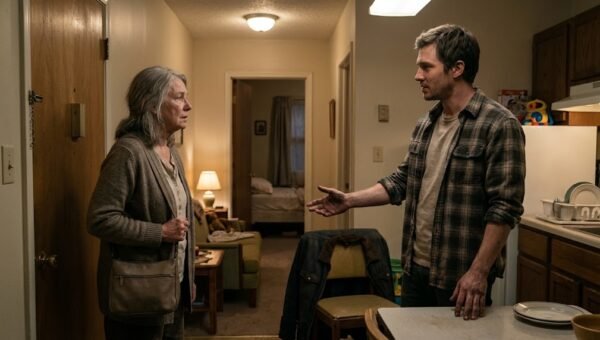
Then an older man I had never seen before stepped out of the line. He wore a faded navy suit that hung loose on his shoulders, like he had bought it thirty years ago and lost fifty pounds since. His eyes were milky around the edges, and his hands were thick and calloused, spotted with liver spots across the knuckles.
He took my right hand with both of his. His grip was tight, and he held on several seconds too long, pressing my fingers between his dry palms.
“He never missed a single month, Mrs. Miller,” the man said. His voice was cracked, the kind of voice that belonged to somebody who spent all day working outside or talking over machinery. “Rain, ice, didn’t matter. You raised a fine boy. A gentle boy.”
I looked down at his wrinkled knuckles, then up at his watery blue eyes. I pulled my hand back half an inch, but he held fast.
“I’m sorry,” I said, trying to soften my voice so the women stacking dessert plates wouldn’t stare. “I think you have the wrong family. Garland and I never had children.”
I thought grief or age had muddled the poor man. We had plenty of older folks from the township who wandered into the wrong side of the fellowship hall when the Methodist ladies held their bake sales.
The man didn’t blink. He leaned in a little closer, squeezing tighter. “David. Little David. Over at the state home in Selinsgrove. He worked the grounds crew with me till his heart gave out in ’08. Garland came the first Saturday of every single month, ten in the morning sharp. He always said, ‘Clara’s home tending the roses, but she sends her love.'”
My breath caught somewhere below my ribs.
The room seemed to shrink down to the humming drone of the big silver coffee urn. David was the name we had chosen in the spring of 1961. It was the only name we ever picked out.
The old man saw my face go slack, and his own expression dropped. The warmth drained right out of his eyes, leaving him staring at me with his mouth slightly open. He looked at my black dress, then at Garland’s framed portrait sitting next to the guestbook, and finally back at my eyes.
“You didn’t know,” he whispered. His hands dropped away from mine like he had touched a hot stove. “Lord have mercy. You didn’t know.”
My knees gave way right there against the metal folding table. The urn rattled against its stand, and the old man caught me by the crook of my elbow before my dress hit the linoleum floor. He leaned down beside my ear, his breath smelling of peppermint, and steadied me with a trembling arm.
“He always brought two cups,” the old man whispered. “He’d set one on the bench and tell the boy, your mama is holding you in her heart today.”
PART 2
The man’s name was Arthur Vance. He had worked maintenance at the Selinsgrove State School for thirty-four years before retiring on a modest county pension.
I did not let him leave the church basement. I steered him by the sleeve into the small pastor’s study behind the choir room, away from my sister-in-law and the ladies carrying out leftover casseroles. My hands were shaking so hard I could barely pull the heavy oak door shut.
“Tell me,” I told him. My voice did not sound like my own. “Tell me every word, Arthur.”
Arthur sat on the edge of the leather sofa with his cap between his knees, turning it round and round by the brim. He looked terrified, like a boy who had accidentally broken a church window.
In May of 1961, I was twenty-two years old. I went into labor six weeks early in the county hospital. It was a long, terrible delivery that ended with three doctors around the foot of the bed, whispering behind green curtains while the anesthesia made the ceiling spin. When I woke up, the bassinet was gone.
Dr. Keller came into the room with his hands in his lab coat pockets. He sat on the rolling stool beside my bed, looked down at his shoes, and told me our boy had severe brain damage and a deformed heart. He said the child would not live to see kindergarten, that he would never speak, never know who I was, and that trying to bring him home would ruin our marriage and break our spirits.
“Sign the state papers, Clara,” Dr. Keller had told me, his voice smooth and professional. “Let the state take him. Go home and start your life over. It is kinder for everyone if you let him go right now.”
I was young, exhausted, and bleeding. I broke down. I buried my face in Garland’s chest and begged him. I told him I couldn’t bear to bring a dying baby into our four-room house. I begged him to let the hospital handle it, to let me believe the baby had simply passed away in the nursery so I wouldn’t spend five years waiting for a crib to turn into a coffin.
Garland had stroked my hair, signed the forms Dr. Keller brought in, and took me home three days later. We packed the yellow booties and the hand-sewn blankets into the cedar chest, locked it with a small brass key, and we never spoke David’s name aloud again. For fifty-four years, I believed our baby had slipped away in a sterile nursery crib before the week was out.
“Garland didn’t let him go,” Arthur said quietly in the pastor’s study. “He went back to the county hospital on Monday morning before the state transport van came. He rode in the transport van with the nurse. He followed the boy to Selinsgrove.”
Arthur rubbed his thumb over the felt brim of his cap. “The doctors told your husband the same thing. Said David had maybe three or four years. But David was stubborn. He had weak legs and he didn’t talk much, but he had a smile that could light up a hallway. When he turned five, Garland bought him a red radio. When he turned eighteen, David moved into the vocational cottage and helped me rake leaves and paint fences.”
“Forty years,” I whispered, the number cutting through my chest like jagged glass. “Garland drove there for forty years?”
“First Saturday of every month,” Arthur nodded. “Garland drove that blue Ford pickup two hours north, rain or shine. He’d pull up to the gate at nine-thirty, check David out for the day, and they’d sit at the picnic table behind the boiler room. Garland always carried a thermos of black coffee and a small white tin of shortbread cookies. He told David stories about your garden, about the stray cat you fed on the back porch, about how pretty you looked when you sang in the choir.”
Arthur paused, swallowed, and reached into the breast pocket of his faded suit coat.
“When David took sick in 2008 with pneumonia, his heart couldn’t take it anymore,” Arthur said, his eyes welling up. “Garland stayed four days straight in the infirmary chair. He held David’s hand until the line went flat. Afterward, Garland gave me an envelope to put in the safe, just in case anything happened to him before he could figure out what to do with it.”
Arthur extended his hand. Between his thick fingers was a small, worn manila envelope, sealed with a strip of yellowed cellophane tape.
PART 3
I took the envelope into my own hands. My name was written across the front in Garland’s unmistakable, heavy pencil script: *For Clara, when the time comes.*
Arthur stood up, bowed his head respectfully, and slipped out of the pastor’s study, leaving me alone with the ticking grandfather clock in the corner.
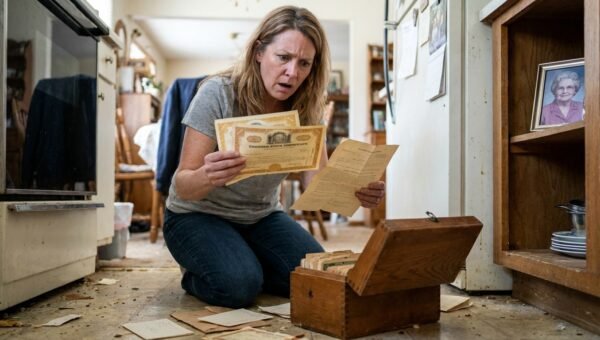
I peeled the yellowed tape back carefully. Inside were three items: a small silver key that did not fit anything in our house, a folded carbon copy of a state death certificate dated October 14, 2008, and a four-page letter written on yellow legal pad paper, the edges slightly curled.
I unfolded the death certificate first.
*David Miller. Age: 47.*
Under “Father,” Garland had written his own full name and our home address. Under “Mother,” he had written *Clara May Miller.*
He had never taken my name off the state records. He had carried the truth alone for four decades, protecting the promise he made to a terrified twenty-two-year-old girl who had begged to be spared the slow agony of watching her baby die.
I smoothed out the yellow legal pages with fingers that felt cold and heavy.
“Dear Clara,” the letter began.
“If you are reading this, I have left you, and I am sorry for leaving you with the chores and the empty house. But there is one thing I have to answer for before God, and I owe it to you first.
The day we left the hospital in 1961, you were sobbing so hard you could barely walk down the front steps. You looked at me and said, ‘Garland, if he’s going to die in a crib, please don’t let me watch it. Tell me he’s already in heaven, because I will break if I have to wait.’
I intended to let him go, Clara. I swear to you, I got in the truck to go home that following Monday, but my boots wouldn’t walk up our porch steps. I kept thinking that if our boy was going to have only a few short years on this earth, he ought to have somebody in the room who knew his name. Somebody who looked like him.
When I got to the state facility, David was lying in a cot with a little yellow tag around his wrist. He looked up at me with your grey eyes. He had the same cowlick on the left side of his head that you have when you wake up in the morning. I sat in a wooden chair next to that cot, Clara, and I couldn’t walk away.
I planned to tell you that first Christmas. I drove home with the words rehearsed in my mouth. But when I walked through the kitchen door, you had finally stopped crying in your sleep. You were baking sugar cookies and humming a hymn, and you smiled at me like the sun had come back out. The doctor had told me David wouldn’t see the new year. I thought, why drag her back down into the pit? If he dies in January, she will have to mourn him all over again.
Then he lived. He lived through his first winter, and then his fifth, and then he grew into a tall boy who loved the smell of engine grease and old hymnals.
Every year that passed, the lie got bigger. It got so big that telling you would have felt like murder. How could I tell my good, gentle wife that our baby was thirty miles away, growing up without her, because her husband didn’t have the courage to tell her the truth on day one?
I was a coward, Clara. I told myself I was protecting your tender heart, but after ten years, I was just protecting myself. I was terrified you would hate me for keeping him to myself. Because the truth is, I loved that boy with everything in me, and every first Saturday of the month was the best day of my life.
I told him all about you. He knew your voice from the tapes of the church cantatas I brought him. He knew you loved yellow tea roses. He kept a picture of you on his bedside table, the one from our trip to Niagara Falls where your hair is blowing in the wind. When he was sick, he would point to it and say, ‘Mama.’
The key in this envelope is for safety deposit box 414 at the Farmers National Bank on Main Street. There are photo albums inside. Forty-seven years of photos. Every birthday, every summer picnic, every pair of work gloves he wore out.
If you can ever forgive me, Clara, do not forgive me for lying. Forgive me for being too weak to share the blessing with you.”
ENDING
On Monday morning, before the banks even unlocked their glass doors, I sat in my car parked outside Farmers National Bank.
The teller led me into the small private viewing booth in the vault and slid box 414 onto the counter. Inside were five thick leather photo albums, their corners worn smooth, along with a stack of hand-drawn Father’s Day cards made on brown construction paper with blunt crayons.
I opened the first album.
There was David at age seven, sitting on a wooden bench in denim overalls, grinning missing-toothed into Garland’s camera. He had my chin, with the slight cleft that my father had passed down to me. He had my high cheekbones, and he held a red toy fire truck between his knees.
On every page, there was Garland, younger, then grey, then stooped with age, standing beside this boy who grew into a broad-shouldered man with a gentle, lopsided smile. In almost every picture taken outside, there on the corner of the picnic table sat a red plaid thermos and two ceramic mugs. Garland never drank from a paper cup when he could bring good china from home.
I spent three hours in that small bank booth, turning page after page. I didn’t scream, and I didn’t curse Garland’s memory. I sat there with the cold safe-deposit box resting against my knees, feeling the sheer weight of what my husband had carried alone on two-lane country roads for forty years while I weeded my flowerbeds and wondered why our house always felt so quiet.
He had lied to me, yes. He had kept me from holding my son’s hand, from washing his face, from tucking him in when he was small. That pain will never leave my throat until the day they lay me down beside Garland in the churchyard.
But as I looked at the photos of David smiling under the pine trees, holding a hand-carved wooden bird Garland had whittled for him, I knew something else, too. My baby had never been abandoned. In a cold state institution where hundreds of children were forgotten by the world, David had a father who came every four weeks like clockwork, who brought him sweet cookies, and who told him that his mother loved him more than life itself.
That afternoon, I drove two hours north to Selinsgrove.
The old state home grounds were quiet, mostly converted into county administrative offices now. Behind the property was a small, well-tended cemetery tucked between two rolling hills of yellow grass.
Arthur Vance had given me the plot number. I walked through the iron gate, past the tall oak trees dropping their brown leaves, until I found the small granite marker flush with the turf.
It read: *David Miller. 1961–2008. Beloved Son.*
I knelt on the damp grass and pulled two yellow tea roses from my handbag. I laid one across the cold grey stone, and then I set the other beside it