PART 1
My parents asked me to host Thanksgiving, then told my sister she could bring twelve extra guests without checking with me first. By noon, my house smelled like sage, roasted turkey, and damp coats. I had spent $420 on groceries, scrubbed the baseboards, and set up two folding tables in the living room because my dining room only seated eight.
My sister, Laura, walked through the front door forty minutes late. She was carrying her leather purse, a travel mug of coffee, and nothing else.
Not a side dish, not a bottle of cider, not even a bag of dinner rolls. Her husband followed behind her, her three kids scattered toward the den, and nine of her in-laws poured into my hallway shaking rain off their umbrellas.
Before Laura even hung up her coat, she stopped at the archway, looked around my dining room, and wrinkled her nose.
“Oh,” she said, loud enough for my mother to hear from the kitchen. “I thought you were going to buy the matching chairs this fall, Brenda. This looks so cheap. It feels like a church basement.”
My mother walked out with a dish towel in her hand and patted Laura’s arm. “She did the best she could on short notice, honey. Let’s just be grateful we have a roof over our heads.”
I stood by the kitchen island holding a pan of sweet potatoes, my knuckles tight against the hot pads.
Short notice. My mother had asked me to take Thanksgiving eight weeks earlier, claiming her back could not handle the standing.
By two o’clock, the living room was loud and crowded. Laura sat on the sofa with her feet up on my coffee table, holding court with her sister-in-law while I carved the bird, refilled water pitchers, and pulled warm rolls from the oven. Laura did not get up once to carry a bowl or help clear a paper plate.
Around three, while the adults were loud over wine, I noticed my twelve-year-old niece, Maya, sitting alone on the bottom stair. Her head was down and she was picking at the seam of her sweater. When I sat beside her and asked if she wanted some dark meat or an extra roll, her chin began to tremble.
“They were fighting,” she whispered, leaning into my shoulder. “Grandma and Grandpa. In the pantry by the coats.
Grandpa told her to shut up before Brenda started asking questions about the storage unit.”
I put an arm around her small shoulders. “It’s okay, sweetie. Grown-ups get grumpy when they’re crowded.”
“No,” Maya muttered, staring at her sneakers. “Grandpa was really mad. He said Laura’s name twice.”
I smoothed her hair and got her a plate of warm pie crust edges, assuming it was the usual holiday bickering over money or driving in the dark.
An hour later, the room went quiet when my father tapped his water glass with a fork. Dessert was on the table, two pumpkin pies and an apple crisp that I had baked from scratch at six that morning.
“Before we cut the pie,” my father said, standing near the head of the table, “I want to propose a toast to the daughter who keeps this family together.”
I was standing by the sideboard, holding a stack of small dessert plates, thinking for half a second that he was looking in my direction.
He raised his glass directly at Laura.
“To Laura,” he said, his voice warm and proud. “The one who makes sure we never drift apart, who brings everybody under one roof, and who always carries the family name with grace.”
The twelve guests clapped. My mother beamed and wiped a pretend tear from her eye.
Everyone looked at Laura, smiling, raising their glasses. Laura tilted her head, offered a modest little smile, and said, “Family comes first, Dad.”
Nobody looked at me. Nobody thanked me for the turkey, the four days of cleaning, or the money that had stretched my grocery budget thin until payday. My sister never noticed that the children had stopped eating and were watching the adults instead of the cake. Maya was staring right at her mother with her jaw set, looking smaller and older than twelve.
When Laura stood up to take second helpings of pie, Maya slipped behind my chair. She took my hand under the tablecloth and pressed a wadded paper napkin into my palm.
“Don’t throw it away,” Maya whispered, her voice barely audible over the chatter. “I found it in Grandpa’s truck console when he made me wait inside while he bought ice.”
I slid the napkin into my apron pocket. Later, when the kitchen was empty and the sound of laughter drifted from the living room television, I pulled the napkin out and smoothed it flat on the counter.
Written in my father’s sharp, slanted handwriting was an address on Highway 14, a unit number, and an access gate code. Underneath, circled in heavy blue ink, was a single handwritten note: *Brenda’s school files & Laura’s 1998 letters. Destroy before Christmas.*
PART 2
The house was not quiet until nine that night.
After the last car pulled out of the driveway, my mother kissed my cheek, told me to leave the heavy roasting pan soaking until morning, and let my father guide her out to their sedan. Neither of them mentioned the dinner. Neither of them said thank you.
I stood in my empty kitchen surrounded by dirty forks, crumpled paper napkins, and the lingering smell of cold poultry fat. My back burned from hours on my feet, but my mind was stuck on the slip of paper sitting next to my coffee mug.
Highway 14 was an industrial road twenty minutes west of town, lined with tractor repair shops, gravel yards, and long rows of corrugated metal sheds. The address was for Valley Self-Storage. My parents lived in a modest three-bedroom ranch four miles from my house. They had a two-car garage and an attic. There was no earthly reason for my father to pay monthly rent on a storage unit unless he had something he did not want in his own house.
The date on the napkin—1998—gnawed at my stomach.
In the spring of 1998, I was a senior at Oak Ridge High School, sitting on a 3.9 grade point average and waiting for the mail every afternoon. I had applied for the Miller-Crane Memorial Scholarship, a full four-year tuition grant funded by a local manufacturing family for one student in the county pursuing chemical engineering. My guidance counselor, Mr. Harrison, had told me I was the front-runner.
Then, two weeks before graduation, a flat white envelope arrived. The committee had rejected my application without explanation. A week later, Mr. Harrison called me into his office, looking uncomfortable, and told me that character references and disciplinary history carried heavy weight. When I asked what he meant, he looked away and said sometimes things were better left within the family.
My parents had refused to pay for college. My father said women in engineering were just taking seats from family men, and that since I couldn’t even keep my high school record clean enough to secure the Miller-Crane, I clearly wasn’t university material. Laura, two years younger, had gone to the state university two years later on a full parent-funded ride, eventually dropping out junior year to marry her husband. I had spent six years taking night classes at the community college, working thirty hours a week at a pharmacy counter, paying every dime of my own way.
The comparison had never stopped. For twenty-five years, Laura was the golden child who stayed sweet and obedient, while I was the stubborn, difficult daughter who had somehow let the family down when it mattered most.
On Friday morning, instead of running the dishwasher, I got into my coat and drove out to Highway 14.
The security gate at Valley Self-Storage had a rusted keypad. I punched in the six-digit code from the napkin. The gate groaned and rolled back on its track.
Unit 114 was located in the third row, half-shielded by an overgrown cedar tree. When I reached the door, my heart hit the roof of my mouth. The latch was held shut with an ordinary Master brass padlock, but it had not clicked. Someone had swung the shackle into place and spun the numbers without pushing the lock closed.
I pulled the lock off, lifted the heavy metal door, and let the morning sun spill across the concrete floor.
The unit was half-empty. In the center sat three plastic storage tubs, an old lawnmower, and two cardboard banker boxes marked *Personal – Oak Ridge*.
I knelt down on the cold floor and pulled the lid off the top box.
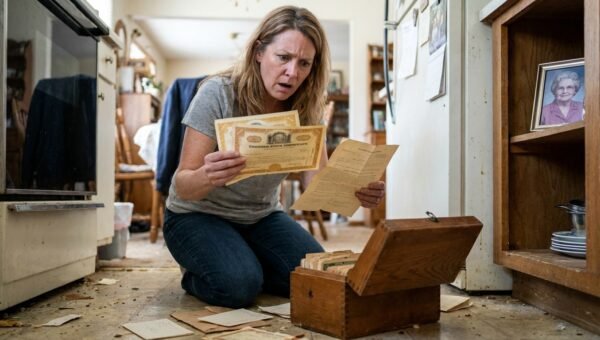
Inside were my childhood report cards, neatly filed by year. First grade through eleventh grade. Straight As, small teacher notes praising my quiet focus. Then, tucked into a manila folder labeled *School Board – 1998*, I found a sheaf of folded notebook paper and formal letterhead.
The first letter was written on lined loose-leaf paper in neat, loopy teenage handwriting that I recognized immediately. It was dated April 12, 1998, and addressed to Principal David Vance.
I read the first line:
*Dear Mr. Vance, I am writing this anonymously because I am afraid of my sister Brenda, but the school needs to know who is really stealing the AP chemistry lab supplies and selling them behind the athletic shed.*
The letter went on for two pages, describing fabricated dates, stolen scales, and claiming I was using lab ethanol to host parties in our basement.
Tucked behind it was a carbon copy of a formal reprimand from Principal Vance to my father, dated April 18, 1998, acknowledging a private conference where my father agreed to handle the matter quietly to avoid a police report, provided my name was formally withdrawn from county scholarship consideration.
And beneath that was a handwritten note from my father to Principal Vance, signed by both of my parents:
*We agree Brenda is not suited for the Miller-Crane grant. We request all records be sealed and Laura be considered for next year’s vocational aid instead.*
My hands shook so hard the paper rattled against the cardboard box.
My parents had known. They hadn’t just believed a rumor. They had received a letter from their younger daughter accusing their older daughter of theft, and instead of defending me or investigating it, my father had walked into that school, buried my scholarship, and used it as an excuse to lock down my future.
And for twenty-six years, they had kept the evidence locked in a metal shed twelve miles from town.
PART 3
I sat on the floor of that storage unit for twenty minutes, listening to the wind rattle the metal siding.
The anger was not loud. It was cold, clear, and quiet. All the times my mother had sighed when I bought a used car, all the times my father had told family gatherings that Brenda was always a little rough around the edges while Laura had natural grace, all the holidays where I was the workhorse and Laura was the princess. It wasn’t an accident. It was an investment they had spent decades protecting because admitting the truth meant admitting what they had done to their own child.
I took the entire manila folder, placed it on the passenger seat of my car, rolled the storage door down, and locked the padlock tight.
I didn’t call. I didn’t yell. I drove straight to my parents’ house on Elm Street.
It was eleven in the morning. My father’s truck was parked in the driveway beside Laura’s minivan. She had stayed overnight with the kids to avoid the holiday traffic.
I walked up the front steps without knocking and turned the brass doorknob. The front door was unlocked.
They were all in the kitchen. My mother was standing by the stove reheating turkey soup. Laura was sitting at the oak table in her flannel pajamas, holding a coffee mug while my father read the local paper.
When the back door clicked shut, my mother turned around, surprised.
“Brenda? Did you forget something yesterday, honey? You could have called.”
I didn’t answer. I walked straight to the table, pulled the two handwritten pages from the folder, and laid them flat between my father’s coffee cup and Laura’s mug.
The kitchen went dead still.
My father looked down at the paper. His reading glasses were perched on the end of his nose. For three seconds, his eyes scanned the lined loose-leaf sheets, and then his hand stopped moving entirely.
Laura looked at the pages, frowned, and picked one up. “What is this? Is this from the basement?”
“Read the first sentence, Laura,” I said. My voice was completely steady. “Read it out loud to Dad.”
Laura’s eyes moved across the handwriting. Her fingers gripped the edge of the sheet, and the slight, smug tilt of her chin vanished. Her face drained of all color.
“Where did you get this?” Laura whispered.
“Maya gave me the gate code,” I said. “From Dad’s console.”
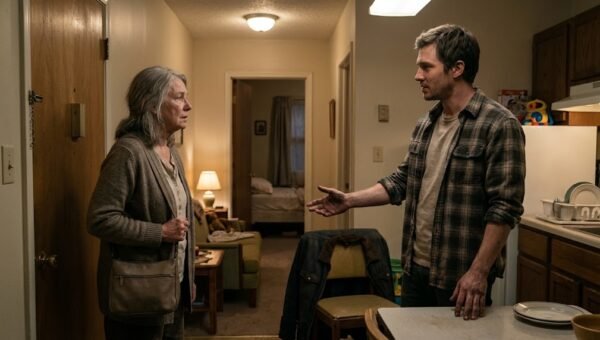
My father stood up so fast his kitchen chair scraped hard against the linoleum. “You had no right to go through my property, Brenda. That’s private. That was handled twenty-five years ago.”
“Handled?” I asked. “You let her write a pack of lies to the high school principal to steal a four-year scholarship out from under me, and then you signed a letter agreeing to pull my name so nobody would investigate it.”
My mother walked over, wiping her hands on her apron, her voice fluttering with panic. “Brenda, please, lower your voice. The children are in the front room watching cartoons. That was a long time ago. Laura was only sixteen, she was jealous, she didn’t know what she was doing—”
“You knew,” I said, looking directly at my mother. “You signed the bottom of the school agreement, Mom. Your name is right next to Dad’s.”
My mother looked down at the linoleum, her mouth opening and closing without a sound.
Laura dropped the paper onto the table like it was on fire. “Brenda, I was a kid. You were always perfect, you were always the smart one, teachers loved you, Dad was always bragging about your grades. I didn’t think they’d actually cancel the scholarship! I thought they’d just give you detention!”
“And what did you think when Dad told you he’d pay for your state tuition because Brenda had proved she wasn’t trustworthy?” I asked.
Laura didn’t answer. She pulled her knees up to her chest on the kitchen chair and looked away, refusing to meet my eyes.
My father leaned over the table, his face red, his fists planted on the wood. “We did what we thought was best for the family, Brenda. A scandal like that would have ruined our reputation in this county. You landed on your feet. You’ve got a decent job, you’ve got a house. You don’t need to dig up old bones and tear this family apart over something that’s already done.”
I looked at him. I looked at the gray hair around his ears, the stoop in his shoulders, and the stubborn, defensive anger in his eyes. There was no regret there. There was only the terror that someone outside this kitchen might find out what kind of parents they really were.
“The family was torn apart in 1998, Dad,” I said. “You just made me pay the bill for it.”
I picked up the original letters from the table, slid them back into the folder, and tucked it under my arm.
“I’m keeping these,” I said.
“Those are my records!” my father barked, taking a step toward me.
“If you take one more step toward me,” I said, “I will scan every page and email them to the Oak Ridge Alumni Association, the school board, and every person who sat at my dining room table yesterday. Try me.”
He stopped. The room fell into total silence, broken only by the sound of the refrigerator hum and the faint cartoon laughter coming from the television down the hall.
I turned my back on them and walked out the door.
ENDING
I spent the rest of Friday afternoon alone in my house.
I emptied the dishwasher, scrubbed the heavy roasting pan until the stainless steel shone, and took down the two folding tables in the living room. I stacked the folding chairs in the hallway closet and vacuumed the carpet where twelve extra guests had tracked in dried mud from the driveway.
Around four o’clock, my phone buzzed on the kitchen counter.
It was a text from my mother: *Your father is very upset. We hope you can find it in your heart to move past this. Family is all we have.*
I didn’t reply. I blocked her number, then blocked my father’s, and then blocked Laura’s.
Twenty minutes later, a message came through from an unknown number.
*Aunt Brenda, it’s Maya. Mom made us leave early. She’s crying in the car and won’t talk to anybody. Thank you for the pie crust yesterday. I love you.*
I sat at my kitchen table, looking at the small screen, and typed back: *I love you too, Maya. You did the right thing. My door is always open to you.*
I took the manila folder and placed it in the fireproof lockbox in my bedroom closet, right next to my deed and my community college diploma. Those two degrees had cost me six years of graveyard shifts and sore feet, but nobody could claim they paid for them, and nobody could ever take them away.
When Christmas came a month later, my house was quiet.
There was no crowd, no twelve-pound turkey, and no folding tables jammed into the living room. I made a small pot roast for myself, put on soft music, and ate dinner off my good china at the head of my table.
The chairs still didn’t match. But for the first time in twenty-six years, the room didn’t feel cheap at all.