PART 1
My brother cleaned out Dad’s accounts three days before the funeral. The exact figure was $154,000, and by Thursday morning it was simply gone.
When I sat across from Kevin at the kitchen table, still wearing the dark sweater I had picked out for the viewing, he pushed a cup of black coffee toward me and didn’t blink. He said Dad gave him the debit card and the PIN two weeks earlier to buy groceries and cover medical co-pays.
He looked tired around the eyes, but his voice was flat and steady.
“Dad wanted things handled without probate tying up the cash, Brenda,” he told me. “You know how stubborn he was about the state taking a cut. I took care of his final expenses, and whatever was left belongs to the estate work I’ve been doing for six months.”
There was no estate work. Dad had been in hospice in his back bedroom for four months, and Kevin moved into the spare room mostly to avoid paying rent after his second divorce. I was the one who drove forty miles every Tuesday and Friday to bathe Dad, change his linens, and check his oxygen tank. But Kevin had been physically in the house at the end, and he held Dad’s wallet.
Before the memorial service even started, Kevin had already transferred the title on Dad’s 2018 Silverado using a signed power of attorney that expired the minute Dad stopped breathing.
He locked Dad’s hunting rifles in his own gun cabinet, and he took the three leather coin albums Dad had spent forty years filling with silver half-dollars. Whenever I asked about an inventory or dividing things fairly, Kevin tightened his jaw and looked past me.
“Dad made his wishes known to the person who stayed under this roof,” Kevin said.
Then came the listing. Seven weeks after we buried Dad next to Mom at Oakridge, Kevin called to tell me an agent was coming by on Monday. Dad bought that brick ranch in 1974 for twenty-two thousand dollars. It was solid, paid off, and smelled like cedar shavings and old paper.
“If you want Mom’s Christmas decorations from the attic, you have until Sunday night,” Kevin said over the phone. “Otherwise the clean-out crew is tossing whatever’s up there in the roll-off dumpster.”
I borrowed my neighbor’s minivan on a muggy Saturday afternoon. Kevin wasn’t even there.
He left the back door unlocked and a sticky note on the refrigerator that said: Attic only. Do not touch the garage.
I hauled down eleven cardboard boxes by myself. They were heavy, covered in gray dust, and sealed with old yellowed masking tape that smelled like attic heat and dry rot. My knees ached on the pull-down ladder, and my hands were black with soot by the time I loaded the eleventh box into the back. I didn’t take a single piece of furniture. I didn’t take Dad’s tools. I just took those eleven boxes, drove home, and stacked them along the far wall of my garage.
December had always been Dad’s favorite time of year, but when winter rolled around five months later, I couldn’t bear to walk past them. Every time I saw the faded black marker on the cardboard—MOM’S ORNAMENTS 1988, VILLAGE HOUSES, TREE SKIRT—my chest felt tight.
Looking at them meant remembering Kevin smirking at the funeral home while he signed the guestbook with Dad’s favorite gold pen. It meant remembering the empty bank account and the feeling that Dad had completely forgotten me before he died.
So the boxes sat untouched through the snow, through the spring rains, and into the dead heat of summer.
It was mid-July when I finally decided to clear the garage so I could park my car inside again. The humidity was brutal, sticking my shirt to my back as I cut the brittle tape on the third carton. It was marked LIGHTS in Dad’s heavy, uneven handwriting.
Inside, beneath three layers of crumpled newspaper from 1996, was a huge, dusty knot of multi-colored ceramic bulbs and stiff green wire. I started untangling them by hand, working the plugs loose so I could test the sockets. Near the bottom, tucked deep inside the center of the tangle where the cords were wrapped tight around a piece of heavy cardboard, something hard tapped against my knuckles.
It wasn’t a replacement bulb. It was a brass key, secured with two wraps of yellowed electrical tape to a stiff three-by-five index card.
I peeled back the tape. Written in dark blue ballpoint pen, dated four years earlier, were two lines in Dad’s unmistakable hand:
FIRST FEDERAL, BOX 22, YOUR NAME IS ALREADY ON IT.
PART 2
I sat on an overturned five-gallon bucket on my garage floor, turning that little brass key over and over in my fingers.
Dad had been diagnosed with heart failure five years before he passed. In the summer of 2019, right after his first bad hospitalization, he told me he was simplifying his affairs. At the time, I thought he just meant naming Kevin as his healthcare proxy because Kevin lived five minutes away in town while I lived out in the county. Dad never mentioned a safe deposit box. He never handed me a key.
On Monday morning, I put on a clean blouse, tucked the key and the index card into my purse, and drove to the First Federal branch downtown.
The building hadn’t changed since I was a teenager. The lobby still had the same gray terrazzo tile and low marble counters. I walked up to the customer service desk and gave my name to a woman named Clara, whose nameplate said she had been an assistant manager there for twelve years.
“I need to check on a safe deposit box,” I said, my voice shaking just enough that I had to clear my throat. “Box number twenty-two. My father was Arthur Miller.”
Clara typed Dad’s name into her terminal. She looked at the screen, then looked up at me over the rims of her reading glasses.
“Do you have your driver’s license with you, Brenda?”
I handed it to her. She looked at the address, verified the date of birth, and nodded.
“Yes. Arthur added you as a joint lessee and authorized signer in August of 2019. Your signature card is on file right here.” She reached into her drawer, pulled out a master key on a leather strap, and stood up. “Follow me.”
My legs felt heavy as I followed her through the heavy iron gate into the vault. The room was chilled and quiet, lined from floor to ceiling with small stainless-steel doors. Clara found box twenty-two at eye level. She slid her master key into the left keyhole, I slid my brass key into the right, and together we turned them until the lock gave a dull, metallic click.
She pulled out the long metal box, carried it into a private viewing booth with a heavy oak door, and set it on the laminate counter.
“Take all the time you need, dear,” she said, pulling the door shut behind her.
The lid was heavy. When I lifted it, I expected to see old insurance policies, Mom’s wedding rings, or maybe the deed to the burial plots.
Instead, the box was neatly packed with thick, crisp bond paper. Beneath the papers lay a heavy cream envelope, unsealed, with my name written across the front.
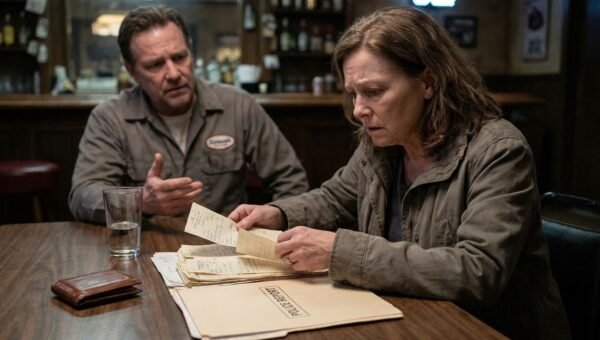
I took out the envelope first. Inside was a single folded sheet of Dad’s personal stationery, dated October 14, 2021—about ten months before he became bedridden.
“Brenda,” the letter began. “If you are reading this, I am gone, and Kevin has likely done exactly what I expected him to do. He thinks I don’t notice him watching my checkbook. He thinks because my legs are giving out, my eyes have too. He will take the easy money. You take the patient money.”
My eyes blurred so hard I had to pause and wipe my cheeks on the collar of my shirt.
Dad had been an accountant for forty years before he retired. He was a quiet man who kept daily logs of his gas mileage and balanced his accounts down to the penny on Sunday evenings. While Kevin had spent the last two years assuming Dad was slipping into senility, Dad had simply been watching him.
I set the letter down and picked up the documents beneath it. They were municipal bearer certificates and registered bonds issued by the water authority and the county district, originally purchased in the late 1980s and rolled over faithfully into long-term municipal paper. Attached to the certificates was an official valuation statement from the bank’s trust department, stamped and signed in late 2021.
The total face value came to exactly $180,000.
Along with the certificates was a notarized memorandum of transfer, specifically naming the box contents as an inter vivos gift delivered directly to me as a joint tenant with full rights of survivorship the day my name was registered to the box. Dad had paid an attorney thirty miles away in the next county to draft the transfer documents so that nothing would pass through the house or cross the desk of anyone Kevin knew.
Dad had anticipated everything. He knew Kevin’s greed. He knew Kevin would pounce on the checking account the minute Dad was too weak to walk to the bank himself. Dad let him have the $154,000 in the checking account because he knew that if he fought Kevin while he was dying in that back bedroom, Kevin would walk out and leave him with no one in the house at night.
He let Kevin rob him of the easy money to keep the peace until his last breath, while quietly securing my future where Kevin could never reach it.
PART 3
I didn’t call Kevin right away. I spent three weeks working with Clara and an independent estate attorney to ensure every certificate was properly transferred, verified, and deposited directly into a secure trust account under my own name.
Once the funds were settled, I drove over to Dad’s house.
The front yard was overgrown. Kevin hadn’t mowed in three weeks, but Dad’s Silverado was parked in the driveway, washed and waxed, with a new set of custom wheels Kevin had clearly bought with Dad’s checking account money.
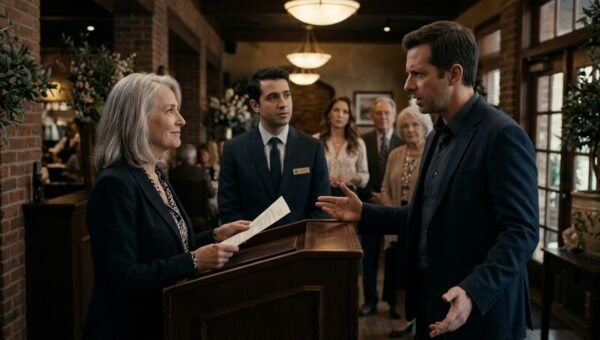
I walked up the porch steps and knocked on the screen door. Kevin came to the door in a sleeveless undershirt, holding a sandwich. He looked annoyed the second he saw my face.
“I told you the house is under contract, Brenda,” he said through the wire mesh. “Closing is in two weeks. If you came to ask about the furniture, the buyers bought the whole lot with the place. There’s nothing left for you to pick through.”
“I don’t want the furniture, Kevin,” I said calmly. “I came to bring you Dad’s Christmas lights.”
He gave a dry, sarcastic laugh and pushed the door open halfway. “Are you serious? You drove across town in the middle of August to give me forty-year-old light bulbs?”
“No,” I said, looking him straight in the eye. “I came to tell you that I found what Dad left inside the box.”
The smirk left his face, replaced by a quick, defensive squint. “Dad didn’t leave anything in the attic. I went through the house top to bottom before I listed it.”
“He left Box twenty-two at First Federal,” I said. “He added me to the lease four years ago. He left me the patient money.”
Kevin froze. The color drained from his face as his gaze darted toward the truck in the driveway, then back to me. His jaw worked, trying to find words that made sense.
“What patient money?” his voice cracked slightly. “Dad didn’t have another account. I saw his taxes. I checked his file cabinet. He had one hundred fifty-four thousand in First National, and that was it.”
“He had one hundred eighty thousand in bearer certificates,” I told him, keeping my voice low and steady. “He put them in the vault before you even moved into the spare room. He wrote me a letter, Kevin. He explained why he let you steal his checking account while he was dying.”
Kevin stepped out onto the porch, his face flushing dark red. “I didn’t steal anything! He gave me that PIN! He said I earned it taking care of him! You can’t keep that money from the estate. We’re fifty-fifty on the will, Brenda. I’m calling my lawyer. You owe me half of whatever was in that box!”
“There is no estate,” I said. “You made sure of that when you drained his checking balance down to zero before the funeral home even printed his program. The lawyer I hired looked at the transfer papers Dad signed in 2019. That safe deposit box was joint property with right of survivorship. It never belonged to Dad’s estate. It belonged to me.”
He stepped closer, his hands balling into fists, trying the same intimidation he had used on Dad during those last months. “You think you’re smart? I’ll sue you for every dime. You took advantage of an old man who didn’t know what he was signing!”
I pulled a folded photocopy from my pocket. It wasn’t the certificate list. It was a copy of Dad’s handwritten note.
“Read it,” I said, holding it out.
Kevin snatched it from my hand. I watched his eyes scan the lines. When he hit the sentence about the easy money, his mouth opened, but no sound came out. Dad’s handwriting was as familiar to him as his own reflection. It wasn’t an old man’s shaky scrawl. It was the sharp, precise print Dad used when he was balancing a ledger.
“Dad knew,” I said. “He knew you were going through his drawers. He knew you were waiting for him to die so you could pay off your debts. He gave you what you wanted so you’d leave him alone in that bed, and he left me the rest.”
Kevin crumpled the paper in his fist. “Get off my property.”
“It’s Dad’s property until closing,” I said. “And after that, you’re on your own.”
ENDING
The closing on the house went through at the end of August. Kevin took his share of the equity, bought a larger camper he couldn’t afford, and moved two counties north. We haven’t spoken since that afternoon on the porch. He didn’t call on Thanksgiving, and he didn’t send a card at Christmas.
I used a portion of the $180,000 to pay off the remaining balance on my mortgage, giving myself the breathing room I had spent twenty years worrying about. The rest remains safely invested in conservative index funds, exactly the kind of patient, quiet growth Dad always preached at the Sunday dinner table.
Last December, when the first cold snap hit, I went down to the basement where I had moved the remaining ten boxes of Mom’s holiday decorations.
I unpacked the small ceramic village houses, the felt tree skirt with the uneven stitching Mom had sewn when Kevin and I were toddlers, and the wooden angel Dad had carved for the top of the tree back in 1982.
When I reached the bottom of the last box, I found the tangled string of ceramic lights. I had cleaned the dust off the bulbs and replaced the five that were burned out.
I took them out to the front porch, tacked them along the eaves of the roof, and plugged them in just as the sun went down behind the pine trees. They glowed bright and steady in the dark, warm against the cold night air. Dad had been patient, and so had I.