PART 1
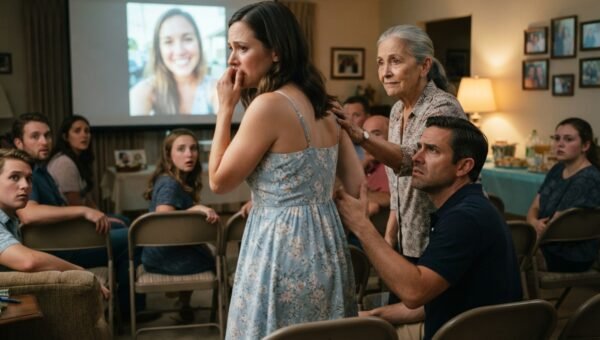
The gym smelled exactly the same as it did forty years ago. It was that distinct mixture of floor wax, varnished pine, and cheap punch, decorated with gold and navy blue balloons that kept losing their helium and sinking toward the bleachers. I was fifty-eight years old, standing by the refreshment table with a plastic cup of ginger ale, squinting across the crowd to read nametags. Most of us had gray hair or reading glasses hung around our necks. We were all politely pretending we recognized each other immediately.
Then a woman I had never laid eyes on in my life stepped out of the crowd and walked directly toward me.
She looked to be around forty. She had dark hair pulled back into a simple clip, gray eyes, and wore a plain navy cardigan. There was no nametag pinned to her chest. She didn’t have the hesitant smile of an old classmate trying to place a face. Her eyes were fixed on me with an intense, quiet certainty that made the hairs on the back of my neck stand up.
“You’re Linda Miller,” she said. It wasn’t a question.
“I am,” I said, smiling politely and extending my hand. “I’m sorry, did you go to Oak Ridge? I don’t remember…”
She didn’t take my hand. Instead, she reached into the canvas tote bag hanging from her shoulder.
“You left me at St. Agnes Hospital,” she said.
The music from the DJ booth—some old song by Hall and Oates—seemed to drop away entirely.
The gym was full of loud laughter and clinking glasses, but around us, the air turned freezing cold.
“Excuse me?” I laughed a little, nervous and confused. “I think you have the wrong person. I never had children. I never had a baby at St. Agnes or anywhere else.”
“I don’t have the wrong person,” she said. Her voice remained steady, flat, and chillingly sure. “412 Elmwood Terrace. You lived there until the fall of 1984, when your parents abruptly packed you up and sent you to your aunt’s house in Michigan for two years.”
My heart hammered against my ribs like a trapped bird. That was my childhood house. I hadn’t thought about that address in decades. My parents had sold it thirty years ago.
Before I could form a sentence, she pulled something out of her tote bag and held it out with both hands.
It was a small, folded baby blanket. The yarn was a pale, buttery yellow with a white scalloped border, worked in an uneven shell stitch.
My breath caught in my throat. I knew that blanket intimately. My mother had crocheted it during the spring of my senior year in 1984. She had severe arthritis in her knuckles, and the tension in the stitches was irregular. There was a tiny knot on the corner where she had tied off a broken strand of wool. When I left for Michigan that autumn, my mother told me the blanket had been ruined by mice in the attic and thrown out with an old trunk.
“Where did you get that?” I whispered, my fingers trembling as I reached toward the edge of the yellow yarn.
Behind me, glass shattered.
I turned around. My high school best friend, Brenda, was standing five feet away. Her wine glass lay in pieces on the hardwood floor, dark red liquid pooling around her sensible low heels. Brenda’s face had drained of every drop of color.
She wasn’t looking at me. She was staring at the yellow blanket in the stranger’s hands, her lips parted in pure terror.
“Brenda?” I asked.
Brenda didn’t say a word. She grabbed her purse from a nearby high-top table, turned on her heel, and practically ran toward the double doors leading to the parking lot.
PART 2
I didn’t think. I dropped my cup onto the refreshment table and ran after Brenda.
“Brenda, wait! Stop!”
My heels clicked sharply against the linoleum of the main hallway. The banners from our 1984 championship teams blurred past me. By the time I pushed through the heavy metal exit doors, the cool night air hit my face, smelling of damp asphalt and autumn leaves. Brenda was already halfway down the second row of parked cars, fumbling frantically with her keys.
“Brenda!” I caught up to her beside the driver’s door of her sedan and grabbed her arm. “What is going on? Why did you run like that?”
Brenda was shaking so hard the keys rattled against the car handle. She kept her head down, refusing to look me in the eye.
“I can’t do this, Linda,” she whispered, her voice choked with tears. “Please just let me go home. You don’t know what you’re digging into.”
“A woman just walked up to me and claimed I abandoned her at St. Agnes Hospital,” I said, holding onto her jacket sleeve. “She had my mother’s yellow blanket. The one my mother told me was thrown away forty years ago. And the second you saw it, you looked like you saw a ghost. You know something.”
“Your parents made me swear,” Brenda sobbed, pressing a trembling hand against her mouth. “Your mother came to my house the week after graduation. She sat in my kitchen with my mother. They made me promise on a Bible that I would never speak about graduation night. They said it would destroy your entire life if you ever found out.”
“Found out what?” My voice cracked. “Brenda, talk to me! What happened on graduation night?”
“I can tell you what happened,” a voice spoke from behind us.
The stranger had followed us out. She stood under the yellow glare of the parking lot light, clutching the yellow blanket against her chest. With her other hand, she pulled a small plastic envelope from her coat pocket.
“My name is Sarah,” she said, walking toward us until she was standing just three feet away. She opened the envelope and slid out an old, faded plastic hospital identification band.
She held it under the streetlight so I could read it.
The plastic was yellowed with age, the edges slightly brittle. Typed in blue ink on the insert paper was the date: *June 8, 1984*.
The patient name was clearly stamped: *Miller, Linda*.
Below that, in the small box meant for age and classification, the black ink read: *Newborn / Female*.
“That is my hospital intake bracelet,” Sarah said, her voice dropping lower. “I was brought into the emergency room at St. Agnes at four in the morning on June 8, 1984. Wrapped in that yellow blanket. The person who admitted me told the triage nurse that the mother was Linda Miller, eighteen years old, residing at 412 Elmwood Terrace. The person who signed the intake paperwork and left me there never gave their own name.”
I stared at the bracelet. June 8, 1984.
That was our graduation night. We had gone to the lake after the ceremony. I remembered the fireworks, the bonfires, and getting violently ill around midnight after drinking punch someone brought. Brenda had driven me home. I woke up in my own bed the next afternoon with a blinding headache and no memory of the hours between midnight and morning. My mother told me I had severe alcohol poisoning, kept me in bed for three days, and by August, I was shipped off to stay with my aunt in Lansing.
“This is impossible,” I stammered, shaking my head violently. “I was never pregnant. Brenda, look at me! Was I pregnant? I was wearing a size four graduation dress! You were with me every single day!”
“No, Linda,” Brenda whispered, tears streaming down her cheeks. “You weren’t pregnant. You were never pregnant.”
“Then whose baby was this?” I demanded, pointing at the bracelet.
“Mine,” a man’s voice called out from the darkness near the gym entrance.
PART 3
An elderly man was walking down the asphalt toward our circle of light. He moved slowly with the aid of an aluminum cane, wearing an old tweed jacket over a navy collared shirt. Even hunched with age and walking with a limp, his silver hair and sharp posture were instantly recognizable.
It was Mr. Donald Vance. He had been our high school principal in 1984. He was eighty-one years old now.
“Sarah,” Mr. Vance said softly, stopping a few feet away and looking at the stranger with an expression of profound sorrow. “I told you to wait in the car. I told you I would speak to her first.”
“You’ve had forty years to speak, Dad,” Sarah replied, her voice tightening. “I wasn’t going to spend another night waiting.”
My mind spun so hard I felt dizzy. “Principal Vance? She called you Dad. What does this have to do with you? What does any of this have to do with me?”
Mr. Vance leaned heavily on his cane, looking down at the cracked pavement before he could bring himself to meet my eyes.
“Sarah isn’t your daughter, Linda,” Mr. Vance said quietly. “She is my biological daughter. And her mother was your sister, Carol.”
The air left my lungs completely.
Carol. My older sister Carol had been twenty-two in 1984. She had been living in an apartment on the other side of town, working at a bank. She had passed away from breast cancer twelve years ago.
“That’s a lie,” I whispered. “Carol never had a child.”
“Yes, she did,” Brenda said, stepping closer to me, her hand gripping my shoulder. “Linda, listen to him. Please. Your parents hid it from everyone, especially you.”
“Carol and I had an affair during the winter of 1983,” Mr. Vance confessed, his voice cracked with shame. “I was forty-one. A married man, the principal of the school where her younger sister was a senior. When Carol found out she was pregnant in the spring, she panicked. She hid the pregnancy for six months. She wore loose clothes, stayed away from family gatherings. But on graduation night, she went into labor at her apartment.”
The pieces began to collide in my head, sharp and jagged.
“She called your house,” Mr. Vance continued. “Your parents rushed over there. Your father delivered the baby in Carol’s bathroom because there was no time to get to a hospital. Your mother used the blanket she had just finished crocheting to wrap the child. But your father was a prominent deacon in the church, and Carol was terrified of being ruined. More than that, your father was furious. He threatened to kill me, to destroy my career, to tear the family apart.”
“Then why does that bracelet have my name on it?” I asked, my voice rising. “Why does it say Linda Miller?”
“Because your father made a horrific, calculated decision,” Brenda said, wiping her face. “Linda, when your father drove the baby to St. Agnes in the middle of the night, he didn’t want Carol’s name anywhere near hospital records. Carol had employer insurance and a public job. If her name was on an abandoned child’s record, it would follow her forever. But you were eighteen. You were about to leave the state. Your father gave the hospital your name and your address, knowing you were leaving for Michigan and that no one would connect the dots.”
“He used my name as a throwaway identity,” I realized, the horror washing over me like ice water. “To protect Carol’s reputation. And his own.”
“And to protect me,” Mr. Vance said, closing his eyes. “Your father came to my house at dawn that morning. He told me what he had done. He said if I ever spoke a word of this, or if I tried to claim the child, he would go to the school board, the police, and my wife, and tell them I assaulted Carol. He promised that if I adopted the baby legally through private channels once she entered state care, he would keep Carol’s name clean and bury the truth forever.”
ENDING
The parking lot was silent except for the distant thumping bass from inside the gymnasium.
“My wife and I couldn’t have children,” Mr. Vance said quietly. “Two weeks after you were dropped at St. Agnes, Sarah was placed into temporary foster care. Through private adoption attorneys who handled difficult placements, I paid every fee, went through the state system, and officially adopted her six months later. I raised her as my own daughter. My late wife loved her with every piece of her heart.”
“Then why did you tell her I left her?” I asked Sarah, my eyes stinging with tears.
“He didn’t,” Sarah said softly. She looked down at the yellow blanket in her hands. “My father kept the box from the adoption agency in his study. When he got sick last winter, he finally showed it to me. The only physical items from the night I was abandoned were this handmade blanket and that hospital band. The band said Linda Miller. For forty years, I grew up believing my mother was an eighteen-year-old girl named Linda who left me in an emergency room and walked away.”
Sarah looked up at me, her gray eyes shining under the lamppost. I looked at the line of her jaw and the shape of her mouth. For the first time, past the shock and the grief, I saw Carol’s face. It was the same nose, the exact same slight tilt of the chin.
“When Dad found out our high school was having its fortieth reunion tonight,” Sarah said, “he told me we were driving here. He told me he was finally going to set it right. But when I saw you inside… I was just so angry. I saw the woman whose name had been on that bracelet my entire life, and I couldn’t wait.”
“Linda, your mother made me swear because she knew I had seen Carol the week before graduation,” Brenda whispered. “I went to Carol’s apartment to drop off graduation announcements and found her crying in the bedroom. She made me promise not to tell you. When your parents sent you away to Michigan, they made sure you were completely isolated from the rumors until everything blew over.”
I leaned back against Brenda’s car, my legs trembling so violently I wasn’t sure they would hold me.
My parents had been dead for over fifteen years. They had taken that secret to their graves, leaving me to live an entire life believing my family was simple, quiet, and ordinary. They had stolen my sister’s motherhood, placed my name on an abandoned infant to shield themselves from social shame, and sent me away to Michigan like an exile just to keep their clean little world intact.
And Carol had carried that silence alone until cancer took her in a hospital room where I had sat holding her hand, having no idea that her daughter was living three counties away.
I straightened my back and took a step toward Sarah.
“I didn’t abandon you,” I said, my voice thick with emotion. “I swear to you on my life, Sarah. I didn’t even know you existed until ten minutes ago.”
Sarah’s composure broke. Her chin trembled, and a tear spilled over her lashes.
“I know,” she said quietly. “Dad told me in the car on the way here that you were innocent. I just… I needed to hear it from you. And I needed to know if anyone in that family ever actually wanted me.”
“Your mother loved you,” Mr. Vance said, his voice breaking as he looked at Sarah. “Carol cried for months. She wanted to keep you, but she was terrified of her father. She let me take you because she knew I would give you a life.”
I reached out my hand again. This time, Sarah didn’t pull away. She took my hand in hers, her fingers warm and tight around mine.
“I have boxes of photos of your mother at home,” I told her. “Albums full of them. She had your laugh, I can tell. She had your smile. If you want to know who she was, I can tell you every single thing about her.”
Sarah looked down at our joined hands, then looked back at me, nodding slowly through her tears.
“I’d like that,” she whispered.
We didn’t go back into the reunion. We left the balloons, the loud music, and forty years of polite lies behind in that gymnasium. Instead, the four of us walked out to the quiet parking lot together, finally ready to tell the truth.