PART 1
My husband, David, got held up at the distribution plant that Saturday afternoon, so I drove over to his parents’ house by myself to drop off a tin of oatmeal raisin cookies. It was just past three o’clock. The gravel driveway was empty except for Harold’s green pickup truck sitting near the side garage door.
I walked up the front steps, tapped the brass knocker three times, and waited.
The house stayed completely quiet. Harold, my father-in-law, was retired from thirty years at the county water authority, and he almost never left Margaret home alone without leaving a note stuck to the screen door. Margaret had lived in that house for forty-two years. She was the kind of woman who kept a fresh pot of decaf on the counter and answered the door before you could knock twice.
I pulled out my phone and sent Harold a quick text: “Dropped by with some cookies. Are you two around?”
His reply came back less than two minutes later: “I’m out with the guys. Margaret’s resting. You can head home.”
I stood on the porch looking at the screen. Harold was seventy-two and had a bad hip; he didn’t hang out with “the guys” on Saturday afternoons. He usually sat in his recliner with the ball game turned down low while Margaret worked on her cross-stitch.
And Margaret never slept through visitors, especially family. If she heard a car pull into the driveway, she was at the side door with her cardigan pulled around her shoulders.
I tried the doorknob. The front door was unlocked.
“Margaret?” I called into the hallway. The smell of cedar oil and old carpeting hung in the warm air. Nothing answered. The downstairs blinds were pulled shut, keeping the living room dim.
I set the cookie tin on the small table by the stairs and was about to turn around and leave when I heard it. A small, dry tapping sound came from right above the second-floor ceiling. It wasn’t a pipe or tree branch. It was rhythmic. Tap, tap, tap. Then a pause, followed by three more.
I walked up the staircase, following the noise down the narrow second-floor hallway to the small wooden door at the far end. That door led to the finished attic, a room Harold had always called his private workshop.
For the seven years I had been married to David, that door had remained locked with a brass skeleton key Harold carried on his personal ring. David had told me once that his father kept old hunting gear, tax receipts, and family records up there and didn’t like people going through his things.
When I reached the door, the heavy brass key was sitting right in the keyhole.
My chest felt tight. I turned the key, gripped the round metal handle, and pushed the door inward. The wood scraped lightly against the floorboards.
Sitting in a dusty, high-backed wooden chair beneath the single roof window was Margaret. She was wearing her beige house cardigan, and her hands were clutched together in her lap. Her hair was pulled back into an unbrushed knot. When she looked up and saw me standing in the doorway, her shoulders slumped, and her face went completely pale.
“Margaret,” I said, rushing across the floorboards to her side. “What on earth are you doing up here?”
She grabbed my wrist with both hands. Her fingers were cold and trembling so hard I could feel the shake in her bones. She didn’t look at my eyes; she looked past my shoulder, staring straight at the open stairway behind me.
“He locks me up here whenever he doesn’t want anyone to know what’s really happening in this house,” she whispered, her voice barely carrying across the room. “And if Harold finds out you saw me, he’ll tell everyone I’m the one.”
PART 2
“The one what, Margaret?” I asked, kneeling beside the chair so I could look directly at her. “What are you talking about?”
“The one losing my mind,” she said. Her voice broke on the last word. “He’s already started telling people at church. He told Pastor Miller three weeks ago that I’ve been wandering at night, that I’ve been hiding bills and forgetting who comes to the door.”
“Are you?” I asked gently.
Margaret reached into the deep pocket of her cardigan and pulled out a small, worn leather address book with a rubber band wrapped around it twice. She didn’t look crazy. Her eyes were clear, red from crying, but completely lucid. She pulled off the rubber band with shaking fingers and flipped past the alphabetized phone numbers to the blank lined pages at the back.
“Look at the dates,” she said.
I took the small notebook into my hands. On every page, in Margaret’s neat, practiced handwriting, there were dates, times, and dollar amounts written in blue ink.
April 14: $12,000 withdrawn from local branch. Check made out to Harold Vance.
June 2: $18,500 transferred from joint savings to personal checking.
August 19: $34,000 drawn against home equity line of credit.
September 28: Notice of default on property tax, $4,120 past due.
At the bottom of the last page, written in heavier ink, was a single number circled twice: $84,650.
“Harold has spent eighty-four thousand, six hundred and fifty dollars out of our retirement savings since last spring,” Margaret said, her voice dropping to an urgent whisper. “He got involved in some private investment group through a friend he met at the diner. Some real estate partnership down in Florida. He told me it was going to double our money so we wouldn’t have to worry about long-term care costs down the road.”
“Where did the money actually go?” I asked.
“Into an account he controls,” she said. “When the statements started showing up in the mail showing zero returns and massive service fees, I confronted him. That was two months ago. I told him I was going to call David, and I was going to call the bank manager, Ron Patterson, who has handled our accounts since 1998.”
Margaret pointed to the lock on the heavy attic door. “That was the first time he brought me up here. He told me if I stayed in the bedroom, I’d pick up the landline and make a scene. He takes my cell phone, puts me up here with a pitcher of water, and locks the door until he gets back from meeting with his people. He told me if I told David, he would file for legal guardianship over me. He said with the doctor notes he’s been gathering about my mild arthritis and his word against mine, no one would believe me.”
“He doesn’t have doctor notes about dementia,” I said.
“He’s been laying the groundwork, Kelly,” she said, calling me by my name for the first time since I walked in. “He told David two weeks ago that I burned a pot on the stove. I never burned any pot. Harold turned the burner on high himself while I was out in the garden, then called David over to show him the scorched pan.”
I remembered that night. David had come home from his parents’ house looking troubled, telling me his mother seemed confused and that Harold was carrying a heavy burden trying to manage the house alone. David had even suggested we start looking at assisted living brochures just to have them on hand. We had believed Harold without asking Margaret a single question.
“We have to get you out of here right now,” I said, standing up. “Take your shoes. Harold said he was out with the guys, but he knows I came by. He could be back any minute.”
Margaret shook her head, pulling back into the chair. “I can’t just run away, Kelly. Harold is David’s father. If I walk out of this house with you and Harold comes home to an empty attic, he will call the county sheriff and report me as a missing vulnerable adult. He threatened to do exactly that if I ever tried to walk down the road to a neighbor. He has the paperwork from the bank locked in his metal desk downstairs. If we leave without the proof, it’s just my word against his.”
PART 3
“Where is the key to the desk?” I asked.
Margaret pointed toward the corner of the attic, where an old sewing machine table sat under an oilcloth cover. “Under the left rear leg. He keeps a spare brass flat key taped underneath the wood.”
I didn’t hesitate. I crossed the dusty floorboards, reached under the leg of the sewing table, and felt the edge of masking tape. I pulled it loose. A small flat desk key came away in my palm.
“Come downstairs with me,” I told Margaret, taking her arm. “You are not staying in this attic for another second.”
Her knees were stiff, but she leaned on my shoulder as we walked down the narrow attic stairs. The house was completely silent. I led her into Harold’s first-floor den, a small room paneled in dark pine where his heavy oak desk sat beside the window facing the driveway.
I used the flat key to unlock the bottom right drawer. Inside was a thick green hanging folder labeled “Vance Holdings.”
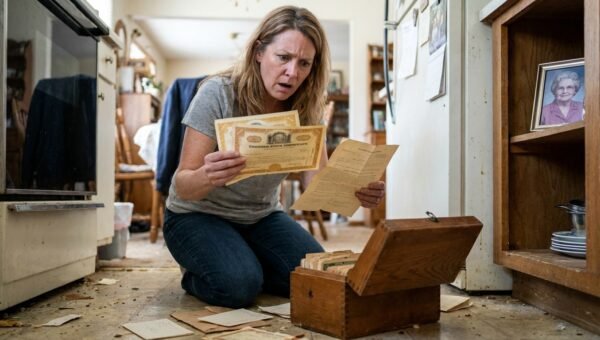
I pulled the folder onto the desk and opened it. The documents weren’t an investment portfolio. They were cashier’s check receipts, personal loan notes, and monthly withdrawal slips from First Community Bank. Exactly $84,650 had been drained from their joint retirement accounts over an eighteen-month span. But the money hadn’t gone to Florida.
The checks were made payable to a private account under the name of Richard Vance.
Richard was Harold’s younger brother, a man who lived two counties over and had filed for personal bankruptcy twice in the last decade. Harold had been secretly funding Richard’s failed commercial printing business, using his and Margaret’s retirement money and home equity to keep his brother afloat, all while telling Margaret the money was tied up in legitimate investments.
On top of the bank receipts was an unsigned application for emergency conservatorship over Margaret Vance, prepared by a local legal aid clinic that Harold had visited under the pretense of seeking advice for an incapacitated spouse. Harold had filled out the intake form himself, claiming Margaret suffered from severe memory loss and financial paranoia.
A pair of headlights swept across the living room window. Tires crunched over the gravel outside.
“He’s back,” Margaret whispered, her hand gripping my sweater.
“Stay right behind me,” I said.
The side door slammed shut, followed by the heavy, uneven sound of Harold’s boots on the kitchen linoleum.
“Margaret?” Harold called out, his voice sharp and impatient. “Kelly sent a text, did she come by here?”
He walked into the hallway and stopped dead in his tracks when he saw both of us standing in the open doorway of his den. In his right hand, he was carrying a bag of groceries. His eyes dropped immediately to the green folder sitting on his desk, then moved to Margaret’s face, and finally to mine.
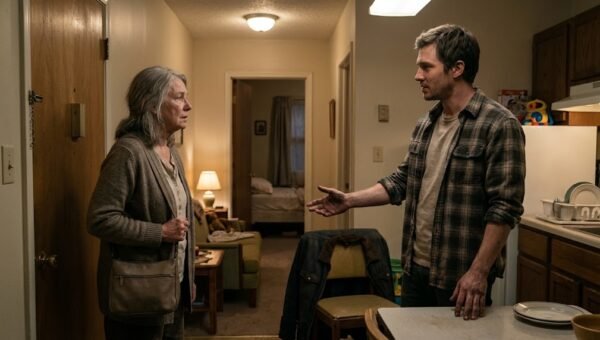
“Kelly,” Harold said, his voice dropping into that smooth, measured tone he used at church committee meetings. “What are you doing in my office? I told you Margaret was resting. She gets agitated when people come over unannounced.”
“She wasn’t resting, Harold,” I said, holding up the cashier’s check receipt for $34,000. “She was locked in the attic. And you’ve been giving your retirement money to Richard while setting up paperwork to have Margaret declared incompetent so she couldn’t stop you.”
Harold’s face tightened, the calm expression vanishing completely. “You have no business going through my personal drawers. You’re David’s wife, not an auditor. Margaret is confused. She doesn’t understand family finances, and she hasn’t for years.”
“I am not confused, Harold,” Margaret said clearly, stepping around my shoulder. She stood straight, her hands no longer trembling. “I kept the ledger. I know every single dollar you took out of the retirement fund my parents helped us start. And Kelly has the papers in her hands.”
Harold took one step forward, pointing a blunt finger at his wife. “You hand those papers over right now, Kelly. You don’t know what you’re interfering with. Richard is my brother, and he was about to lose his home.”
“By stealing yours?” I asked.
Before Harold could answer, my phone rang loudly on the desk. It was David, calling on his way home from the plant.
I hit the speaker button and set the phone directly on top of the green folder.
“Kelly?” David’s voice filled the room. “I just got off my shift. Did you drop those cookies off for Mom?”
“David,” I said, looking straight into Harold’s eyes as his father’s jaw clenched shut. “I’m in your father’s office right now with your mother. You need to come straight over here. Your mother was locked in the attic, and your father has some financial statements he needs to explain to both of us.”
ENDING
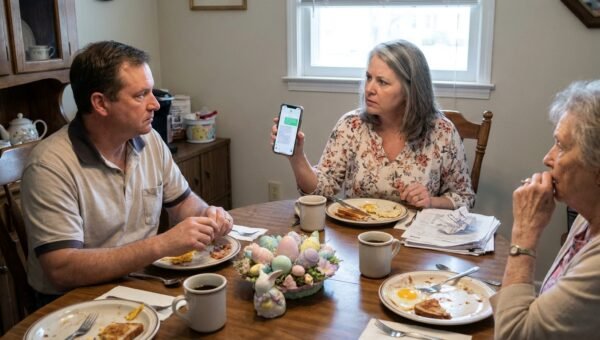
David arrived twenty minutes later, his work clothes still covered in dust from the plant. When he saw his mother sitting at the kitchen table with her coat on and the bank statements laid out between us, the story Harold had been building for months completely collapsed.
Harold tried to claim it was a temporary family loan and that he had only locked the attic door by mistake while organizing boxes, but the unsigned conservatorship intake form ended that lie on the spot. David looked at his father with a look of quiet disbelief that hit Harold harder than any shouting match could have. David took the folder, helped his mother out to my car, and drove her straight to our house that evening.
Margaret stayed in our guest room for four months. During that time, we hired an elder law attorney in town who immediately filed an emergency freeze on the remaining joint accounts at First Community Bank. The attorney revoked Harold’s power of attorney over Margaret’s financial decisions and formally notified the bank of the unauthorized transfers.
Richard had already spent the $84,650 on business debts and overdue lease payments, so the money was largely unrecoverable. But because the house deed was held in both Harold and Margaret’s names with survivorship rights, the attorney ensured that no further liens or home equity loans could be approved without Margaret’s separate legal representation.
Harold lives alone in that big house now. He tried calling David several times during the first few weeks, blaming me for turning his family against him, but David told him plainly that until he admitted what he had done to his mother, there was nothing to discuss. The church eventually learned that Margaret was living with us; she didn’t hide the truth, but she didn’t spread gossip either. She simply told Pastor Miller that Harold had made financial choices that made it unsafe for her to remain under his roof.
Last month, Margaret signed the lease on a quiet one-bedroom apartment three miles from our house, right near the public library. She paid the deposit using her half of their remaining monthly pension check, which now gets direct-deposited into her own private account.
On Tuesday, I went over to her new place to help her hang some curtains in the living room. As she was putting a set of mismatched mugs into the kitchen cupboard, she stopped and set a small brass skeleton key on the counter next to the sink.
“What’s that?” I asked.
“I took it out of the attic door before we walked down the stairs that day,” Margaret said, her voice steady and calm. “Harold thought he was locking me in. But every time I look at that key, I remember that I was the one who kept the ledger.”