PART 1
Dr. Marcus told me my hip replacement went smoothly, but the second I woke up in that sterile recovery room, I knew something felt heavy and wrong. My son, David, was standing at the foot of the bed with his hands buried deep in his jacket pockets, looking less like a worried child and more like a man guarding a door. When the physical therapist came by the next morning with a pair of rubber-soled slippers and a rolling walker, David stepped right in front of him.
“She is far too weak,” David said, his voice smooth and loud enough for the nurses at the station to hear. “She was shaking all morning. Let us take her straight to the car and up to my guest room. I have everything set up there.”
The therapist looked at me, hesitation written across his face. I tried to lift my right foot, and a sharp, familiar pinch caught in my hip. I nodded, assuming David knew best. I was seventy-one years old, my body felt hollowed out, and my home had sixteen stairs leading up to the front door. David insisted that my house was a hazard, that I would break my new joint before it even had a chance to knit together.
For the first three weeks, David was attentive in that particular way that makes you feel like a fragile piece of glass. He brought me soft-boiled eggs on a chipped yellow plate, fluffed my pillows every afternoon, and locked the front deadbolt whenever he went out to work.
But by week four, the fog of the anesthesia lifted, and the daily rhythm of his care began to curdle into something strange.
Whenever I asked for the walker so I could practice the hallway laps the hospital booklet recommended, David sighed and shook his head.
“The physical therapist called while you were napping,” he would say, leaning against the doorframe. “He said rest is more important right now. You are pushing too hard, Mom. Trust me.”
I did trust him. He was my only son, and since my husband passed away three years ago, David was the anchor I held onto in every storm. Yet a strange, small detail kept bothering me. Every time I heard him come back from his errands, he spent a long time in the basement before coming upstairs. I could hear the heavy thud of the cellar door sliding across the linoleum, followed by the metallic scrape of something being dragged across concrete.
When I asked him about the noise, he smiled too quickly and told me he was just organizing old boxes from my attic that he had brought over for safekeeping.
The turning point came on a Tuesday when David drove into town to pick up his dry cleaning and stock up on groceries. He had left his phone on the kitchen island, face down, vibrating with a text message from a local real estate agency. I ignored it at first, telling myself it was none of my business. But as I sat there in the armchair staring at the blank television screen, the quiet of the house felt too heavy to bear. I wanted to stand up. I wanted to feel my own legs carry my weight.
I pushed myself up from the deep cushions, gripping the wooden arms of the chair until my knuckles turned white. My right hip gave a dull throb, but I stayed upright.
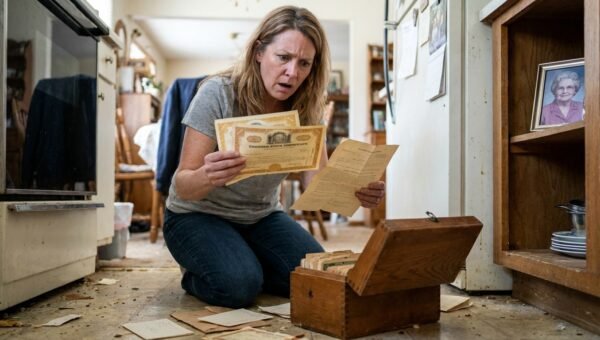
Slowly, balancing against the edge of the side table, I shuffled toward the kitchen to get a glass of water. That was when I noticed a white envelope wedged halfway beneath the refrigerator toe-kick, out of David’s sight.
I knelt down, ignoring the warning ache in my joint, and pulled it out. It was a folded sheet of clinic stationery with my name typed neatly at the top. The date stamped on the corner was from three days prior.
I unfolded the paper and read the bold text at the top of the physical therapy progress report. It listed a series of milestones I was supposed to have completed by week four, including unassisted hallway balance and stair navigation. Below those headings, in a neat grid of checkmarks initialed by a therapist named Sarah, it noted that the patient had demonstrated excellent compliance during home visits.
Except there hadn’t been any home visits. No therapist had stepped foot inside David’s house since the day I arrived from the hospital.
I stared at the signature block, my breath catching in my throat as the pieces of the puzzle shifted into place. David had not canceled my care because I was too weak. He had been turning the therapists away at the front door, telling them I was resting or unresponsive, while keeping my insurance records and therapy schedules filed away in his own briefcase.
Before I could even fold the paper back up, the front door rattled open and David stepped into the hallway with two plastic grocery bags swinging from his fingers.
PART 2
David stopped dead in the entryway when he saw me standing unassisted beside the kitchen island with the white paper clutched in my hand. The grocery bags slipped from his fingers, hitting the floor with a dull thud as a carton of milk rolled against the baseboard. For three seconds, neither of us breathed. The silence in the kitchen was thick enough to touch, stripped of all the fake warmth he had worn for the past month.
“Where did you find that?” David asked, his voice losing its usual soft cadence, dropping into something flat and cold.
“A therapist left it under the fridge,” I said, my voice shaking less than I expected it to. “Sarah. She came to the house while you were out at the hardware store, didn’t she? And you told her to go away.”
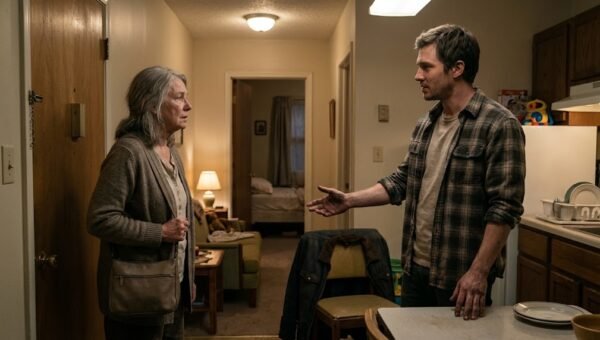
David didn’t run. He didn’t even look panicked. He just walked over to the kitchen table, pulled out a wooden chair, and sat down with a heavy sigh, rubbing his temples with his palms.
“You were not supposed to be out of that chair,” he said, staring at the grain of the wood. “You have no idea how complicated things are right now, Mom. The bills from the surgery center have been piling up. Your secondary insurance denied the extended rehabilitation coverage because they claim you are making progress faster than expected on paper, but you and I both know you are fragile. I had to protect you from getting overwhelmed.”
“You did not protect me, David,” I said, taking a cautious step forward, using the counter to steady my balance. “You locked my walker in the basement. You told my friends from church that I was bedridden and could not take visitors. Why?”
He looked up then, and his eyes were hard, fixed on mine with a bitter resentment that made my stomach turn. “Because your house is in a trust, and the maintenance costs on that property are eating through every cent of your retirement fund. If you go back there alone and fall, the liability falls on me. I talked to the care facility downtown. They have a permanent assisted living wing. It costs four thousand dollars a month, but with your Social Security check and the equity we can unlock by selling your house, it practically pays for itself.”
The words hit me like physical blows. My home. The small brick house where I raised him, where my husband’s workbench still sat in the garage exactly where he left it. David had already priced it out. He had already decided that my independence was too expensive and too inconvenient to maintain.
“You were never going to let me go home,” I whispered.
“It is for your own safety,” he insisted, standing up and taking a step toward me. “You are living in the past, Mom. You cannot manage those stairs. You cannot manage the yard. Let me handle the paperwork. Just sign the transfer forms tomorrow morning like a good mother.”
I didn’t argue with him. I didn’t scream or throw the glass of water. I simply turned around, walked back to the armchair with my jaw set tight, and sat down. David followed me halfway across the living room, lecturing me about being stubborn, but I kept my eyes fixed on the floor until he finally muttered something under his breath and walked out the front door, slamming it behind him. The click of the deadbolt turning from the outside echoed through the silent house.
I waited twenty minutes until I was certain he had driven down the street. Then I reached into the pocket of my cardigan, pulled out my old flip phone, and dialed the number for my neighbor across the street from my real home, a retired schoolteacher named Martha who still had my spare garage key.
PART 3
Martha arrived forty minutes later in her blue Buick, parking right behind David’s sedan in the driveway. I had already packed my small overnight bag, placing the physical therapy report right at the top of the clothes. When the front doorbell rang, I did not wait for David to come back. I walked across the living room on my own two feet, gripping the wall for balance, and turned the deadbolt myself.
Martha took one look at my face, pushed the door open wide, and wrapped her arms around my shoulders without asking a single question.
“I saw David’s car wasn’t here,” Martha said softly, her eyes scanning the neat, sterile living room. “You ready to go home, Evelyn?”
“More than ready,” I told her.
We drove the three miles back to my street in near silence, the afternoon sun casting long, golden shadows across the maple trees. When Martha unlocked my front door, the air inside smelled faintly of old books and lemon polish, exactly the way I had left it four weeks ago. It didn’t smell like betrayal or spreadsheets. It smelled like my life.
The real reckoning came two days later on a Thursday morning. David pounded on my front door just as I was boiling water for tea on the stove. When I opened it, he looked frantic, his hair uncombed and his shirt rumpled. He had clearly gone to his guest house, found my empty room, and panicked.
“Are you out of your mind?” he shouted, stepping past me into the kitchen without an invitation. “You could have fallen in the street! How did you even get here? Did Martha drive you?”
“Sit down, David,” I said, pointing to the kitchen table. My voice was steady now, drained of all the shock that had paralyzed me at his house.
He stopped mid-sentence, glaring at me. “I am not sitting down until you pack your bags. I already spoke to the attorney about the transition paperwork. If you stay here alone, the state can come after this property for unpaid medical debts if you have another setback.”
“There is no attorney,” I said quietly, sliding a single sheet of paper across the laminate tabletop between us. It was a printout of the official patient log I had requested from the clinic yesterday morning when Martha took me to see Dr. Marcus. It clearly documented every single visit David had cancelled, along with the clinic’s formal notes stating that my recovery was progressing normally and that I was fully capable of living independently with minimal outpatient support.
David looked down at the paper, and the color drained completely from his face. He didn’t try to make up an excuse. He didn’t mention the care facility or the mortgage payments. He just stared at the ink as if it were a verdict.
“You went behind my back,” he muttered.
“You went behind my back first,” I replied, standing tall beside the counter, leaning only slightly against the edge for support. “You took my strength away on paper because it was easier for you to manage me when I was helpless. Well, I am not helpless, David. And I am not selling this house.”
He opened his mouth to argue, looking for a loophole, a threat, or a way to twist the situation back into his favor. But for the first time in his life, my son realized there was nothing left for him to manipulate.
ENDING
David left twenty minutes later without another word, his car tires crunching sharply against the gravel in my driveway as he backed out toward the main road. I watched him go from the living room window, the afternoon light catching the glass of the front door.
I walked slowly back to the kitchen, turned off the burner under the cooling kettle, and picked up the chipped yellow plate he had left behind on the counter. I washed it in the sink with warm soapy water, dried it with a clean cotton towel, and placed it back at the very back of the cupboard where I kept the things I rarely used. Then I walked out onto the front porch, breathed in the cool autumn air, and left the front door unlocked for the mailman.