PART 1
I have had severe pet dander allergies since I was thirty. My son Kevin knew that, and his wife Chloe knew that, which was why my kitchen counter always held an inhaler and a box of non-drowsy antihistamines. Yet eight months ago, Kevin and Chloe bought an Australian Shepherd puppy named Tucker.
Whenever I drove forty minutes across town to visit them, Tucker stayed in their second-floor guest room behind a closed door, but the dander was in their rugs and on their sofa cushions.
After two hours, my chest would tighten and my eyes would turn red. I never made a public scene about it. I loved Kevin, and I wanted to be in his life, so I took my pills in the driveway, stayed as long as my lungs could handle, and drove home to rinse my eyes with saline.
Then on a damp Tuesday morning in late October, my apartment intercom buzzer went off at 6:45 AM.
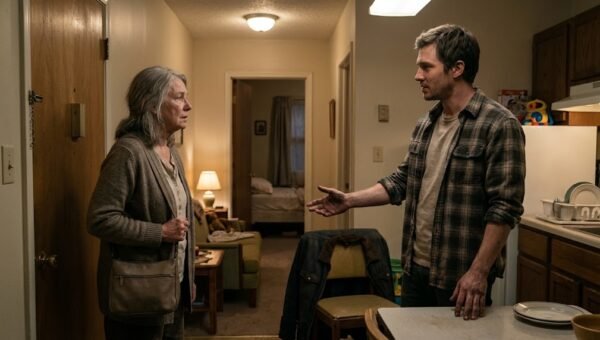
I was in my bathrobe making coffee. When I looked through the peephole into the carpeted hallway of my building, nobody was there. I unlocked the deadbolt and pulled the door open.
Sitting on the welcome mat was Tucker.
He was trembling, his tail tucked tight between his hind legs, tied by a short blue nylon leash to my brass doorknob. Tucked under the metal clip of the leash was a folded piece of lined notebook paper.
I picked it up with shaking hands. The note was written in Kevin’s handwriting:
“Mom, please keep Tucker for just a few days. We had an emergency come up and Chloe couldn’t take him. Don’t call Kevin or text about this right now, I will explain on Friday. Just give him water and dry food. There is a bag in the hallway near the elevator.”
My throat closed up from sheer disbelief. Not only had he left a shedding, energetic dog outside my door in a no-pets-allowed senior apartment complex, but he had explicitly told me not to call him.
I stepped into the hallway, grabbed the fifty-pound bag of dog food propped against the trash chute wall, and pulled Tucker inside my entryway. I closed the door and locked it. My eyes were already stinging.
I sat down on my wooden entryway bench to catch my breath and looked at the dog.
He had a brand-new silver rabies tag from Oakridge Animal Hospital, but right next to it was a brass ID tag.
I turned the brass tag over in my fingers.
The front did not say “Tucker.” It said “Barnaby.”
On the back, stamped into the metal, was a phone number and a name I had never seen or heard in my life: “Elena Vance.”
Before I could even process what Elena Vance had to do with my son, my landline phone rang. The caller ID on the kitchen wall read: OAKRIDGE ANIMAL HOSPITAL.
It was 7:12 AM. The clinic wasn’t even open to the public yet.
I picked up the receiver and pressed it to my ear. “Hello?”
“Mrs. Miller?” a woman’s voice asked, sounding hurried and professional. “This is Oakridge Animal Hospital. We received an automated flag on Barnaby’s microchip transfer request filed late last night. Dr. Miller requested an immediate owner verification before noon today, or the transfer holds and animal control has to be notified regarding the abandonment report on file.”
I stood frozen in the middle of my kitchen, holding a dog I couldn’t breathe around, with an inhaler in my pocket and a stranger’s name in my hand.
PART 2
“Excuse me,” I said into the receiver. “Did you say Dr. Miller?”
“Yes, Dr. Mark Miller,” the receptionist answered, shuffling papers on her end. “He placed a medical hold on Barnaby yesterday afternoon after the surrender paperwork came through from the boarding kennel. We have a conflicting transfer authorization submitted online under your son Kevin Miller’s account at midnight. The file shows Barnaby was registered under Elena Vance, but the account lists this phone number as the emergency contact. If we do not clear this up in person with the dog and the original registration papers before noon, county animal services takes custody.”
“I will be there,” I said.
I hung up the phone. My hands were clammy. Mark Miller was my late husband’s younger brother. Mark had run Oakridge Animal Hospital for thirty years. He and Kevin had barely spoken in three years, not since Kevin borrowed four thousand dollars from Mark to invest in a friend’s auto detailing shop and never paid back a dime.
I looked down at the dog. Barnaby sat quietly by my kitchen table, resting his chin on my slipper. He was gentle, entirely unlike the hyperactive puppy Kevin had described over the summer.
I took two allergy pills, grabbed my car keys, and loaded Barnaby into the backseat of my sedan. On the drive across town, I dialed Kevin’s cell phone three times. Each call went straight to voicemail. Then I called Chloe. Her phone rang five times before clicking to an automated greeting.
I pulled into the gravel parking lot of Oakridge Animal Hospital at 8:30 AM.
The clinic smelled of antiseptic and cedar shavings. Mark was standing behind the reception desk in his green scrubs, reading a printout with reading glasses perched on the tip of his nose. When the bell above the door chimed, he looked up, took off his glasses, and stared at me, then down at the Australian Shepherd beside my knee.
“Carol,” Mark said quietly. “I had a feeling you’d be the one holding the leash.”
“Mark, what is going on?” I asked, my voice cracking slightly. “Kevin left this dog tied to my apartment door at six-thirty this morning with a note saying it was an emergency. The tag says Elena Vance. Who is Elena Vance?”
Mark sighed, walked around the counter, and motioned for me to follow him into an empty exam room. Barnaby trotted right behind us and lay down flat on the linoleum floor.
Mark shut the door and pulled a beige folder from under his arm. “Elena Vance was eighty-two years old. She lived four houses down from Kevin and Chloe on Maple Street. She passed away three weeks ago.”
I stared at him. “Passed away?”
“Elena had no children,” Mark said. “She had a small pension and this dog. About six months ago, when her health began failing, she hired Kevin to do her yard work and run her errands. According to Elena’s attorney, she signed over temporary guardianship of Barnaby to Kevin three weeks ago, along with a certified check for eight thousand dollars from her estate to cover Barnaby’s lifetime medical care and rehoming with an approved rescue ranch in Oregon.”
The room felt entirely airless. “Eight thousand dollars?”
“Yes,” Mark said, opening the folder. “The attorney called me yesterday because Kevin was supposed to surrender Barnaby to the transport coordinator on Monday morning. Instead, Kevin stopped answering the attorney’s calls. Then at midnight last night, someone logged into our clinic portal using Kevin’s email and attempted to transfer Barnaby’s microchip into your name, listing your apartment as his permanent residence.”
PART 3
The truth hit me with brutal clarity. Kevin hadn’t bought an Australian Shepherd puppy eight months ago. He had taken Elena Vance’s elderly neighbor dog under the guise of helping her, kept the dog in his spare bedroom while telling me it was his own pet, pocketed eight thousand dollars meant for the animal’s rescue, and then dumped the dog on my doorstep to make it look like an abandoned stray or my responsibility when the estate attorney started pressing him for proof of transfer.
“If the transfer went through to you,” Mark said gently, “Kevin could tell the attorney the dog ran off or was rehomed to family, keeping the cash while leaving you to deal with the housing violation and the vet bills.”
I sat on the low exam bench. My lungs ached from the dander, but my chest felt hollow for an entirely different reason. I had spent months feeling guilty because my allergies prevented me from visiting my only son more often. I had blamed my own body for creating distance between us.
“Where is the attorney?” I asked Mark.
“His office is two miles down the road,” Mark replied. “He told me if the dog wasn’t accounted for by twelve o’clock, he was filing a formal fraud and theft report with the county sheriff.”
I pulled Kevin’s note out of my purse and laid it on the exam table. Then I took out my phone and dialed Kevin’s number one more time. Like before, it went to voicemail.
This time, I didn’t hang up.
“Kevin,” I said, keeping my tone completely even. “I am sitting in Exam Room 2 at Oakridge Animal Hospital with Uncle Mark, Barnaby, and the microchip transfer paperwork. The estate attorney for Elena Vance is waiting for my call. You have twenty minutes to get here, or I hand this note and your midnight transfer log directly to the sheriff.”
I ended the call.
Seventeen minutes later, the front door chime rang hard.
Kevin walked into the clinic, his face flushed and his work jacket half-zipped. Chloe was not with him. He came into the exam room, shut the door behind him, and looked at Mark, then at me.
“Mom,” Kevin began, his voice defensive. “You don’t understand the bind we were in. Chloe’s credit cards were maxed out, and the transmission on my truck went last month. Elena had money. She didn’t care about that dog, she just wanted someone to take care of it, and we were going to find him a home eventually.”
“She gave you eight thousand dollars to take him to a sanctuary, Kevin,” I said.
“We needed the money to catch up on the mortgage,” he said, stepping toward me. “I was going to pay it back into an account once my bonus came in December. I just needed you to watch him for three days until the attorney stopped snooping around.”
“You tied an animal to my apartment door knowing I can’t breathe around dog hair,” I said. “You tried to put his microchip in my name so the fraud would lead to my address if anyone came looking.”
Kevin looked at the floor. He didn’t deny it. He couldn’t.
ENDING
I didn’t yell. There was no point in shouting in a veterinary office.
“Here is what is going to happen,” I told him. “You are going to write a cashier’s check back to Elena Vance’s estate for the eight thousand dollars. You will borrow it against your truck, take an advance, or sell whatever you have to sell, but the attorney will have that full balance by Friday morning.”
“Mom, I don’t have eight grand sitting in checking,” he stammered.
“Then you had better find it,” Mark said from the doorway, his arms crossed. “Because if Carol doesn’t sign off on this affidavit showing you abandoned the dog here today, the attorney files charges before lunch. I already called him. He agreed to hold off until noon on Friday only because Carol asked him to.”
Kevin looked at me, searching my face for the soft, accommodating mother who had swallowed antihistamines and sneezed in his driveway for eight months just to see his face.
He didn’t find her.
“Okay,” Kevin whispered. “I’ll get a personal loan against the truck.”
He turned and walked out of the clinic without touching the dog, without apologizing, and without looking back.
Mark helped me arrange for Barnaby to stay at Oakridge’s boarding wing until Friday morning, when the official transport van from the Oregon sanctuary arrived. I paid for his three nights of boarding myself, out of my personal savings, because Elena Vance was no longer here to protect her companion and Kevin certainly wasn’t going to do it.
On Friday at 11:00 AM, the estate attorney called my cell phone to confirm that Kevin had delivered a certified cashier’s check for $8,000 to his office. The legal matter was closed.
I drove over to Oakridge one last time to see Barnaby off. The transport driver, a pleasant woman in hiking boots, was loading his kennel crate into the back of a climate-controlled van. Barnaby saw me, gave two low, slow thumps of his tail against the asphalt, and let me scratch him behind the ears through my knit gloves.
I washed my coat as soon as I got home, vacuumed my entryway rug twice, and put my inhaler back into the medicine cabinet.
Kevin has texted twice since that morning, asking if we can get dinner and talk things through. I haven’t replied. For the first time in thirty years, the air in my home is completely clear, and I intend to keep it that way.