PART 1
We bought an old dairy farm in eastern Wisconsin last spring because the land was cheap and the bank wanted it gone.
The property sat five miles north of Manitowoc, tucked behind two low ridges of scrub pine and overgrown alfalfa. The bank had taken the parcel back after a foreclosure in November, and the seller was listed on the deed as the estate of Martha Lindstrom. Martha had passed away in a nursing home in Green Bay at eighty-nine.
Her adult grandchildren lived down in Milwaukee, and according to our real estate agent, none of them had set foot on the property during the sale. When we signed the paperwork at the county title office in April, the seller’s signature line was signed by a court-appointed administrator. The family simply took the remaining proceeds from the bank sale, mailed the keys to the title company, and walked away.
The bank told us straight out that the big gambrel-roof barn had been locked up since the late 1980s. A heavy chain and a rusted Master padlock held the main sliding doors shut. When my husband, Tom, cut the chain with a pair of long-handled bolt cutters, the door groaned along its track and kicked up forty years of dry gray dust. Inside, the stalls were empty. The concrete gutter where the milking machines once hooked up was cracked, but the timbers were solid white oak.
Our plan was practical. We sold our suburban ranch outside Appleton to put everything into eighty acres of hay ground. Tom took over the lower level of the barn to store our tractor and mower, while I claimed the second level, the old hayloft, to clear it out for a seed-drying and storage floor.
Two weeks ago on a warm Thursday afternoon, I climbed the loft stairs with a flat-edge shovel and a shop broom. The floorboards were buried under loose chaff, rot-brittle twine, and two dozen rotted burlap sacks that smelled like stale grain and dried mouse droppings.
I worked along the north side, shoveling the chaff into heavy contractor bags. That was when I noticed the geometry of the back wall didn’t match the outside framing.
From the outside, the roofline ran forty-eight feet to the back gable end. But up in the loft, the tongue-and-groove pine wall ended two feet shorter than the exterior siding.
If you weren’t scraping down to the bare timber baseboards, you would never notice. It just looked like a standard double-planked shear wall built to brace the roof against prairie winds.
I leaned my shovel against a support post and hauled away five rotted burlap bags stacked against the corner.
Behind those bags was a vertical seam in the wood. It was a narrow access door, barely twenty-four inches wide, made of the exact same tongue-and-groove pine as the wall itself. The boards had been stained with the same muddy gray barn wash, disguising the cut line completely. There was no latch, only a countersunk knot hole near the waistline that served as a finger pull.
I hooked my index finger into the hole and gave it a tug.
I expected it to be jammed tight with dirt or swollen shut from decades of Wisconsin humidity. But the panel moved without making a sound.
The hinges were heavy steel strap hinges, mounted flush on the inside frame, and when my finger brushed against the knuckle of the upper hinge, my skin came away with fresh, amber-colored machine oil.
Someone had oiled those hinges. It hadn’t happened in 1985. It had happened recently.
I took the small rechargeable flashlight from my back pocket, clicked the beam on, and stepped through the narrow opening into the hollow space between the walls.
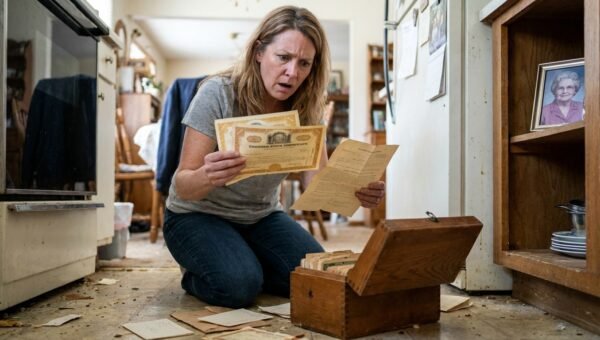
The beam hit a concrete sub-floor that didn’t show up on any farm survey. It was a clean, enclosed room, roughly eight feet wide and twelve feet long, completely insulated with thick foam boards nailed between the studs.
In the center of the floor sat a metal surplus folding cot with an army-green wool blanket folded neatly at the foot. Beside the cot was a three-drawer metal file cabinet, a small battery-operated desk fan, and five plastic ten-gallon storage tubs stacked in pairs against the far stud wall.
On top of the file cabinet lay an open, clean spiral notebook, an unlit kerosene camp lantern, and a laminated wallet-sized photograph.
I walked over to the cabinet, keeping my feet light on the dry floor, and shined the beam on the photograph.
It was a school picture from the mid-1970s. A boy about twelve years old, with crooked front teeth, a cowlick in his brown hair, and thick tortoiseshell glasses. Across the bottom of the cardstock, written in faded blue ballpoint ink, was one sentence:
“Peter Lindstrom, 6th Grade, St. Mark’s Parish.”
I picked up the photo. Below it on the metal cabinet was a silver key ring holding three brass keys, and resting underneath the keys was a small pharmacy pill bottle with the label turned face-up.
The prescription was filled in March of this year, just four weeks before we closed on the farm. The name on the label was Peter Lindstrom.
The moment I read that date and realized who had been sleeping in that barn while the bank sold the land right out from under him, I backed out through the door, pulled it shut behind me, and walked straight out into the afternoon daylight.
PART 2
I stood by the side of our pickup truck in the gravel yard, waiting for my breathing to settle.
Tom was down at the co-op in town picking up a five-hundred-pound drum of hydraulic fluid, so the farm was dead quiet except for the crows in the treeline. I kept looking up at the high loft window, half expecting to see someone peering down through the cracked glass.
I took out my phone and searched the Manitowoc County court records website. It took me twenty minutes to dig through the public dockets for the Lindstrom name.
Martha Lindstrom had four children. Three of them were listed on the probate petition filed down in Milwaukee: David, Karen, and Susan. They were the ones who had divided the small balance left over after the bank satisfied the agricultural lien. But there was a fourth child named in Martha’s original 1994 will.
Peter Alan Lindstrom. Born in 1963.
Next to Peter’s name in the probate court record, there was a single handwritten line filed by the administrator’s attorney: “Whereabouts unknown since October 1998; presumed abandoned interest.”
I sat in the truck cab with the air conditioning running and looked at the date on that pill bottle again. It had been filled at a small independent drugstore on Washington Street in Two Rivers, eight miles east of our farm, on March 18. That was twenty-four days before the bank gave us the deed.
When Tom pulled into the driveway twenty minutes later with the truck bed loaded down, I didn’t wait for him to step out. I walked over, caught him by the elbow, and led him directly up the loft stairs.
“I’m not crazy,” I said before I pulled the false wall open. “Look at the floor. Look at the hinge.”
Tom took his work cap off, ducked his head, and squeezed through the gap. He shined his heavier halogen work light over the plastic tubs, the cot, and the notebook. When he picked up the prescription bottle and read the name, his jaw set tight.
“The family told the bank the place had been abandoned for years,” Tom said, his voice flat. “The bank inspector signed off that the buildings were vacant.”
“He was living here, Tom. He was sleeping fifty feet above our tractor.”
We didn’t rifle through the personal things on the cot, but we opened the top drawer of the file cabinet. Inside was a neat stack of electric bills dating from 1989 to 2004, each marked paid in pencil, a yellowed copy of a high school diploma from Manitowoc Lincoln High School, and a spiral notebook with daily weather notes and rainfall totals that ended abruptly on April 4.
April 4 was the Monday the county sheriff’s deputy drove down the lane to staple the final auction notice to our front gate.
Peter hadn’t left trash or filth. The room was kept like an army barrack. But in the bottom tub, under a bundle of winter socks and clean flannel shirts, Tom found an envelope with seven hundred dollars in twenties and a typed letter addressed to the county probate registrar. The letter was dated February 12. It was signed by Peter, but it had never been mailed.
In the letter, Peter wrote that he had lived in the secondary loft space since his father died in the late eighties, taking care of the herd until the milk price collapsed, and then taking care of his mother in the farmhouse until her memory failed and his siblings moved her to the facility in Green Bay. He wrote that his brother David had taken his name off the farm deed in 1998 by filing an affidavit claiming Peter had walked away and could not be located.
“I am still here,” the unmailed letter read. “I have always been here. I just want the back ten acres to park my camper.”
Tom and I walked back down to the kitchen and sat at the table until sunset without turning on the lights.
Legally, we owned the farm. Our title insurance policy was clear. We had paid fair market value to the bank’s liquidation trust. If we called the sheriff’s department, a deputy would come out, catalog the property in the loft as abandoned personal effects, and warn whoever had been staying there that returning to the land was criminal trespass.
“We can’t do that,” I told Tom. “Not until we know where he went.”
The next morning, I drove into Two Rivers to the Washington Street Pharmacy.
I took the empty plastic prescription bottle with me. The pharmacist was a gray-haired man in his early sixties named Miller. When I set the bottle on the high counter, he glanced at the label, adjusted his glasses, and looked up at me with immediate suspicion.
“You’re not Peter,” he said.
“No,” I said. “My husband and I bought the dairy farm out on County Road B last month. I found this up in the loft yesterday.”
Miller’s expression shifted from defensive to tired. He looked down at the plastic bottle, turned it between his thumb and forefinger, and let out a long breath.
“I wondered when somebody was going to come in,” Miller said quietly. “Peter hasn’t been by since the first week of April. He had a small checking account he kept at the credit union across the street, but his social security disability check was tied to the farm address.”
“Where is he staying?” I asked.
Miller hesitated, looking toward the prescription bins behind him. “He was sleeping in his old station wagon down by the public boat launch at Neshotah Park for about ten days after the auction notice went up. Then his car wouldn’t turn over. One of the guys from the municipal maintenance garage let him put a cot in the back of the tool shed by the breakwater. But the city council is clearing that parcel next week for the seasonal beach parking.”
Miller looked right at me. “Peter doesn’t cause trouble, ma’am. He never has. His brother David convinced him thirty years ago that if the county knew Peter had cognitive troubles from the farm accident he had as a boy, the state would take his rights away and put him in a home. David told him to stay out of sight and let the family handle the taxes. Then David sold off the dairy quota, let the bank take the mortgage, and told the court Peter disappeared.”
I took the bottle off the counter and slid it into my purse. “Does he have any money left?”
“Not enough to pay rent on a room in town,” Miller said. “And he’s terrified of anyone with a badge.”
PART 3
I drove straight from the pharmacy down to the lakefront at Neshotah Park.
The wind off Lake Michigan was damp and cold, carrying the smell of dead alewives and wet sand. Tucked behind the municipal utility shed, nearly hidden by a row of yellow town snowplows parked for the summer, was a 1997 blue Buick LeSabre wagon. The rear tires were soft, sitting three inches deep in the gravel.
Sitting on an overturned plastic milk crate by the wagon’s rear bumper was a man wearing a brown canvas jacket with worn cuffs. He had graying hair that fell over the collar of his shirt, thick glasses with black frames held together at the bridge with a tiny strip of electrical tape, and large, calloused hands that rested quietly on his knees.
I parked our truck twenty feet away, turned off the engine, and stepped out. I didn’t hurry. I kept my hands out of my coat pockets so he could see them.
He didn’t run, but his shoulders tightened until he looked smaller than he was.
“Mr. Lindstrom?” I asked.
He looked down at his boots. “I don’t have anything that belongs to you. The deputy said the bank took the whole parcel. I left the keys on the cabinet.”
“I know,” I said. “I found them yesterday. I found the room in the loft.”
Peter didn’t answer for a long time. The wind rattled the aluminum siding on the tool shed behind him.
“My dad and I framed that room out during the winter of 1978,” he said, his voice quiet and gravelly, like someone who didn’t use it more than once a week. “When my head got bad after the hay elevator collapsed on me, the noise in the house made me sick. The light hurt my eyes. Dad put that foam insulation in so I had a place that stayed cold and dark. When my brother told me people were coming to take the land, I stayed up there because I didn’t know where else to go.”
“Why didn’t you go to court when your mother passed?” I asked.
He looked up then. His eyes behind the thick lenses were clear, but there was an old, fixed fear in them.
“David told me if I went into the courthouse, the county judge would declare me incompetent and send me to the institution down in Winnebago. He said as long as I stayed quiet in the barn, he’d send me two hundred dollars a month for groceries and let me keep the garden plot. Then the money stopped coming last winter. And then the bank papers showed up.”
He wasn’t lying. There wasn’t an ounce of calculation in his face. It was the simple, devastating honesty of a man who had been kept in the shadows by his own flesh and blood for thirty years so they wouldn’t have to share eighty acres of valuable lakeshore-corridor land.
I took the pharmacy bottle and the silver key ring out of my pocket and held them out.
“We need to move your things out of that loft, Peter,” I said.
He flinched. He looked at the keys, then down at the gravel. “Yes, ma’am. I can get a friend with a truck. I don’t mean to trespass.”
“You’re not moving them to town,” I said. “We have the old pump house down by the south pasture. The walls are good, the roof is dry, and it has an independent electric hookup from the well service. Tom and I talked it over this morning. It needs a window replaced and a new baseboard heater, but it has a locking door and space for your cot.”
Peter looked at my face, searching for a catch. “The bank sold it to you.”
“The bank sold us the deed,” I told him. “They didn’t sell us the right to throw a sixty-year-old man into a lakefront ditch because his brother was a thief.”
We stood there by the municipal shed for five minutes while the lake wind whipped the sand against the truck doors. Peter didn’t cry. He just reached out with a hand that had spent four decades milking cows and cutting cedar posts, took the keys from my palm, and nodded once.
“The south pump house gets good morning sun,” he said softly. “The soil around it was always the best dirt for sweet corn.”
ENDING
That was five months ago.
We hired an attorney in Manitowoc named Sarah Vance. She didn’t charge us an arm and a leg. When she pulled the 1998 probate records and saw the fraudulent affidavit of disappearance that David Lindstrom had filed, she went straight to the county circuit judge.
David Lindstrom had to hire his own lawyer down in Milwaukee. When Sarah showed the court the pharmacy records, the electric receipts Peter had saved in that file cabinet, and the sworn statements from three local shopkeepers who had seen Peter every single month for thirty years, the judge vacated the distribution of Martha’s estate.
It didn’t undo the bank foreclosure. The mortgage lien was valid because Martha had signed the original loan papers back in 2002 to cover David’s failed trucking business. The farm still belonged to Tom and me. But the judge ordered David and his two sisters to return forty-two thousand dollars of the remaining estate proceeds to a protected special-needs trust established solely for Peter’s care.
David tried calling our house once in July. Tom answered the phone, listened to him shout for about thirty seconds about family business and outside meddlers, and then Tom said, “If your truck pulls into this driveway, the sheriff will be waiting at the culvert.” Then Tom hung up. We haven’t heard from any of them since.
We spent three weeks in June cleaning out the south pump house. Tom put down new subflooring, hung drywall, and installed a small wood stove we found for three hundred dollars at a farm swap in Chilton. Peter moved his five plastic tubs, his cot, and his file cabinet down from the hayloft on a Sunday afternoon.
He didn’t want to live in the main house with us. He told us plain that sixty years of living alone makes a man noisy in his head if people are around all the time. But every Tuesday and Friday morning, he walks up the gravel lane and leaves a brown paper bag on our back porch.
Sometimes it’s four ears of sweet corn from the patch he planted behind the well. Last week, it was three quart jars of wild blackberry jam he put up himself using a camp stove.
Yesterday afternoon, I went up to the loft to sweep the last of the seed dust off the floorboards. The narrow door in the back wall stood wide open, letting the afternoon sunlight cut straight through into the space that had been hidden for almost forty years.
I looked at the clean, bare concrete where the cot used to sit. The air didn’t smell like fear or secrets anymore. It just smelled like dry pine timber and cured hay.
Down in the lower field, I could hear the steady, low thrum of the tractor engine. Tom was cutting the second crop of alfalfa, and right behind the wagon, Peter was walking along the windrows with a wooden pitchfork, checking the cut. He had his cap pulled low against the sun, his boots planted firm in the dirt, exactly where he had belonged all along.